

About this worksheet
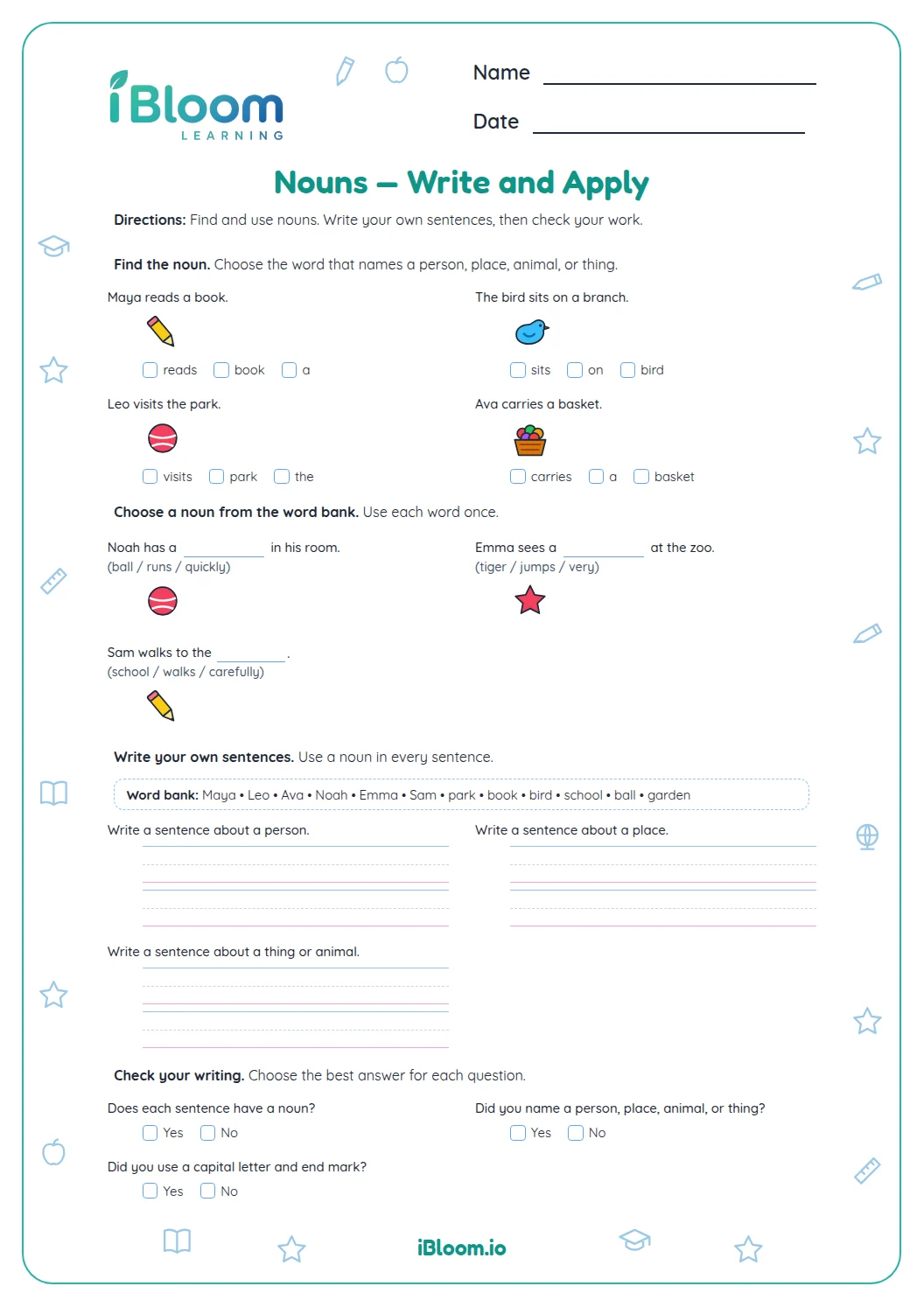
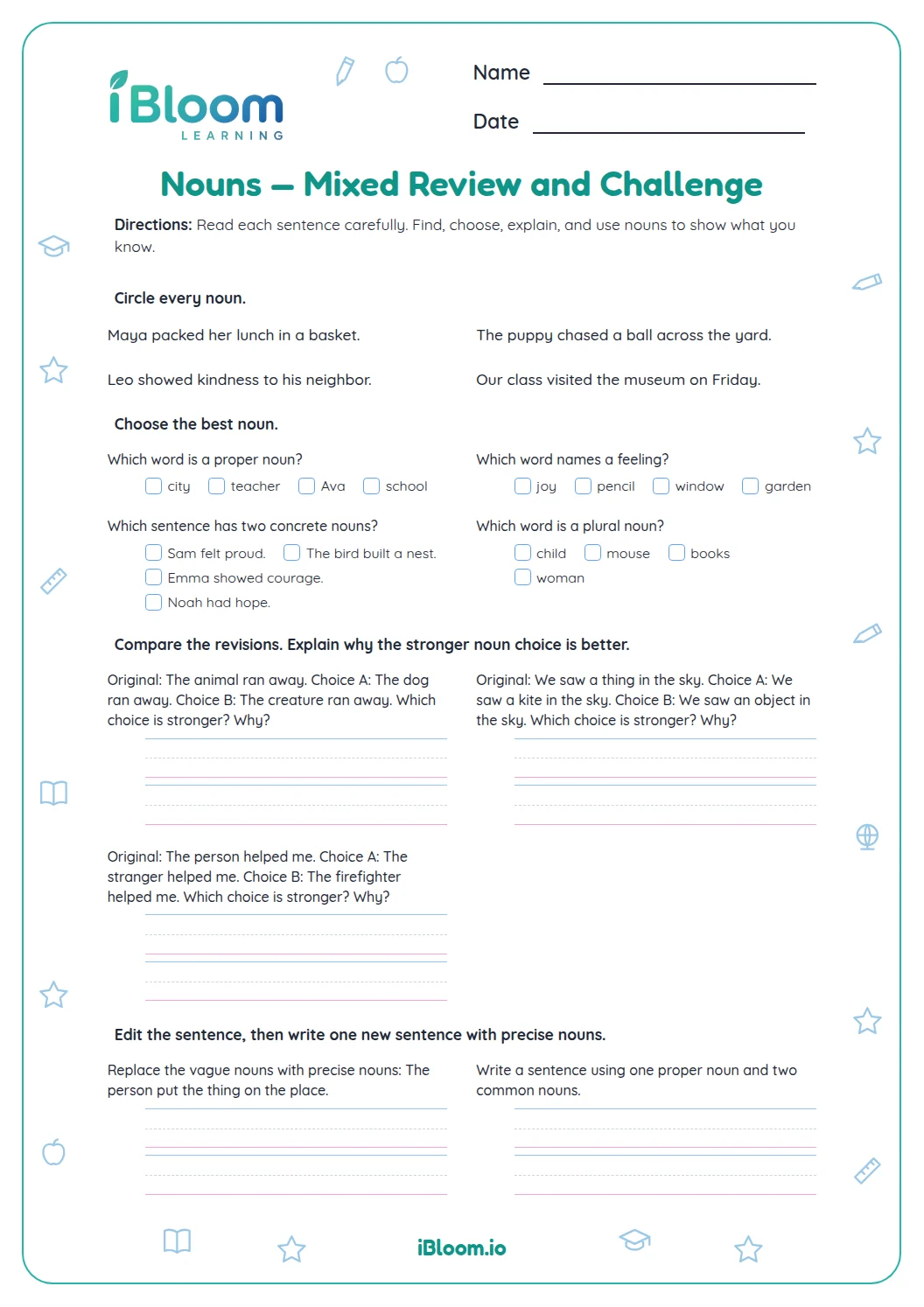
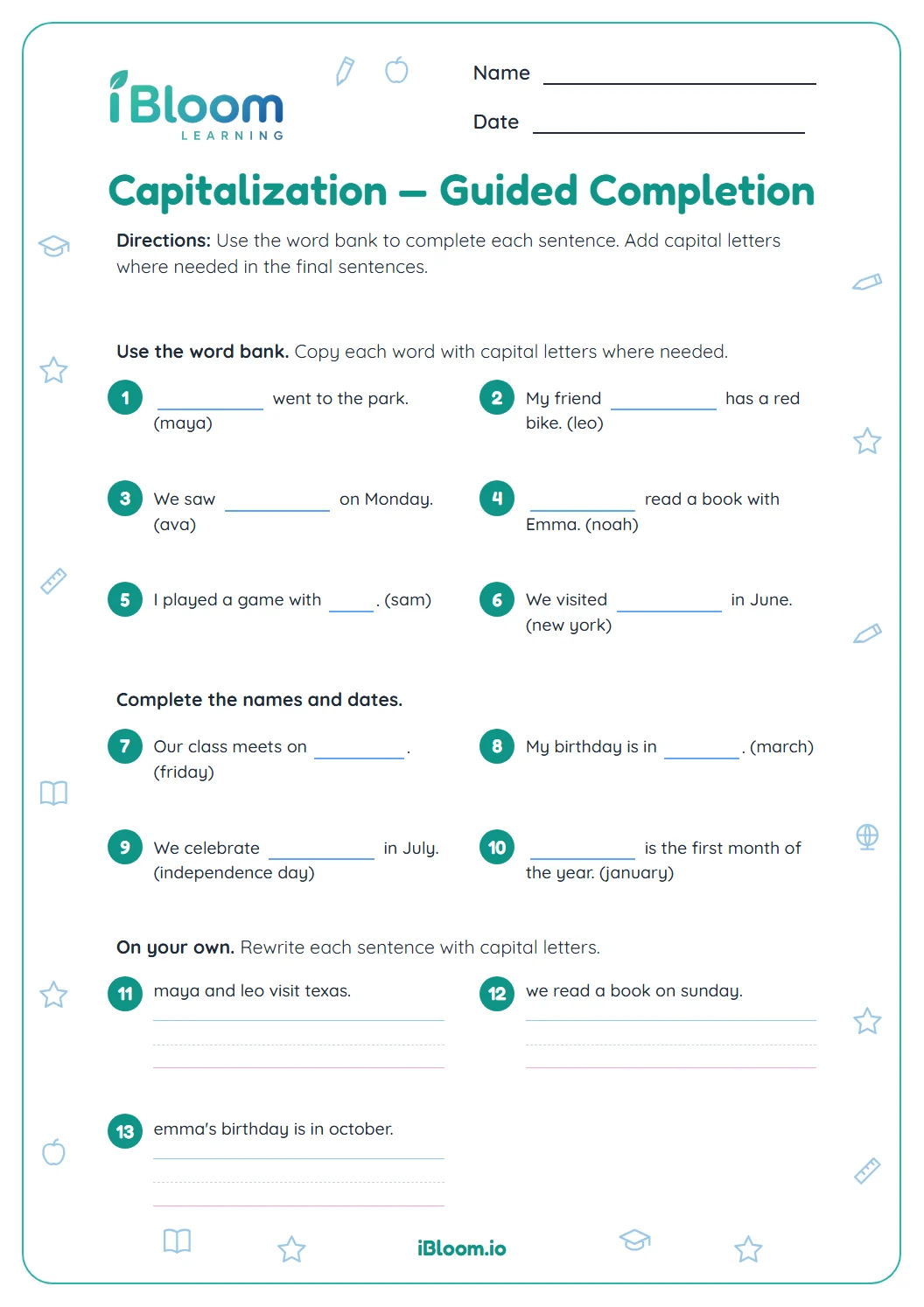
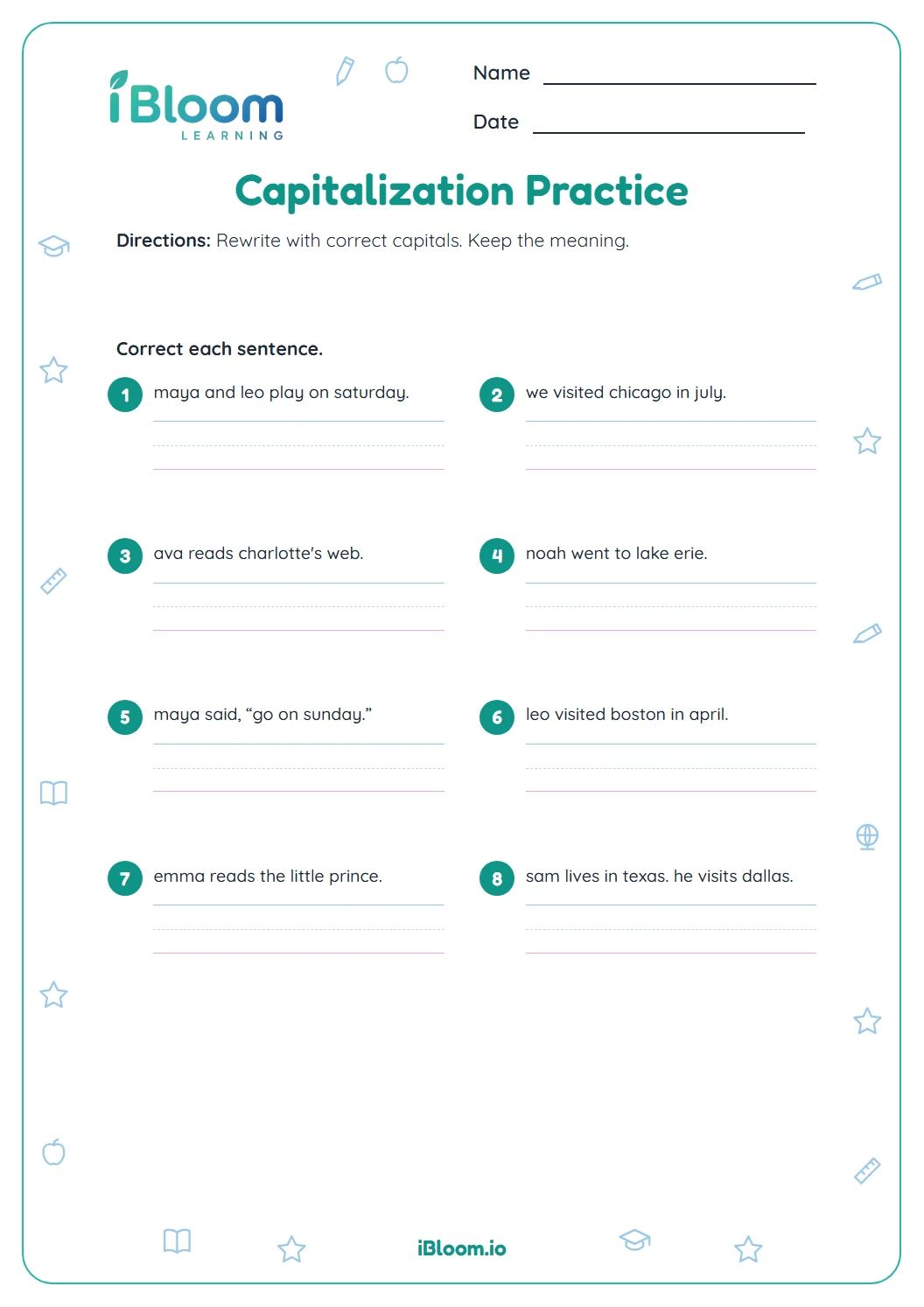
This free printable noun editing worksheet gives students in Grades 1–5 practice checking capitals, number, and ownership. Part A asks for four corrected nouns. Part B has six choices about singular, plural, and possessive nouns. Part C asks students to rewrite two sentences and explain one noun rule for each. Part D finishes with a two-sentence paragraph containing three noun errors. Younger learners can work with an adult; older learners can use it as an editing check. The 13 tasks practice Common Core L.1.1b and L.3.1b, with a separate answer key.
Aligned to L.1.1b and L.3.1b
What should students check in a noun?
Start with the job of the noun. A general place such as a park uses a lowercase letter inside a sentence. A person’s name or a named month begins with a capital. Then check the number: two boxes needs a plural, while one mouse needs a singular.
Ownership is another check. The sheet gives an owner explicitly before asking for the possessive form, so students can decide between a plain name and a name with an apostrophe.
How do you fix a plural noun?
Read the number word before changing the ending. In question 5, two tells the reader that more than one box is needed. Box takes es, so the corrected noun is boxes. Other nouns change more: child becomes children, and mouse becomes mice.
- 1Error: I packed two boxs.
- 2Two means more than one.
- 3Box ends in x, so add es.
- 4Correct noun: boxes.
What editing work is on the sheet?
Part A has four short corrections: park, Nina, July, and Ben. Part B mixes six choices about noun number and ownership. Part C combines two errors in each of two sentences and asks for one noun rule after each rewrite.
Part D applies those checks across two connected sentences. Students change two bird to two birds, one squirrels to one squirrel, and the childs to the children. Keep the meaning and punctuation while correcting the nouns.
How to use this worksheet
- 1Read the first sentence and find Park, the noun named in the prompt.
- 2Complete Part A by writing only the corrected noun.
- 3In Part B, use number words and ownership clues before choosing.
- 4Rewrite each Part C sentence, fix both errors, and explain one noun rule.
- 5Rewrite the Part D paragraph, checking all three noun errors.
- 6Compare with the key, then explain one plural correction aloud.
Mistakes to look for
The mistake
Writing Park with a capital inside a sentence about a general park.
The fix
Use lowercase for a general place; save capitals for names such as Ben.
The mistake
Adding s to every plural, producing boxs or childs.
The fix
Use boxes for box and children for child; check each noun’s plural form.
The mistake
Choosing Mayas for a bag that belongs to Maya.
The fix
Add apostrophe-s to the singular owner: Maya’s bag.
Common Core alignment
Use common, proper, and possessive nouns correctly.
On this sheet: Students correct common and proper noun forms and choose nouns that show ownership.
Show the official wordingHide the official wording
Use common, proper, and possessive nouns.
Correct regular and irregular plural nouns in sentences.
On this sheet: Students replace forms such as boxs, childs, and mouses with correct plurals.
Show the official wordingHide the official wording
Form and use regular and irregular plural nouns.
What to practice next
Make more practice
Further reading
Questions parents and teachers ask
Which grades can use this noun editing sheet?
Students in Grades 1–5 can use it as focused noun practice. Work through the short corrections with a younger child, then try the sentence rewrites together. Older students can complete all four parts independently, explain a noun rule, and apply the same checks to the final paragraph.
How many errors should students fix in each part?
Part A names one noun to correct in each prompt. Part B gives a noun error or an ownership clue and asks for the correct form. Each Part C sentence has two noun errors; the Part D paragraph has three. Students should reread every rewrite before checking the key.
Why does the sheet include both boxes and children?
The two words practice different ways of making plurals. Boxes adds es to box, while children changes the form of child. Having both on the sheet asks students to use the noun they know and the sentence’s number clue instead of adding s to every word.
How should students mark the possessive questions?
Students choose the noun form that shows the named owner. In the bag question, Maya is one person who owns the bag, so Maya’s is correct. The clue sentence identifies the owner before the choices, making the apostrophe decision part of the grammar task.
What does the answer key include?
The key gives four corrected words, marks six correct choices, and supplies sample sentences with rule explanations for Part C. It also gives the corrected Part D paragraph. Accept equivalent rule explanations, but check that every noun error is fixed and the original meaning stays the same.