



About this worksheet
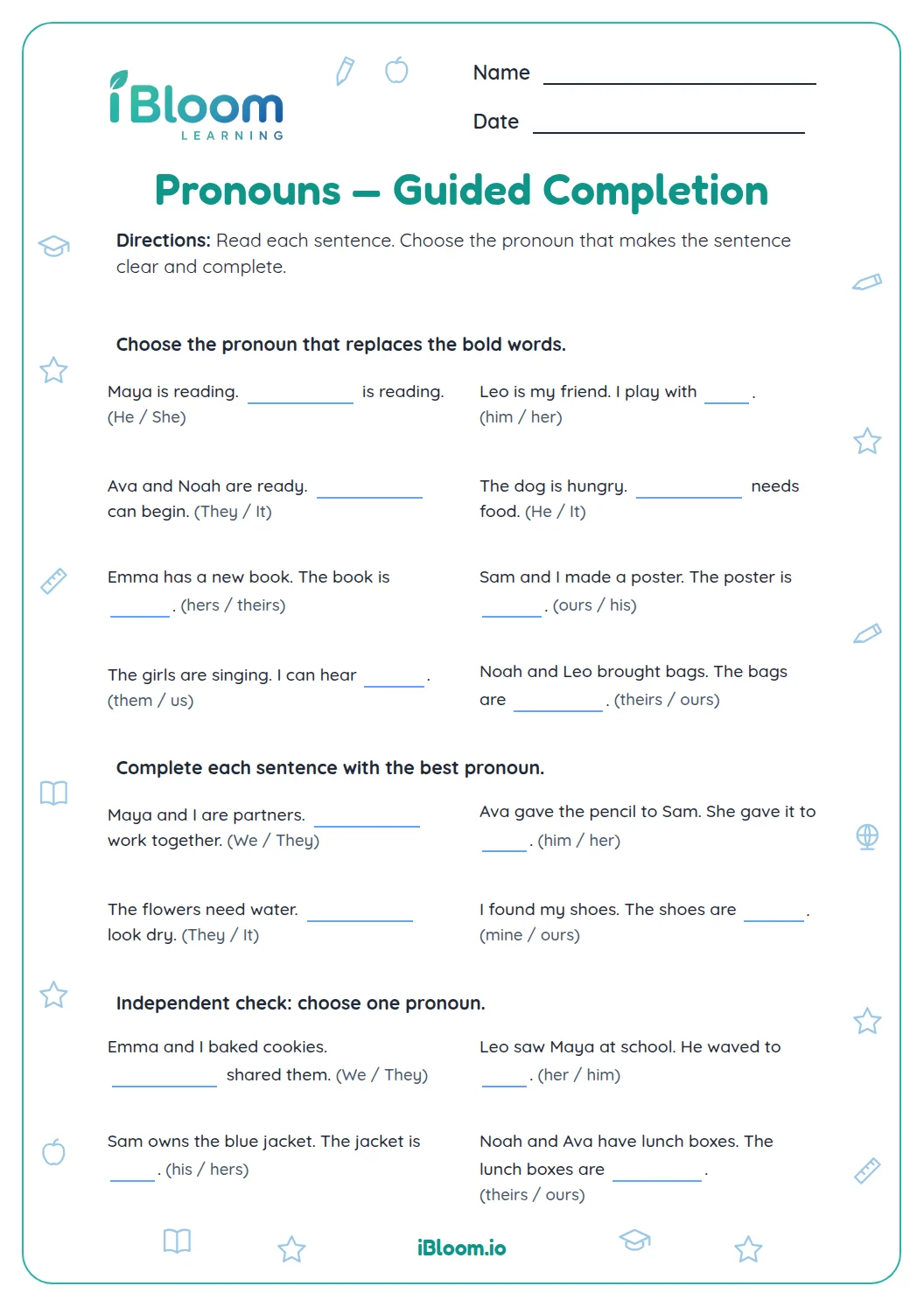
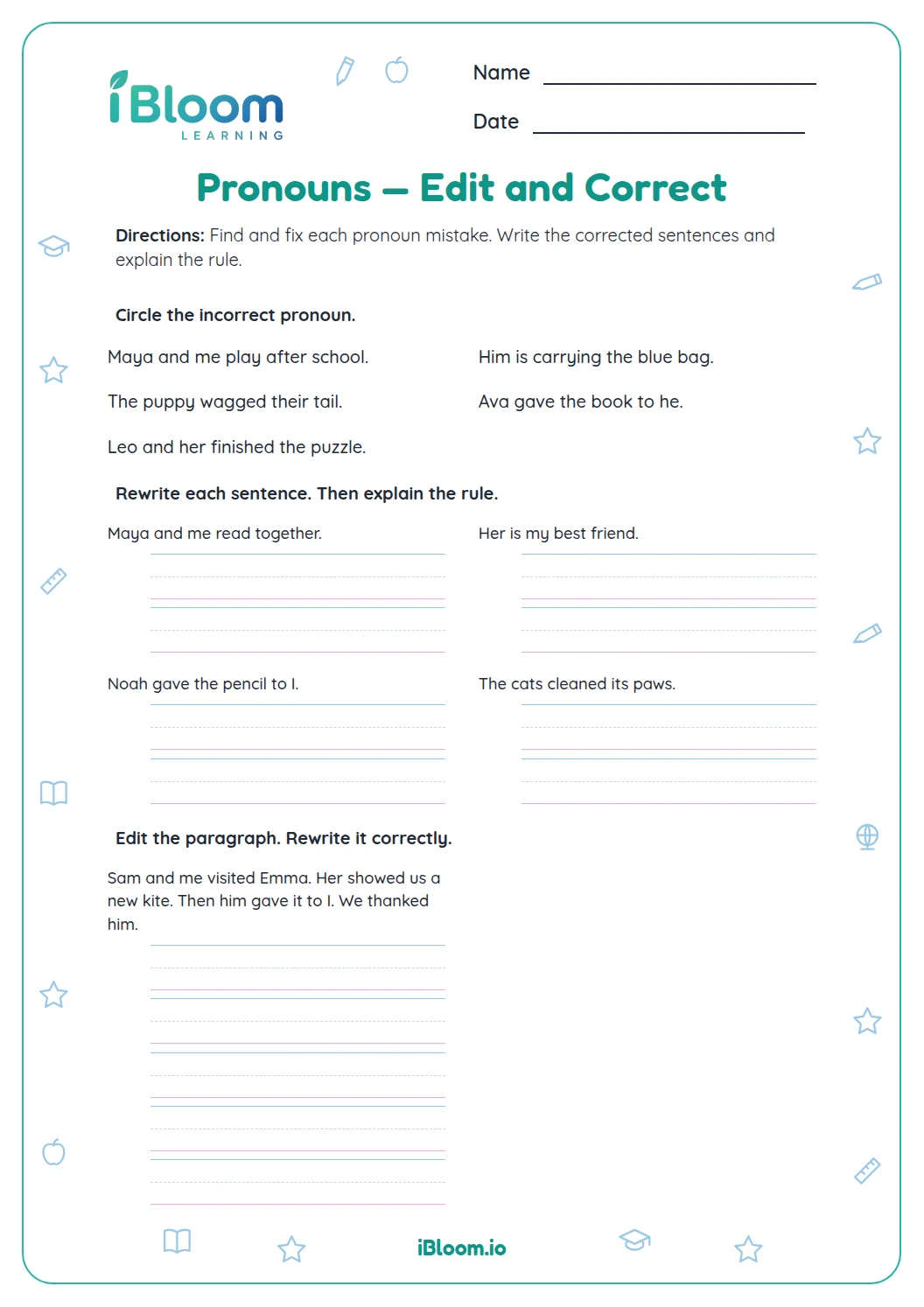
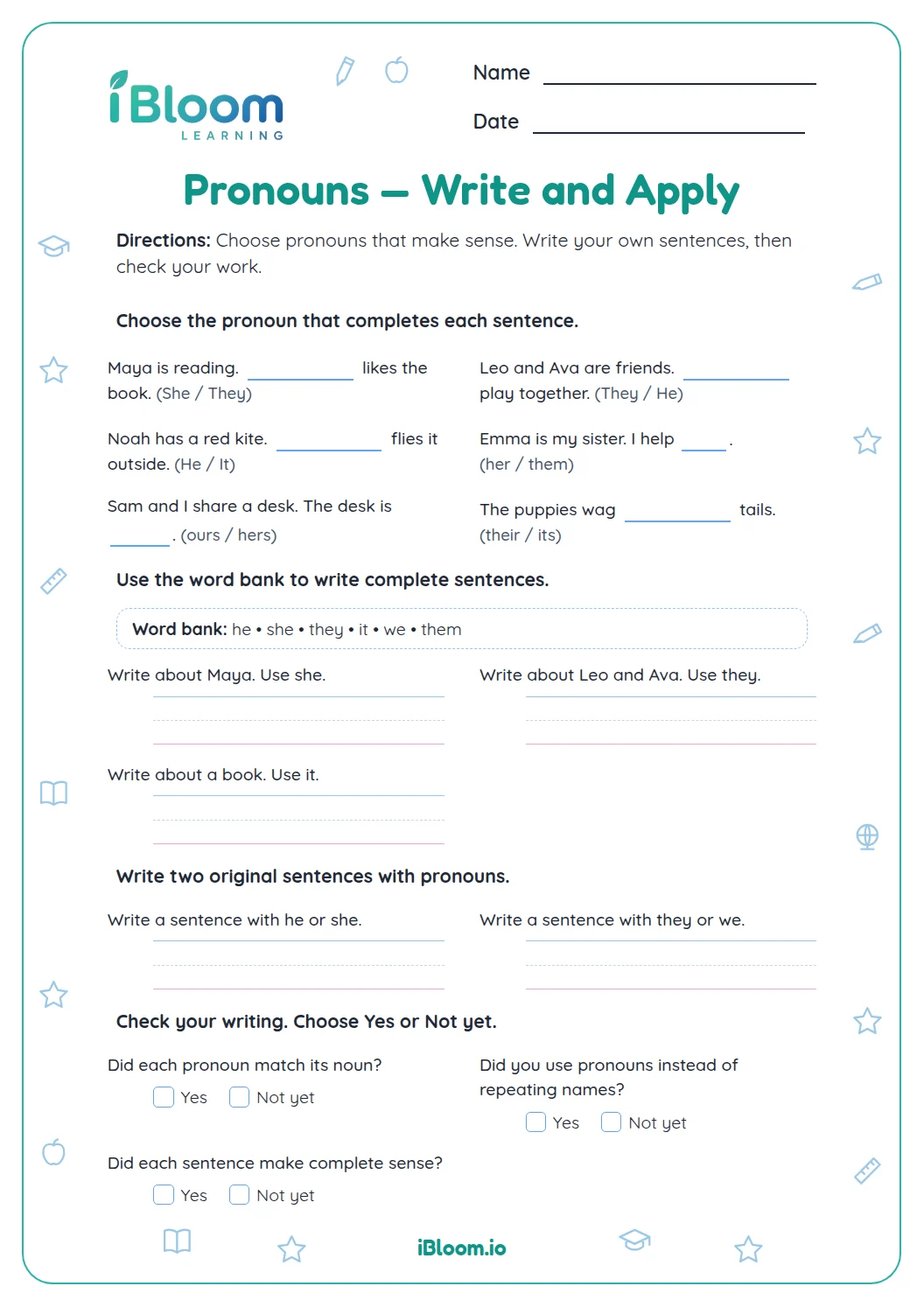
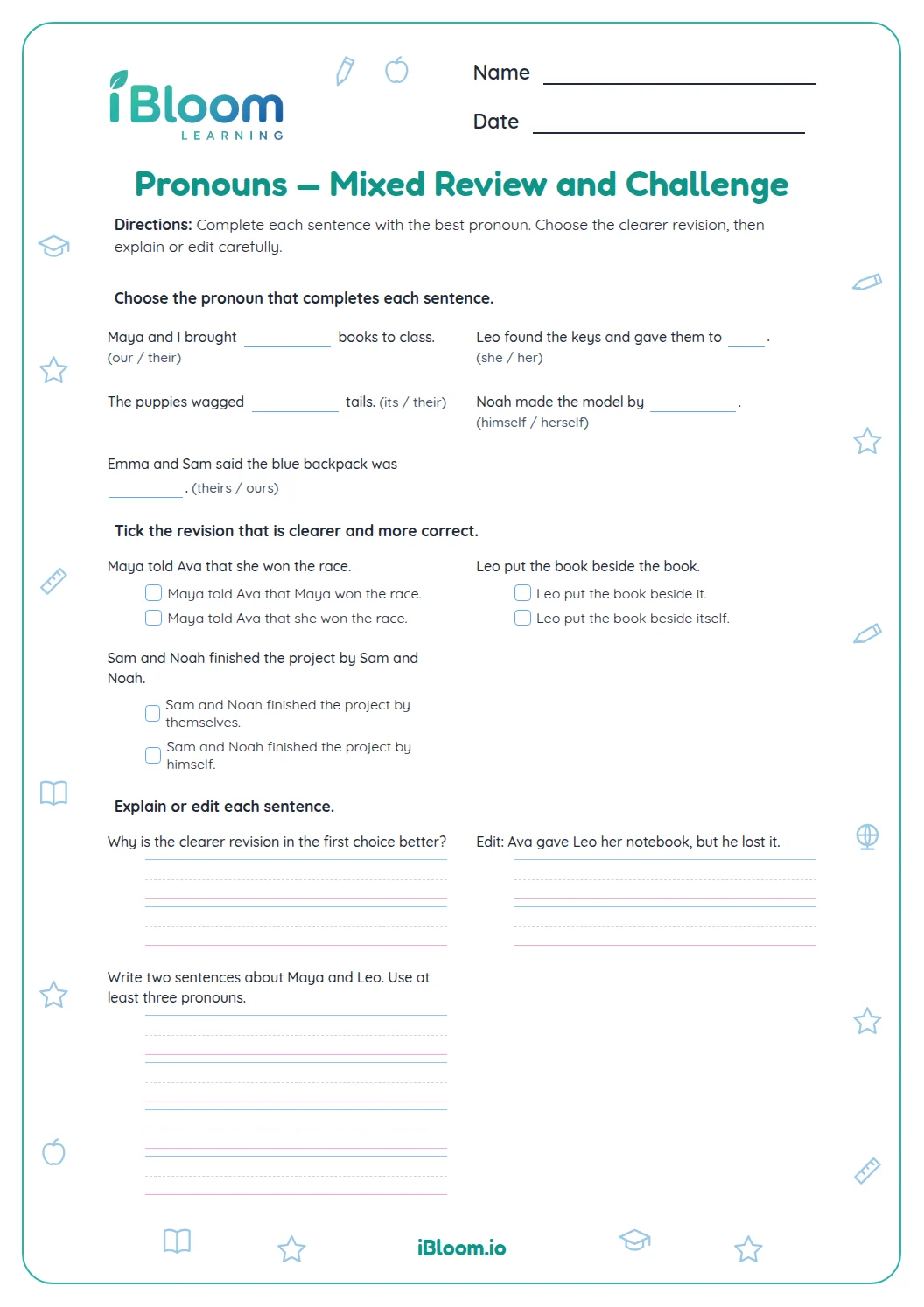
This free printable worksheet helps children in Grades 1 to 3 recognize pronouns and use them in place of nouns. In Part A they circle the pronouns in three short sentences, such as "Mom gave them a ride." In Part B they pick which word is a pronoun and which one takes the place of a pair of names. In Part C they choose the pronoun that fits a sentence, such as "Tara and Leo packed their own bags." Part D asks them to rewrite a sentence so the repeated words become pronouns. The sheet supports Common Core L.1.1.d, and a two-page answer key gives every answer.
Aligned to L.1.1.d
What is on this worksheet?
The questions move from spotting pronouns to using them. Part A is three sentences with the pronouns to circle: She, them, and both They and we in one sentence. Part B has three multiple-choice questions. One asks which word is a pronoun, one asks which pronoun takes the place of Mia and Ben, and one asks which word is not a pronoun.
Part C gives three sentences with a blank and three choices each, for example "Tara and Leo packed ___ own bags" with her, their and his. Part D asks for one rewritten sentence, so children decide for themselves which words can become pronouns.
- Part A: circle the pronouns in 3 sentences (4 pronouns in all)
- Part B: 3 multiple-choice questions on spotting and replacing
- Part C: 3 fill-in sentences with three choices each
- Part D: 1 sentence to rewrite with pronouns
How can a child tell if a word is a pronoun?
Try the swap test. A pronoun can stand in for a noun without changing who or what the sentence is about. In "Maya is tired. She wants to rest," she replaces Maya. Words like garden and table name something, so they are nouns and not pronouns, and a word like yellow describes a noun instead.
The pronouns on this sheet come from three families: subject pronouns (she, they, we, it), object pronouns (them, him, me) and possessive pronouns (your, their). Children do not need those labels yet. They only need to notice that each one stands for a person, animal or thing.
- 1Grandpa waved at me, and I waved at ___.
- 2Who is getting the wave? Grandpa.
- 3Grandpa is one man, so we need a pronoun for one boy or man.
- 4Choices: he, him, his
- 5He does the action, and his shows who owns something. Him comes after waved at.
- 6Answer: him
How do children choose the right pronoun?
Ask two questions: who or what is this about, and is it one or more than one? "Mia and Ben" is two people, so the pronoun is they, not we or it. In "Tara and Leo packed ___ own bags," the word own shows the bags belong to the two people who packed them, so their fits and her or his does not.
The same thinking helps with "Maya is tired. ___ wants to rest." Maya is one girl, so she is the match, not he or they. This is pronoun-antecedent agreement, named in Grade 3 standard L.3.1.f: the pronoun has to fit the noun it replaces.
Why does the sheet ask children to rewrite a sentence?
Using a pronoun is different from recognizing one. In Part D, children read "Lily has a red kite. Lily flies the kite at the park." and rewrite the second sentence. A strong answer replaces Lily with she and the kite with it: "She flies it at the park."
Accept any answer that sounds natural and keeps the meaning. If a child replaces only one word, such as "She flies the kite at the park," that is a fine first step, and you can ask whether the kite could be replaced too. The answer key shows one sample.
How to use this worksheet at home or in class
- 1Say two sentences out loud, such as "Maya is tired. Maya wants to rest," and ask your child how to say it without repeating Maya.
- 2Do Part A together. Read each sentence, then let your child circle the pronouns without telling them how many to find.
- 3In Part B, ask your child to say the noun a pronoun could replace before picking an answer.
- 4In Part C, have your child read the sentence aloud with each choice and listen for the one that sounds right.
- 5Let your child write Part D in a complete sentence, then read both sentences aloud to check that the pronouns point to the right words.
- 6Check with the answer key, and for each wrong answer ask, "Who or what is this pronoun standing for?"
Common mistakes and quick fixes
The mistake
Circling a name or noun, such as Mom in "Mom gave them a ride," because the word seems important.
The fix
Ask whether the word could be swapped for another word. Mom names a person. Them takes the place of a noun like the kids, so them is the pronoun.
The mistake
Using the wrong number, for example picking we or it for Mia and Ben instead of they.
The fix
Count the people or things first. Two or more means they, them, we, us or their. One thing means it. One boy or man means he or him; one girl or woman means she or her.
The mistake
Using a subject pronoun where an object pronoun belongs, such as writing "waved at he" instead of "waved at him."
The fix
Ask whether the person is doing the action or getting it. After words like at, to and with, the person is on the receiving end, so use him, her, them or me.
Common Core alignment
Most US states use the Common Core Language standards or a close version, so this sheet fits early grammar work in most classrooms.
Use pronouns such as she, they, them, him and their in place of nouns.
On this sheet: Main standard. Children identify and use personal pronouns (she, they, we, them, him) and a possessive pronoun (their).
Show the official wordingHide the official wording
Use personal, possessive, and indefinite pronouns (e.g., I, me, my; they, them, their, anyone, everything).
What to practice next
Make more practice
Further reading
Questions parents and teachers ask
What is a pronoun in simple words?
A pronoun is a small word used in place of a noun. Instead of saying "Maya is tired. Maya wants to rest," we say "Maya is tired. She wants to rest." Pronouns such as he, she, it, we, they, them and their keep sentences short and stop us repeating names.
Which pronouns are on this worksheet?
Children circle She, them, They and we in Part A, then choose among words such as it, he, him, his, her and their. Question 6 also uses we, your and him as pronouns beside the noun table, and question 8 includes I and me. Children do not need grammar labels like subject or object pronoun to do the sheet.
What are the answers to Part C?
The three answers are She, him and their. Each uses a clue in the sentence: Maya is one girl, Grandpa is one man who is receiving the wave, and Tara and Leo are two people who own the bags. The answer key lists all ten answers, including a sample for Part D.
Is this worksheet for first graders or third graders?
It is made for a mix, Grades 1 to 3. First graders can do Parts A to C with help reading aloud, while second and third graders can do all four parts alone. Part D is the hardest, so first graders can say their sentence aloud instead of writing it.
Do children need to know the word antecedent?
No, not yet. The word is not on the sheet, but the idea is built in: a pronoun has to fit the noun it replaces. Asking who or what a pronoun stands for, and whether it is one or more than one, is the pronoun-antecedent agreement named in Grade 3 standard L.3.1.f.
How long does the pronouns worksheet take?
Most children finish in about 10 to 15 minutes. Parts A to C are quick, and the writing lines in Part D take the longest. For younger children, try Parts A and B one day and C and D another day. An adult can read the sentences aloud if reading is still new.