

About this worksheet
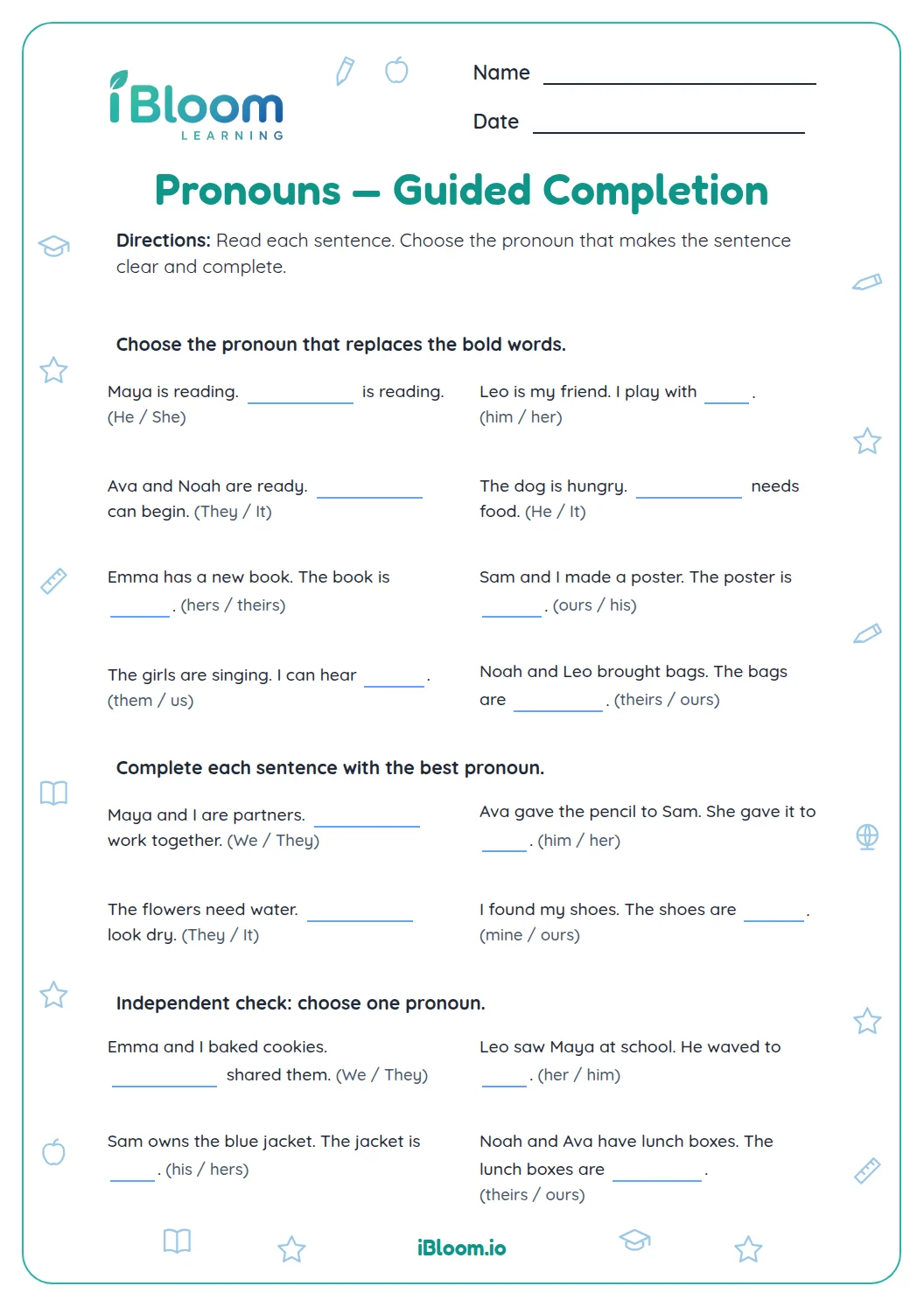
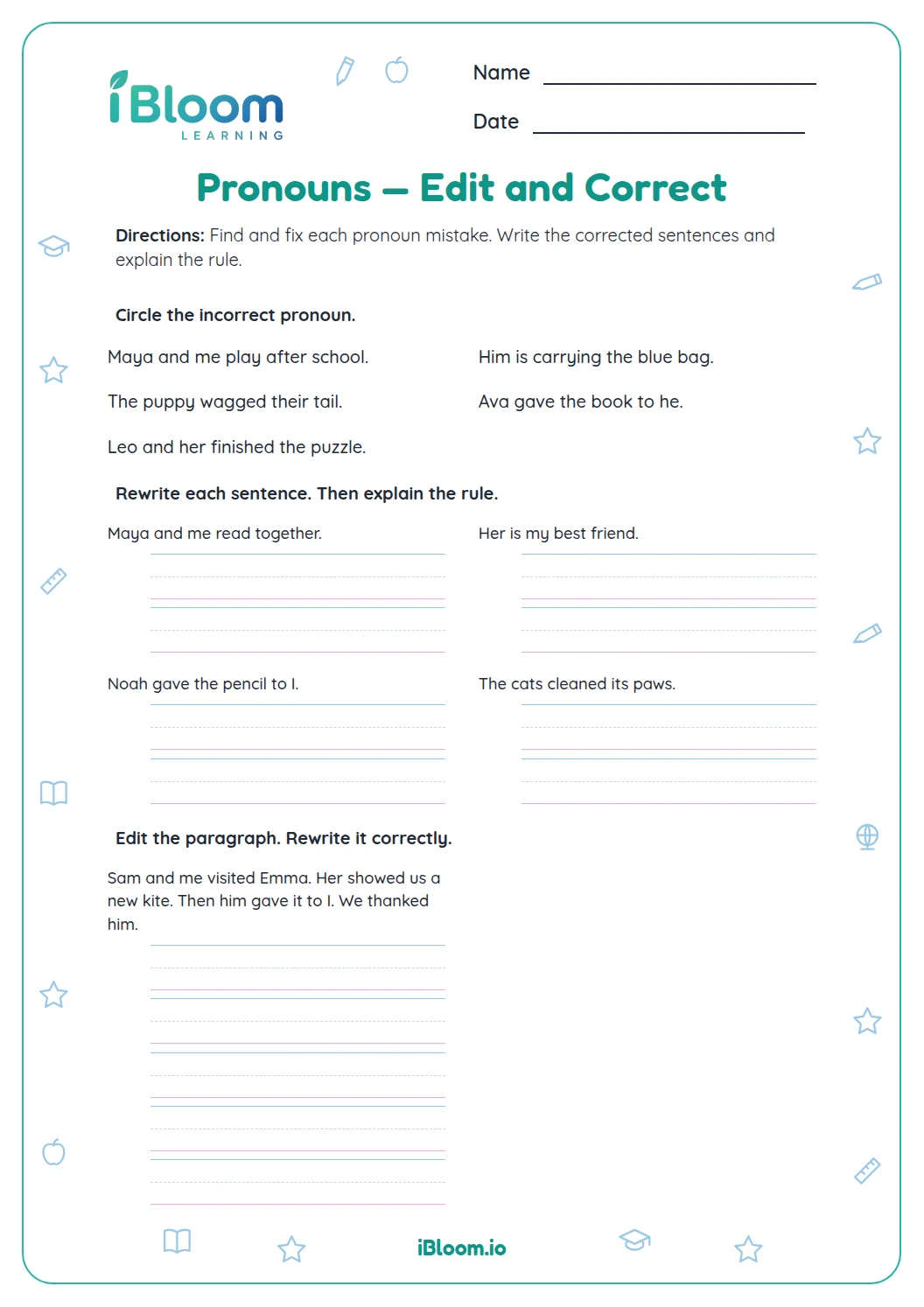
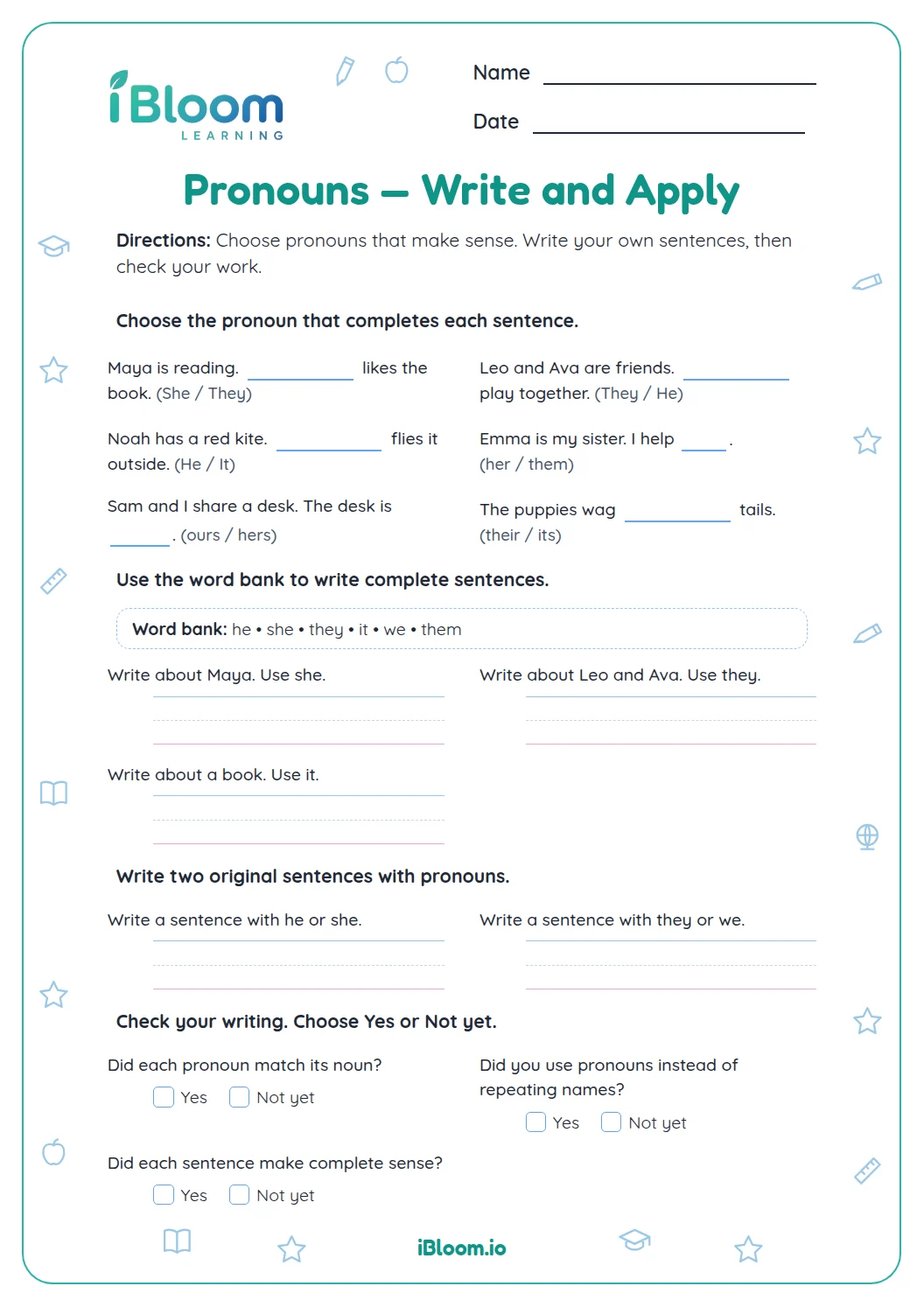
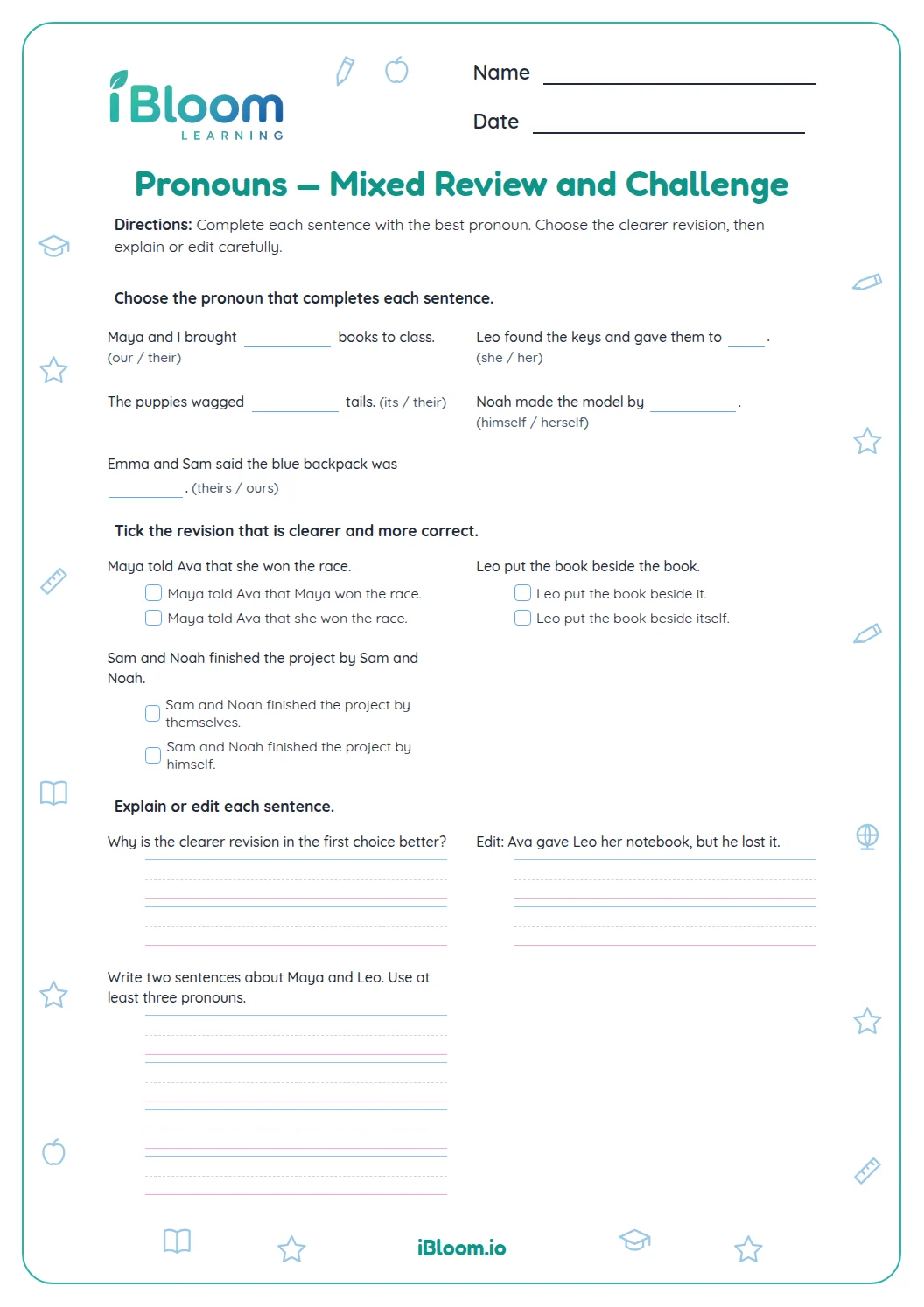
This Grade 3 worksheet gives students 14 chances to use pronouns in sentences. Part A asks them to choose a pronoun that matches its noun; Part B has them supply pronouns; Part C asks them to revise repeated names and check whether the reference stays clear. The examples practice subject, object and possessive forms in short sentences. It aligns with L.3.1.a.
Aligned to L.3.1.a
How do I choose a matching pronoun?
Find the noun the pronoun replaces. Then check whether it names one person, more than one person, or a thing. The pronoun should fit that noun and the sentence’s job.
- 1“Mia found a shell. ___ kept it.” → She (Mia is one girl.)
- 2“Please give the book to ___.” → me (the pronoun follows “to”)
How can I make a pronoun clear?
A reader should be able to tell which noun a pronoun means. When two people appear in a sentence, use a pronoun only if its reference is clear; otherwise repeat a name or revise the sentence.
What job does each pronoun do?
A subject pronoun does the action, an object pronoun follows an action or preposition, and a possessive pronoun shows who owns something. Read the whole sentence to choose the form that fits.
How to use this worksheet
- 1Read the noun before choosing or writing its pronoun.
- 2Check whether the pronoun is a subject, object or shows ownership.
- 3Read a revision aloud and make sure the reader can identify each person or thing.
- 4Use the two-page key to review the choices and sample revisions.
Common mistakes and quick fixes
The mistake
Using “they” for one singular noun such as “the puppy.”
The fix
Check whether the noun names one or more than one. A single puppy needs “it” or “its” in these examples.
The mistake
Using “I” after a verb or preposition, as in “give it to I.”
The fix
Use “I” as a subject and “me” after an action word or preposition: “Give it to me.”
The mistake
Using a pronoun that could refer to either of two names.
The fix
Repeat a name or rewrite the sentence so the reader knows who the pronoun means.
Common Core alignment
This Grade 3 worksheet practices the grade-level skill described by the Common Core standards below.
Use nouns, pronouns and verbs in sentences.
On this sheet: Students identify and use pronouns in complete sentences.
Show the official wordingHide the official wording
Explain the function of nouns, pronouns, verbs, adjectives, and adverbs in general and their functions in particular sentences.
What to practice next
Make more practice
Further reading
Questions parents and teachers ask
What is a pronoun?
A pronoun is a word that stands in for or refers to a noun. Words such as “she,” “it,” “they,” “we” and “me” are pronouns. The noun the pronoun refers to is its antecedent. Readers use that connection to follow who or what a sentence is about.
How can a child choose the right pronoun?
First find the noun the pronoun refers to. Check whether that noun means one person or thing, or more than one. Then check the pronoun’s job: a subject, an object after an action, or a word that shows ownership. These checks help the pronoun fit the sentence.
Why revise sentences with pronouns?
Pronouns can reduce repeated names and make writing smoother. A useful revision still lets the reader tell exactly who or what each pronoun means. If two names could match “she” or “he,” repeat a name or rewrite the sentence so the reference is clear.
When should a writer repeat a name?
Repeat a name when a pronoun could point to more than one person. Clear meaning matters more than avoiding every repeated noun. Writers can read the sentence again and ask whether a reader could identify the person without guessing. If not, the name may be clearer.
What is the difference between “I” and “me”?
Use “I” as the subject doing an action, as in “I carried the book.” Use “me” after an action or preposition, as in “Please give the book to me.” In this worksheet, students use the sentence around the blank to decide which form belongs there.