



About this worksheet
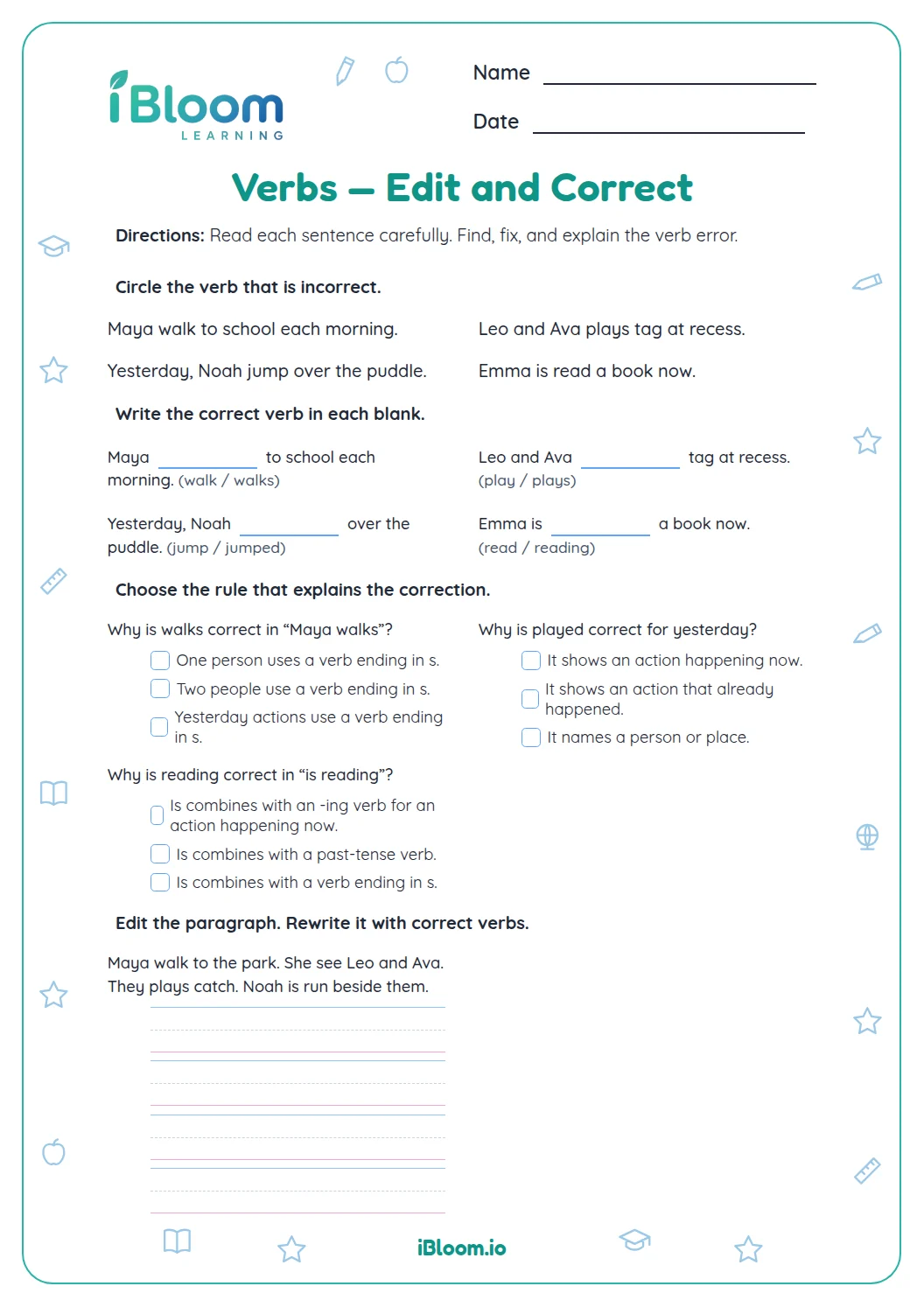
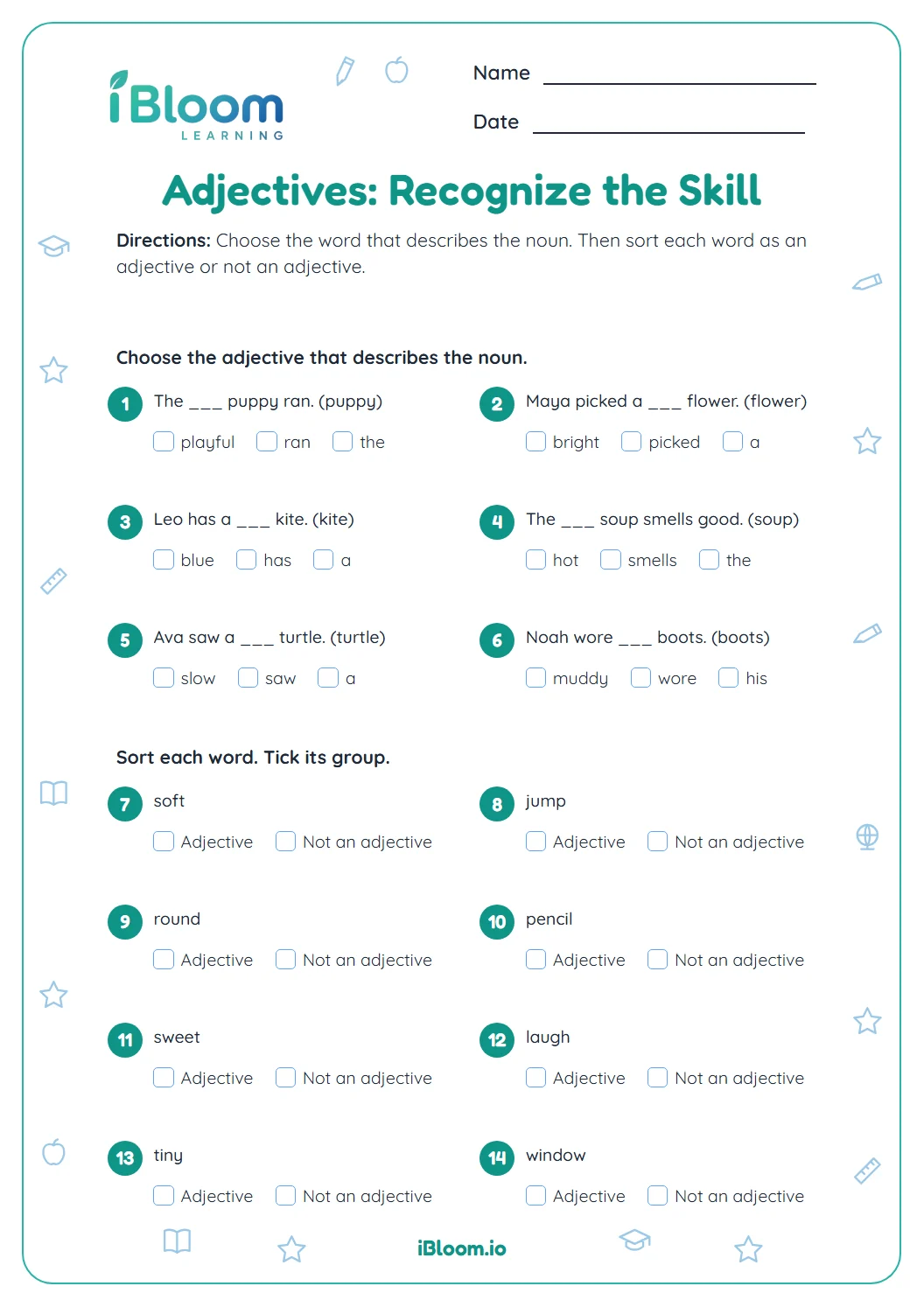
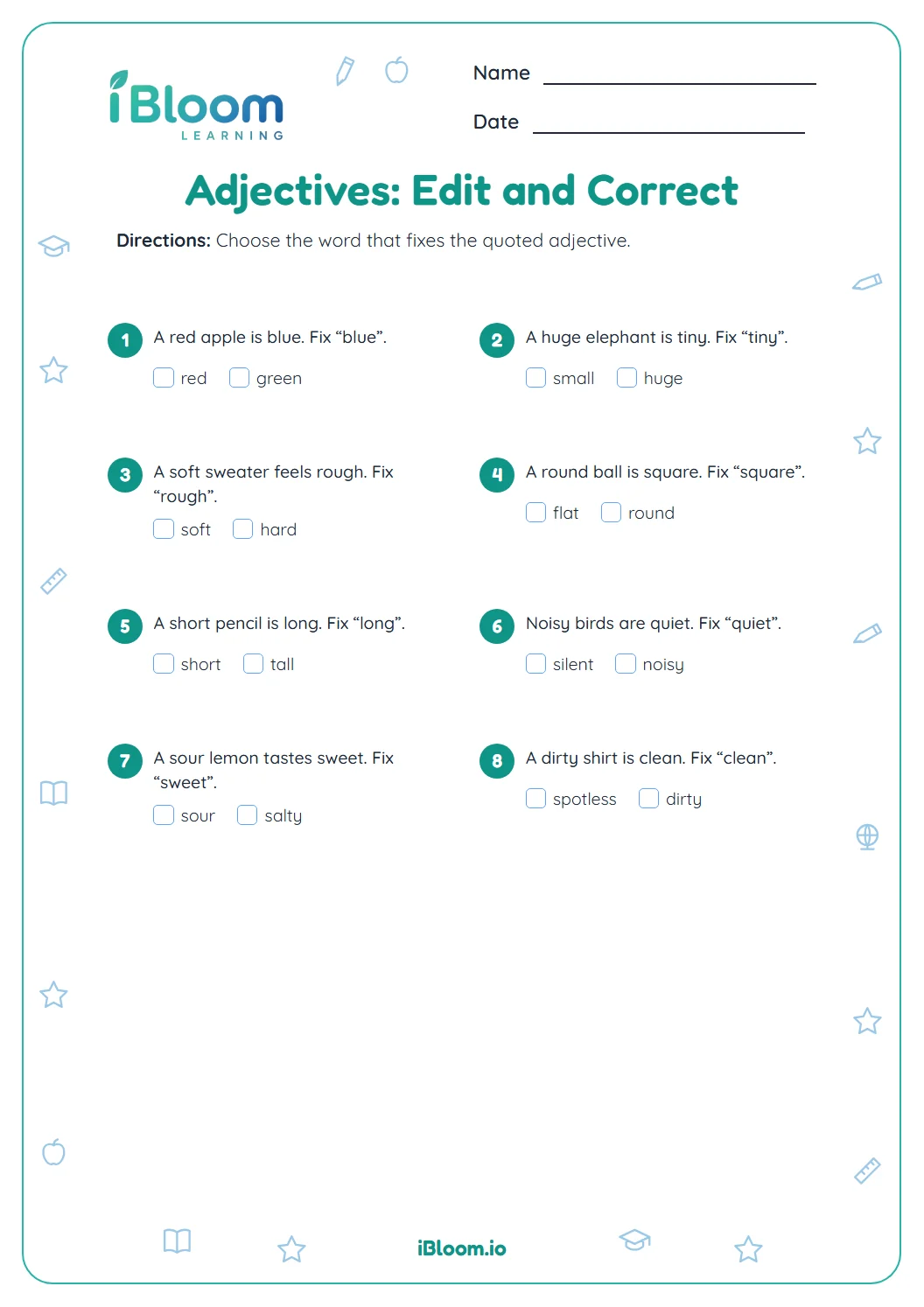
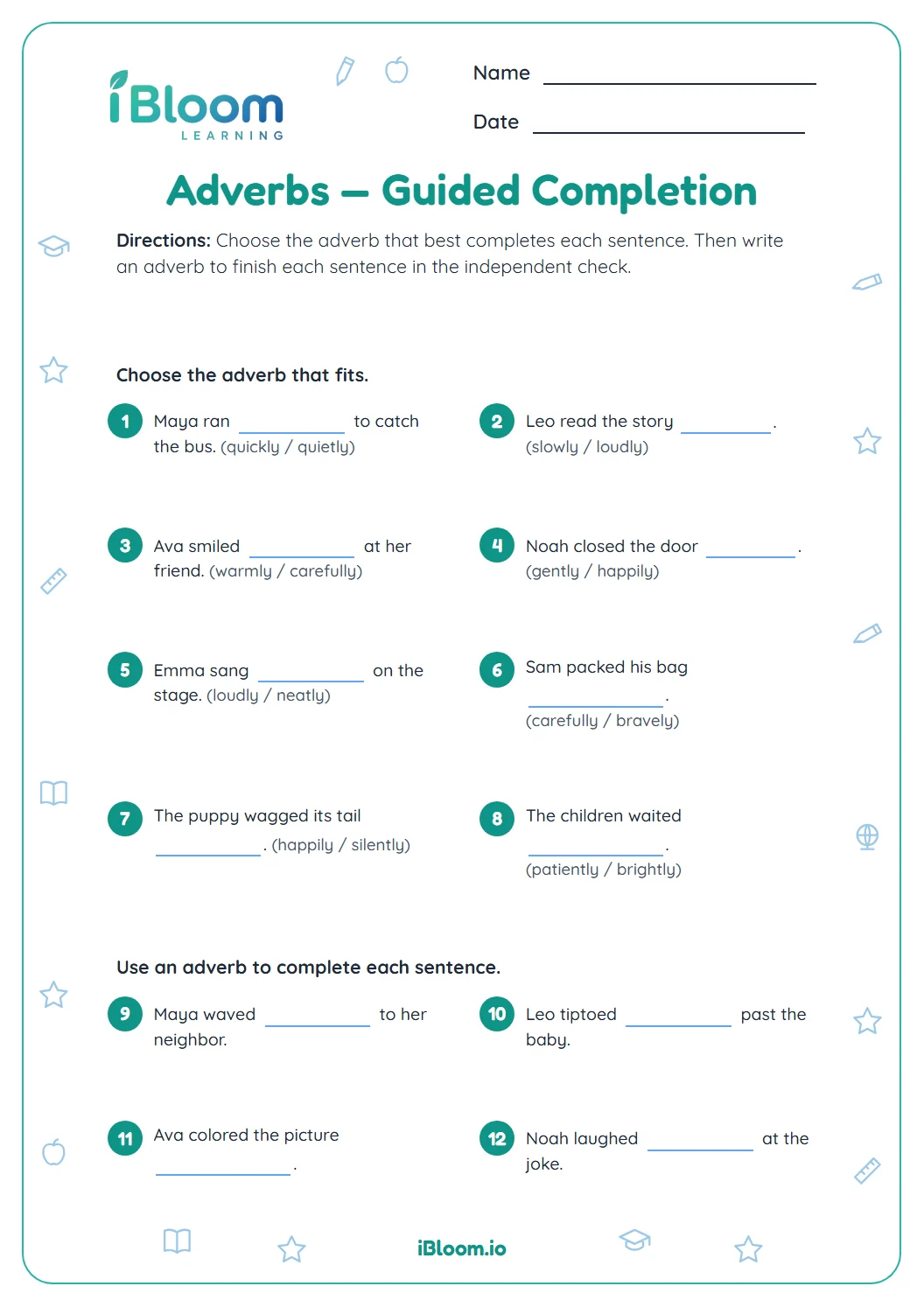
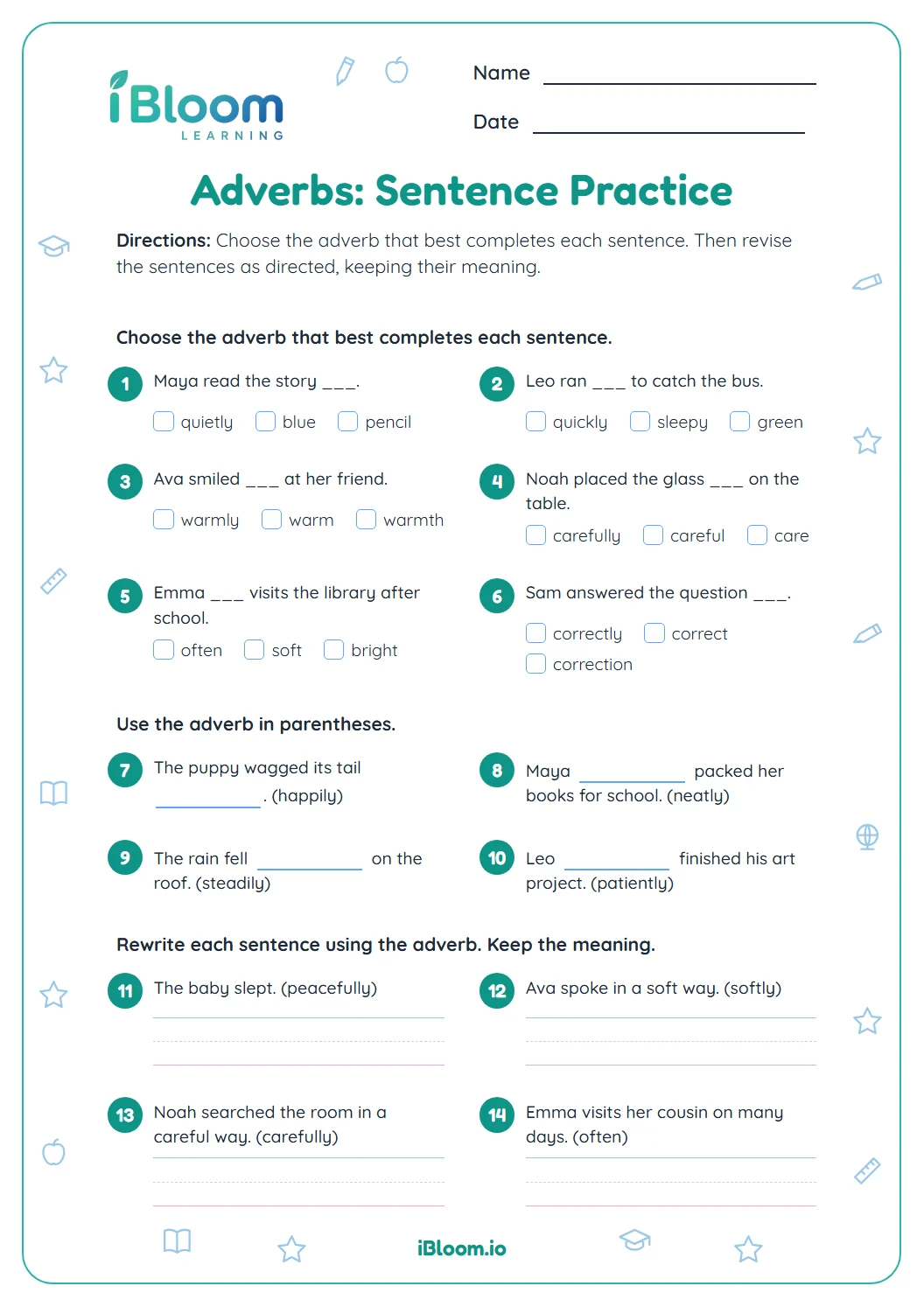
This parts of speech worksheet gives children fourteen short editing tasks. Part A corrects labels for a noun, verb, adjective and adverb. Part B chooses word forms that fit each sentence. Part C asks children to rewrite five sentences, changing the capitalized word. It practices agreement in Common Core L.3.1f and adjective and adverb use in L.2.1e. The page belongs to the Grades 1–5 grammar collection; use adult reading support or independent work according to the learner’s experience. The separate key includes every correction.
Aligned to L.3.1f and L.2.1e
Which word labels do children correct?
Part A deliberately supplies a wrong label for a capitalized word. Children choose the right label: a noun names a person, place or thing; a verb expresses an action or state; an adjective describes a noun; an adverb can describe how an action happens.
Read “A BIRD sings” as a complete sentence. Bird names the animal, so noun is the correct choice even though the sentence also contains the action sings.
How do word jobs help with editing?
Part B contrasts word forms such as careful and carefully. “Walks carefully” needs an adverb because it tells how the turtle walks. “A bright star” needs an adjective because bright describes the noun star. Questions 13 and 14 also ask for adverbs that describe actions.
The other two choices involve agreement. A plural subject such as dogs uses bark, and plural nouns such as shoes take they as a pronoun.
What changes in the sentence rewrites?
Correct the form of the capitalized word and copy the whole sentence, including its capital letter and period. Question 9 requests an adverb, and question 10 specifies present tense. The four fixes are silently, carry, their, and quiet. Questions 13 and 14 return to choosing a word form.
- 1The rabbit moves SILENT.
- 2Which word does SILENT describe? Moves.
- 3An adverb tells how it moves: silently.
- 4Corrected sentence: The rabbit moves silently.
How to use this worksheet
- 1Review noun, verb, adjective and adverb with a spoken example of each.
- 2Read each wrong label in Part A and choose its correction.
- 3Try both choices in each Part B sentence before writing one in the blank.
- 4Rewrite each Part C sentence, changing only the capitalized word.
- 5Use the key to check the correction, then explain which word it refers to or describes.
Mistakes to notice and fix
The mistake
Choosing verb for BIRD because a bird can move.
The fix
Classify the word’s job in this sentence: bird names an animal; sings tells its action.
The mistake
Writing “walks careful” when choosing between careful and carefully.
The fix
Ask how the turtle walks. Carefully describes the action walks.
The mistake
Using its for the plural noun ducks.
The fix
Match the pronoun to more than one duck: their wings.
Common Core alignment
Edit verbs and pronouns so they agree with the words they refer to.
On this sheet: Children correct subject-verb agreement and choose pronouns that match nouns.
Show the official wordingHide the official wording
Ensure subject-verb and pronoun-antecedent agreement.*
Choose an adjective for a noun and an adverb for an action.
On this sheet: Children select and repair describing words in short sentences.
Show the official wordingHide the official wording
Use adjectives and adverbs, and choose between them depending on what is to be modified.
What to practice next
Make more practice
Further reading
Questions parents and teachers ask
What does my child do with the wrong labels in Part A?
Choose the correct label from the three options. The sentence itself is already correct; the supplied label is the error. For example, BIRD is called a verb, but the word names an animal in “A BIRD sings.” Children choose noun to fix that label.
Does every word ending in ly need to be an adverb?
No, the word’s job in its sentence is what matters. On this sheet, softly and carefully describe actions, so they are adverbs. Help the child ask what the word describes instead of checking only its ending. Bright and quiet describe nouns in the adjective questions.
How much should children rewrite in Part C?
They rewrite each complete sentence and correct the capitalized word’s form. Question 10 requests the present tense, so it becomes “The boys carry bags.” Keeping the other words preserves the meaning. Check that the copied sentence begins with a capital letter and ends with a period.
Can younger children use this worksheet?
Yes, with an adult reading the sentences and explaining the word labels as needed. Younger learners can discuss a correction aloud before writing it. Children who already know these word classes can work independently, then explain why each corrected word fits its role in the sentence.
What does the answer key show?
The separate key marks the four correct labels, supplies the four missing words, and prints the four corrected sentences. For the written items, compare the changed word carefully. Then ask the child to locate the subject, noun or action that explains why that correction is needed.