



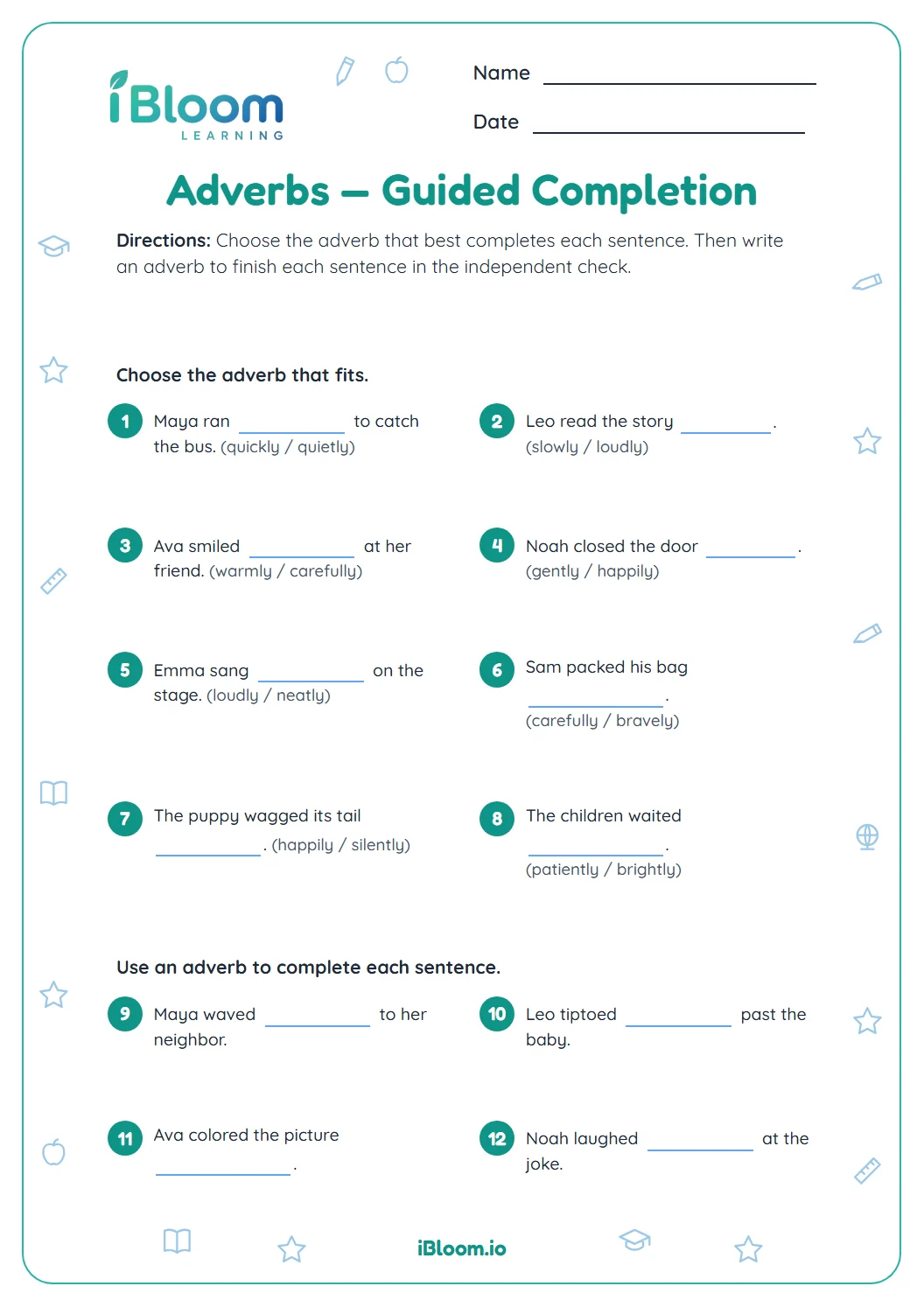
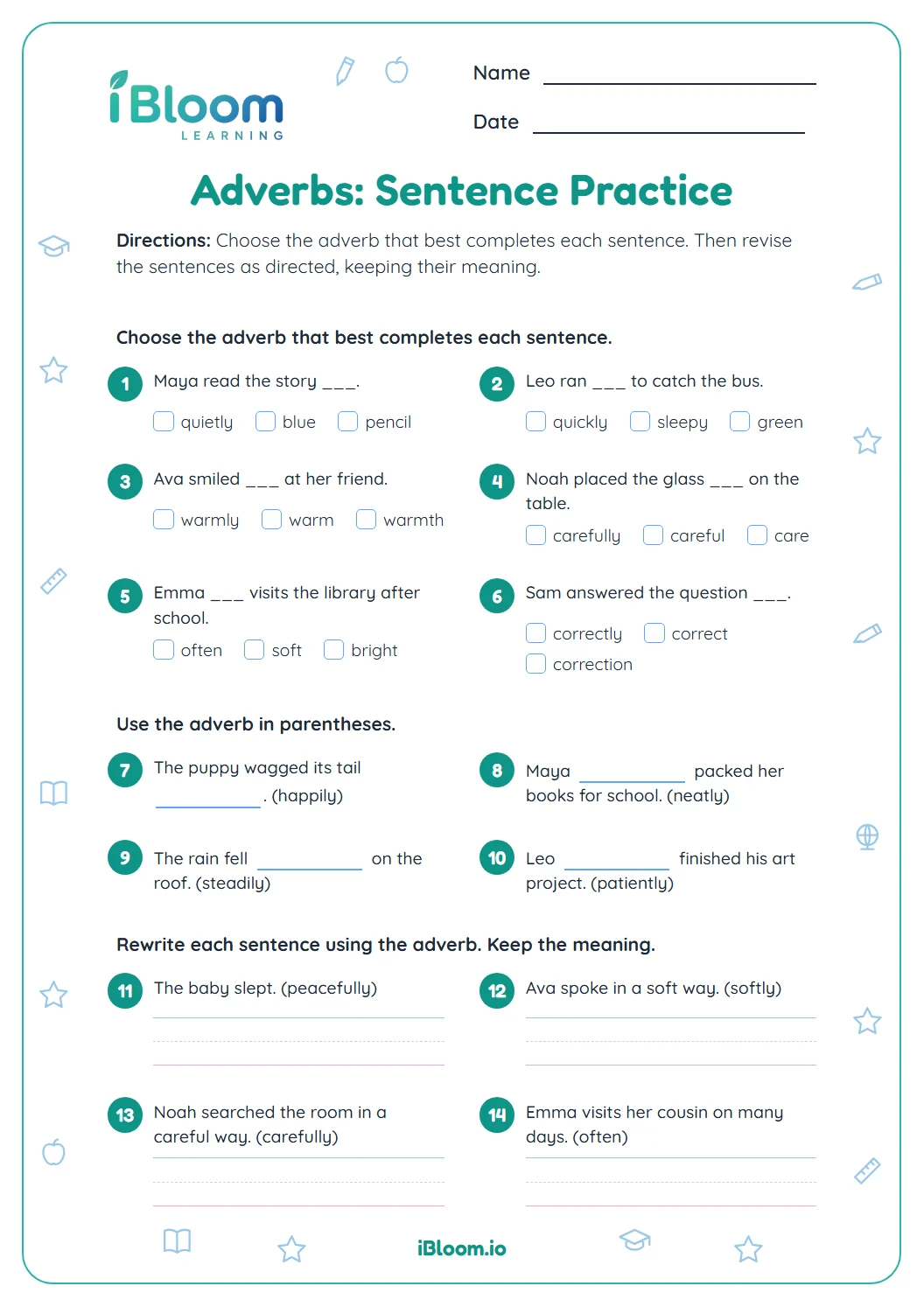
About this worksheet
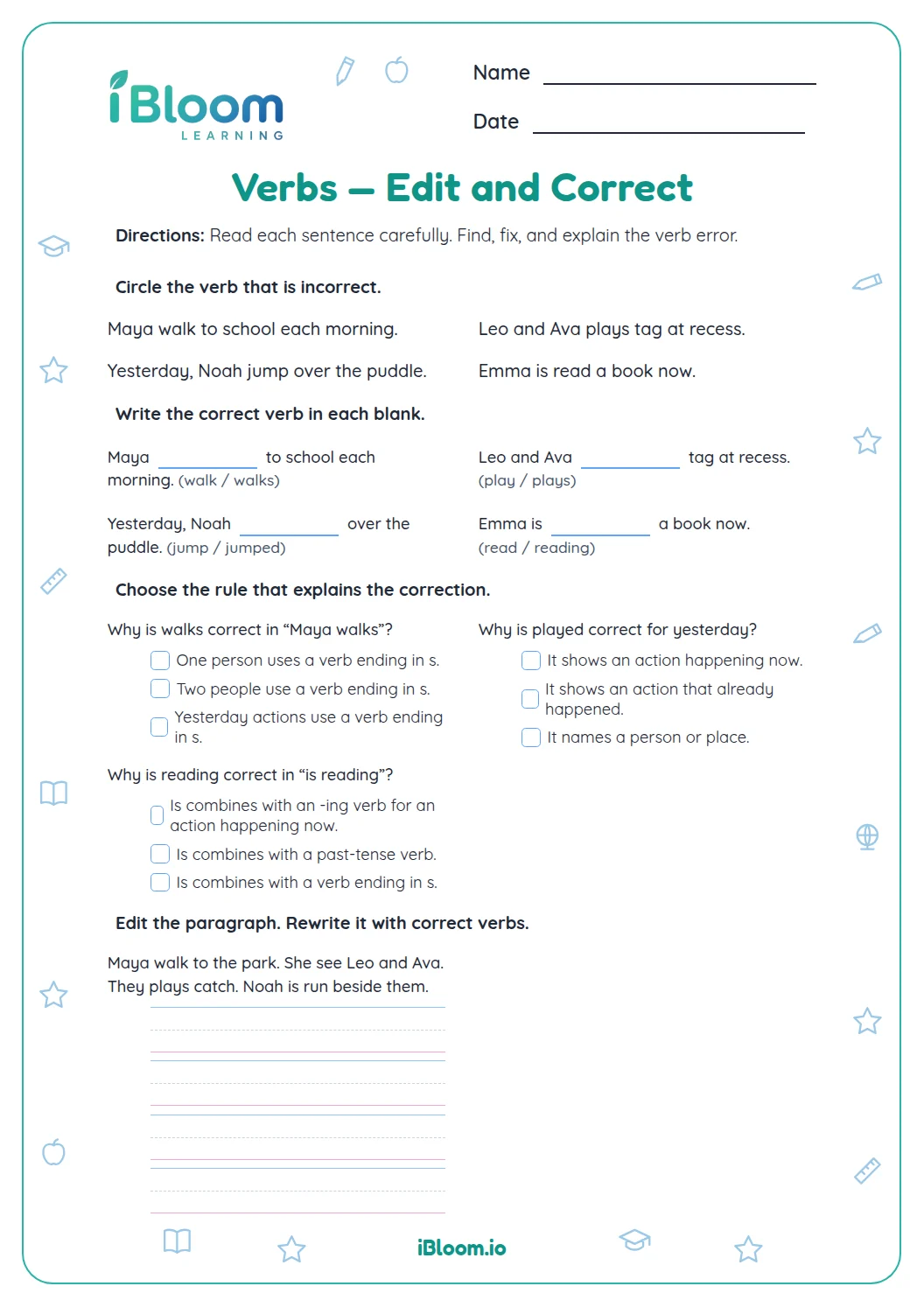
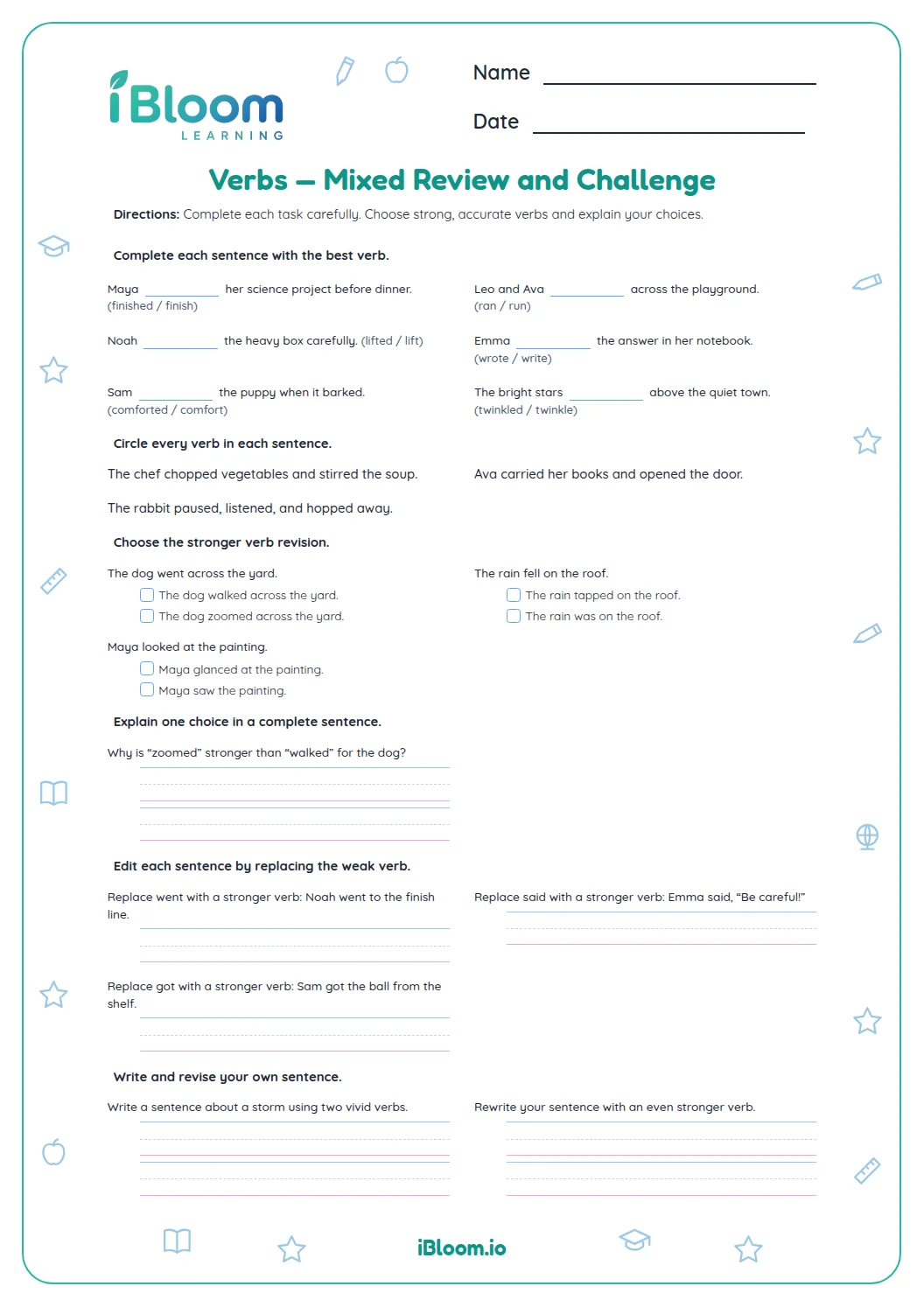
This Grade 3 printable has six verb-identification choices, eight compact sentence completions, and two original sentence prompts. Students identify action and linking verbs, use time clues to choose verb forms, and apply verbs in their own writing. The separate key gives sample responses for the open writing prompts. The practice supports Common Core L.3.1.
Aligned to L.3.1
How can you spot a verb?
A verb tells what a subject does or is. In question 1, “The puppy ___ beside the gate,” runs tells what the puppy does; yellow describes it instead.
- 1The puppy runs beside the gate.
- 2Runs names the puppy’s action.
How does a time clue help choose a verb?
Words such as yesterday, every night, right now, and tomorrow point to when an action happens. Use the clue and the subject together to choose a form that makes a complete sentence.
- 1Yesterday, we walked to school.
- 2Yesterday signals past time, so use walked.
How do you use a verb in your own sentence?
Give the sentence a subject and a verb that makes sense with it. Question 15 asks for an action verb; question 16 asks for a linking verb that connects the subject to a description.
- 1The sky is cloudy today.
- 2Is links the subject sky with the description cloudy.
How to use this worksheet
- 1Read the whole sentence and identify its subject.
- 2Choose the word that tells an action or state.
- 3Notice the time clue before completing a verb form.
- 4Read each completed sentence aloud to check its meaning.
- 5Write a complete sentence for each final prompt, following its verb direction.
Common verb mistakes and quick fixes
The mistake
Choosing a describing word such as yellow instead of a verb.
The fix
Ask what the subject does or is; that word is the verb.
The mistake
Using a present form after “yesterday.”
The fix
Match the verb to the time clue: yesterday points to past time.
The mistake
Writing a fragment without a subject.
The fix
Name who or what the sentence is about, then add the requested verb.
Curriculum alignment
This page practices the skill described in the listed standard.
Use standard grammar, including simple verb tenses, when writing and speaking.
On this sheet: The sheet asks students to identify verbs and use simple tenses in sentences.
Show the official wordingHide the official wording
Demonstrate command of the conventions of standard English grammar and usage when writing or speaking.
What to practice next
Make more practice
Further reading
Questions parents and teachers ask
How do you find a verb?
A verb tells what a subject does or is. Action verbs include runs and sings; a linking verb such as tastes connects soup to a description. Part A asks students to choose the verb in six sentences. These examples include both actions and a verb linking a subject with a describing word.
How do time clues help?
Part B uses clues such as yesterday, every night, right now, and tomorrow. Students complete each sentence with a form that matches its time. Read the finished sentence aloud to check that the tense makes sense. Ask the child to point to the exact word or phrase in the sentence that supports the answer before checking the key.
Why write original sentences?
The final prompts ask students to use a named verb in context. Each response needs a subject and a complete thought. The key gives samples, but other complete sentences using the requested verb can be correct. Ask the child to point to the exact word or phrase in the sentence that supports the answer before checking the key.
What grade is this for?
This printable is set at Grade 3, with short sentences and familiar actions. It practices identifying verbs, matching tense to time clues, and writing original examples. An adult may read a direction aloud if useful. Ask the child to point to the exact word or phrase in the sentence that supports the answer before checking the key.
What should I accept for writing?
Accept a complete sentence that uses the requested verb and follows the time clue. The key gives one sample for each prompt, not the only possible answer. Check that the sentence has a subject and a finished thought. Ask the child to point to the exact word or phrase in the sentence that supports the answer before checking the key.