Free printable practice
Counting Pennies Nickels Dimes Quarters Practice Activities
Printable Grade 1 money worksheets for recognizing and counting pennies, nickels, dimes, and quarters using coin values and simple totals.
Free printable worksheet PDFs
Preview every available page, then download the free worksheet PDF for home, homeschool, tutoring, or classroom practice.
Preview the exact activity before downloading it.
Practice that builds confidence
Building coin recognition first
These Grade 1 counting money worksheets help children practise identifying pennies, nickels, dimes, and quarters, then counting their values accurately. Students work with the coin names, cent values, and visual differences that make each coin recognizable.
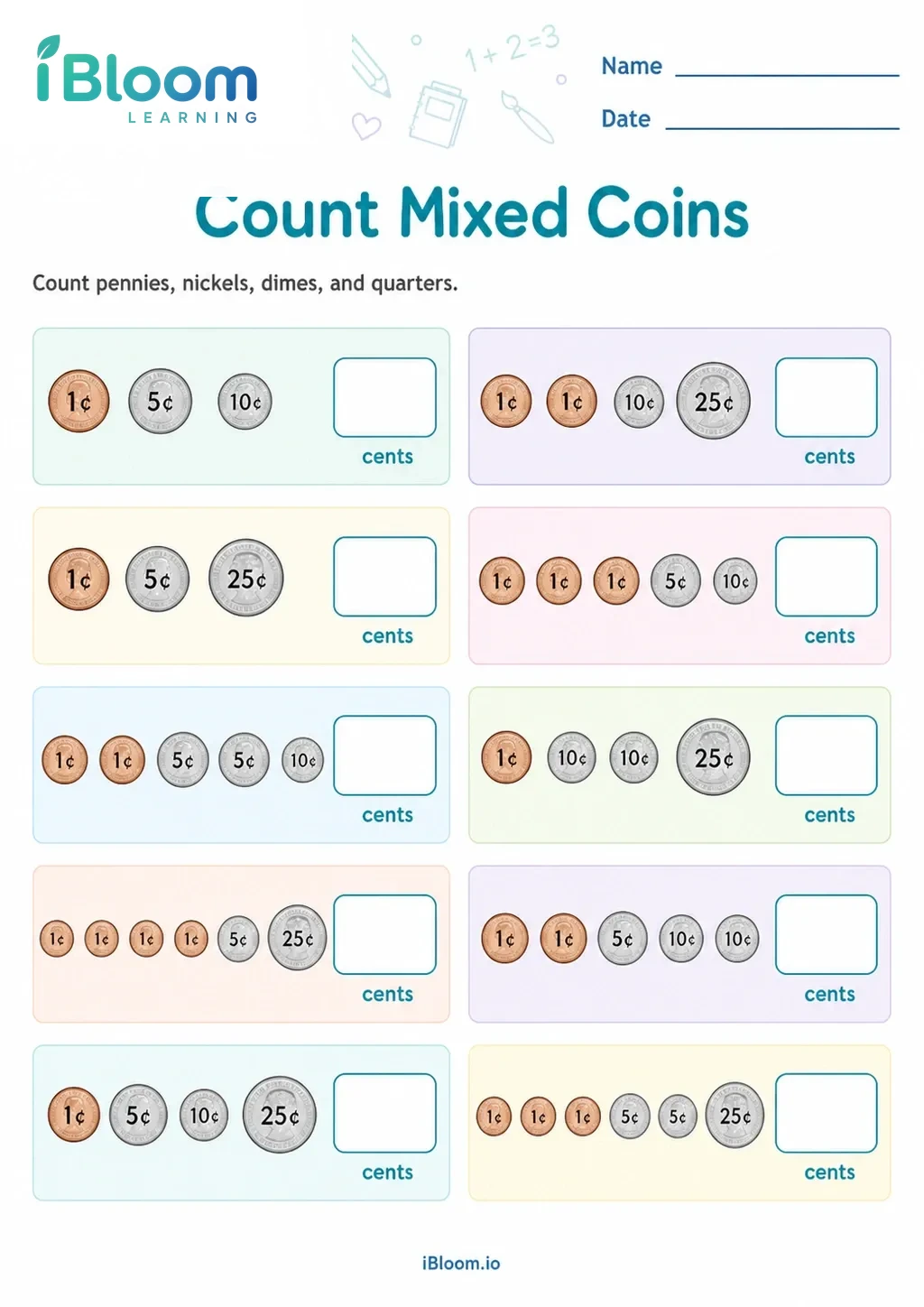
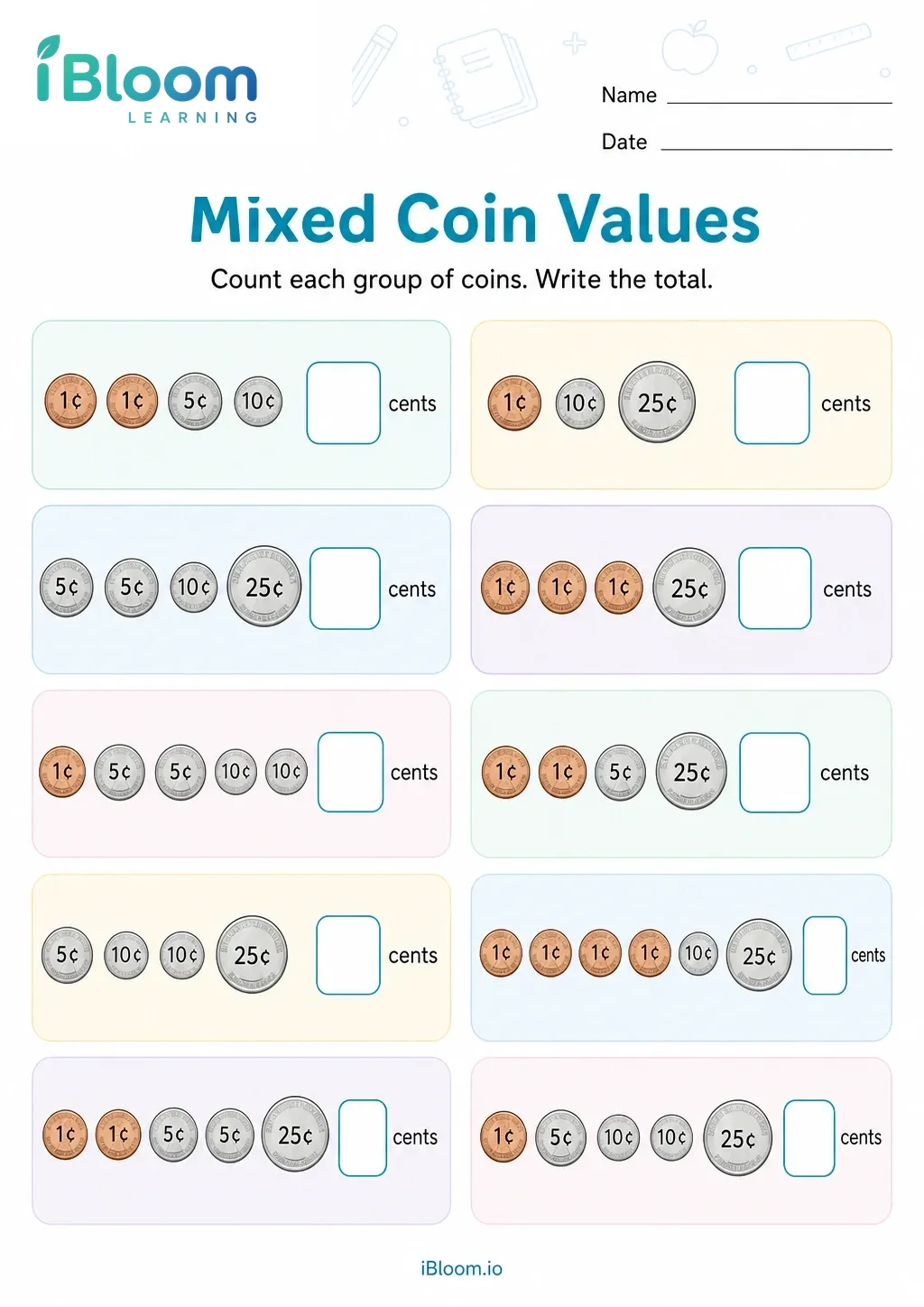
The printable activities include coin groups, value matching, counting by 1s, 5s, 10s, and 25s, and simple mixed-coin totals. They give children repeated practice moving from “What coin is this?” to “How much money is here?”
Before children can count money confidently, they need to know what each coin is worth. These worksheets focus on the four coins Grade 1 students meet most often: penny = 1 cent, nickel = 5 cents, dime = 10 cents, and quarter = 25 cents. Activities may show coins in small groups so children can connect the picture of the coin with its name and value.

Counting by coin values
The practice gradually strengthens skip counting. Pennies support counting by 1s, nickels by 5s, dimes by 10s, and quarters by 25s. Children learn that counting coins is not the same as counting objects one by one; the value changes depending on the coin. A set of three dimes is 30 cents, while three pennies is only 3 cents.
Moving into mixed coins
Once single-coin groups feel familiar, children can begin counting mixed coins. A helpful order is to start with the coin of greatest value, then count on: quarter, dime, nickel, penny. For example, with a quarter, dime, and two pennies, a child can say, “25, 35, 36, 37 cents.” This builds number flexibility without introducing more advanced money operations.
A simple home routine
Parents can place a few real or play coins beside one worksheet problem. Ask your child to name each coin, sort matching coins together, then count the total aloud. Keep a small number line or hundred chart nearby for skip counting support. After finishing a row, ask, “Which coin helped the total grow the most?” to reinforce value, not size.

Classroom uses and errors to watch for
Teachers can use these pages for math centers, morning work, small-group reteaching, or quick checks after a money lesson. Common errors include thinking the larger coin is always worth more, confusing nickels and quarters, counting every coin as 1, or switching between 5s and 10s mid-count. Encourage students to touch or mark each coin once so they do not skip or double count.

Free printable PDF download
Use this counting pennies nickels dimes quarters worksheets grade 1 page to preview the activity, print it, or download it as a PDF for quick practice. It works well for homework, homeschool lessons, tutoring, morning work, revision, and classroom centers.
Answers and answer key support
After the child completes the worksheet independently, parents and teachers can use the answer support or answer key information to check the work, review mistakes, and choose the next practice step.
Why iBloom worksheets help
The pages keep the focus narrow: pennies, nickels, dimes, and quarters only. Clear coin groups, repeated value practice, and counting-on tasks help Grade 1 learners build accuracy step by step. A child-friendly strategy is: name the coins, start with the biggest value, count on carefully, and write the total with the cent sign.
Helpful answers
Frequently asked questions
Which coins are included in these Grade 1 worksheets?
The worksheets focus on pennies, nickels, dimes, and quarters. Children practise both the coin names and their values in cents.
Should children count the coins in any particular order?
For mixed coins, it usually helps to start with the greatest value coin, such as a quarter or dime, and then count on with smaller values.
What if my child knows the coin names but not the values?
Have your child say the name and value together each time: “penny, 1 cent,” “nickel, 5 cents,” “dime, 10 cents,” and “quarter, 25 cents.” Repetition with pictures and real coins builds recall.
Are these worksheets for adding money with dollars?
No. This page is for counting coin values in cents using pennies, nickels, dimes, and quarters. It does not require dollar notation.
How can I help with nickel and quarter confusion?
Place a nickel and quarter side by side and compare size, edge, and value. Then ask your child to point to the 5-cent coin and the 25-cent coin before counting.
Is this counting pennies nickels dimes quarters worksheets grade 1 free?
Yes. You can preview it for free and use the printable worksheet for home or classroom practice.
Can I download this counting pennies nickels dimes quarters worksheets grade 1 as a PDF?
Yes. Use the worksheet download option to save a printable PDF, or print the worksheet directly from the page.
Does this counting pennies nickels dimes quarters worksheets grade 1 include answers or an answer key?
When the activity has fixed answers, iBloom includes answer support so parents and teachers can check the completed worksheet.