Free printable practice
Identify Coins Practice Activities
Printable Grade 1 activities help children recognize US pennies, nickels, dimes, and quarters by name, value, size, color, and coin details.
Free printable worksheet PDFs
Preview every available page, then download the free worksheet PDF for home, homeschool, tutoring, or classroom practice.
Preview the exact activity before downloading it.
Practice that builds confidence
What children learn first
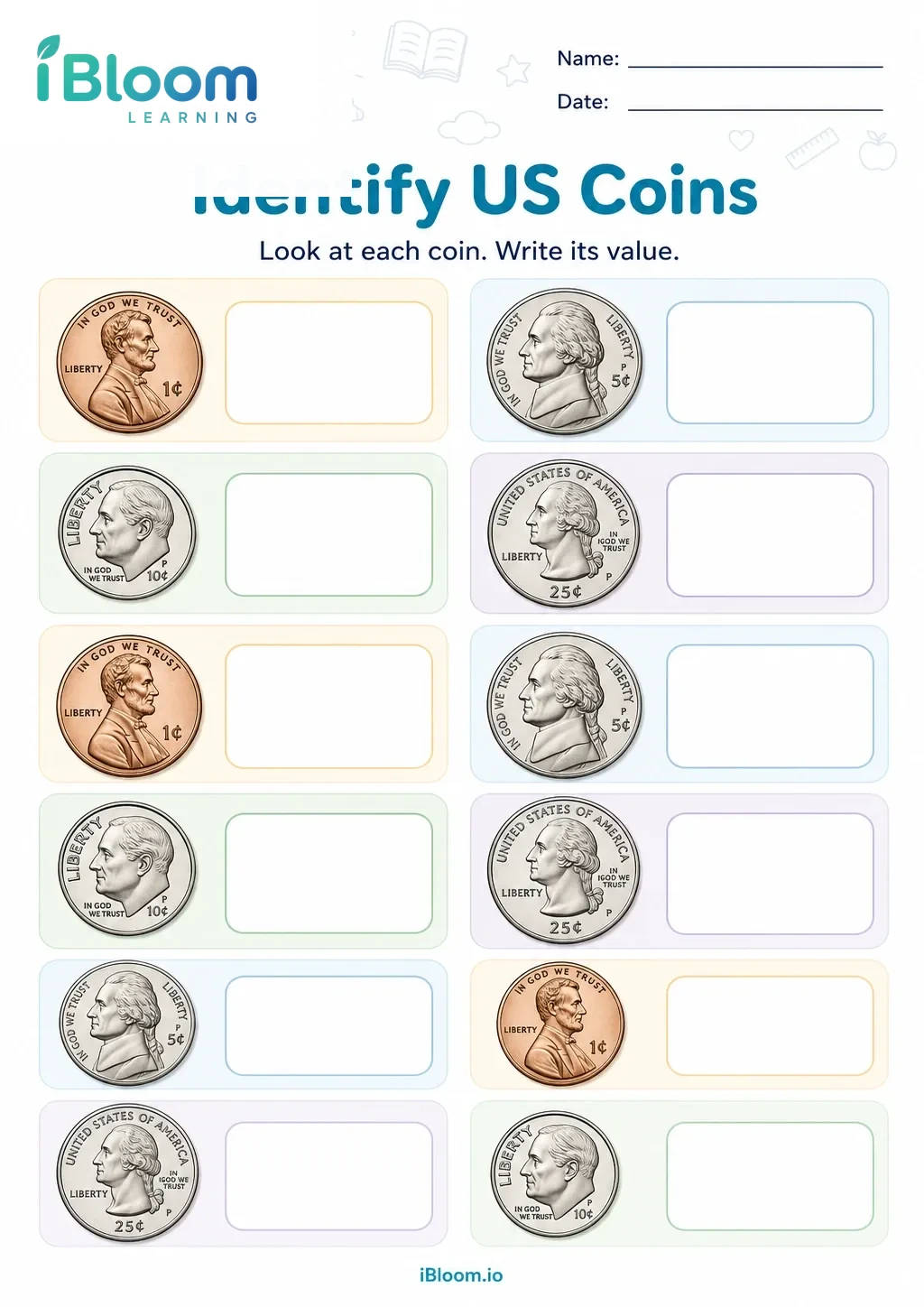
These Grade 1 counting money worksheets focus on identifying US coins: penny, nickel, dime, and quarter. Children practise noticing each coin’s name, value, size, color, and common front and back details before they begin solving harder money problems.
The printable activities include matching, sorting, labeling, circling, and comparing coin pictures. They are designed to build careful observation so children can tell coins apart even when the coins are shown in mixed groups or from different sides.
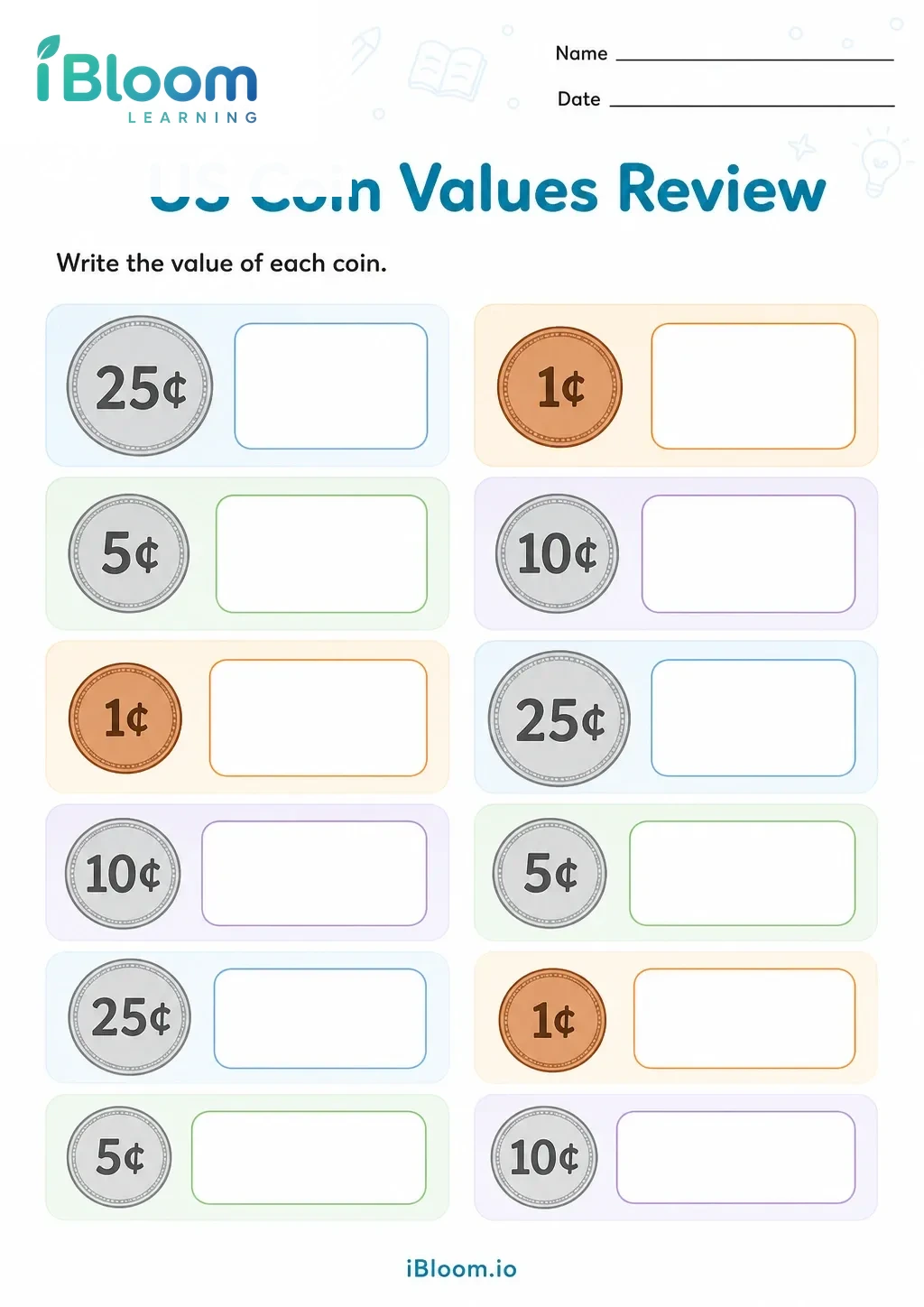
Identifying coins is the starting point for counting money. Children learn that a penny is worth 1 cent, a nickel 5 cents, a dime 10 cents, and a quarter 25 cents. They also compare attributes: the penny is copper-colored, the dime is small, the nickel is thicker and larger than the dime, and the quarter is the largest of these common classroom coins.

Progression across the worksheets
The practice begins with single coins and clear pictures. Children match coin names to images, choose the correct coin from a small set, and label coins with their values. Later pages mix pennies, nickels, dimes, and quarters so children must look closely instead of guessing from one clue. Some tasks show both heads and tails, which helps children understand that the same coin can look different depending on the side shown.
A simple parent routine
Use a small cup of real coins at home. Ask your child to pick one coin, say its name, tell its value, and give one reason: “This is a dime because it is small and says one dime.” Then place four coins in a row and ask, “Which one is the nickel?” Keep the focus on identification before asking the child to add coin values.

Classroom uses for teachers
These worksheets fit well in Grade 1 math centers, morning work, small-group reteaching, or a money unit warm-up. Teachers can pair a page with plastic or real coins so students move from real objects to pictures. A quick exit ticket can ask students to circle a named coin and write its value in cents.

Common errors to watch for
Many children confuse nickels and quarters because both are silver-colored. Others think the dime must be worth less than a nickel because it is smaller. Encourage students to check more than one clue: color, size, words on the coin, and value. Also watch for children who recognize the front of a coin but not the back.
Free printable PDF download
Use this identify coins worksheets grade 1 page to preview the activity, print it, or download it as a PDF for quick practice. It works well for homework, homeschool lessons, tutoring, morning work, revision, and classroom centers.
Answers and answer key support
After the child completes the worksheet independently, parents and teachers can use the answer support or answer key information to check the work, review mistakes, and choose the next practice step.
Why iBloom worksheets help
The pages give repeated, focused practice without rushing into complex counting. Clear coin images, varied question types, and mixed examples help children build reliable coin recognition. A child-friendly strategy is: name it, find a clue, say the value. For example, “Quarter, big silver coin, 25 cents.”
Helpful answers
Frequently asked questions
Which coins are included in these Grade 1 worksheets?
The worksheets focus on the four common US coins usually introduced first: penny, nickel, dime, and quarter.
Do children need to count coin totals for this page?
No. The main skill is identifying coins by name, value, and features. Counting totals can come after children recognize each coin confidently.
Why do children often confuse nickels and quarters?
Both coins are silver-colored, so children may rely only on color. These activities encourage them to also compare size, words, and value.
How can I support coin identification at home?
Give your child real coins to sort. Ask them to name each coin, say its value, and point to a clue such as color, size, or the words on the coin.
Are the coin pictures shown from both sides?
The practice includes coin recognition in varied formats, including front and back views, so children learn that the same coin may have different details on each side.
Is this identify coins worksheets grade 1 free?
Yes. You can preview it for free and use the printable worksheet for home or classroom practice.
Can I download this identify coins worksheets grade 1 as a PDF?
Yes. Use the worksheet download option to save a printable PDF, or print the worksheet directly from the page.
Does this identify coins worksheets grade 1 include answers or an answer key?
When the activity has fixed answers, iBloom includes answer support so parents and teachers can check the completed worksheet.