Free printable practice
Sort Canadian Coins Practice Activities
Grade 1 printable activities help children identify, compare, and sort Canadian coins by name, value, colour, size, and design.
Free printable worksheet PDFs
Preview every available page, then download the free worksheet PDF for home, homeschool, tutoring, or classroom practice.
Preview the exact activity before downloading it.
Practice that builds confidence
What children learn first
These Grade 1 counting money worksheets focus on sorting Canadian coins, an important first step before children count mixed amounts. Students practise recognizing coins such as nickels, dimes, quarters, loonies, and toonies by looking closely at their shape, colour, size, pictures, and value markings.
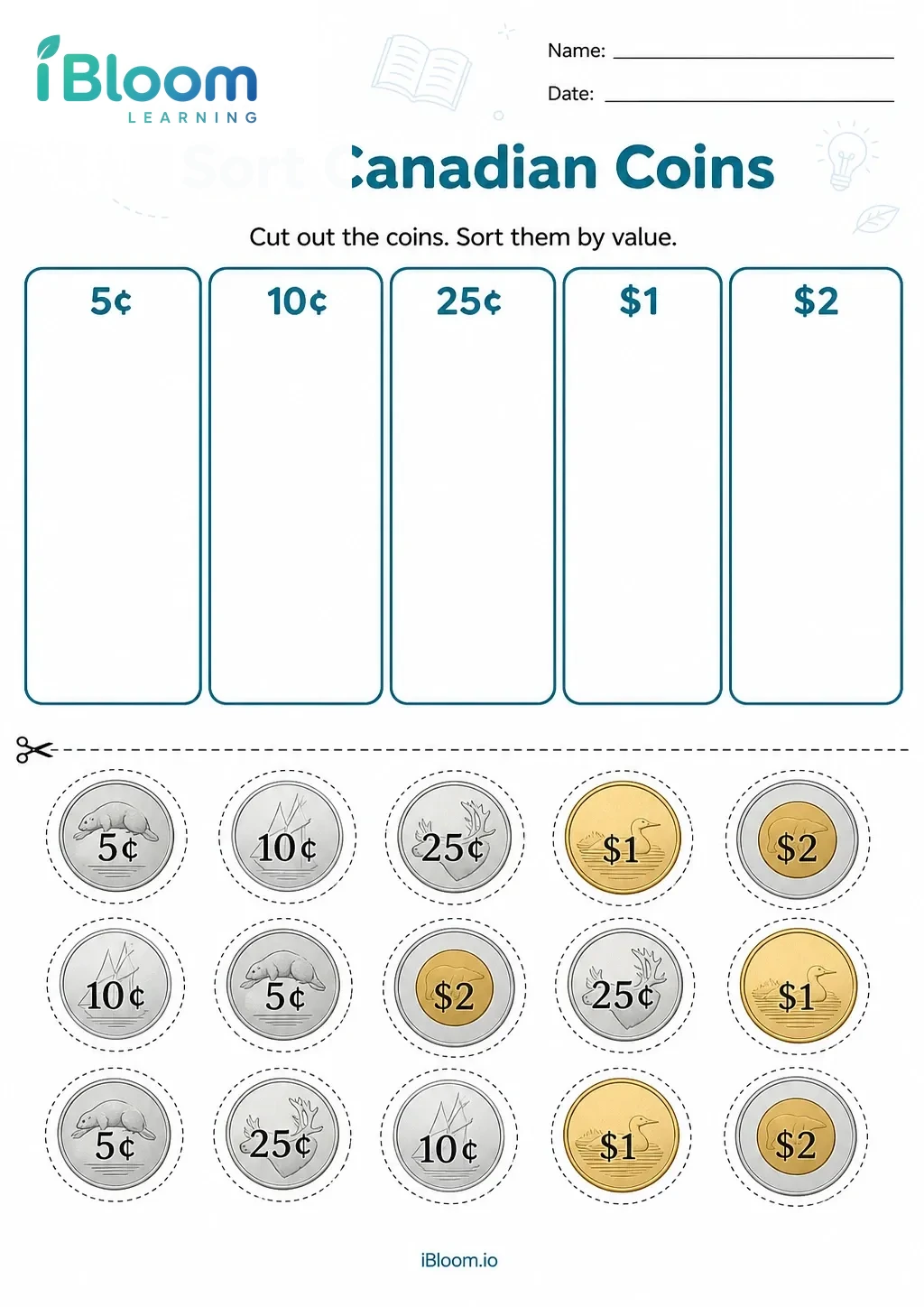
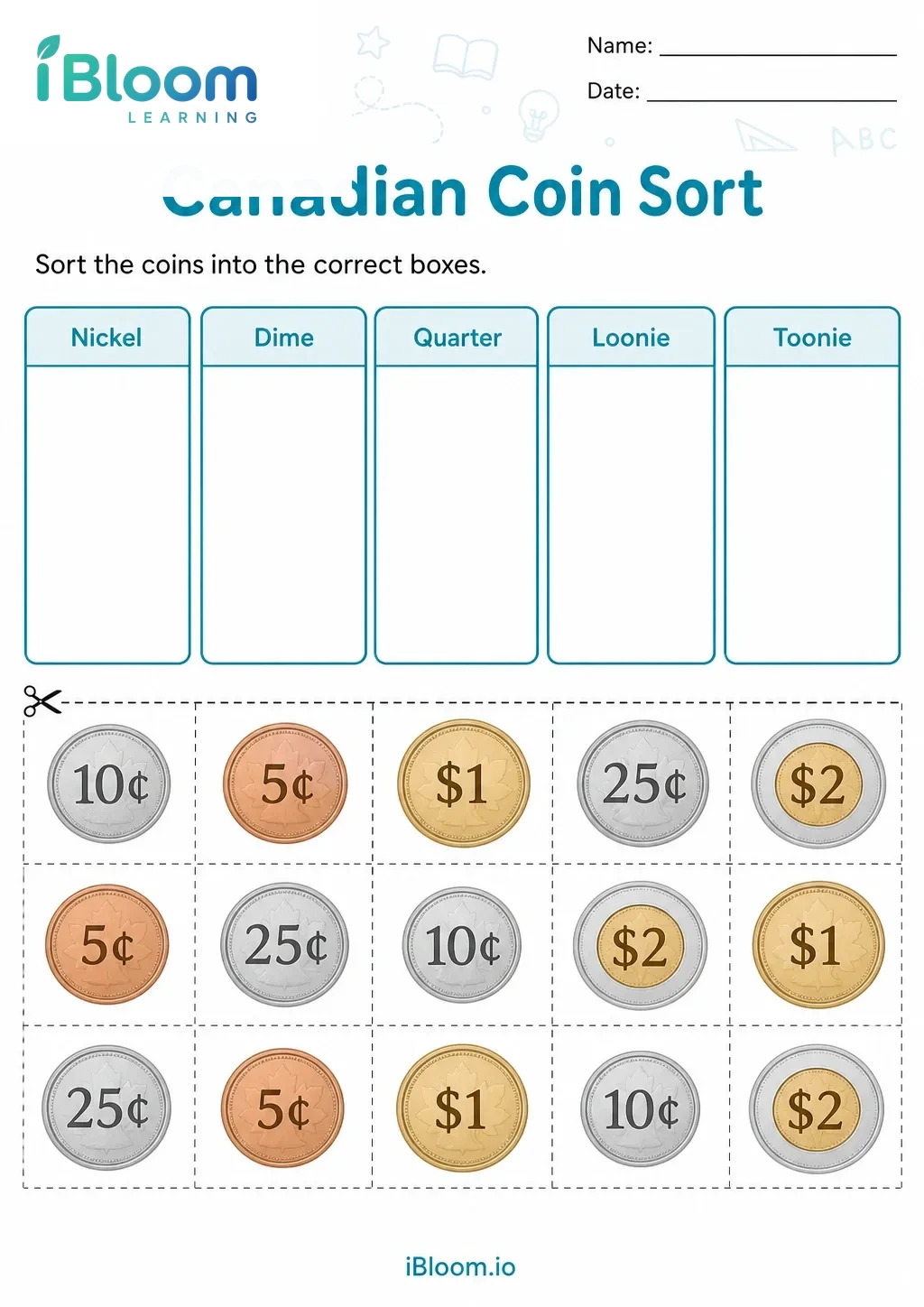
The printable activities include coin-matching, cut-and-sort tasks, visual grouping, and simple classification pages. Children learn to place like coins together, explain how they know a coin belongs in a group, and build confidence with Canadian money vocabulary.
Sorting Canadian coins helps Grade 1 learners slow down and notice details before they try to count money. A child may see that a dime is smaller than a nickel, that a loonie is gold-coloured, and that a toonie has two colours. The goal is not just naming coins from memory; it is learning to use observable clues such as size, edge, picture, colour, and value.

How the practice progresses
The pages move from clear visual recognition to more independent sorting. Children may match identical coins, circle all coins of one type, place mixed coins into groups, or sort coins under labels such as nickel, dime, quarter, loonie, and toonie. Some activities encourage children to compare two coins and say what is the same or different, which supports both money skills and early classification skills.
A simple parent routine
At home, place a small group of real or play Canadian coins on the table. Ask your child to pick one coin, name one thing they notice, and then find all coins that match it. Keep the language simple: “This is silver-coloured,” “This one is smaller,” or “This coin says 25 cents.” After sorting, have your child point to each group and name it. If they are unsure, compare just two coins at a time instead of the whole pile.

Classroom uses for teachers
Teachers can use these worksheets during math centers, small-group money lessons, morning review, or as follow-up practice after handling real coins. Cut-and-sort pages work well for partner talk because students can justify their choices: “I put these together because they are both toonies.” The pages also provide quick evidence of whether a student recognizes coin features or is guessing based on one clue.

Common errors to watch for
Many children confuse size with value, so they may think a larger coin is always worth more. Others mix up nickel and dime because both are silver-coloured, or rely only on colour and overlook the pictures and numbers. Encourage children to check more than one feature before deciding. If a worksheet includes similar-looking coins, ask them to say the coin name aloud while pointing to the detail that helped them.
Free printable PDF download
Use this grade 1 sort Canadian coins worksheet page to preview the activity, print it, or download it as a PDF for quick practice. It works well for homework, homeschool lessons, tutoring, morning work, revision, and classroom centers.
Answers and answer key support
After the child completes the worksheet independently, parents and teachers can use the answer support or answer key information to check the work, review mistakes, and choose the next practice step.
Why iBloom worksheets help
iBloom worksheets give repeated, focused practice without rushing into harder money calculations too soon. The layouts are clear, the tasks stay connected to sorting, and the visual variety helps children recognize coins in different arrangements. A child-friendly strategy is: “Look, name, check, sort.” Look at the coin, name one feature, check another clue, then place it in the correct group.
Helpful answers
Frequently asked questions
Which Canadian coins are practised on these worksheets?
The activities focus on common Canadian coins children are likely to meet in early money lessons, including nickels, dimes, quarters, loonies, and toonies.
Are these worksheets about counting totals or sorting coins?
The main skill is sorting and recognizing coins. Children group coins by type and features, which prepares them for later counting of mixed coin amounts.
How can I help if my child mixes up nickels and dimes?
Have your child compare one nickel and one dime side by side. Ask them to notice more than one clue, such as size, picture, and value marking, instead of using colour alone.
Can these pages be used with real coins?
Yes. Using real or play Canadian coins before or after the worksheet helps children connect the printed pictures to coins they can touch and compare.
Are the activities suitable for math centers?
Yes. The sorting tasks work well in centers because students can match, group, cut, paste, and explain their coin choices independently or with a partner.
Is this grade 1 sort Canadian coins worksheet free?
Yes. You can preview it for free and use the printable worksheet for home or classroom practice.
Can I download this grade 1 sort Canadian coins worksheet as a PDF?
Yes. Use the worksheet download option to save a printable PDF, or print the worksheet directly from the page.
Does this grade 1 sort Canadian coins worksheet include answers or an answer key?
When the activity has fixed answers, iBloom includes answer support so parents and teachers can check the completed worksheet.