Free printable practice
Sorting Practice Activities
Grade 1 sorting worksheets that help children classify objects by attributes and prepare for early data and graphing work.
Free printable worksheet PDFs
Preview every available page, then download the free worksheet PDF for home, homeschool, tutoring, or classroom practice.
Preview the exact activity before downloading it.
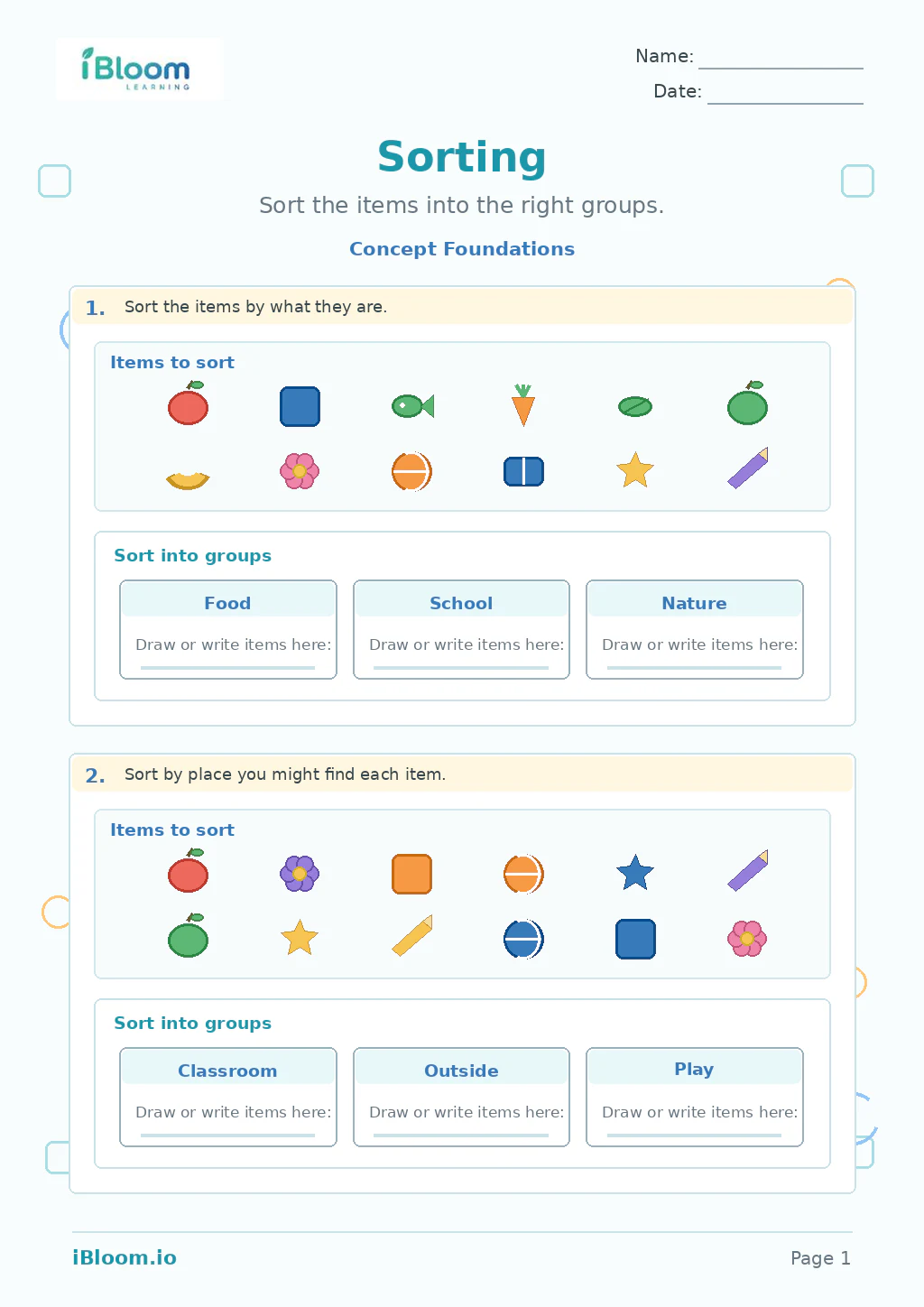 Sorting — Concept FoundationsGrade 1 sorting worksheets that help children classify objects by attributes and prepare for early data and graphing work. This Grade 1 foundations worksheet adds concise teaching notes, worked examples, and supported first attempts.Grade 1Free PDF preview
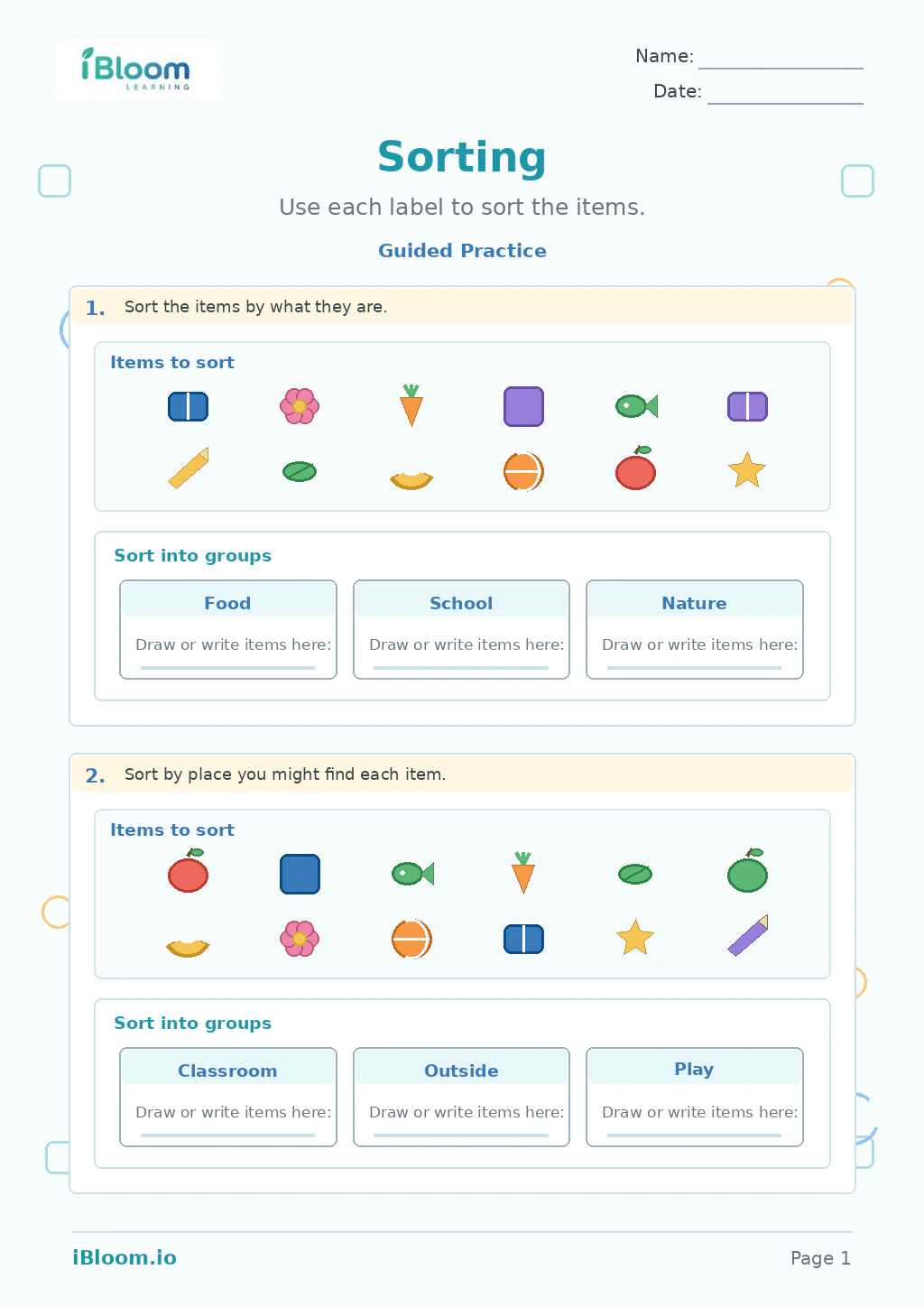 Sorting — Guided PracticeGrade 1 sorting worksheets that help children classify objects by attributes and prepare for early data and graphing work. This Grade 1 guided-practice worksheet progresses from prompts and checkpoints to independent questions.Grade 1Free PDF preview
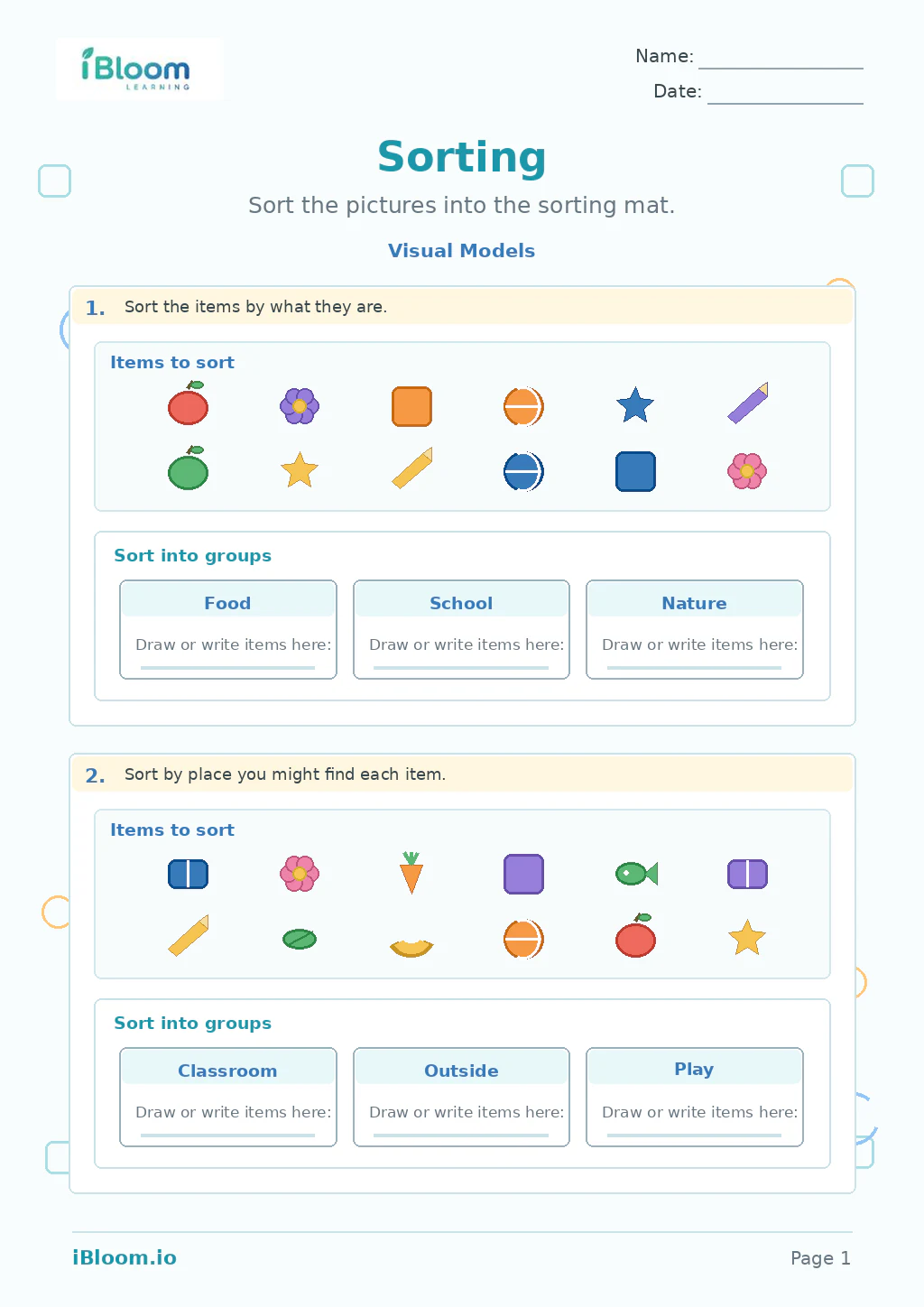 Sorting — Visual ModelsGrade 1 sorting worksheets that help children classify objects by attributes and prepare for early data and graphing work. This Grade 1 visual-model worksheet connects suitable diagrams, tables, number lines, or place-value models to mathematical notation.Grade 1Free PDF preview
 Sorting — Independent PracticeGrade 1 sorting worksheets that help children classify objects by attributes and prepare for early data and graphing work. This Grade 1 independent-practice worksheet provides a balanced sequence of accurate, grade-level exercises.Grade 1Free PDF preview2 pages
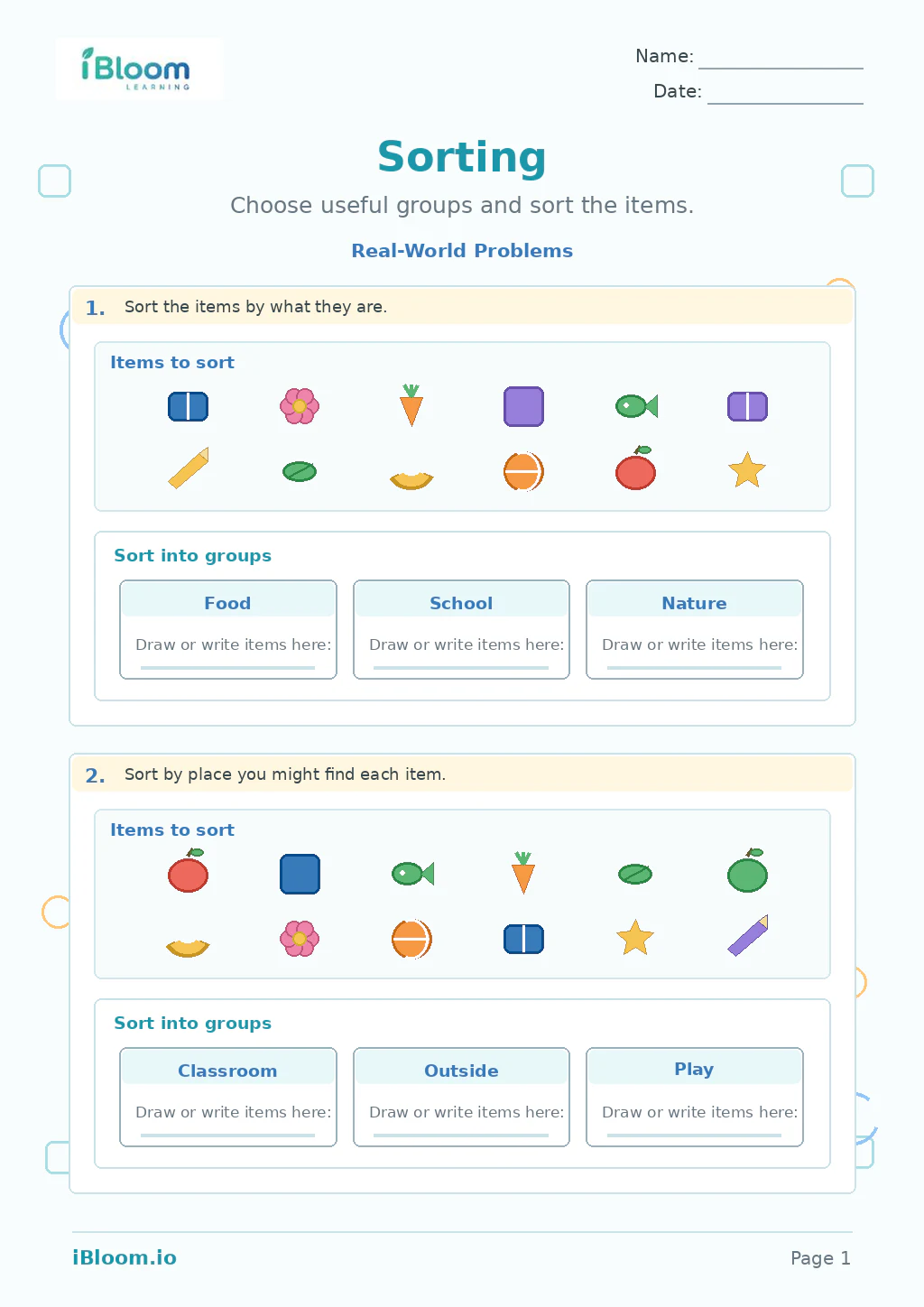 Sorting — Real-World ProblemsGrade 1 sorting worksheets that help children classify objects by attributes and prepare for early data and graphing work. This Grade 1 application worksheet uses realistic one-step and multi-step situations with room to model and solve.Grade 1Free PDF preview
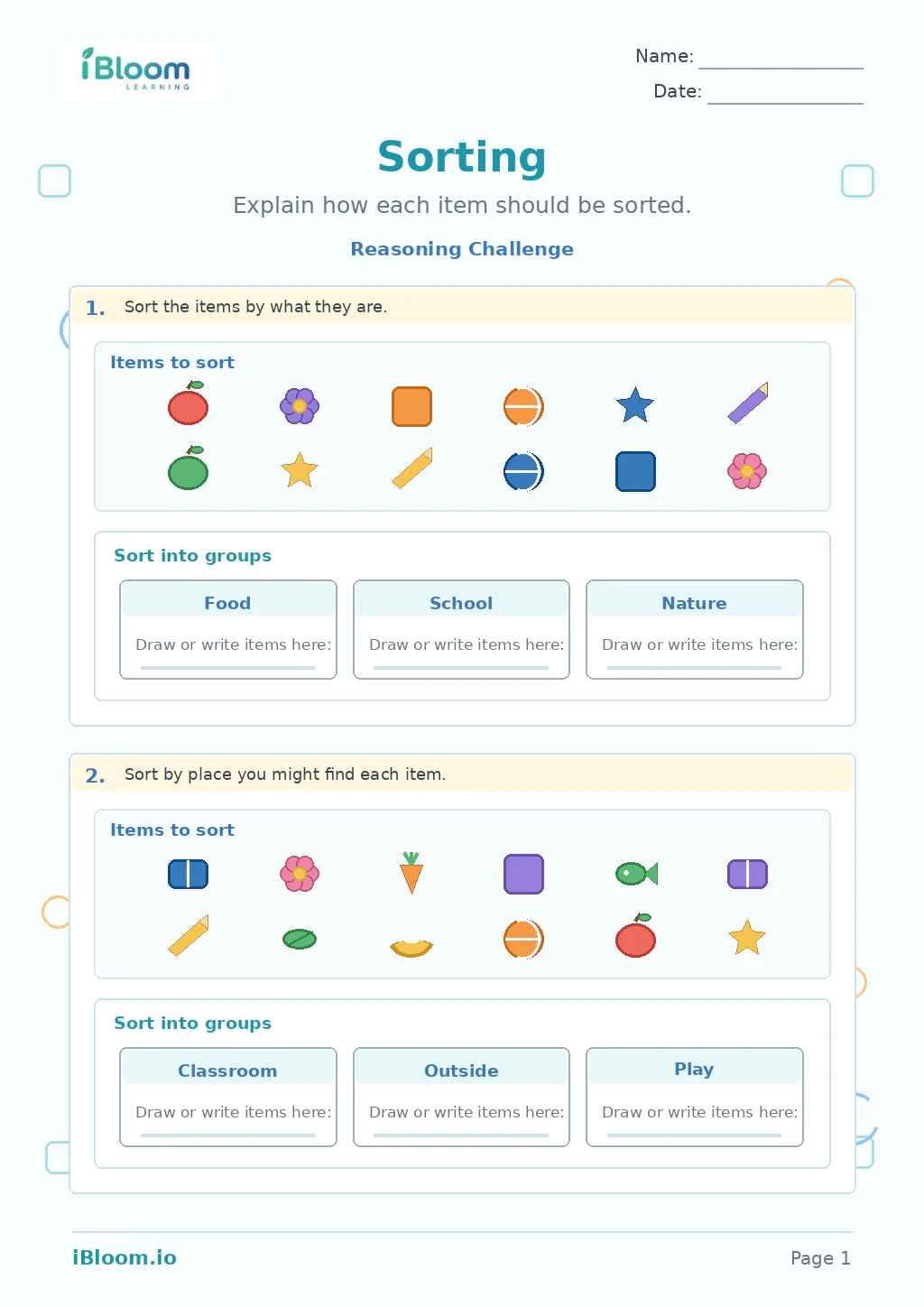 Sorting — Reasoning ChallengeGrade 1 sorting worksheets that help children classify objects by attributes and prepare for early data and graphing work. This Grade 1 reasoning worksheet combines error analysis, strategy comparison, missing information, and a gentle extension.Grade 1Free PDF preview
Practice that builds confidence
What Grade 1 sorting builds
These Grade 1 math worksheets help children practise sorting objects into groups before they move into reading and making graphs. Students look closely at attributes such as shape, size, color, type, and purpose, then decide which items belong together.
The printable activities include simple classification tasks, cut-and-sort style thinking, matching groups, identifying odd items, and explaining sorting rules. Each page supports the Data Graphing pathway by building the idea that organized data is easier to count, compare, and describe.
Sorting is a first step in data graphing because children learn to notice features, make categories, and compare groups. A child may sort buttons by color, animals by where they live, or objects by shape. In Grade 1, the focus is not just placing items in piles; it is naming the rule: “These are circles,” “These are things we wear,” or “These are large objects.”

How the skill progresses
The worksheets move from obvious visual attributes to more thoughtful categories. Children may begin by sorting pictures that differ clearly, such as red and blue objects, then work with groups that require closer attention, such as items with the same shape but different sizes. Some activities ask students to find the item that does not belong, which strengthens reasoning and prepares them to explain data choices later.
A simple parent routine
At home, choose 8 to 12 everyday objects such as spoons, crayons, socks, toy cars, and blocks. Ask your child to sort them one way, then sort the same objects a different way. After the worksheet, use three quick questions: “What is your sorting rule?” “How many are in each group?” “Can any object fit in more than one group?” This keeps the practice oral, hands-on, and connected to real life.

Classroom uses for teachers
Teachers can use these printables in math centers, small-group reteaching, morning work, or as a lead-in before picture graphs and tally charts. Students can compare answers with a partner and explain why a category makes sense. The pages also support vocabulary such as sort, group, attribute, same, different, more, fewer, category, and rule.

Common errors to watch for
Some children sort by appearance but cannot state the rule. Others change the rule midway, placing one object by color and another by use. A few may think there is only one correct sort, even when several logical answers are possible. Encourage children to check every item against the same rule and to revise if something does not fit.
Free printable PDF download
Use this grade 1 sorting worksheet page to preview the activity, print it, or download it as a PDF for quick practice. It works well for homework, homeschool lessons, tutoring, morning work, revision, and classroom centers.
Answers and answer key support
After the child completes the worksheet independently, parents and teachers can use the answer support or answer key information to check the work, review mistakes, and choose the next practice step.
Why iBloom worksheets help
iBloom sorting worksheets give Grade 1 learners clear visuals, manageable sets, and varied prompts so they practise both classifying and explaining. A child-friendly strategy is: “Look, choose a rule, sort, then check.” Saying the rule aloud helps children slow down and make consistent decisions, which is exactly the thinking they need for later data and graphing lessons.
Helpful answers
Frequently asked questions
What sorting skills should a Grade 1 child practise?
A Grade 1 child should practise sorting objects by one clear attribute, such as color, shape, size, type, or use. They should also learn to explain the sorting rule and count or compare the groups.
How does sorting connect to data graphing?
Sorting helps children organize information into categories. Once objects are grouped, students can count how many are in each group and compare them, which prepares them for picture graphs, tally charts, and simple data questions.
What should I do if my child sorts correctly but cannot explain the rule?
Ask simple prompts such as, “How are these the same?” or “What name could we give this group?” You can model a sentence like, “I sorted these because they are all animals,” then have your child repeat or create their own rule.
Can there be more than one correct answer in a sorting worksheet?
Sometimes, yes. If the worksheet asks children to create their own groups, more than one answer may be logical. The important part is that the child uses one consistent rule and can explain why each item belongs.
How can I extend these sorting worksheets at home?
After a worksheet, give your child a small mixed collection of household items and ask them to sort it two different ways. For example, crayons can be sorted by color first and then by length or condition.
Is this grade 1 sorting worksheet free?
Yes. You can preview it for free and use the printable worksheet for home or classroom practice.
Can I download this grade 1 sorting worksheet as a PDF?
Yes. Use the worksheet download option to save a printable PDF, or print the worksheet directly from the page.
Does this grade 1 sorting worksheet include answers or an answer key?
When the activity has fixed answers, iBloom includes answer support so parents and teachers can check the completed worksheet.