

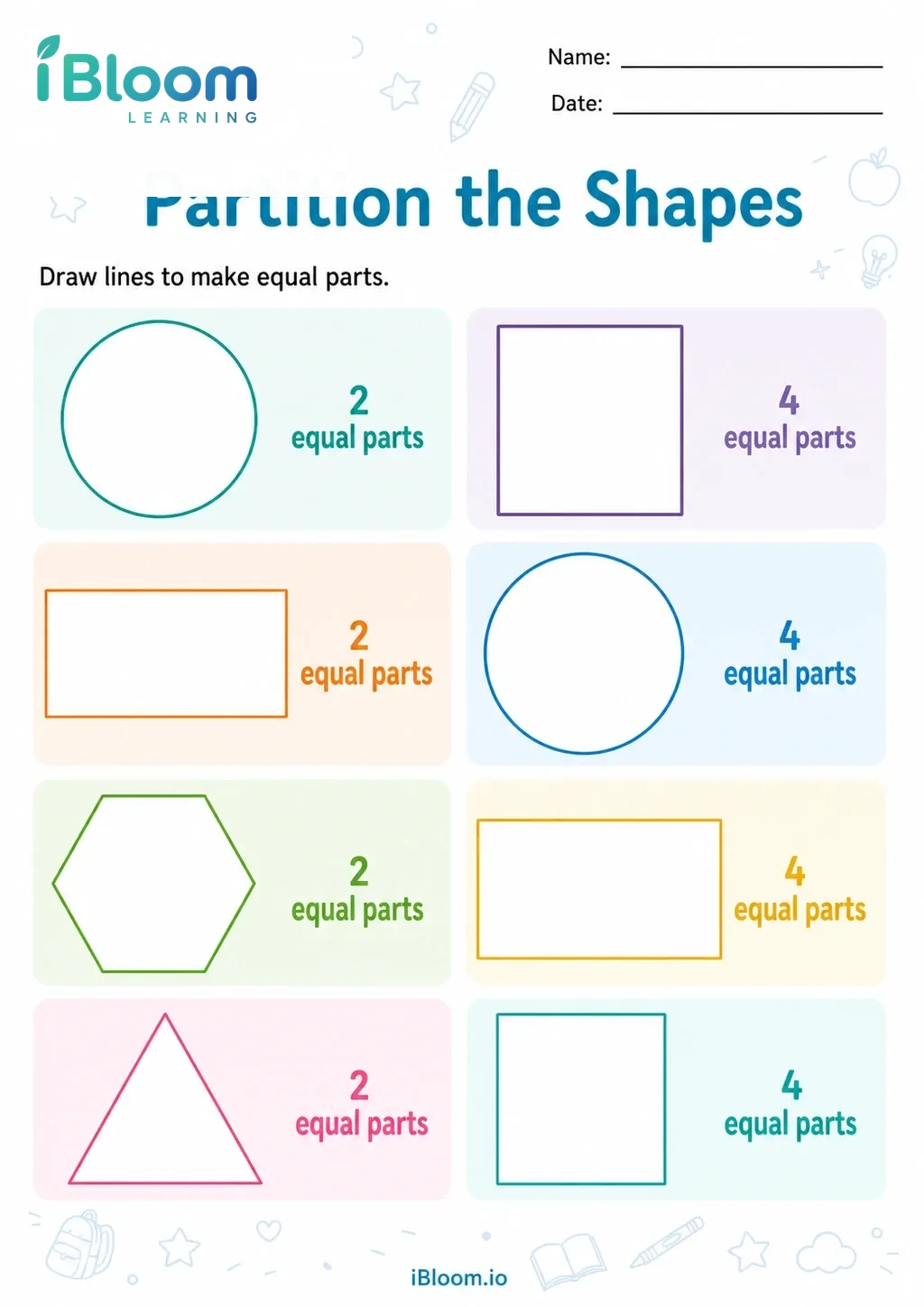
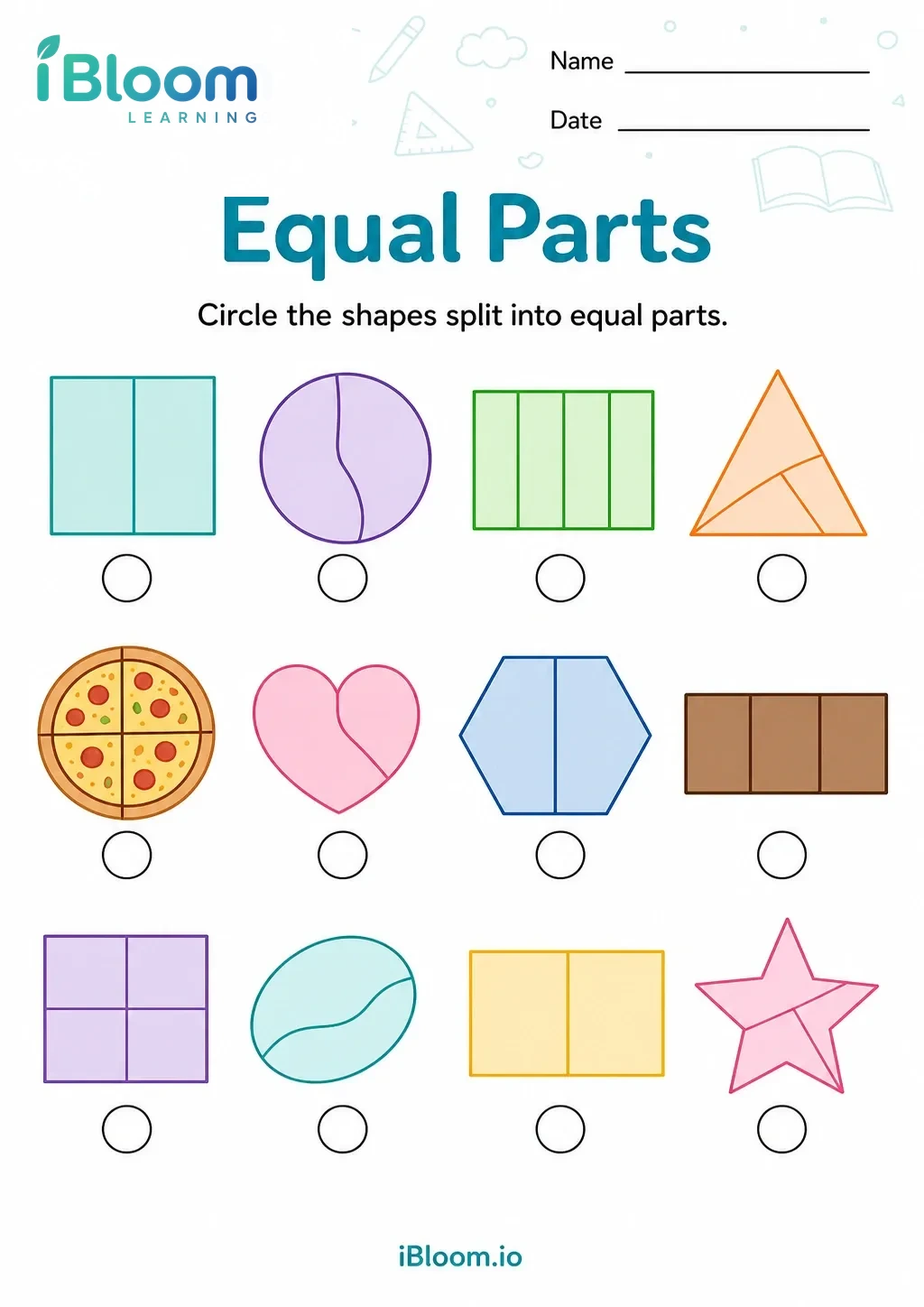
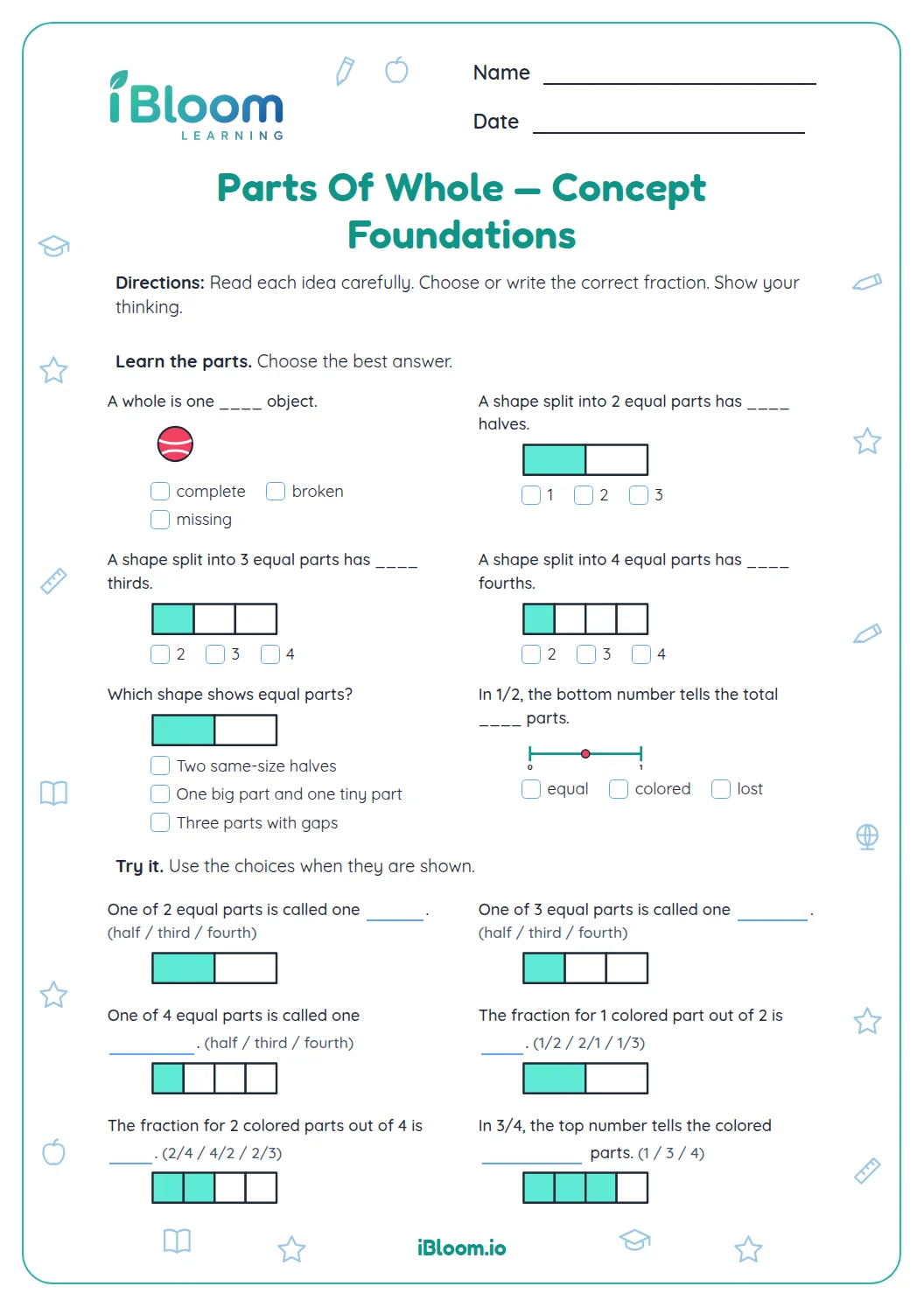
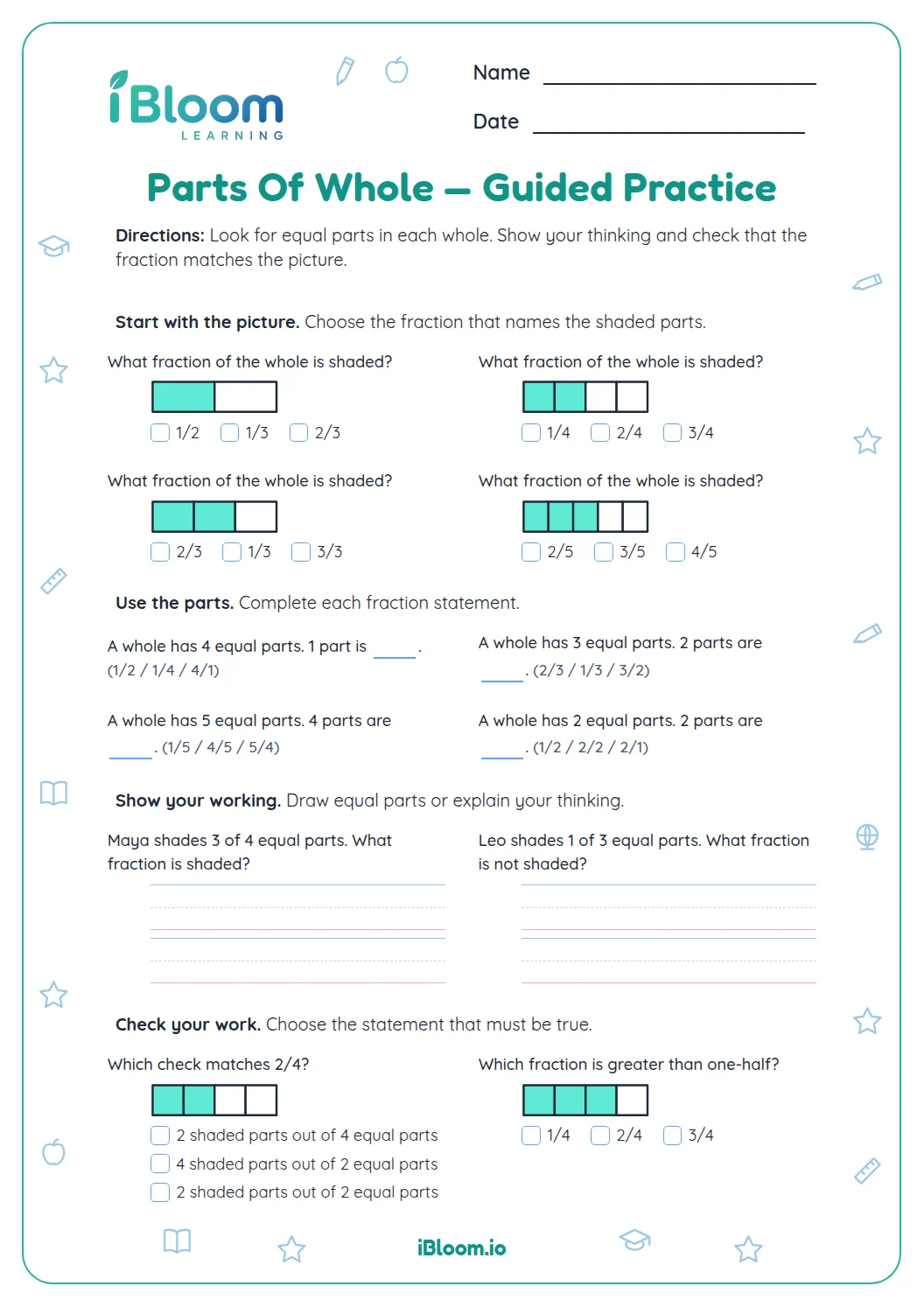

About this worksheet
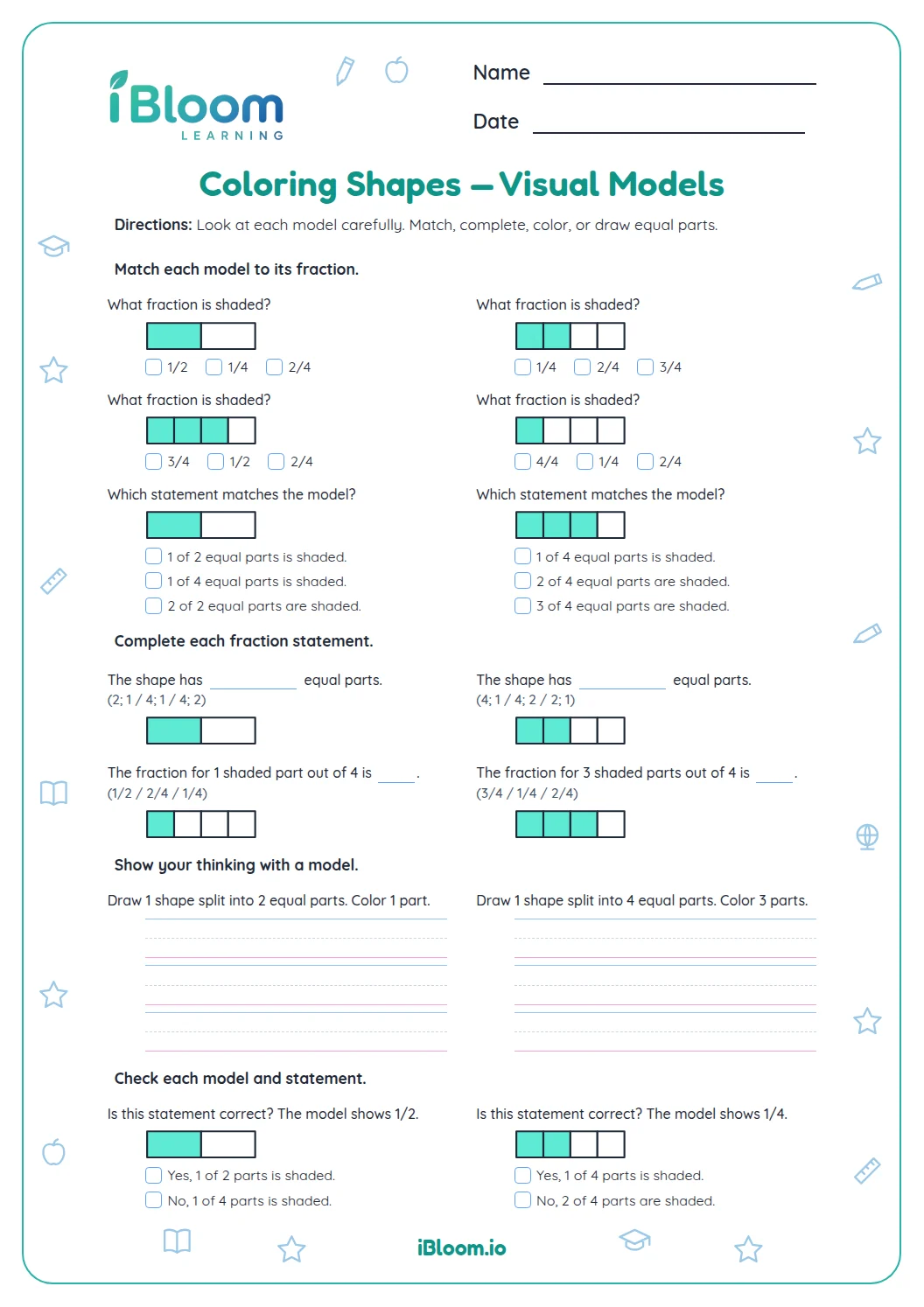
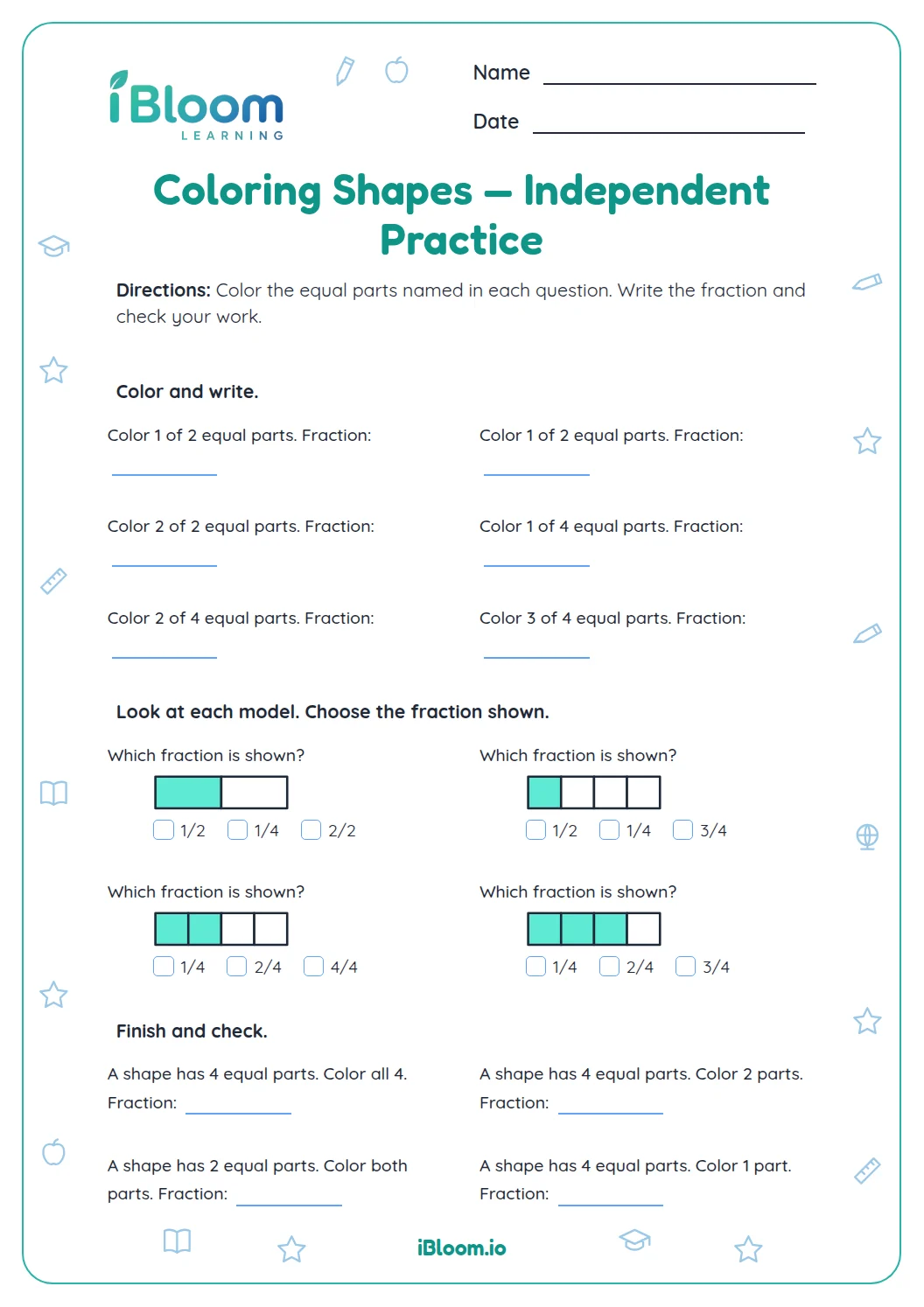
This free printable Grade 1 worksheet introduces fractions through food children already share: sandwiches, pizzas, pies and cookies. Children decide whether a cut is fair, name halves and fourths, say what the top and bottom numbers of a fraction mean, and write fractions such as 1/4 and 3/4 from a short description. It practices Common Core 1.G.A.3, partitioning shapes into two and four equal shares, and gives first practice with fraction notation. It has 13 questions, ending with one short explanation, and an answer key on separate pages. Every question is in words, so a grown-up can read each one aloud.
Aligned to 1.G.A.3
What is a fraction, for a first grader?
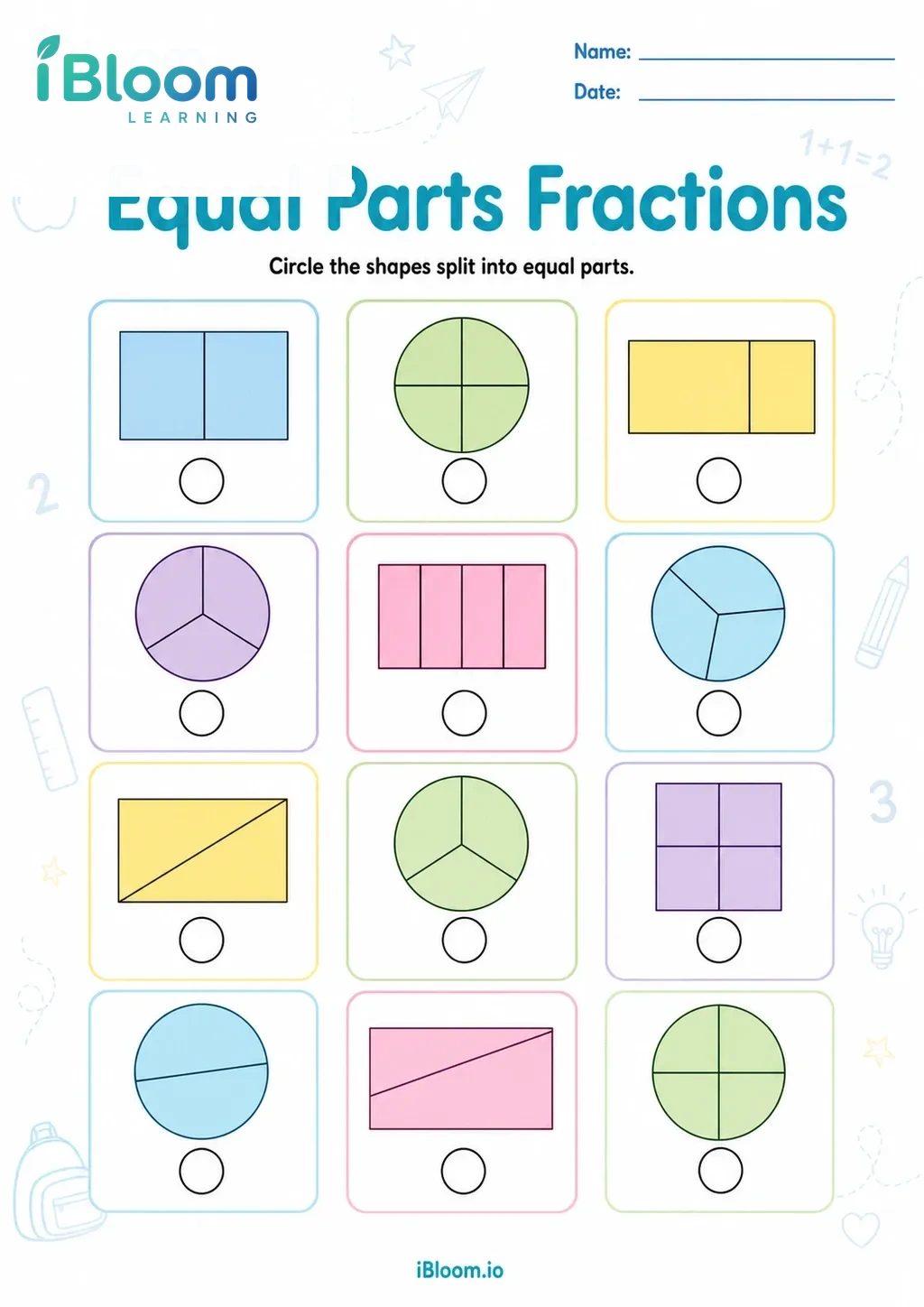
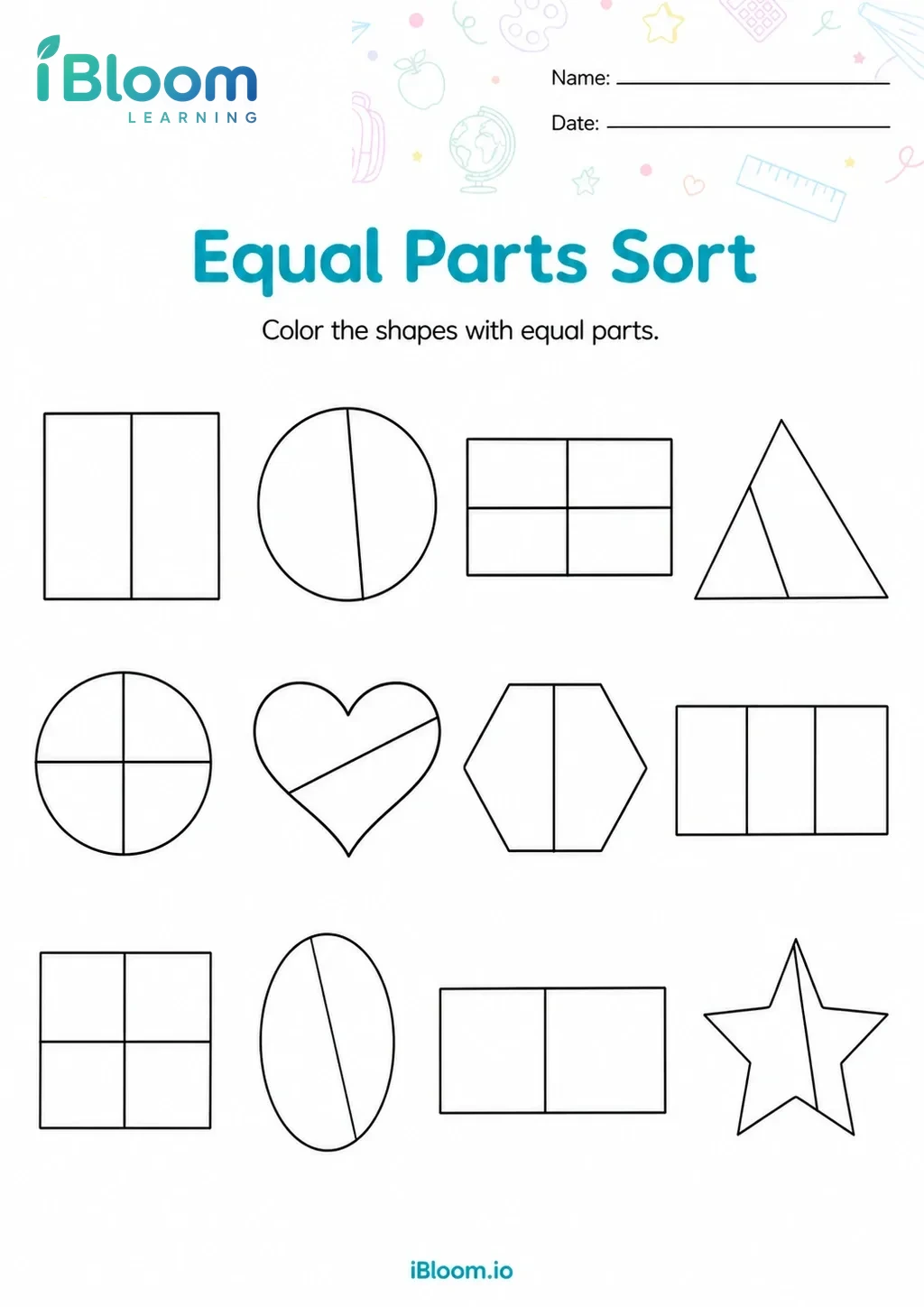
A fraction names one or more equal parts of a whole. Grade 1 children start with two kinds: halves, when a whole is cut into 2 equal parts, and fourths (also called quarters), when it is cut into 4. The word equal matters most. A cookie cut into one big piece and one small piece has two pieces, but neither is a half, which is exactly what question 13 asks children to explain.
This worksheet names halves and fourths in words and with food children know, then adds the written form, 1/2 and 1/4, so children see how the words map onto numbers.
What do the top and bottom numbers mean?
The bottom number says how many equal parts the whole is cut into. The top number says how many of those parts you are talking about. Reading the fraction 3/4 as "3 of 4 equal parts" keeps the meaning in view and avoids treating it as two unrelated numbers.
Question 3 asks what the 2 in 1/2 tells you. That gives children the language to explain a fraction before they have to write one.
- 1A pie is cut into 4 equal slices. You eat 1 slice.
- 2Bottom number: equal parts in all = 4
- 3Top number: parts you took = 1
- 4Write: 1/4
- 5Answer: 1/4, not 4/1
What is on this worksheet?
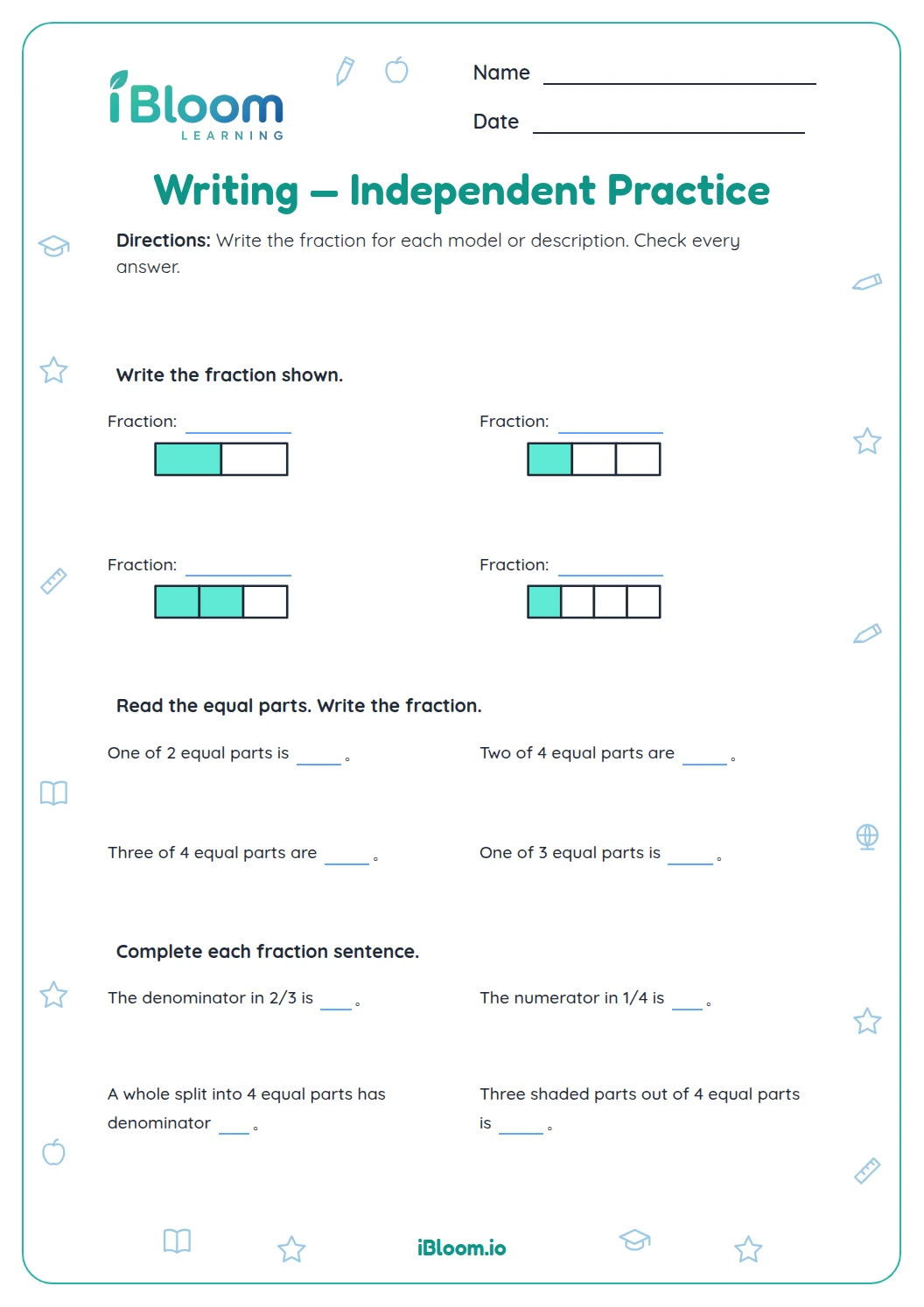
Four parts that go from ideas to writing. Part A has two questions on fair shares and the words half and fourth. Part B has four questions on reading a fraction: what the 2 in 1/2 means, naming 1/4, taking both halves to make 2/2, and whether 1/2 or 1/4 of a pizza is bigger. Part C asks children to write 1/2, 1/4, 3/4, 2/4, 4/4 and 2/2 from descriptions such as "3 of 4 equal parts." Part D asks children to judge a cookie cut into one big and one small piece and explain why the small piece is not a half.
- Part A: 2 questions on equal shares and the words half and fourth
- Part B: 4 questions on what the numbers mean, 2/2 and which is bigger
- Part C: 6 fill-in questions writing fractions with 2 or 4 equal parts
- Part D: 1 explain-why question about an unfair cut
- No pictures needed: every question is described in words
Why compare 1/2 and 1/4 of the same pizza?
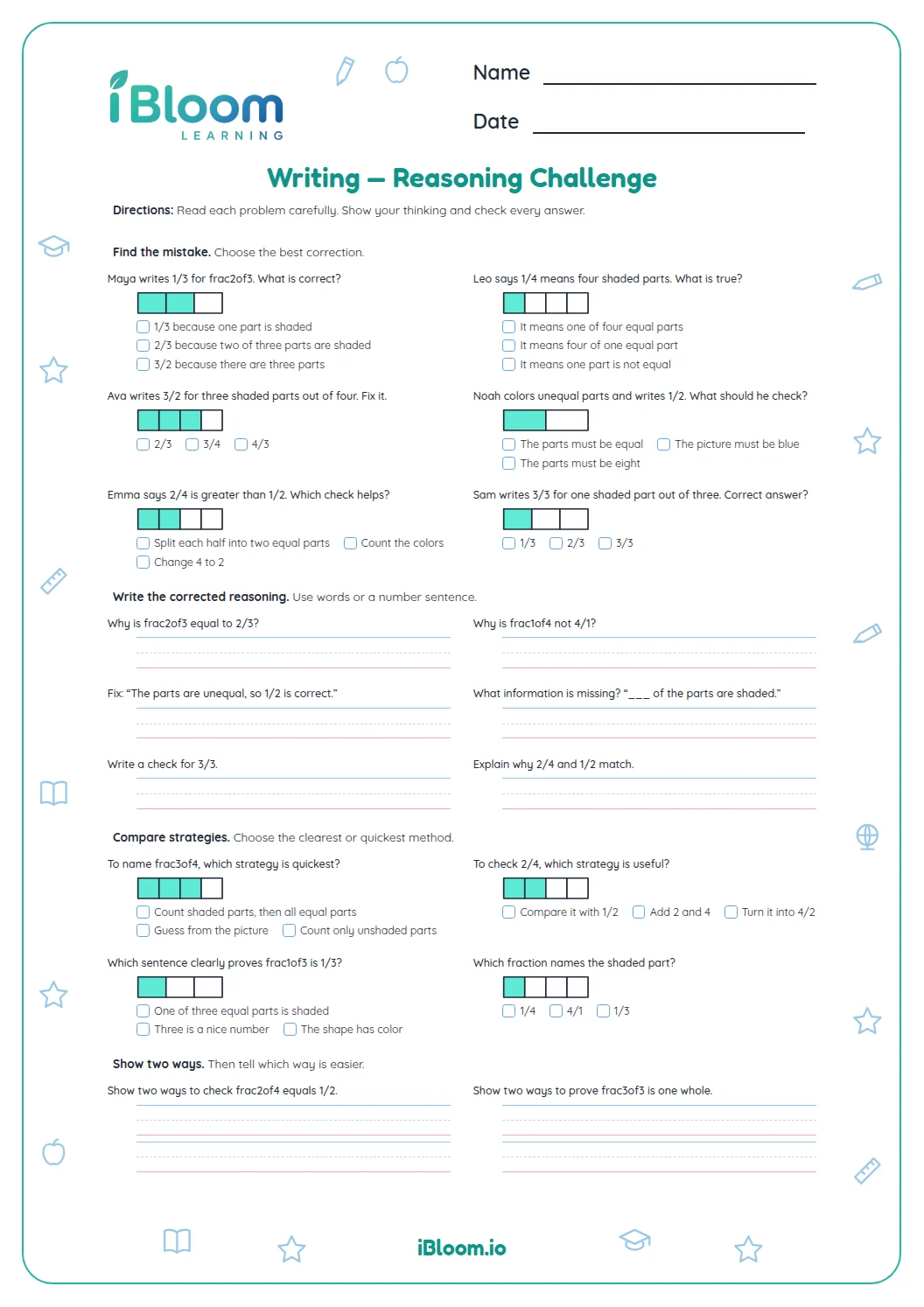
Many children think 1/4 is bigger because 4 is bigger than 2. Cutting the same whole into more equal parts makes each part smaller, and that idea is part of 1.G.A.3. Question 6 puts it in front of them: a half of a pizza is more than a fourth of the same pizza. If your child is unsure, fold a paper circle and look.
How to use this worksheet at home or in class
- 1Warm up with a real snack or a paper square. Fold it into 2 equal parts and call each a half, then fold again and call each a fourth.
- 2Read question 1 aloud and ask why equal pieces matter. Let your child explain it in their own words.
- 3Do Part B together, reading each fraction aloud as "1 of 4 equal parts" instead of "one over four."
- 4In Part C, let your child work alone, then check that every answer has the number of parts on the bottom.
- 5For question 13, cut a paper cookie into one big and one small piece and lay them side by side. Let your child say why the small piece is not a half, then write a short answer (you can write it for them).
- 6Check the answers together and fold paper again for any missed question.
Common mistakes and quick fixes
The mistake
Writing the fraction upside down, such as 4/1 for 1 out of 4 equal parts.
The fix
Say it as "how many of how many": 1 of 4. The parts you take come first on top, and the parts in all go on the bottom.
The mistake
Counting pieces without checking that they are equal, then calling any 2 pieces halves.
The fix
Hold the pieces up against each other, or fold the paper so the edges match. If they do not match, the parts are not equal, so they are not halves or fourths.
The mistake
Thinking 1/4 is bigger than 1/2 because 4 is bigger than 2.
The fix
Fold a paper circle into halves, then fold again into fourths. Lay one fourth on top of one half and see that the fourth is smaller.
Common Core alignment
Most US states use the Common Core mathematics standards or a close state version. This sheet practices the Grade 1 geometry standard below on halves and fourths.
Learn that halves and fourths are equal shares, and that more cuts make smaller shares.
On this sheet: Main standard: Parts A and B use equal shares, halves and fourths, the whole as 2/2, and the idea that more cuts make smaller shares.
Show the official wordingHide the official wording
Partition circles and rectangles into two and four equal shares, describe the shares using the words halves, fourths, and quarters, and use the phrases half of, fourth of, and quarter of. Describe the whole as two of, or four of the shares. Understand for these examples that decomposing into more equal shares creates smaller shares.
What to practice next
Make more practice
Further reading
Questions parents and teachers ask
What fractions do first graders learn?
First graders learn halves and fourths, also called quarters, by cutting circles and rectangles into 2 or 4 equal shares. They use the words half of, fourth of and quarter of. On this sheet they also write halves and fourths as fractions, such as 1/2 and 3/4.
How does this sheet help first graders write fractions like 1/4?
It uses only halves and fourths and always says the parts in words first, such as one of four equal slices, before children write 1/4. Question 3 asks what each number means. Children who need more time can do Parts A, B and D first and come back to Part C.
Why does the sheet have no pictures of shaded shapes?
Every question is described in words, such as "a pie cut into 4 equal slices," so a grown-up can read each one aloud while children picture the pie themselves. For children who need to see a model, fold a paper square or circle beside the sheet and shade the parts as you go.
What are the answers to Part C?
The six blanks are 1/2, 1/4, 3/4, 2/4, 4/4 and 2/2. Each puts the number of equal parts on the bottom and the parts taken on top. The answer key lists every answer, including a model answer for the cookie question at the end.
What is a good answer to the cookie question?
Max is not right, because his two pieces are not equal. A half is one of 2 equal parts, so a small piece of an unevenly cut cookie is less than 1/2. Any answer that says the pieces are not the same size is correct, written or said aloud.
How long does the worksheet take, and is there an answer key?
Most first graders need about 15 to 20 minutes, a little longer if a grown-up reads each question aloud and talks about it. There is an answer key on separate pages that lists the correct choice or fraction for every question. You can split it by doing Parts A and B first.