Free printable practice
Geometry Practice Activities
Grade 1 geometry worksheets for naming, identifying, drawing, moving, scaling, and comparing 2D and 3D shapes.
Explore Geometry
Free printable worksheet PDFs
Preview every available page, then download the free worksheet PDF for home, homeschool, tutoring, or classroom practice.
Preview the exact activity before downloading it.
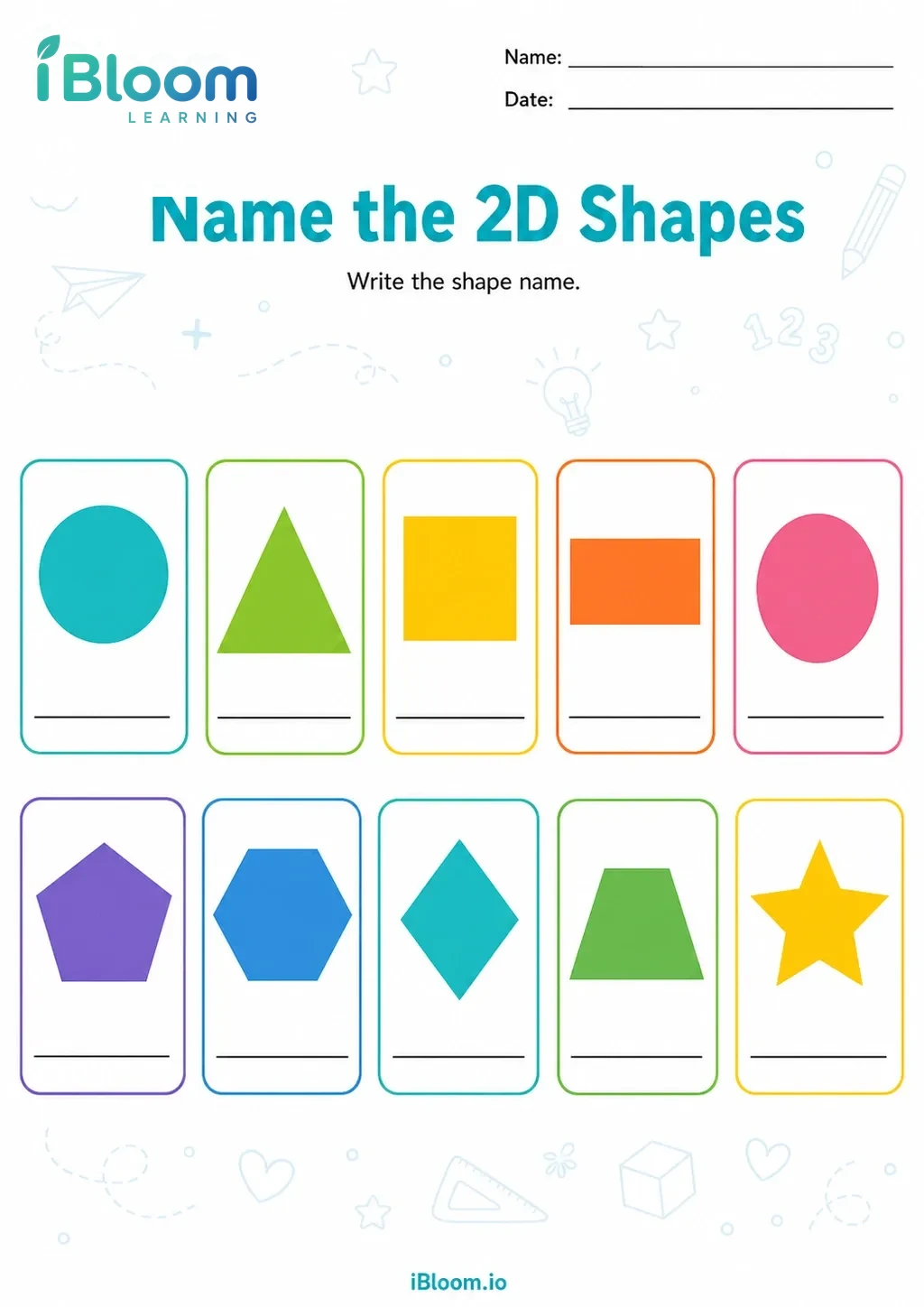 Name the 2D ShapesA Grade 1 geometry worksheet where children name common 2D shapes from pictures.Grade 1Free PDF preview
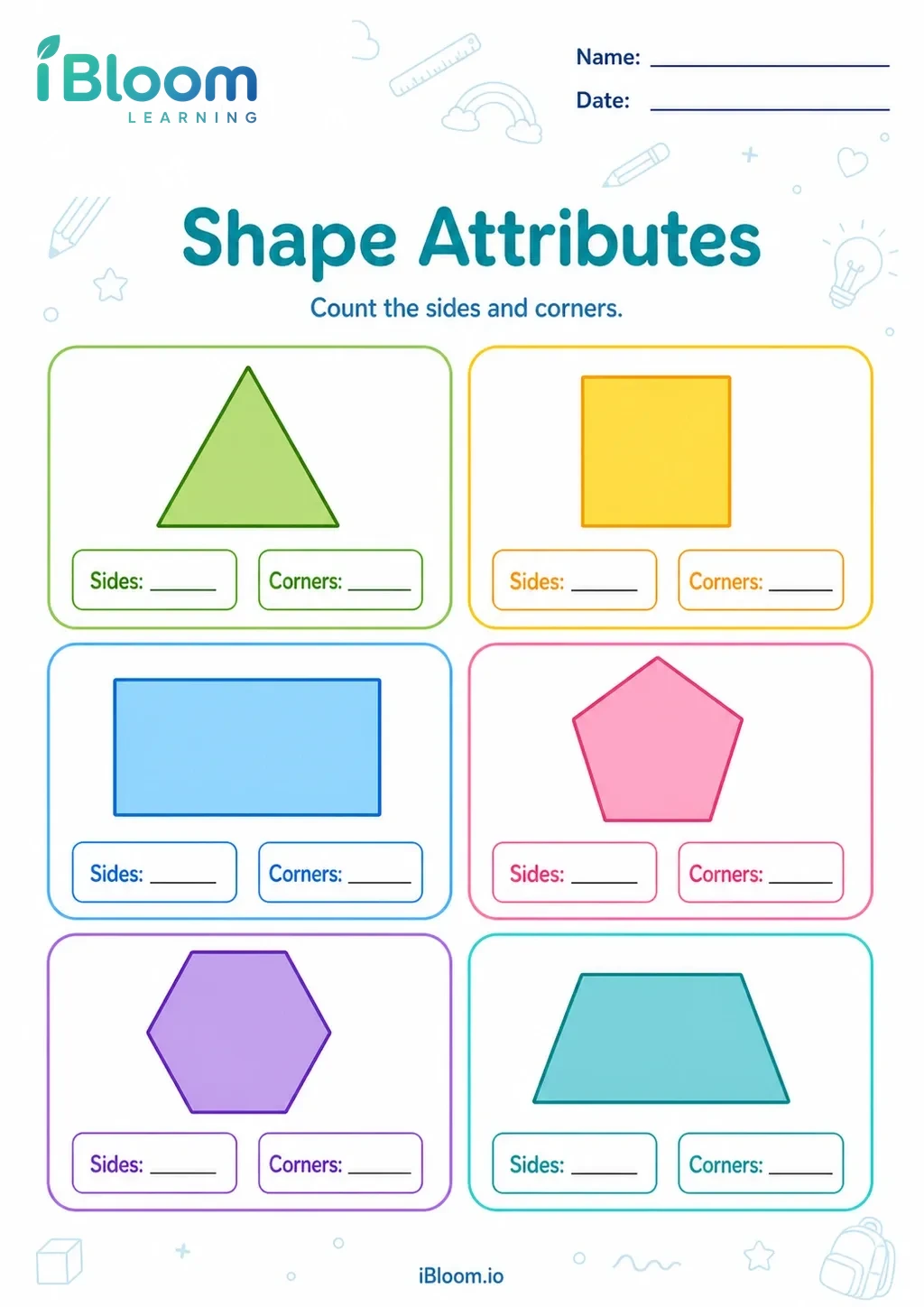 Shape AttributesA Grade 1 geometry worksheet where children count sides and corners of common two-dimensional shapes.Grade 1Free PDF preview
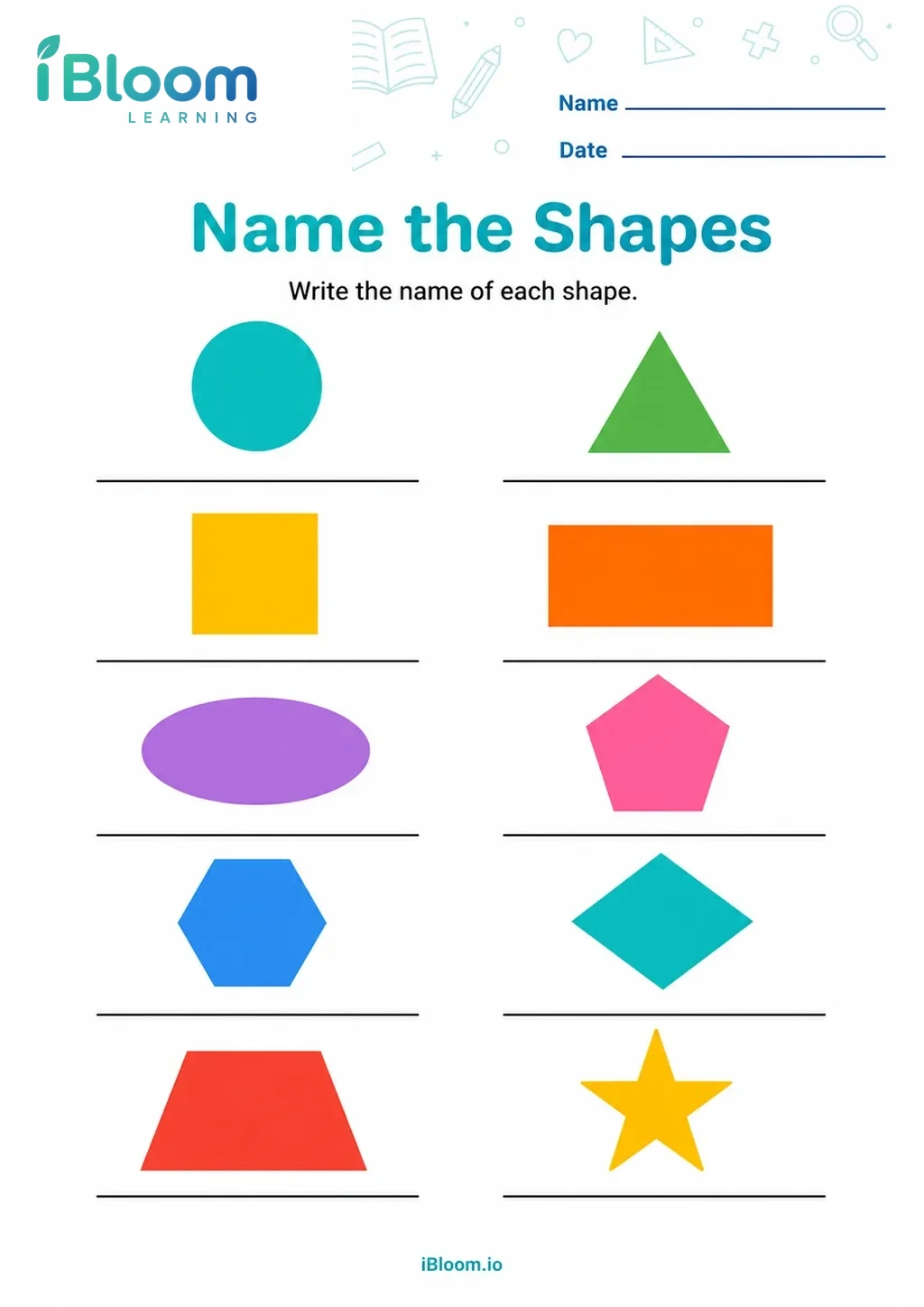 Name the ShapesA Grade 1 geometry worksheet where children write the names of common 2D shapes.Grade 1Free PDF preview
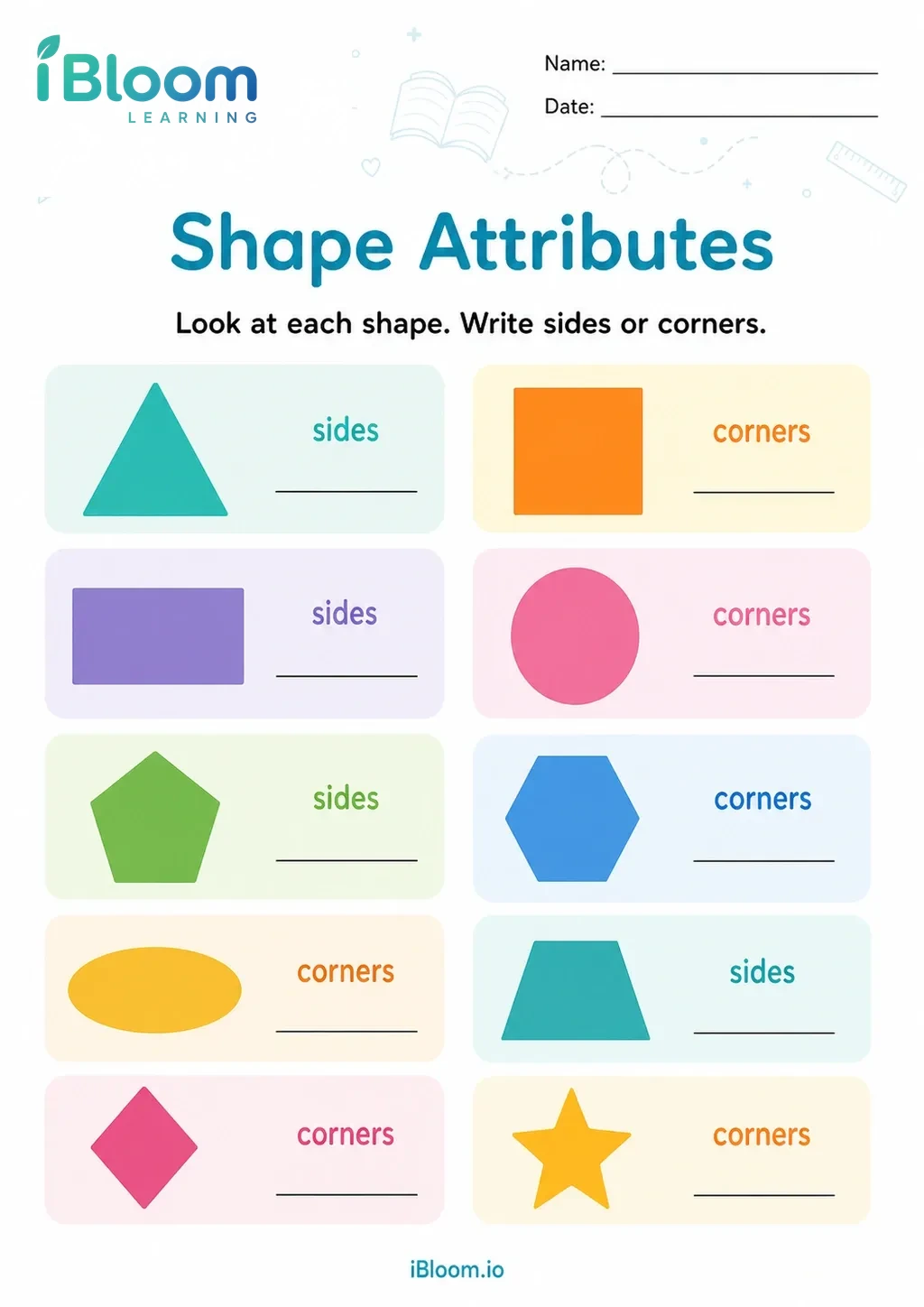 Shape AttributesA Grade 1 geometry worksheet for identifying sides and corners of common 2D shapes.Grade 1Free PDF preview
Practice that builds confidence
Geometry ideas in Grade 1
These Grade 1 geometry practice activities help children describe where objects are, name common shapes, identify flat and solid figures, and notice how shapes can be drawn, turned, mirrored, or resized.
The printable worksheets include position tasks, shape-name practice, 2D drawing, 3D shape recognition, mirror-image symmetry, rotation activities, and simple scale changes so children build visual reasoning step by step.
Geometry at this level is about seeing, naming, comparing, and describing. Children practise position words such as above, below, beside, between, left, right, in front of, and behind. They also learn that a shape can be identified by its features, not by its color, size, or direction on the page.

Flat and solid shapes
The worksheets move between 2D shapes and 3D shapes so children can compare what is flat with what has faces, edges, or curved surfaces. A child may identify a circle, triangle, square, or rectangle in one activity, then look for a cube, cone, cylinder, sphere, or rectangular prism in another. Drawing 2D shapes gives extra practice with straight sides, corners, and curved lines.
Positions, flips, turns, and size
Mirror-image symmetry activities ask children to look carefully at matching halves. Rotate 2D shapes tasks help them understand that a shape can turn and still be the same shape. Scale 2D shapes activities introduce the idea of a shape becoming larger or smaller while keeping the same general form. These visual changes strengthen spatial awareness and attention to detail.
Parent routine and child strategy
At home, choose one worksheet and add a quick object hunt. Ask, “Can you find something shaped like this?” or “Put the pencil beside the book, then behind it.” Watch for common errors: calling every four-sided shape a square, confusing left and right, or thinking a tilted triangle is a different shape. A helpful child strategy is: look, name the parts, then check the position or turn.

Classroom uses for teachers
Teachers can use these pages for math centers, morning work, partner sorting, small-group review, or quick checks after a geometry lesson. Students can trace, circle, match, draw, and explain their choices. The variety supports children who need more practice with vocabulary as well as children ready to compare shapes in different orientations.

Free printable PDF download
Use this grade 1 geometry worksheet page to preview the activity, print it, or download it as a PDF for quick practice. It works well for homework, homeschool lessons, tutoring, morning work, revision, and classroom centers.
Answers and answer key support
After the child completes the worksheet independently, parents and teachers can use the answer support or answer key information to check the work, review mistakes, and choose the next practice step.
Why iBloom worksheets help
The iBloom collection is organized around specific Grade 1 geometry skills rather than mixed, unfocused practice. Children meet the same idea in several forms—pictures, drawings, matching tasks, and spatial puzzles—so they build confidence while learning precise geometry vocabulary.
Helpful answers
Frequently asked questions
What geometry skills are covered in these Grade 1 worksheets?
They cover positions, shape names, identifying 2D and 3D shapes, drawing 2D shapes, mirror-image symmetry, rotating 2D shapes, and simple scaling of 2D shapes.
How can I help my child tell 2D and 3D shapes apart?
Use simple language: 2D shapes are flat drawings, while 3D shapes are solid objects. Point to classroom or home items such as a ball for a sphere, a can for a cylinder, and a box for a rectangular prism.
Why does my child still miss shapes when they are turned sideways?
Many first graders rely on the familiar upright view of a shape. Rotation activities help them notice features such as sides and corners so they can recognize the shape even when it is turned.
Are the position worksheets only about left and right?
No. They also practise words such as above, below, beside, between, in front of, and behind, which help children describe location clearly.
How should teachers use these geometry activities in class?
They work well in math centers, small groups, warm-ups, partner practice, or review after lessons on shapes, position language, symmetry, and spatial reasoning.
Is this grade 1 geometry worksheet free?
Yes. You can preview it for free and use the printable worksheet for home or classroom practice.
Can I download this grade 1 geometry worksheet as a PDF?
Yes. Use the worksheet download option to save a printable PDF, or print the worksheet directly from the page.
Does this grade 1 geometry worksheet include answers or an answer key?
When the activity has fixed answers, iBloom includes answer support so parents and teachers can check the completed worksheet.