

About this worksheet
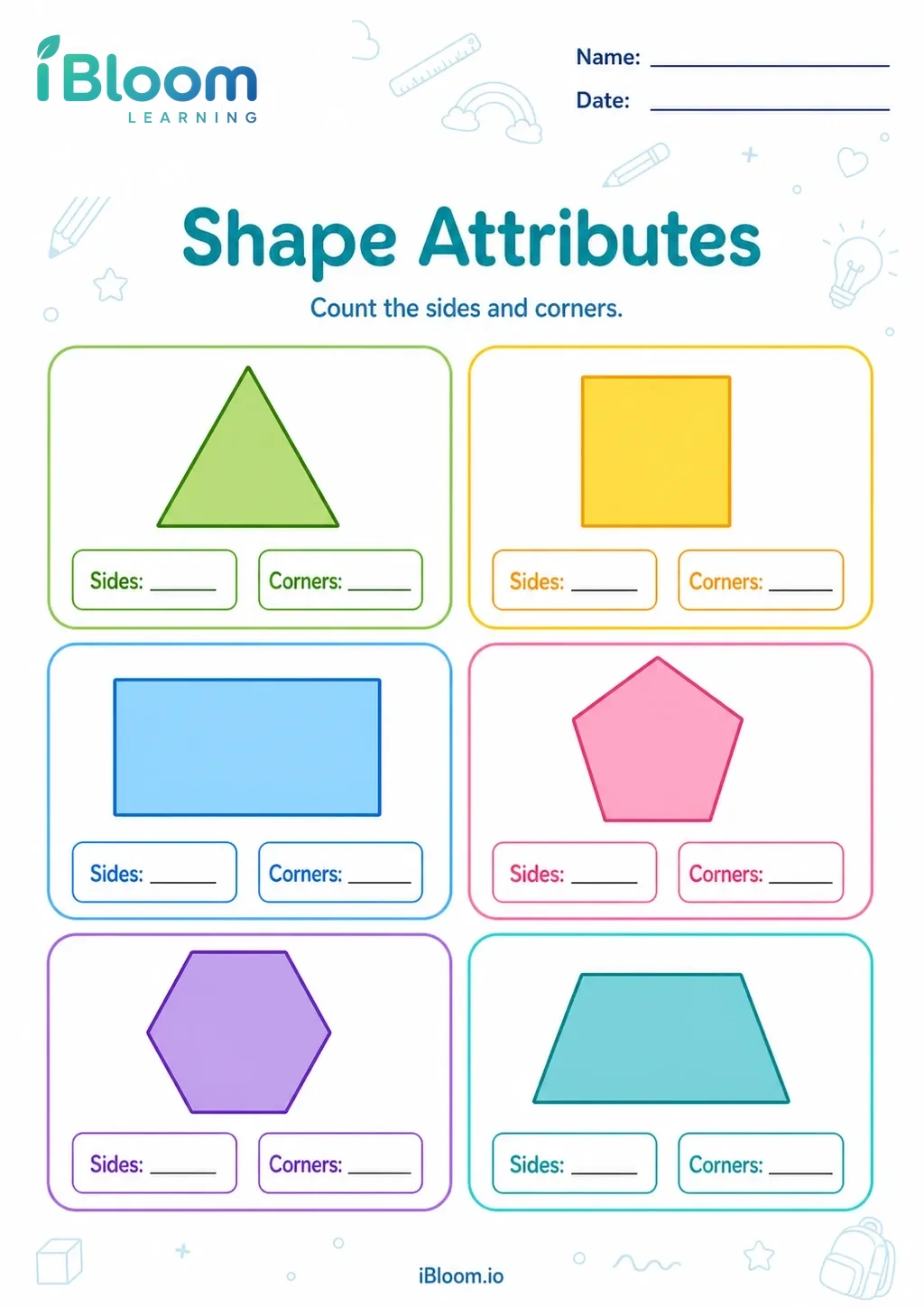
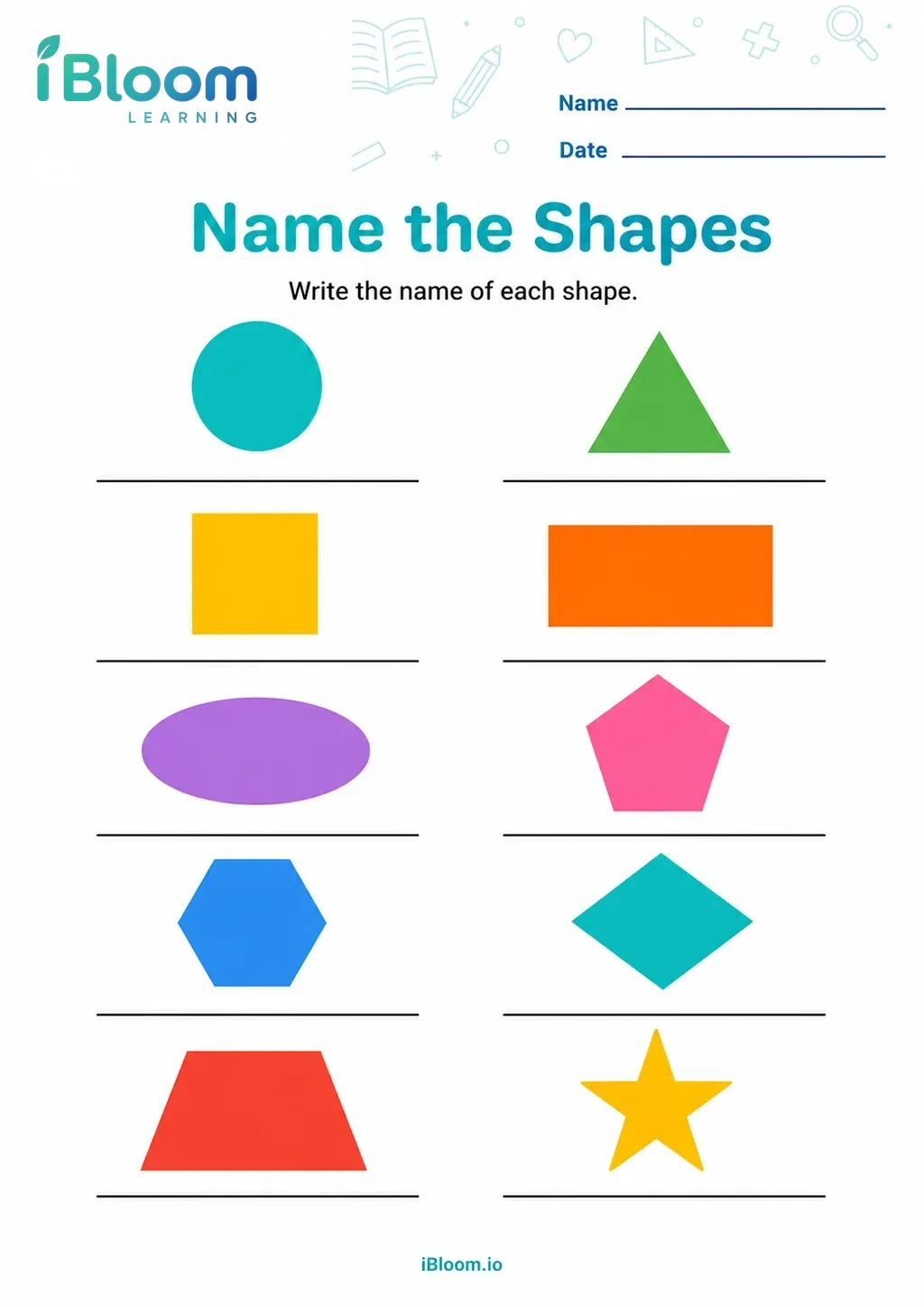
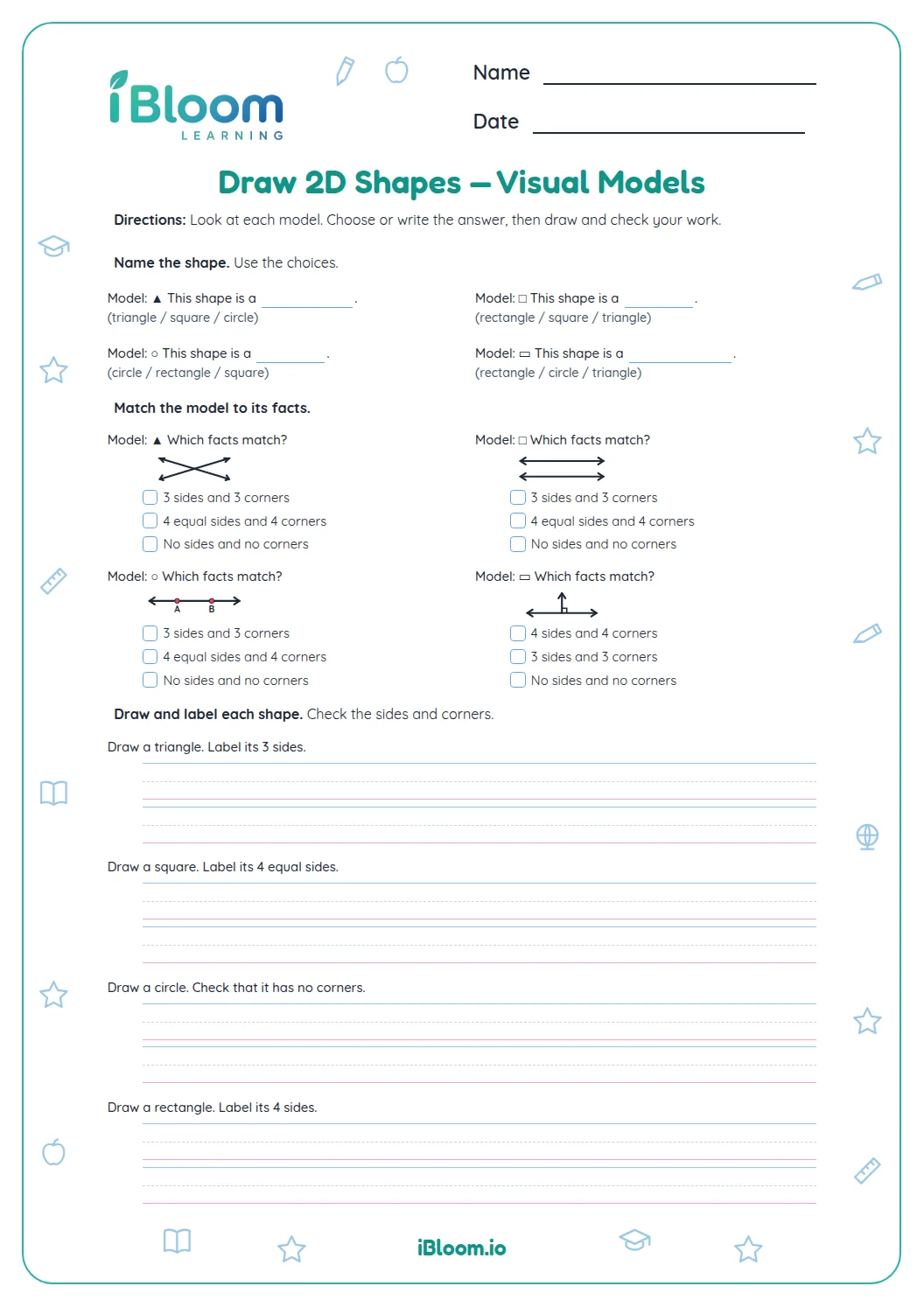
Look around each shape’s outline. Count straight sides and corners, then use those features to identify a triangle, square, rectangle, or circle. The questions use familiar shape names and one short response at a time.
Aligned to 1.G.A.1
How do you count sides and corners?
Trace the outline with your eyes. Count each straight edge once for sides and each place where edges meet for corners. A triangle has 3 sides and 3 corners; a circle has no straight sides or corners.
How can features help name a shape?
Use the number of straight sides and corners as clues. A square and rectangle each have 4 sides and 4 corners. A triangle has 3 of each.
What will you practice?
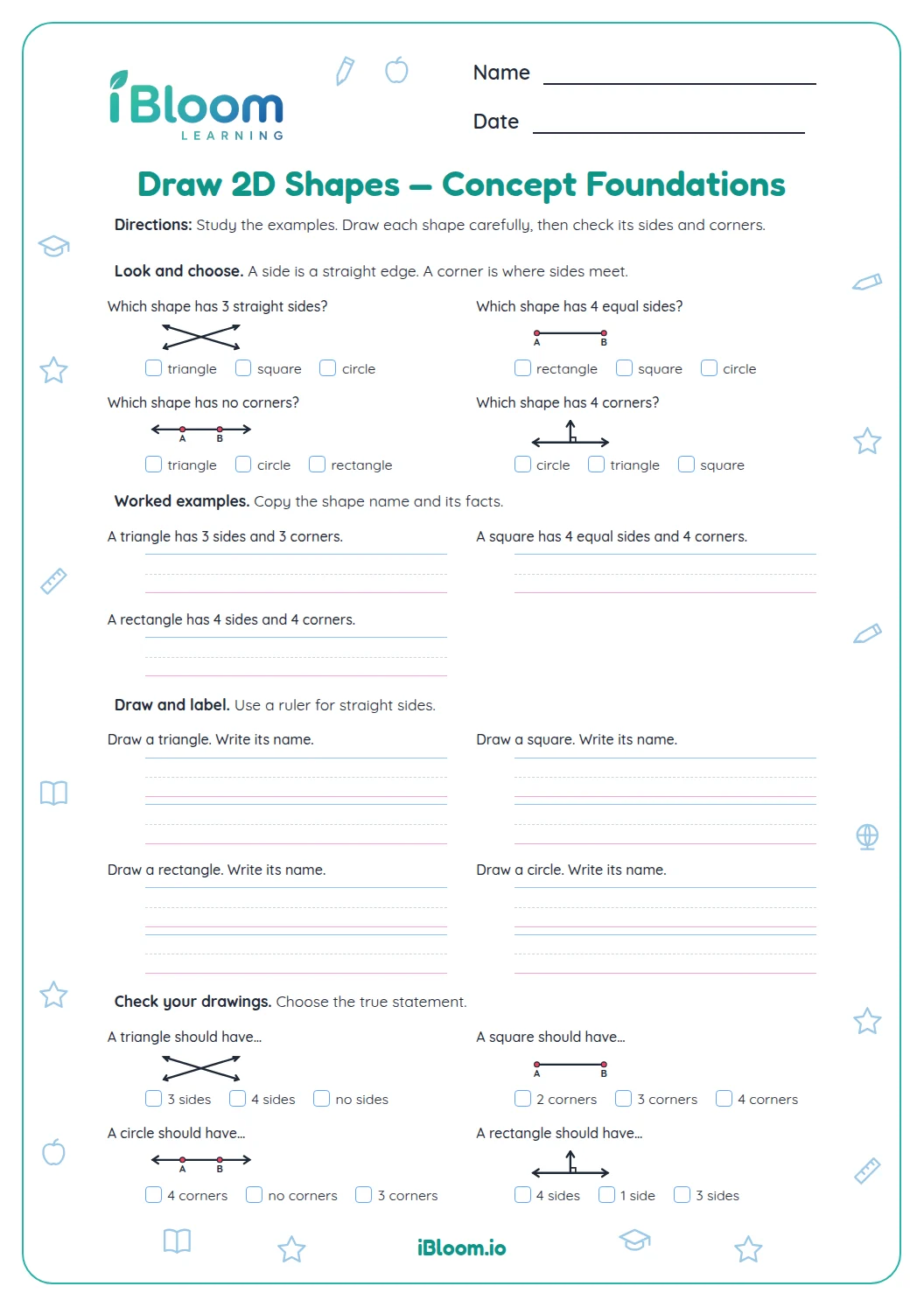
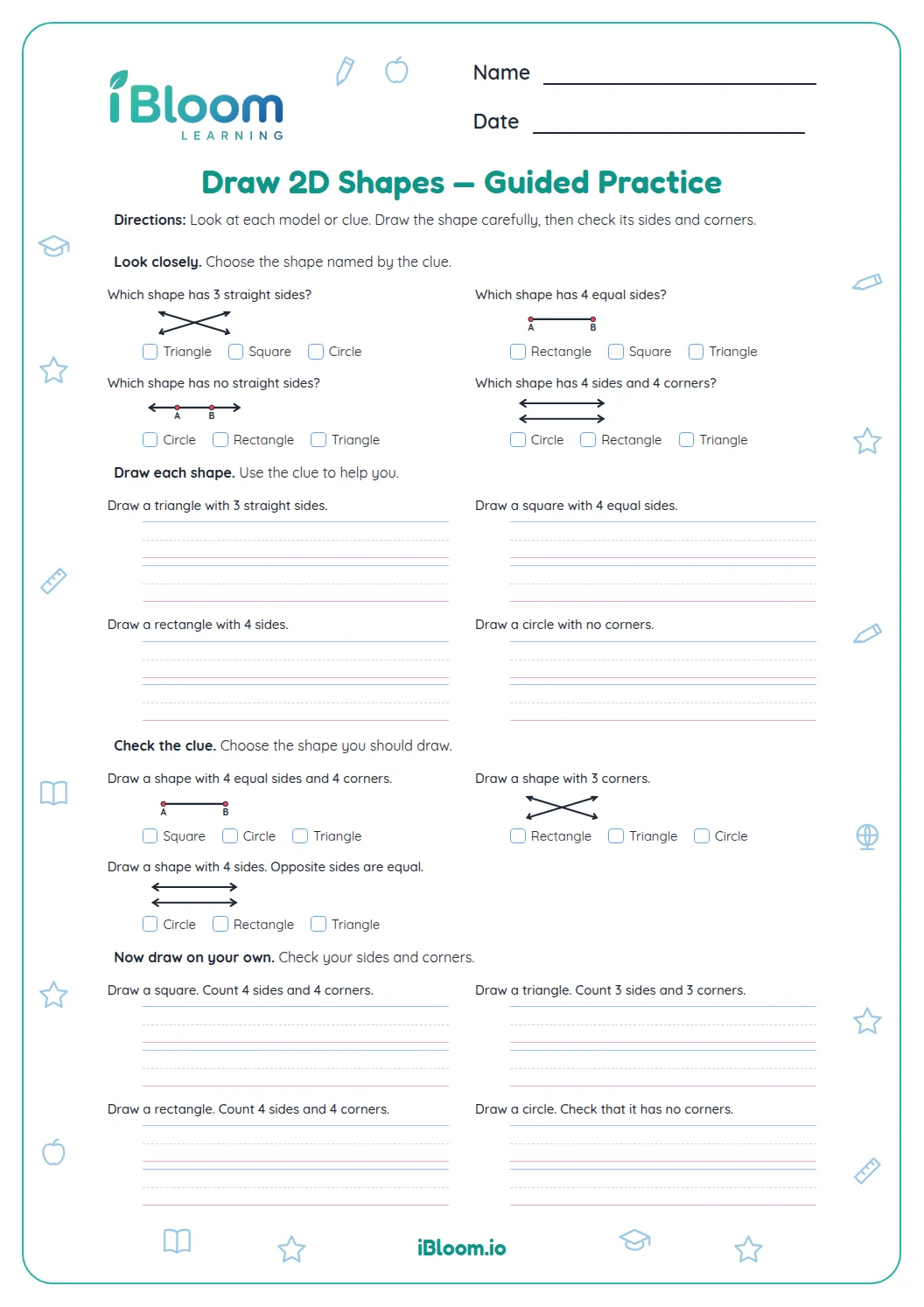
Part A counts sides and corners. Part B names shapes from clues. Part C checks familiar features, and Part D uses the clues to identify or compare shapes.
How to use this worksheet
- 1Read the shape named in the prompt.
- 2Trace its outline in your mind.
- 3Count each straight side once, then count the corners.
- 4For a blank, write the count or name a shape that fits.
- 5Use the answer key to check your responses.
Common mistakes and quick fixes
The mistake
Counting the same side twice at a starting point
The fix
Begin at one corner and move around the outline until you return to it.
The mistake
Calling a curved edge a straight side
The fix
A circle has a curved boundary, but no straight sides or corners.
The mistake
Naming a shape by how it is turned
The fix
Turned shapes keep the same number of sides and corners.
Common Core alignment
This worksheet practices the following Common Core skill.
Recognize and describe defining attributes of common two-dimensional shapes.
On this sheet: Learners identify shapes by their sides and corners and compare shared attributes.
Show the official wordingHide the official wording
Distinguish between defining attributes (e.g., triangles are closed and three-sided) versus non-defining attributes (e.g., color, orientation, overall size); build and draw shapes to possess defining attributes.
What to practice next
Make more practice
Further reading
Questions parents and teachers ask
What is a corner on a shape?
A corner is a point where two straight sides meet. A square has four such meeting points. Children can trace around the outline and pause at each point to count the corners once. Have the learner point to the relevant detail before using the answer key to check.
How many sides and corners does a triangle have?
A triangle has three straight sides and three corners. The worksheet asks for these counts and uses the number of corners as a clue for naming a triangle. Count each side and meeting point once. The count stays the same when a shape turns.
Does a circle have a side?
For this worksheet, children count straight sides and corners. A circle has no straight sides and no corners because its boundary is curved all the way around. Have the learner point to the relevant detail before using the answer key to check.
What is alike about squares and rectangles?
A square and a rectangle each have four straight sides and four corners. The last question asks students to fill in both shared counts. A good response is 4 sides and 4 corners. Students can compare the two counts directly.
How many questions are included?
The sheet has 16 questions in four parts. Children count sides and corners, name familiar shapes from feature clues, and compare shape attributes. The separate answer key gives the count or shape name for each item and a sample response where a response may vary.
How can I help a child who loses count?
Have the child start at one corner and move a finger around the shape in one direction. Count each side while moving between corners, then count the corners in the same order. A second pass can confirm the total. Have the learner point to the relevant detail before using the answer key to check.