


About this worksheet
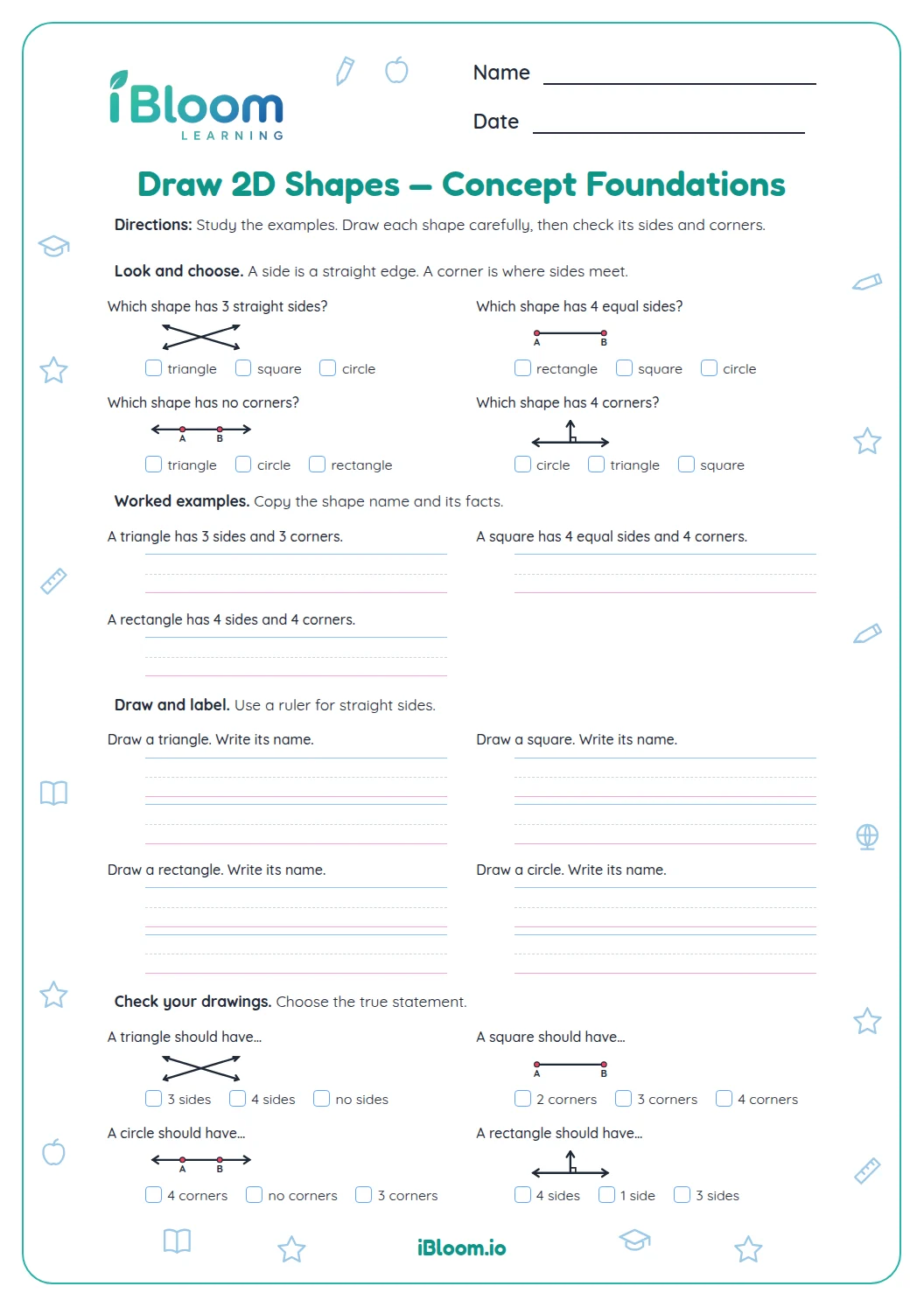
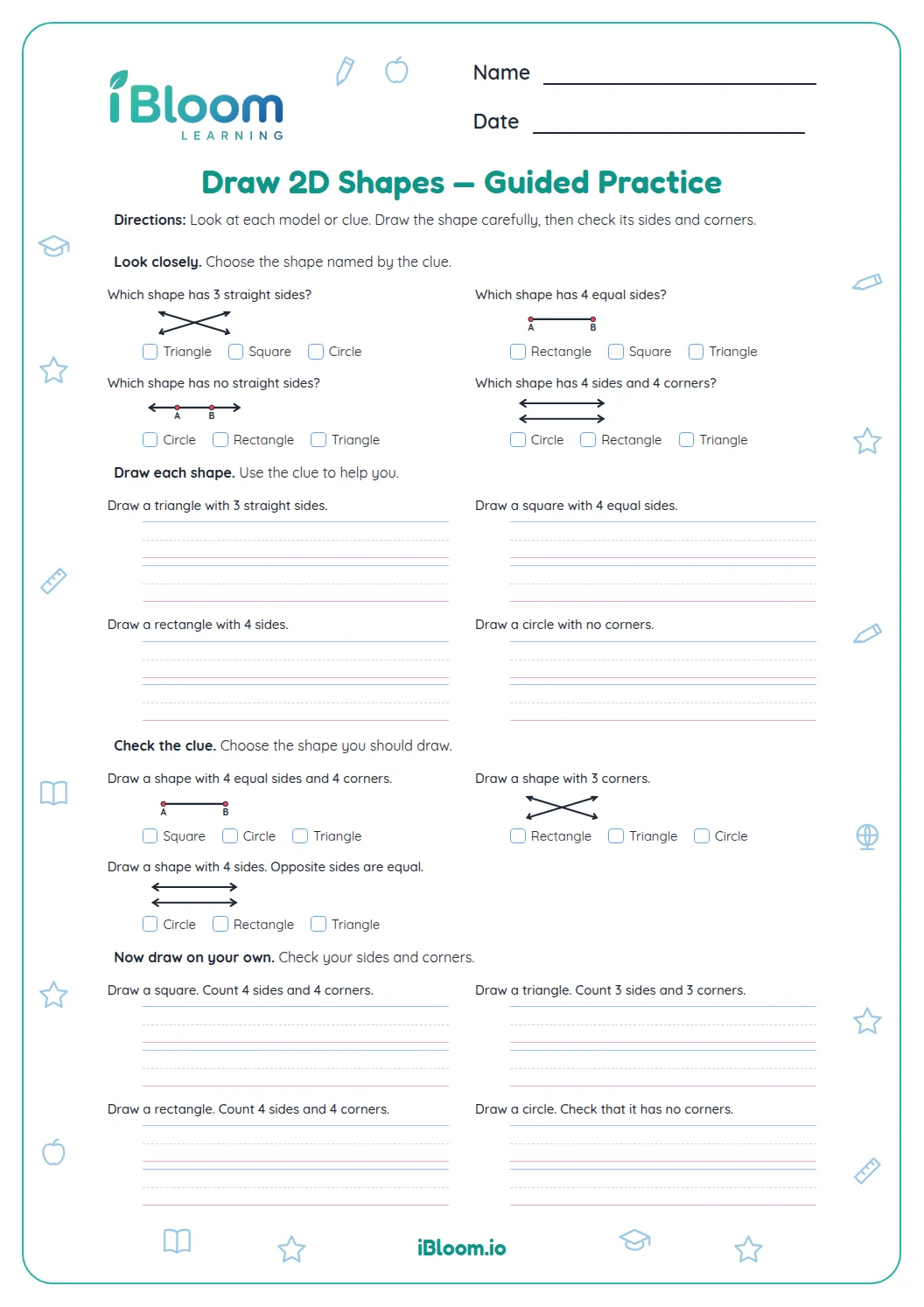
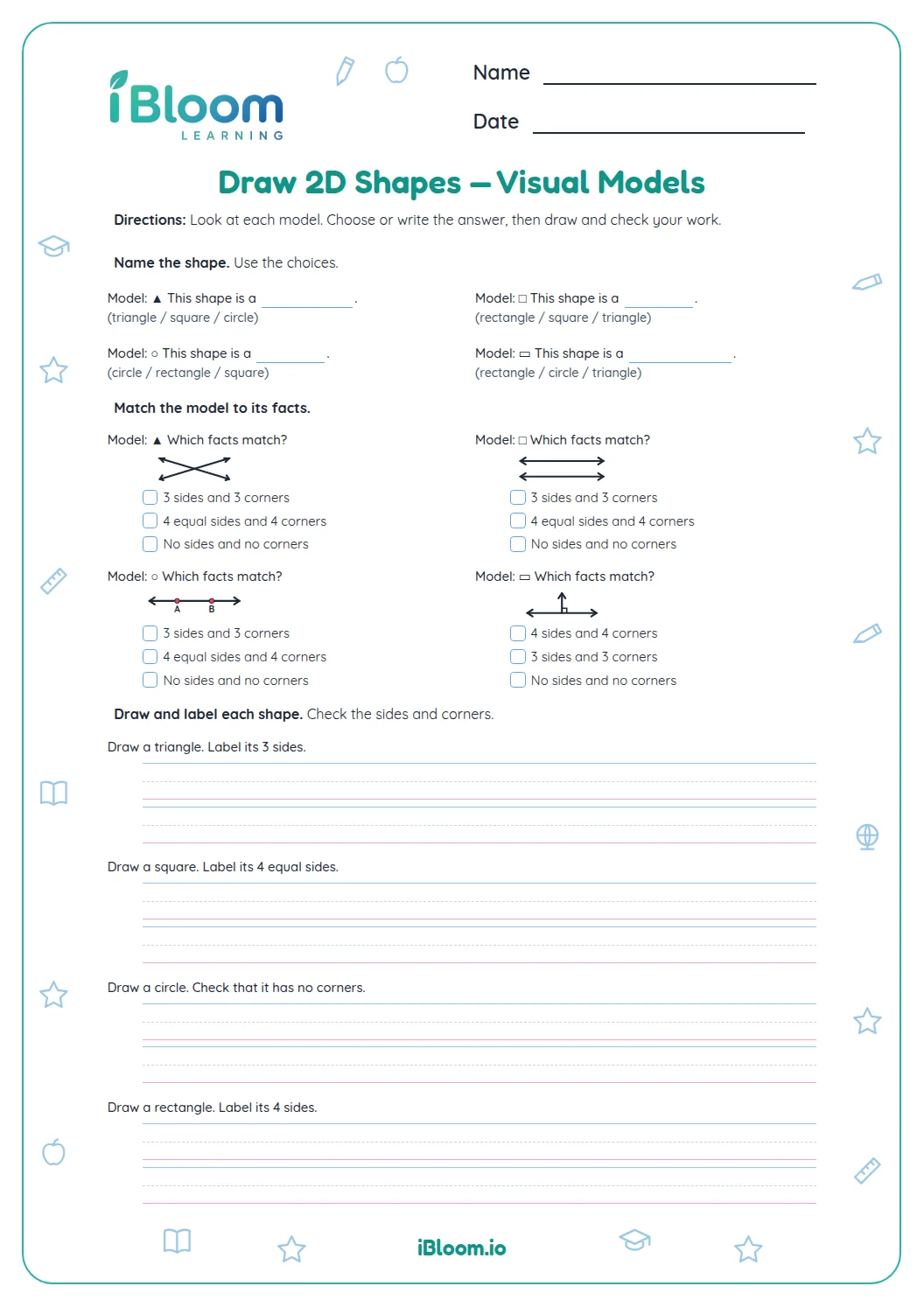
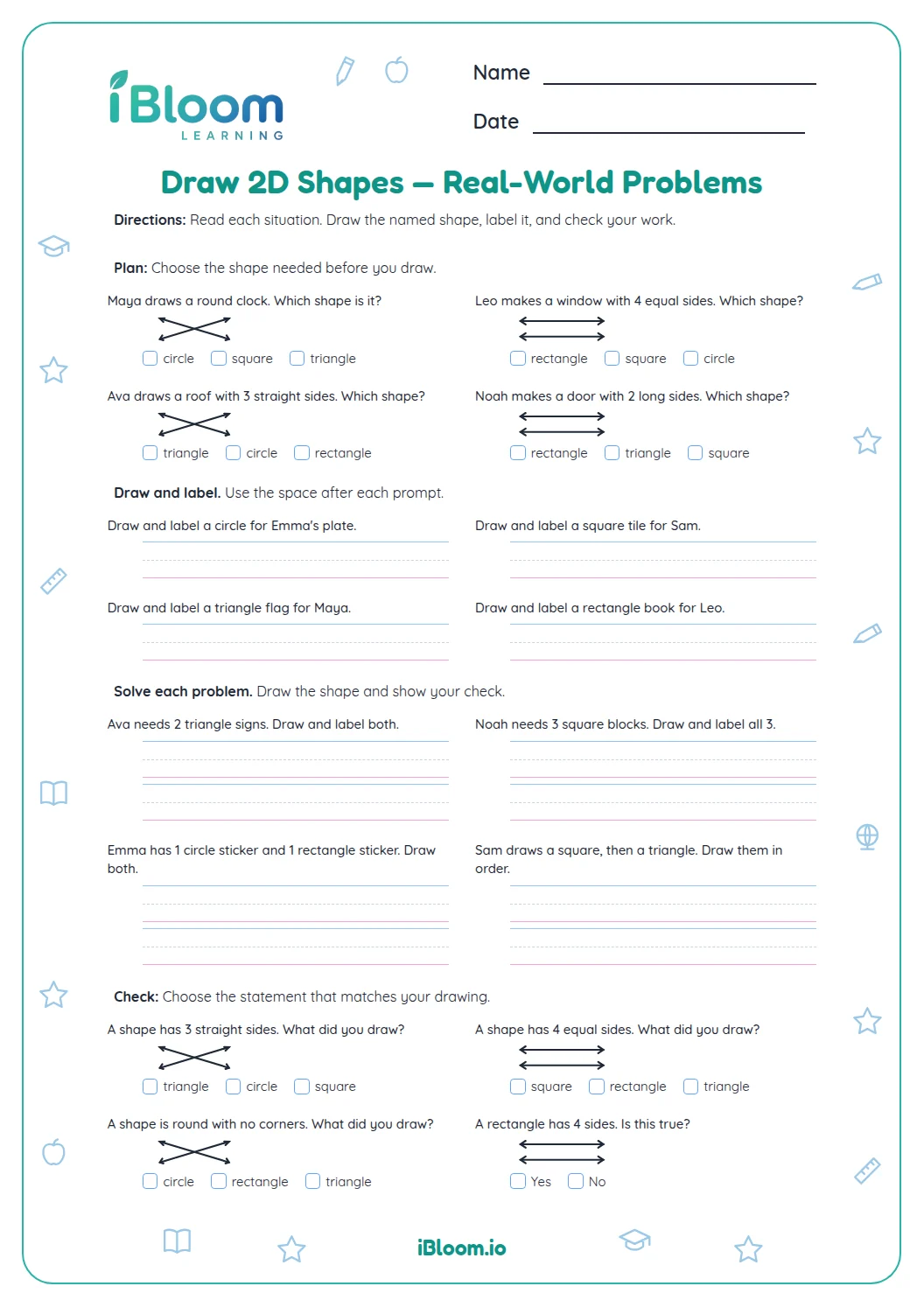
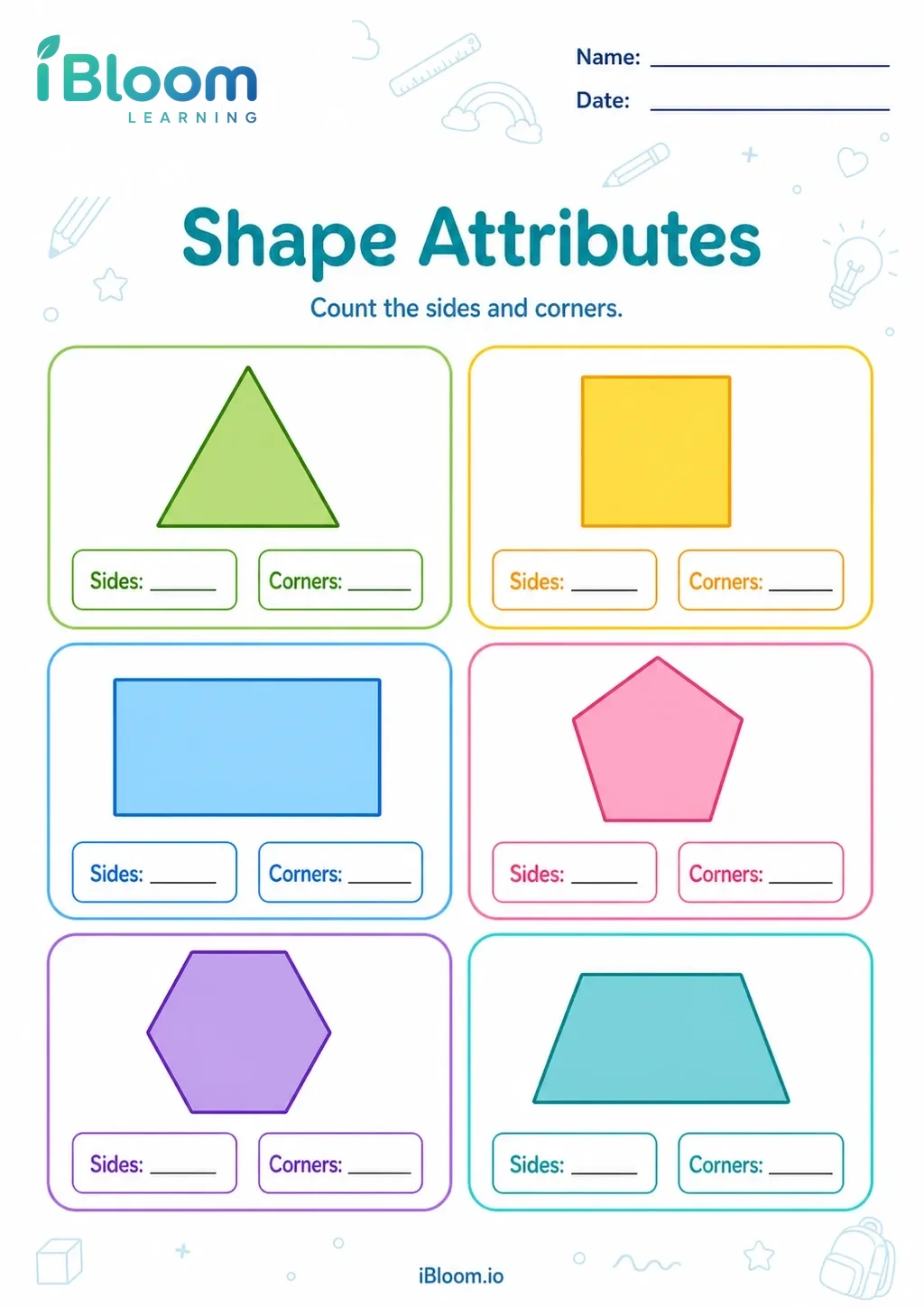
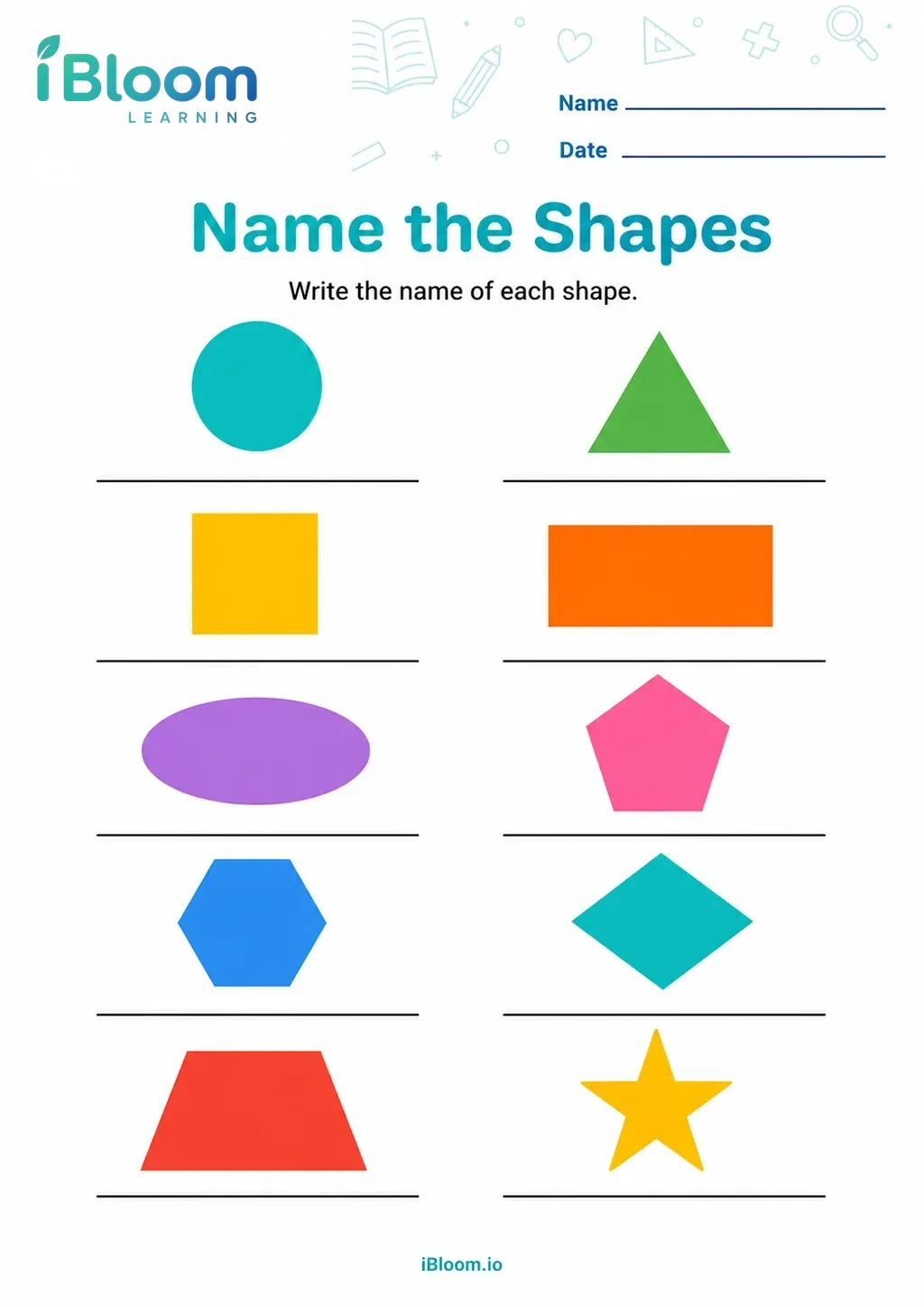
This Grade 1 printable gives children 14 ways to draw and recognize two-dimensional shapes. They draw a triangle, square and rectangle, identify shapes from side-and-corner clues, and consider how position or color leaves defining features unchanged. The page practices Common Core 1.G.A.1 and includes a separate answer key with shape names and feature checks.
Aligned to 1.G.A.1
What makes a shape a triangle or a square?
Use defining features: count straight sides and corners. A triangle has three of each; a square has four equal sides and four square corners. Color and direction do not change the shape.
- 1Count the straight sides: 3.
- 2Count the corners: 3.
- 3A closed shape with 3 sides is a triangle.
How do sides and corners help identify a shape?
Count straight sides and corners rather than looking at color or direction. A triangle has three sides and three corners; turning a rectangle does not change its four sides or four square corners.
What is included in this printable?
There are 14 questions in three parts: one drawing task and 13 multiple-choice items. The choices move from naming pictured shapes to using defining features, orientation and a closed outline.
How to use this worksheet
- 1Draw a triangle, square and rectangle with closed outlines.
- 2Count the straight sides and corners before choosing a name.
- 3Use the side and corner clues in the later questions.
- 4For a turned shape, check its features instead of its direction.
- 5Review each choice with the answer key.
Common mistakes and quick fixes
The mistake
Calling a turned rectangle a different shape.
The fix
Count sides and corners instead of relying on direction.
The mistake
Leaving a gap between line segments.
The fix
Connect the last side back to the starting point.
The mistake
Calling every four-sided shape a square.
The fix
Check whether all four sides are equal and each corner is square.
Common Core alignment
This worksheet practices the standard through the reading and response tasks on the page.
Identify shapes by defining features such as the number of sides and corners.
On this sheet: Children draw and identify shapes using defining side and corner features.
Show the official wordingHide the official wording
Distinguish between defining attributes (e.g., triangles are closed and three-sided) versus non-defining attributes (e.g., color, orientation, overall size); build and draw shapes to possess defining attributes.
What to practice next
Make more practice
Further reading
Questions parents and teachers ask
Does the worksheet include freehand drawing?
The page begins with a freehand drawing task: children draw a triangle, square and rectangle. It then gives 13 multiple-choice questions about pictured shapes and their defining sides and corners. The answer key lists the shape names and identifies the correct choices.
Which shapes will children draw?
Children draw a triangle, a square and a rectangle in the worksheet’s drawing box. The other questions ask them to identify shapes by sides and corners. A turned rectangle also appears, showing that orientation does not change its shape name.
Does turning a rectangle change its name?
No. A rectangle stays a rectangle when it is turned. It still has four straight sides and four square corners, even if its longer sides point up and down. Question 7 checks whether children use those defining features instead of the shape’s position.
What does a square need to show?
A square has four straight sides of equal length and four square corners. The worksheet asks children to use both clues when they name the square, rather than relying on its color or position. The answer key confirms the side and corner features.
Is there an answer key?
Yes. The separate key gives the correct multiple-choice selections and describes the triangle, square and rectangle in the drawing task. It also explains which side and corner features support each answer, so a parent or teacher can discuss the child’s reasoning.