

About this worksheet
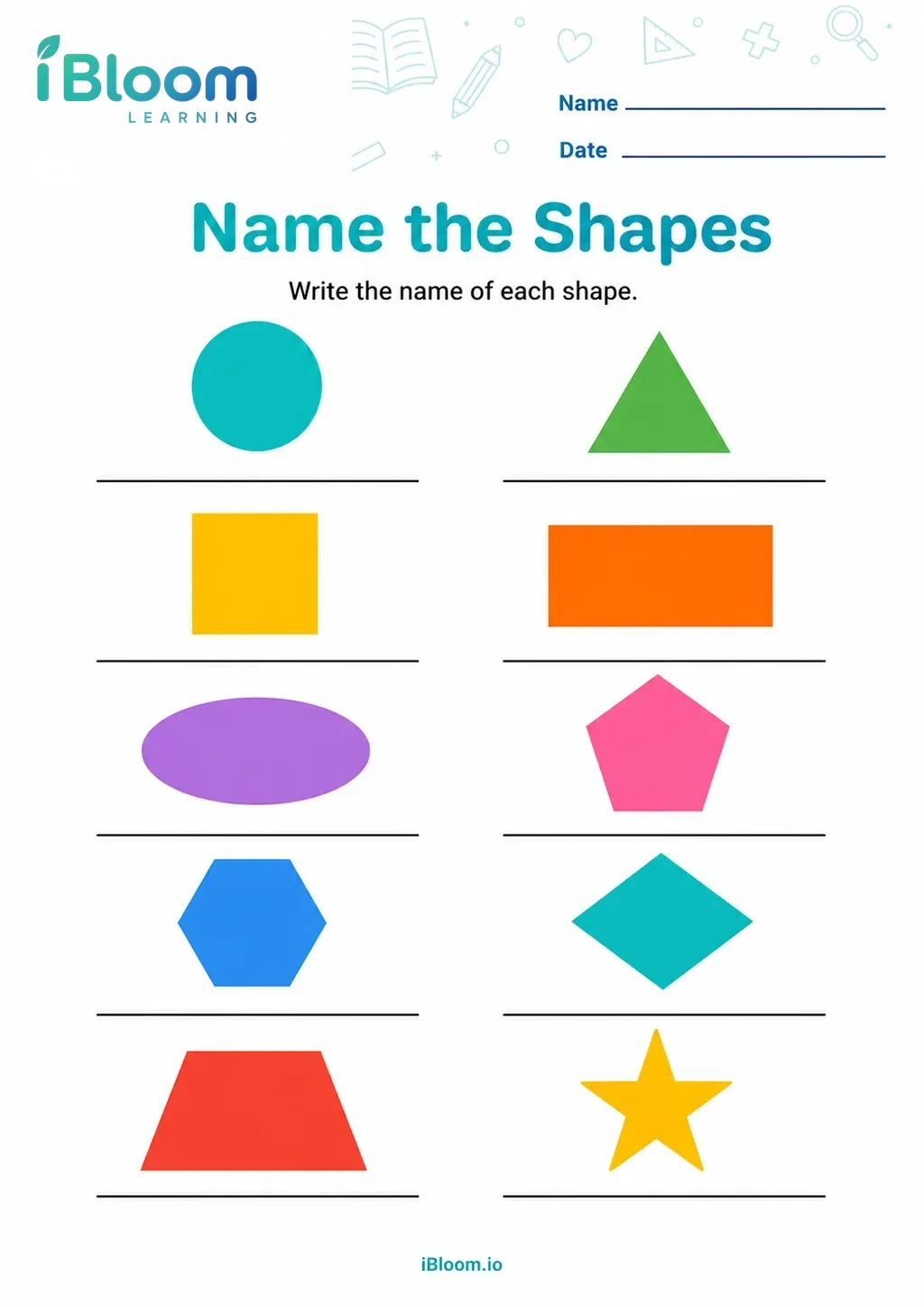
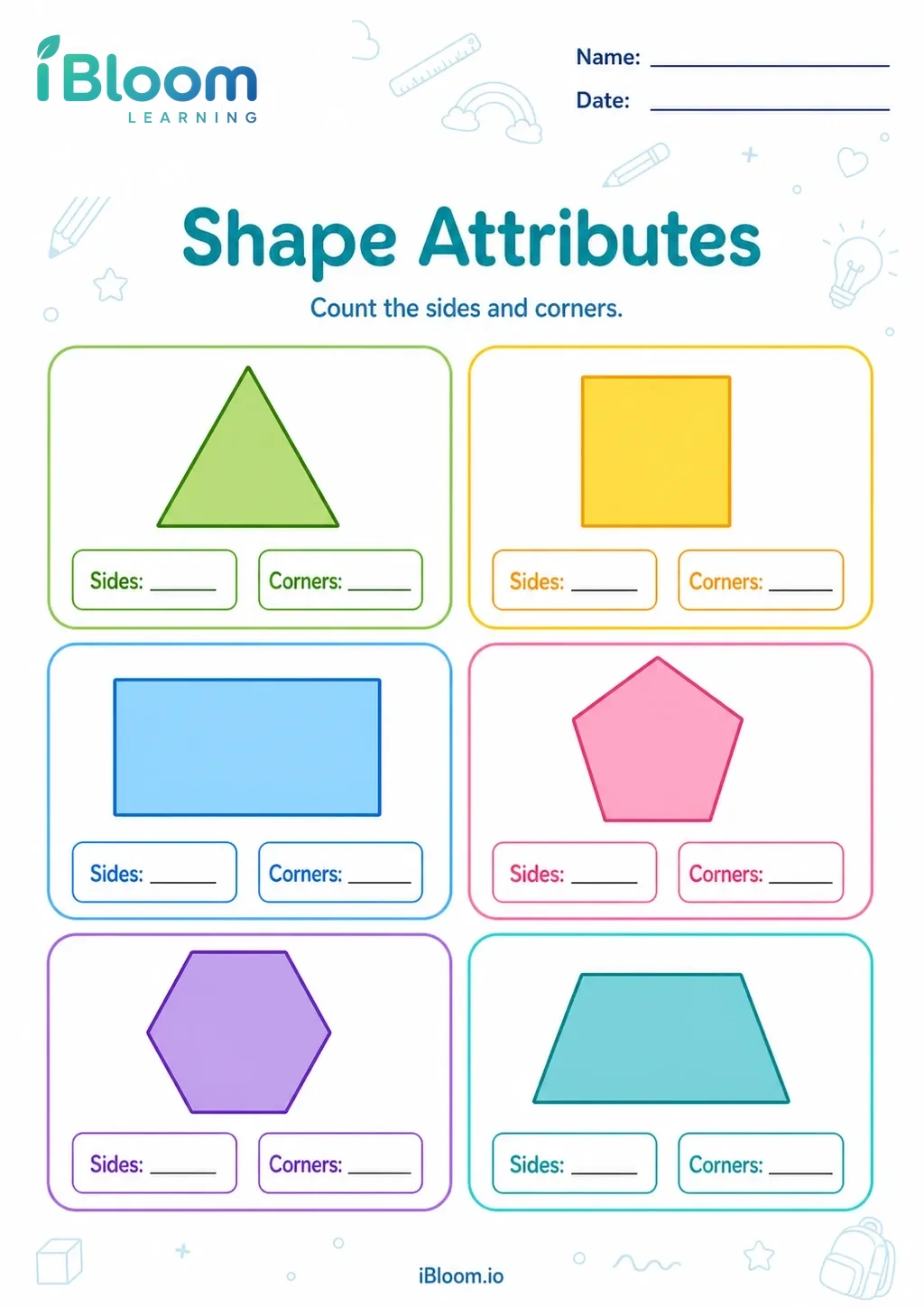
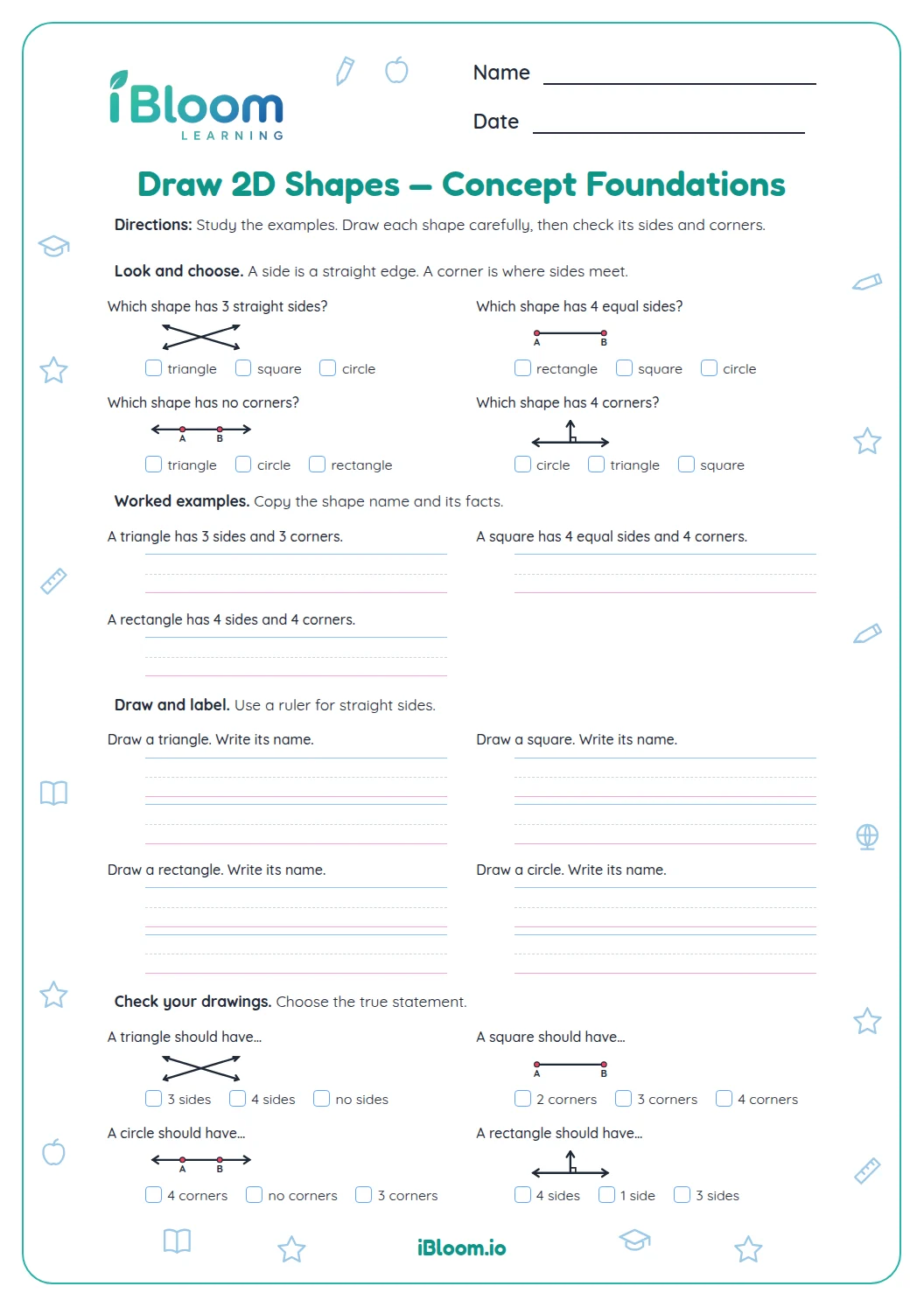
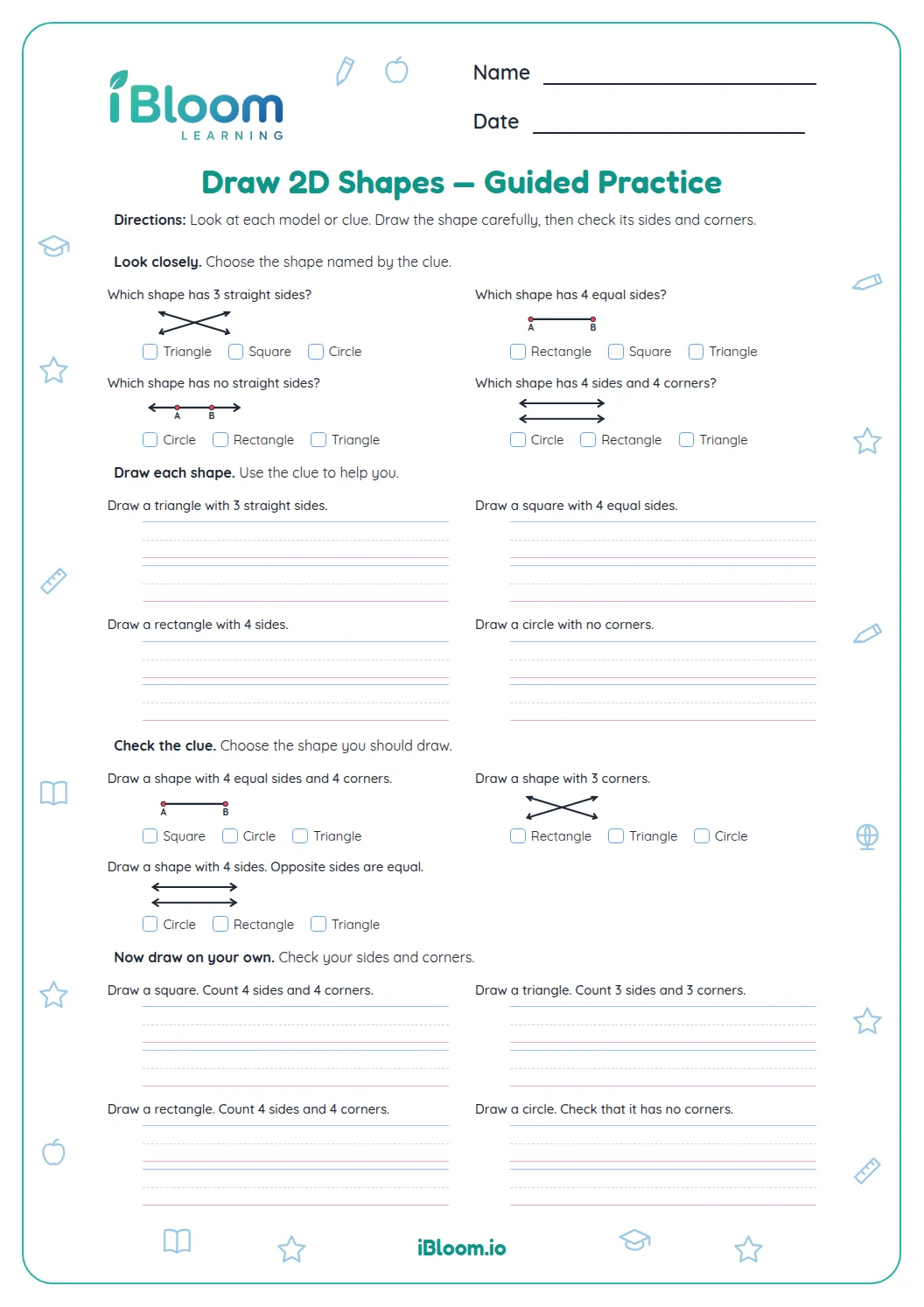
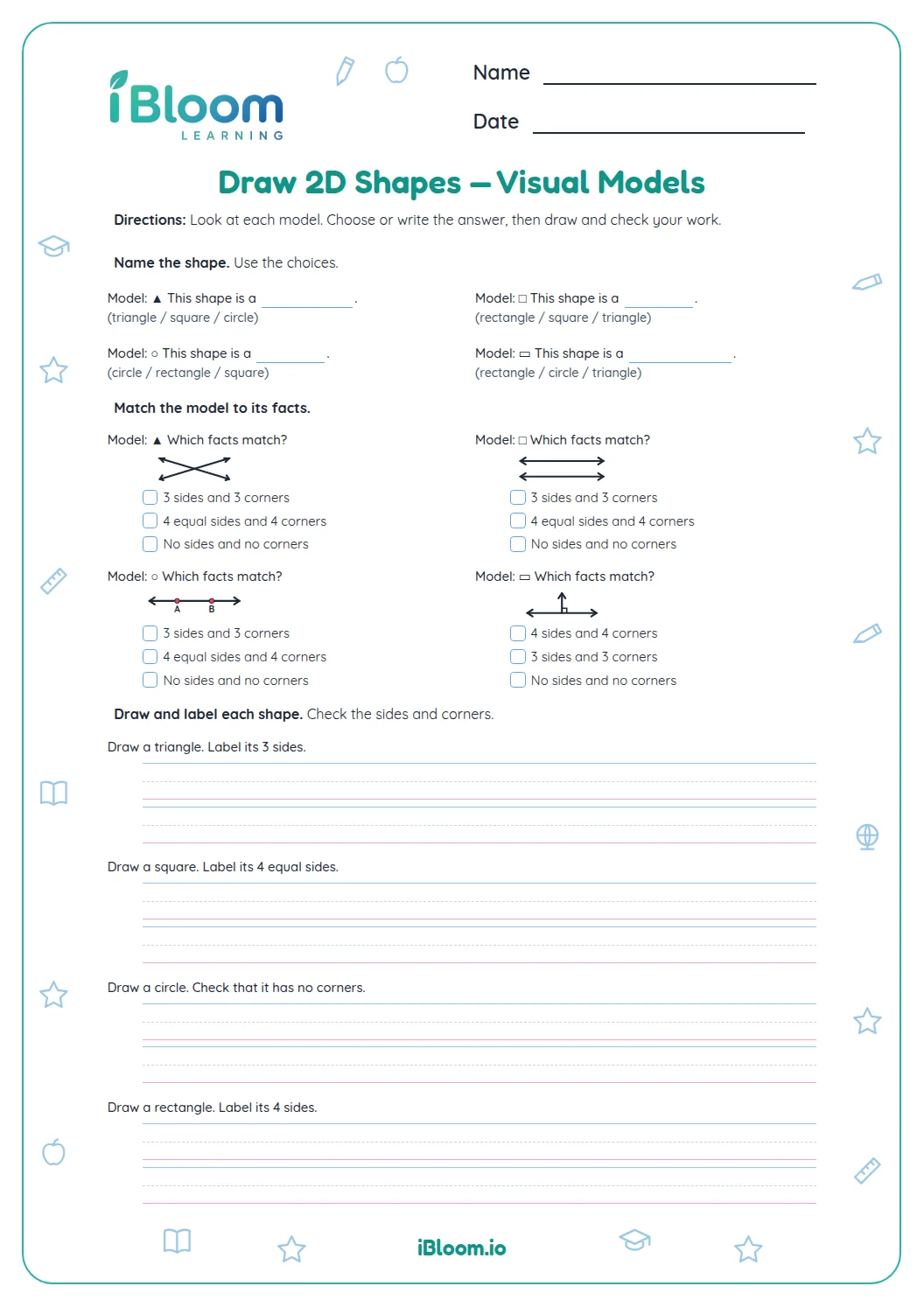
This Grade 1 printable helps students name familiar two-dimensional shapes by looking at outlines, sides, and corners. The 14 questions use circles, triangles, squares, and rectangles; some show a shape drawing and others ask learners to recall a defining feature. A separate answer key supports checking.
Aligned to 1.G.A.1
What features help name a shape?
A triangle has three straight sides, a square has four equal sides, and a rectangle has four sides with opposite sides equal. A circle has a curved outline and no corners. The page asks students to name shapes and count features.
How can students check a shape name?
Trace the outline with a finger and count its sides or corners. For a triangle, count three straight sides before naming it.
- 1Trace the outline.
- 2Count three straight sides.
- 3Name the shape: triangle.
Which shapes appear on the page?
The 14 questions focus on circles, triangles, squares, and rectangles. Six questions include outline drawings; the rest ask learners to recall or count defining features.
How to use this worksheet
- 1For each drawing, trace the outline with a finger.
- 2Count straight sides and corners.
- 3For a curved outline, check whether it has corners.
- 4Read the clue twice and match each feature to a shape name.
- 5Check uncertain answers with the answer key and recount the sides.
Common mistakes and quick fixes
The mistake
Calling every four-sided shape a square.
The fix
Check whether all four sides are equal before naming a square.
The mistake
Calling a turned square a diamond.
The fix
Rotation does not change the shape name; check its equal sides and four corners.
The mistake
Counting a curved edge as a straight side.
The fix
Follow the outline slowly and count only straight segments as sides.
Curriculum alignment
This practice focuses on identifying familiar plane shapes by their defining attributes.
Identify familiar shapes by their defining sides and corners.
On this sheet: Students name familiar shapes and count sides on the pictured outlines.
Show the official wordingHide the official wording
Distinguish between defining attributes (e.g., triangles are closed and three-sided) versus non-defining attributes (e.g., color, orientation, overall size); build and draw shapes to possess defining attributes.
What to practice next
Make more practice
Further reading
Questions parents and teachers ask
How many questions are included?
A total of 14 questions ask learners to name circles, triangles, squares, and rectangles or count their sides and corners. Six questions include a shape drawing. The separate answer key lists a response for every numbered item, so the student can check work after finishing.
Does the printable include an answer key?
Yes. A separate answer key follows the practice sheet and lists a response for each numbered question. Students can finish the work before checking it, then compare each response with the key. For an incorrect answer, return to the prompt and identify the step that needs another try.
How should students use this worksheet?
Read the direction at the start of each part, then answer one question at a time. The practice focuses on identify circles, triangles, squares and rectangles. After completing the page, use the separate key to check responses and review the items that were difficult.
How long does the worksheet take?
Plan about 15 minutes for the 16 questions, with extra time if a student wants to discuss a method. The exact pace depends on reading and writing speed. Breaking the practice into parts can make it easier to pause and return later.
Who is this worksheet for?
This printable is labeled Grade 1. Its questions focus on identify circles, triangles, squares and rectangles with short prompts and an answer key. A parent, teacher, or tutor can read a direction aloud, then let the learner complete the practice and check it afterward.