

About this worksheet
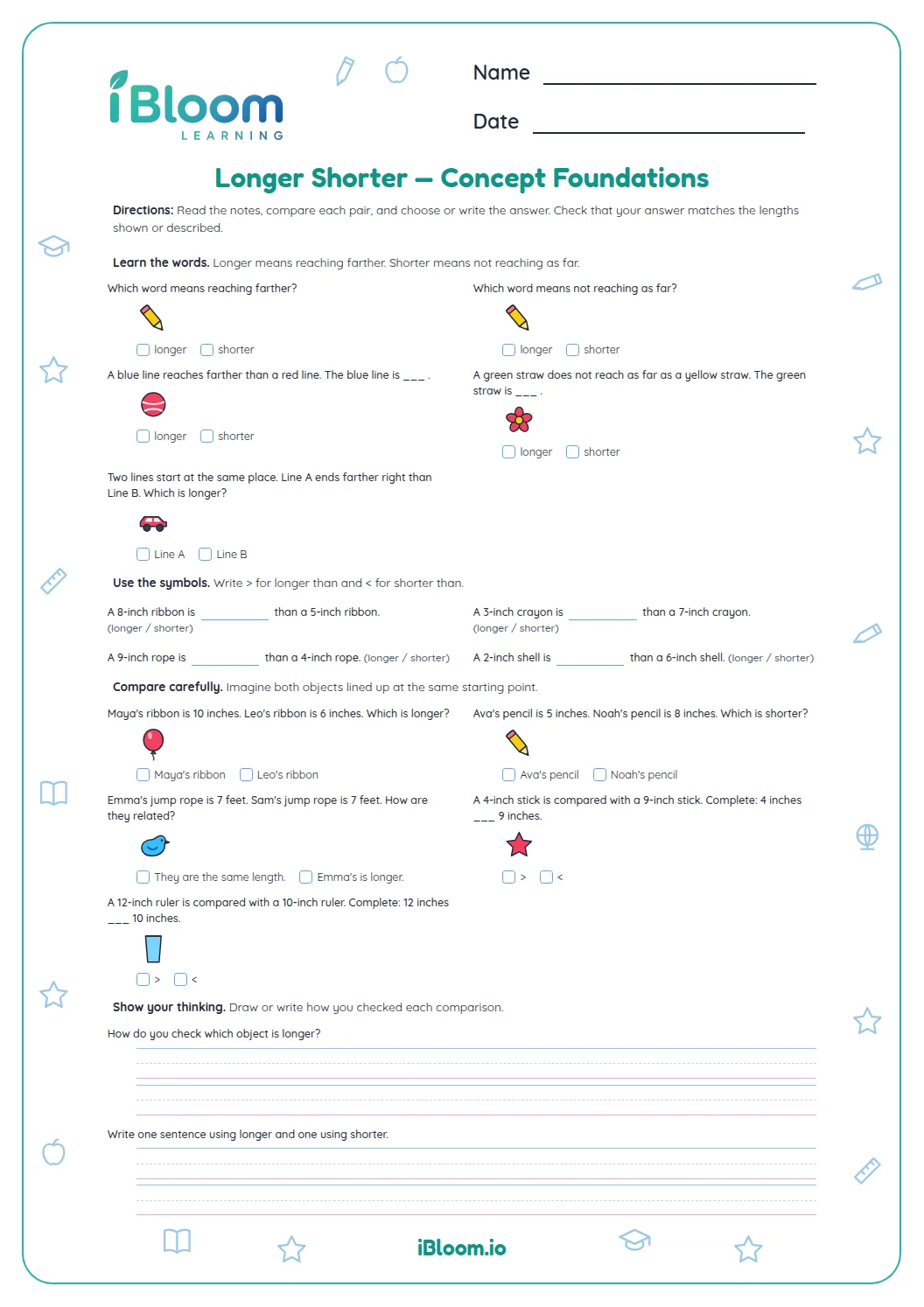
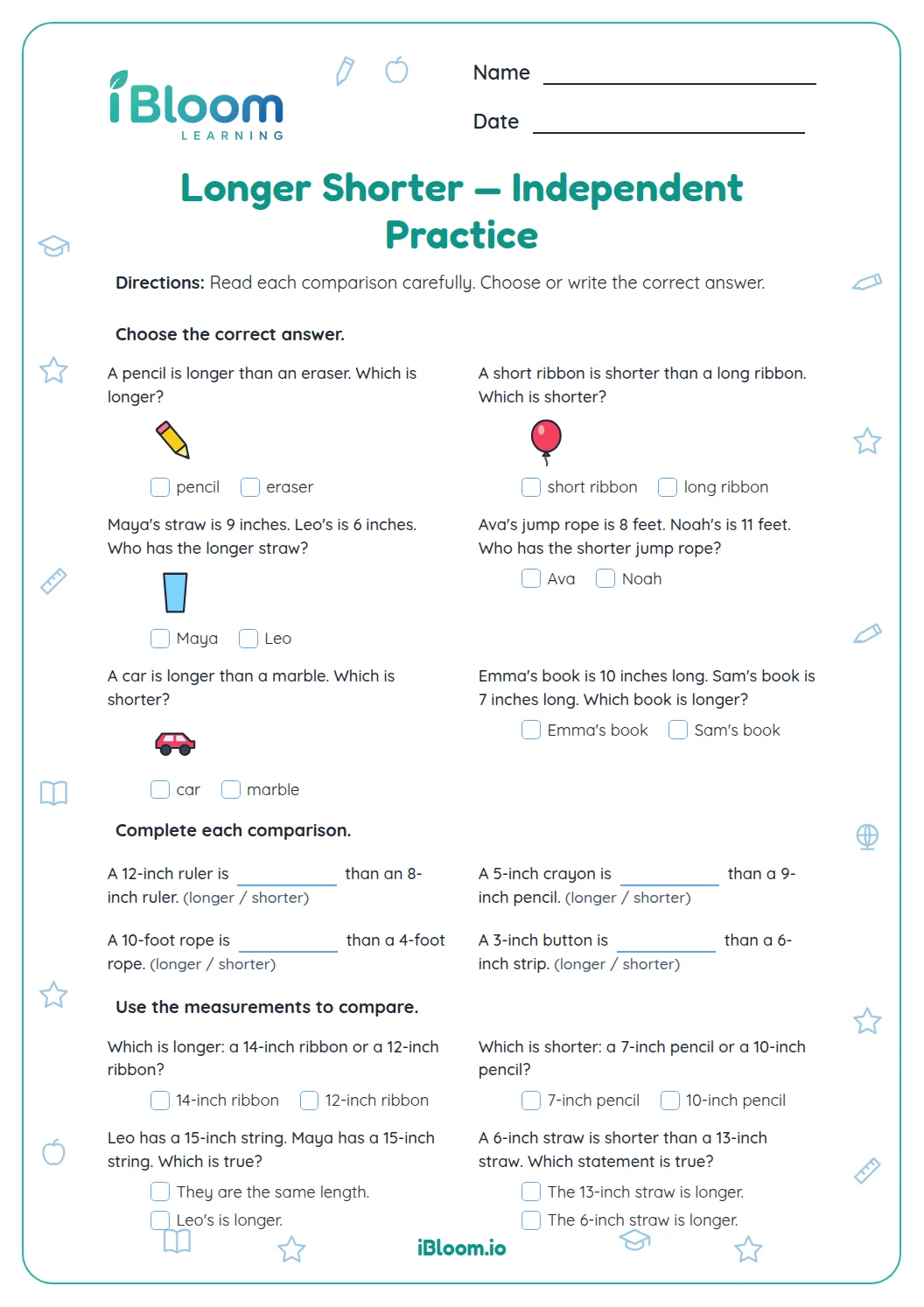
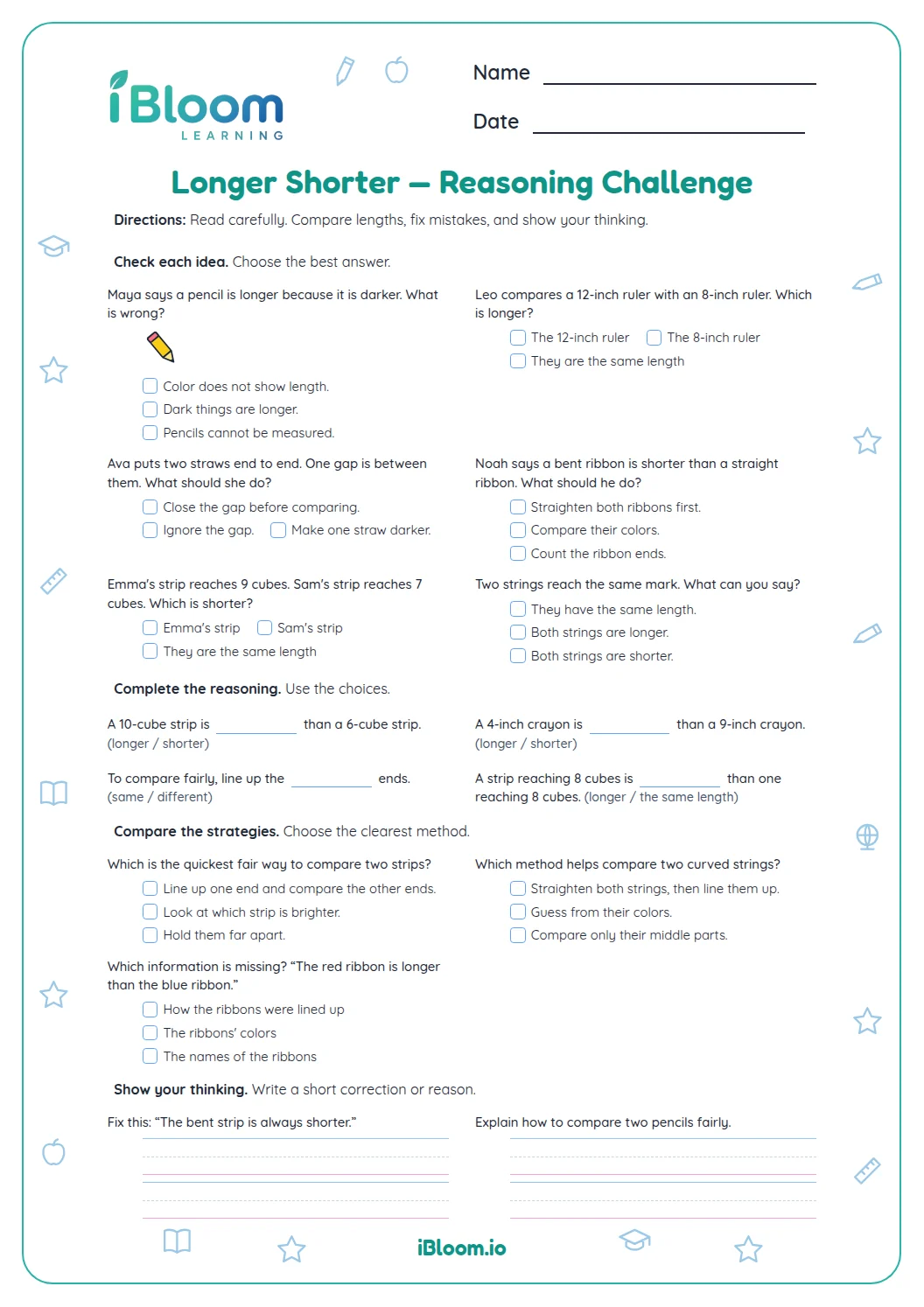
This Grade 1 measurement worksheet uses short stories about lengths measured in cubes or links. Students compare two measurements, decide which object is longer or shorter, and find the difference or a new length. The 14 multiple-choice questions use same-unit comparisons, and the answer key shows the correct choice for each story. The practice connects to CCSS 1.MD.A.1, which asks students to compare lengths and reason about measurement.
Aligned to 1.MD.A.1
How do you compare two lengths?
First check that both measurements use the same unit, such as cubes. The measurement with the greater number is longer; the one with the smaller number is shorter.
For example, in “A ribbon is 8 cubes long and a string is 5 cubes long,” the ribbon is longer because 8 is greater than 5.
How can you find how much longer one object is?
Subtract the smaller measurement from the larger measurement. If one strip is 7 cubes and another is 4 cubes, the difference is 3 cubes. The answer describes the gap between the lengths, not the total length.
What other length questions appear?
Later stories give one length and describe another as a certain number of units longer or shorter. Students use addition or subtraction to find the unknown length, then include the unit named in the story.
How to use this worksheet
- 1Read both lengths and check that they use the same unit.
- 2For “which is longer” or “which is shorter,” compare the two numbers.
- 3For “how much longer,” subtract the smaller count from the larger count.
- 4For a new length described as longer or shorter, add or subtract that change.
- 5Include the unit in your choice and check that the result fits the story.
Common mistakes and quick fixes
The mistake
Adding when asked how much longer.
The fix
Find the difference by subtracting the smaller length from the larger one.
The mistake
Choosing the longer object when asked for the shorter one.
The fix
Circle the comparison word in the question before choosing.
The mistake
Leaving off cubes or links in a numerical answer.
The fix
Use the same unit named in the story.
Curriculum alignment
This worksheet practices the skills named in the standard below.
Order three objects by length and compare lengths indirectly.
On this sheet: Students compare measured lengths and describe the difference using same-size units.
Show the official wordingHide the official wording
Order three objects by length; compare the lengths of two objects indirectly by using a third object.
What to practice next
Questions parents and teachers ask
What units does this worksheet use?
The stories measure lengths in same-size cubes or links. Each comparison keeps both measurements in the same unit, so students can compare the counts directly. Both measurements in each comparison are given with matching units, so the numbers can be compared.
How do you answer “how much longer”?
Subtract the shorter length from the longer length. For example, a ribbon measuring 8 cubes and a string measuring 5 cubes differ by 3 cubes. The question asks for the gap between lengths, which is found by taking away the smaller count.
Does the worksheet include finding an unknown length?
Yes. Some stories give one length and say another is a certain number of units longer or shorter. Students add or subtract that change to find the second measurement. The unit stays the same, so only the number changes when finding the unknown length.
How many questions are on the worksheet?
There are 14 multiple-choice questions. They ask students to compare lengths, name the longer or shorter object, find a difference, or calculate a length from a stated change. The answer key lists a correct choice for every item to support quick checking after practice.
Why should the units match?
Comparing counts is meaningful when both objects are measured with the same-size unit. The worksheet uses cubes or links within each story so students can focus on the length comparison. That shared unit makes the comparisons fair and keeps the focus on longer, shorter, and difference.