




About this worksheet
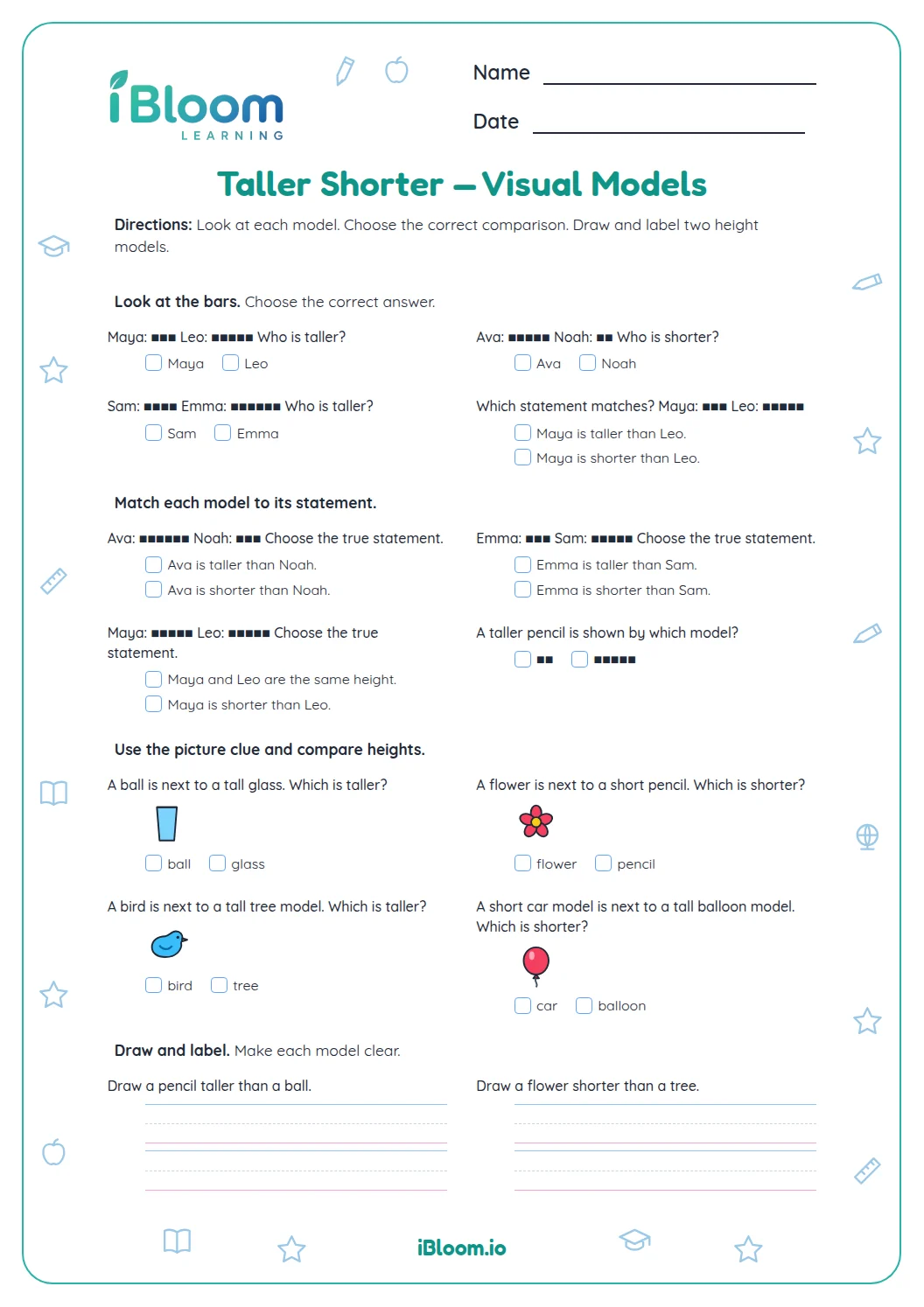
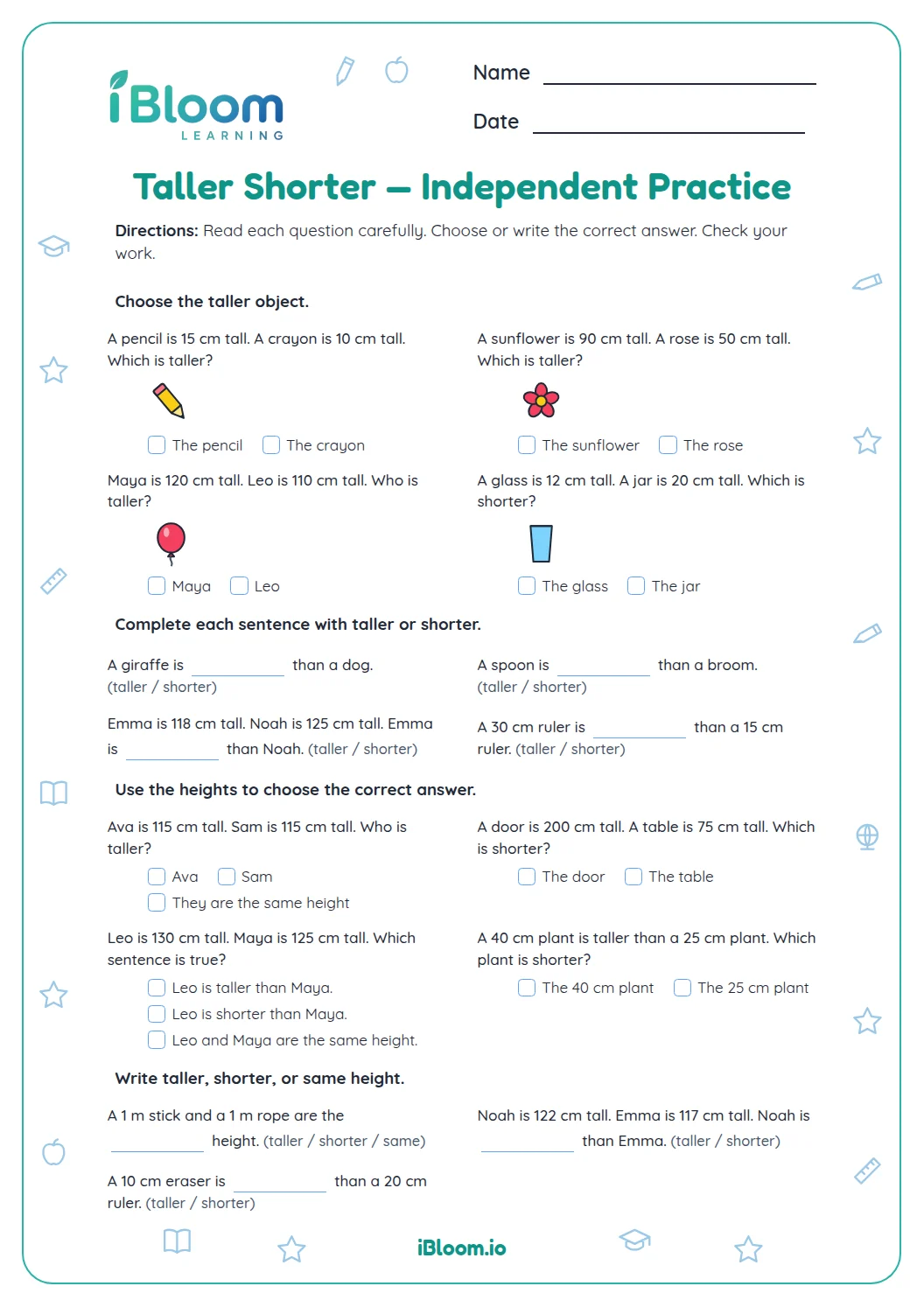
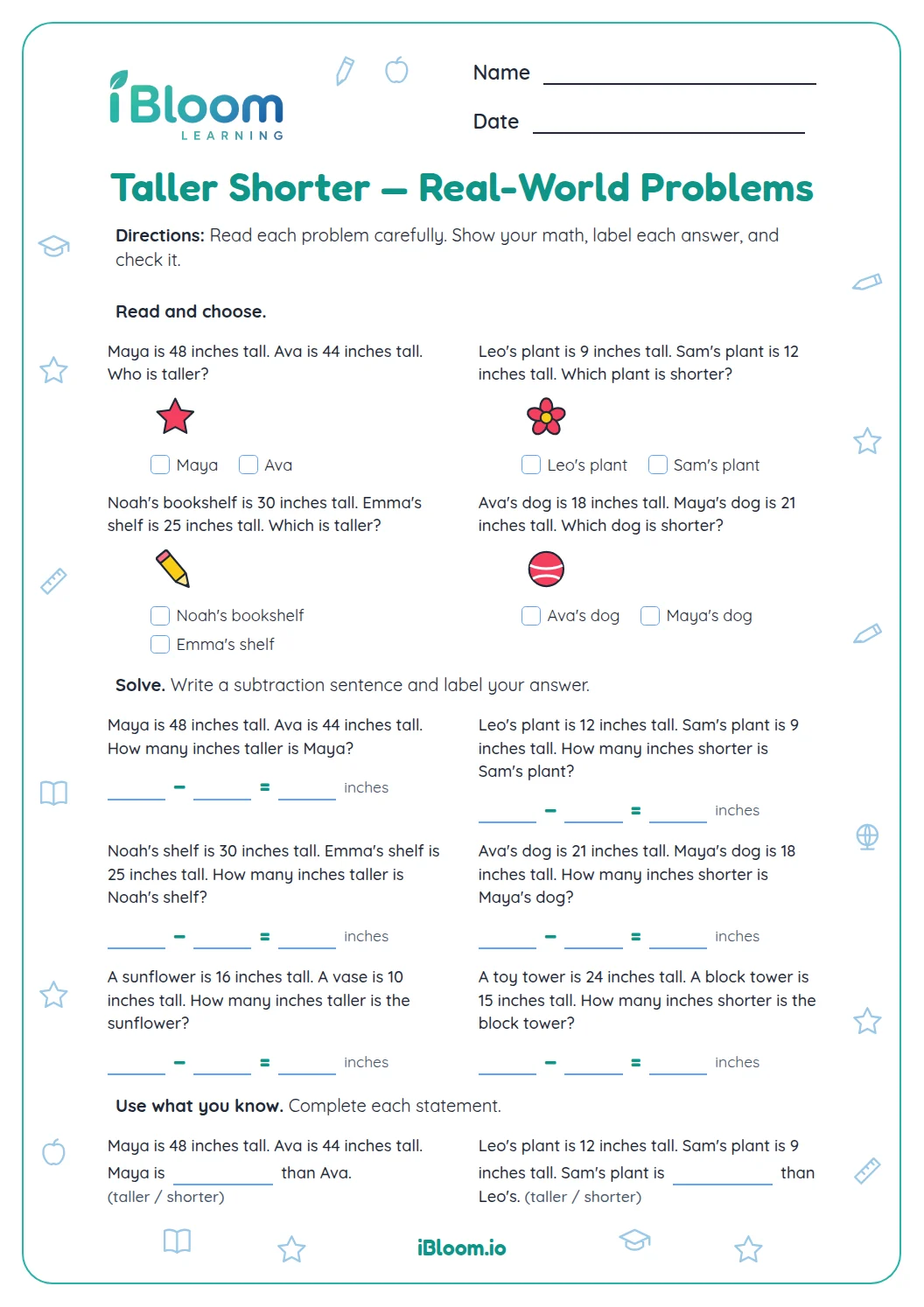
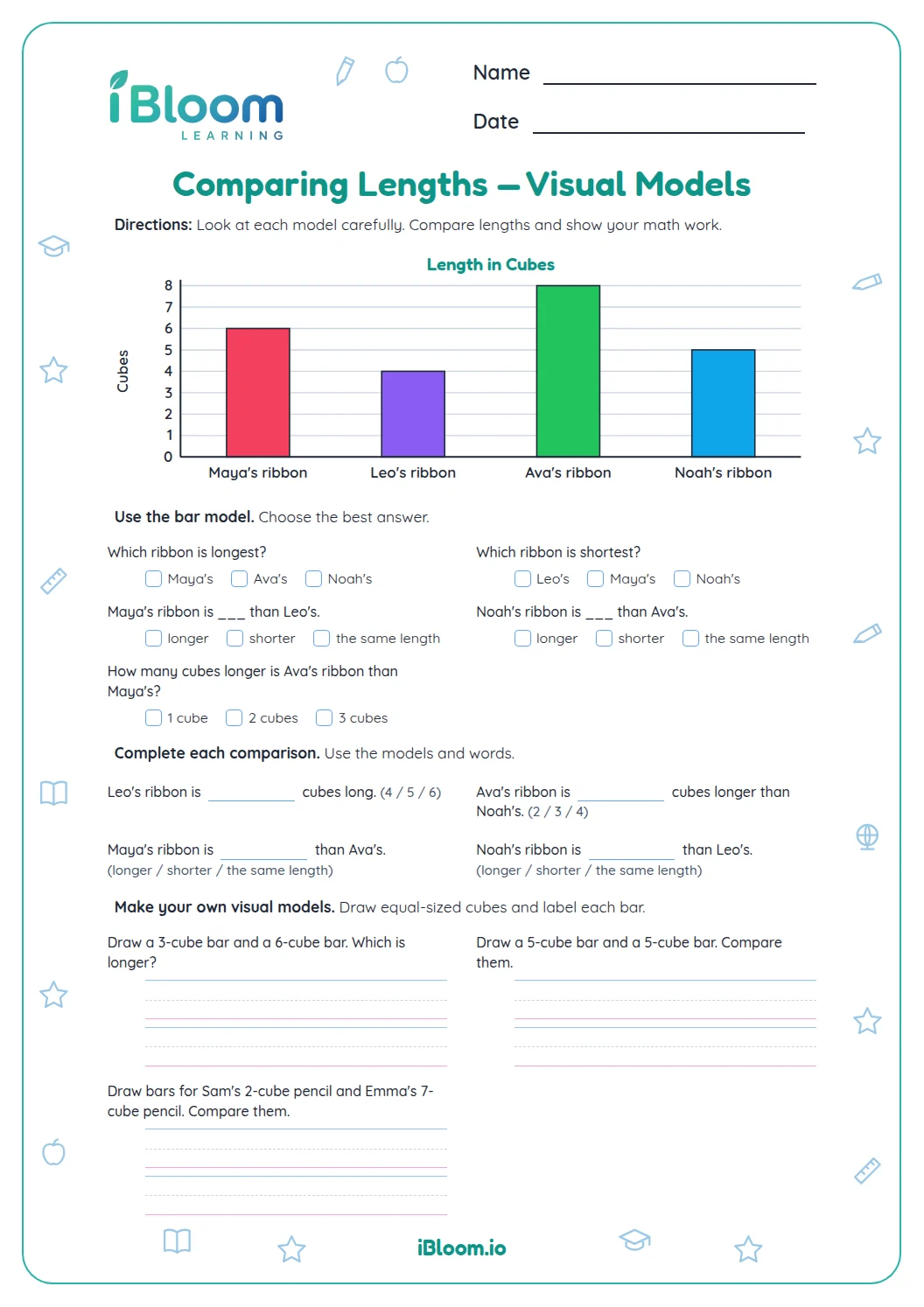
This free printable Grade 1 worksheet builds the meaning of taller, shorter, tallest, and shortest. Part A compares two pairs of tower heights in blocks. Part B orders three heights, and Part C links two clues through a shared object. The final four questions compare measured heights and order objects. Children answer 14 questions, then check the key. The practice uses direct and indirect comparisons of length under Common Core 1.MD.A.1.
Aligned to 1.MD.A.1
What makes one tower taller?
A taller tower has a greater height when both measurements use the same unit. Part A gives two pairs of tower heights in blocks. Children compare the stated measurements, just as they would compare objects placed on the same surface.
Part B gives three tower heights to order. The later questions also use stated heights in centimeters or feet.
How do children order three heights?
Find the shortest first, then the middle height, then the tallest. If the question asks for tallest to shortest, reverse that direction before choosing an answer.
- 1Tower A is 5 blocks high, B is 2, and C is 4.
- 2B is shortest. C is taller than B but shorter than A.
- 3Shortest to tallest: B, C, A.
How can a middle object help?
Part C gives two comparisons that share an object. In question 5, the cup is shorter than the plant and taller than the toy. Those clues place the objects in order: toy, cup, plant.
Questions 5–10 give two comparisons that share an object. In question 5, the cup is shorter than the plant and taller than the toy. Those clues place the objects in order: toy, cup, plant. The last four questions compare or order stated heights.
How to use this worksheet
- 1Place two upright books on a table and compare their tops.
- 2Read the tower labels and the words taller or shorter in questions 1 and 2.
- 3For questions 3 and 4, say the requested direction before choosing an order.
- 4Read each Part C clue aloud, pausing at the shared object.
- 5Check the choices with the key and explain one answer using both clues.
Mistakes to check together
The mistake
Comparing the tops of objects that start on different levels.
The fix
Set both objects on the same surface before comparing.
The mistake
Giving tallest-to-shortest order when shortest-to-tallest is requested.
The fix
Point to the first ordering word and start there.
The mistake
Using only one of the two clues.
The fix
Find the object named in both clues and place it between the other two.
Common Core alignment
Order three tower heights and use a shared object to compare two other heights.
On this sheet: Part B orders three heights; Part C compares objects through a third object.
Show the official wordingHide the official wording
Order three objects by length; compare the lengths of two objects indirectly by using a third object.
What to practice next
Make more practice
Further reading
Questions parents and teachers ask
Do children need a ruler?
No ruler is needed for this worksheet. The first questions give tower heights in blocks, and the later questions supply height relationships in words. A pair of upright books can help demonstrate why the starting level matters before children begin the printed comparisons.
What do the bars in Part A mean?
The first two questions list each tower’s height in blocks. Because both use the same unit, compare the counts: more blocks means taller and fewer means shorter. Later questions use centimeters or feet in the same way. Check that the units match before comparing the numbers.
How does question 5 use a middle object?
The cup connects the plant and the toy. The plant is taller than the cup, and the cup is taller than the toy, so the plant must be taller than the toy. Say the three names in height order to make both clues easier to hold together.
Can I read the height clues aloud?
Yes, you can read the clues and answer choices aloud. Keep the focus on comparing heights by asking your child to explain which object belongs in the middle. For a longer question, pause between the two clues and let your child repeat each relationship before answering.
What does the answer key help me check?
The key identifies the correct choice for each of the 14 questions. Check the ordering direction as well as the selected object. When an answer differs, return to the tower tops or both written clues and ask the child to explain the comparison before changing the choice.