


About this worksheet
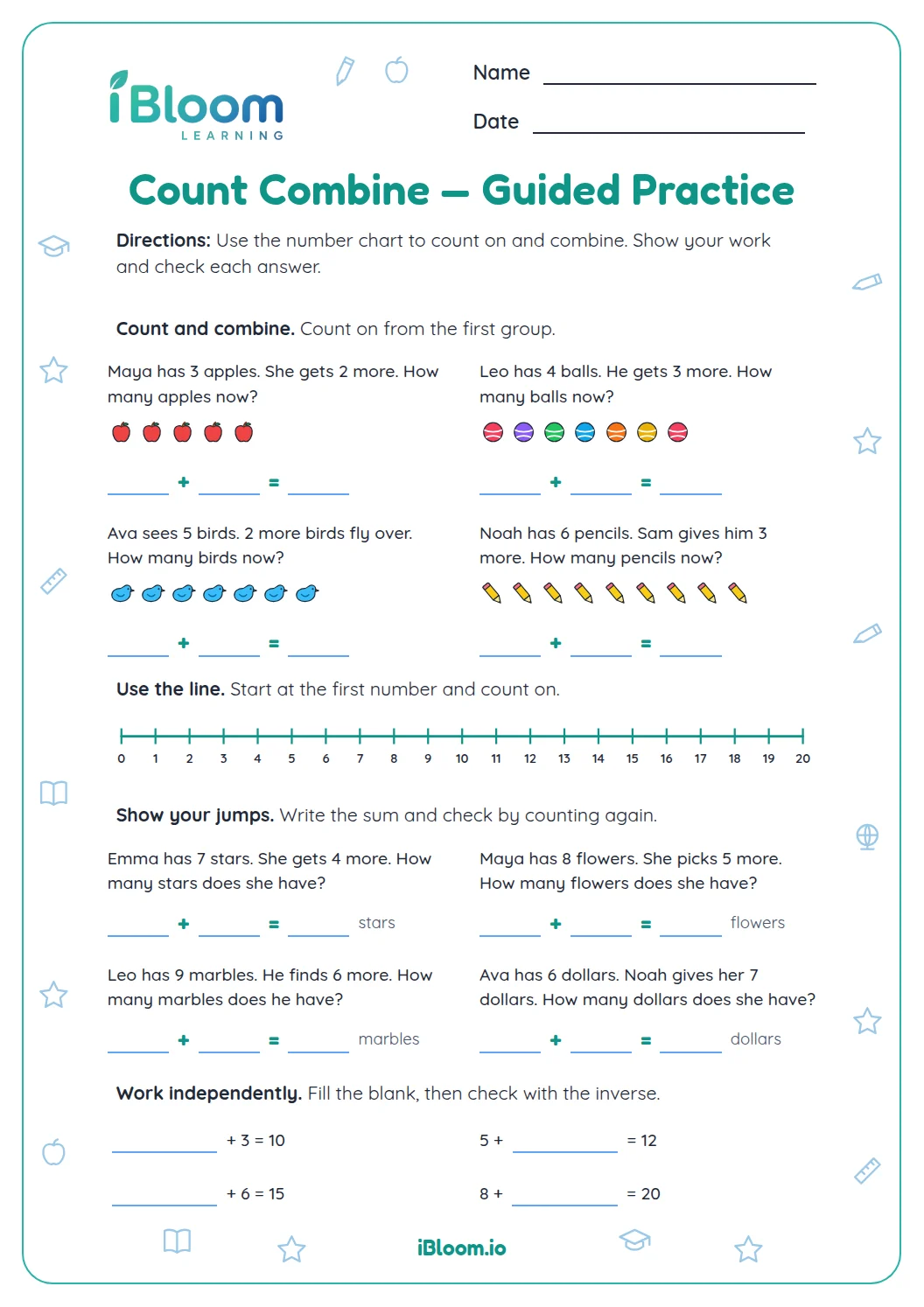
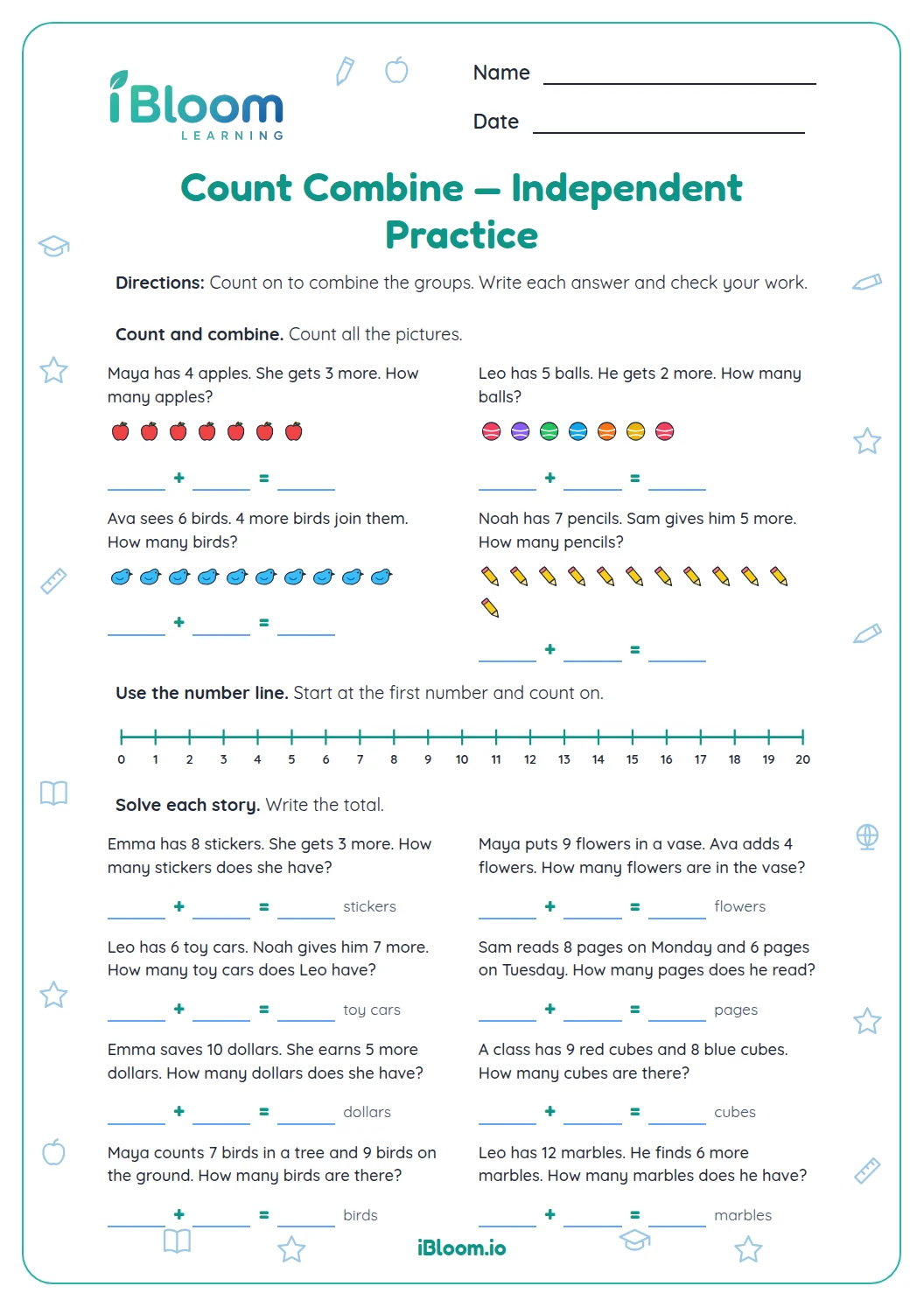
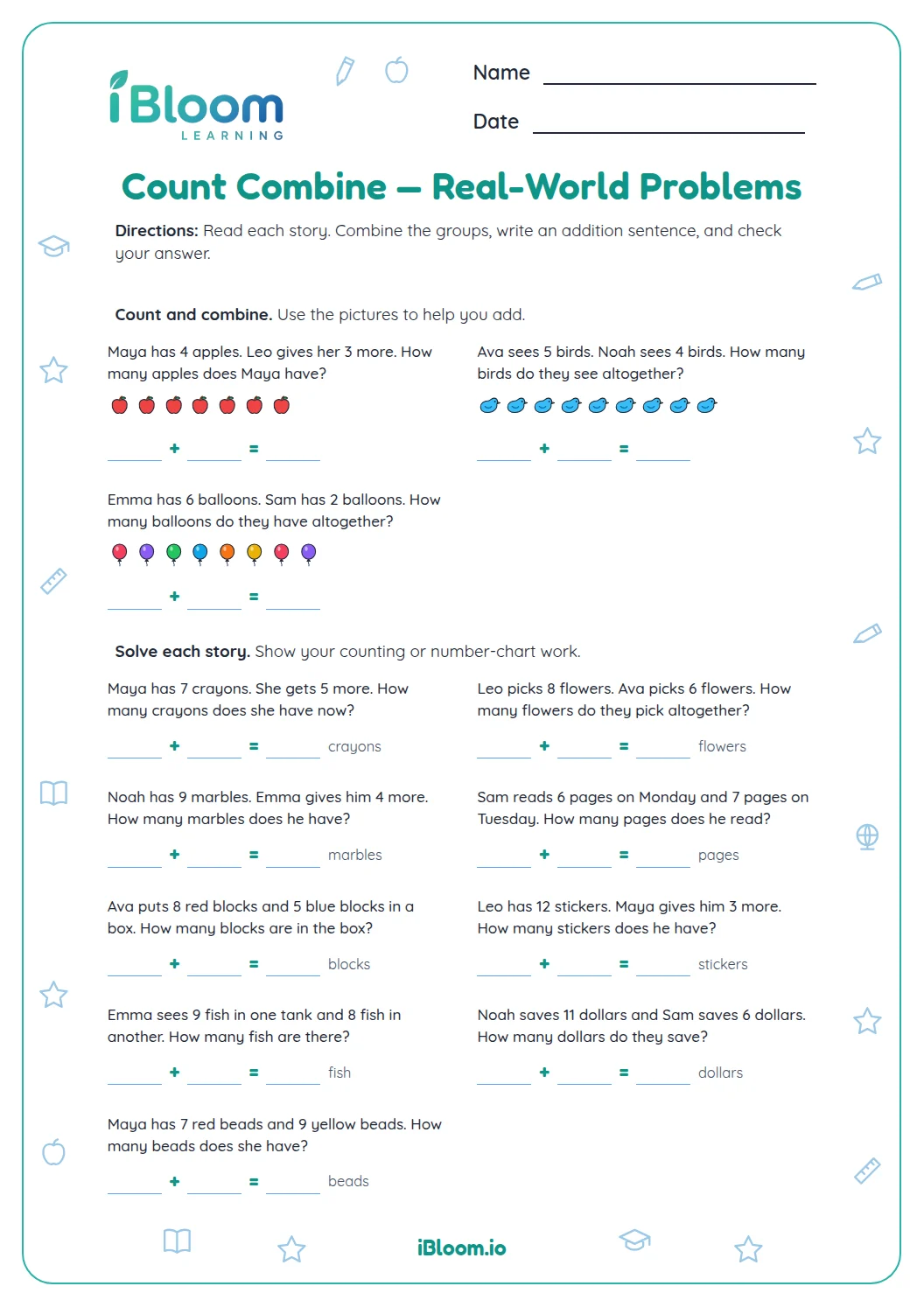
This Grade 1 worksheet moves from visual counting to combining two groups. Children read ten frames, an apple array, and base-ten blocks before solving everyday addition situations with sums no greater than 20. The progression supports CCSS 1.OA.C.6, solving addition and subtraction word problems within 20. Fifteen problems and a separate answer key are included.
Aligned to 1.OA.C.6
How can a model show a number?
A ten frame organizes counters into groups of five and ten. Base-ten blocks show hundreds, tens, and ones; count each kind by its value.
- 11 hundred + 4 tens + 3 ones
- 2100 + 40 + 3 = 143
How do you solve an addition story?
Find the two groups in the story, write an addition equation, and count on or use a known fact. For 7 red beads and 5 blue beads, 7 + 5 = 12 beads.
How can you check a total?
Count on from the larger group by the number in the smaller group. For 9 + 9, count nine more after 9 to reach 18.
How to use this worksheet
- 1Count counters in complete rows before writing the number.
- 2For blocks, name hundreds, tens, and ones before combining their values.
- 3Underline both group amounts in each story.
- 4Write a plus equation before solving the word problem.
- 5Check by counting on from the larger addend.
Common mistakes and quick fixes
The mistake
Counting each ten-frame counter twice while switching rows.
The fix
Touch each counter once, moving left to right and top to bottom.
The mistake
Reading a ten rod as one instead of ten.
The fix
Say the block value aloud before combining hundreds, tens, and ones.
The mistake
Using only one group in a story total.
The fix
Underline both groups and include both in the addition equation.
Add and subtract within 20 using strategies such as counting on.
On this sheet: The story problems join two groups and ask for the total, with sums within 20.
Show the official wordingHide the official wording
Add and subtract within 20, demonstrating fluency for addition and subtraction within 10. Use strategies such as counting on; making ten (e.g., 8 + 6 = 8 + 2 + 4 = 10 + 4 = 14); decomposing a number leading to a ten (e.g., 13 − 4 = 13 − 3 − 1 = 10 − 1 = 9); using the relationship between addition and subtraction (e.g., knowing that 8 + 4 = 12, one knows 12 − 8 = 4); and creating equivalent but easier or known sums (e.g., adding 6 + 7 by creating the known equivalent 6 + 6 + 1 = 12 + 1 = 13).
What to practice next
Make more practice
Further reading
Questions parents and teachers ask
What is included in the visual models?
The first five items use ten frames, an apple array, and base-ten blocks. Students count counters, array objects, and hundreds, tens, and ones before moving to addition equations. The models give children a visual reference before they solve the number sentences.
How are the addition questions solved?
Each equation combines two addends and asks for the total. Children may count on, use a known fact, draw groups, or use the visual models from Part A. Every total is 20 or less, and the answer key lists each sum.
Are the sums within 20?
Yes. The addition facts and quantities in the worksheet have totals of 20 or less, so students can practice joining groups in the intended Grade 1 range and check their answers with the included key. Each result can be checked by counting on from the first addend.
How can an adult check a base-ten answer?
Ask the child to name the value of each block group first. For example, one hundred, four tens, and three ones make 143. The blocks make each place value visible before a child records the number. Naming the units first helps prevent mixing up the place values.
What models appear before the addition problems?
Children count ten-frame counters, a number-line model, pictured groups, and base-ten blocks. The models lead into short addition situations and number sentences, so students move from seeing quantities to combining them. Children can count the dots or blocks, then record a matching addition sentence before finding the total.
Does the page include number charts?
The page focuses on visual models for counting and addition rather than a printed number chart. It includes 15 questions across two parts, followed by a separate answer key. The title refers to number charts, but this rebuilt page emphasizes models and addition practice.