




About this worksheet
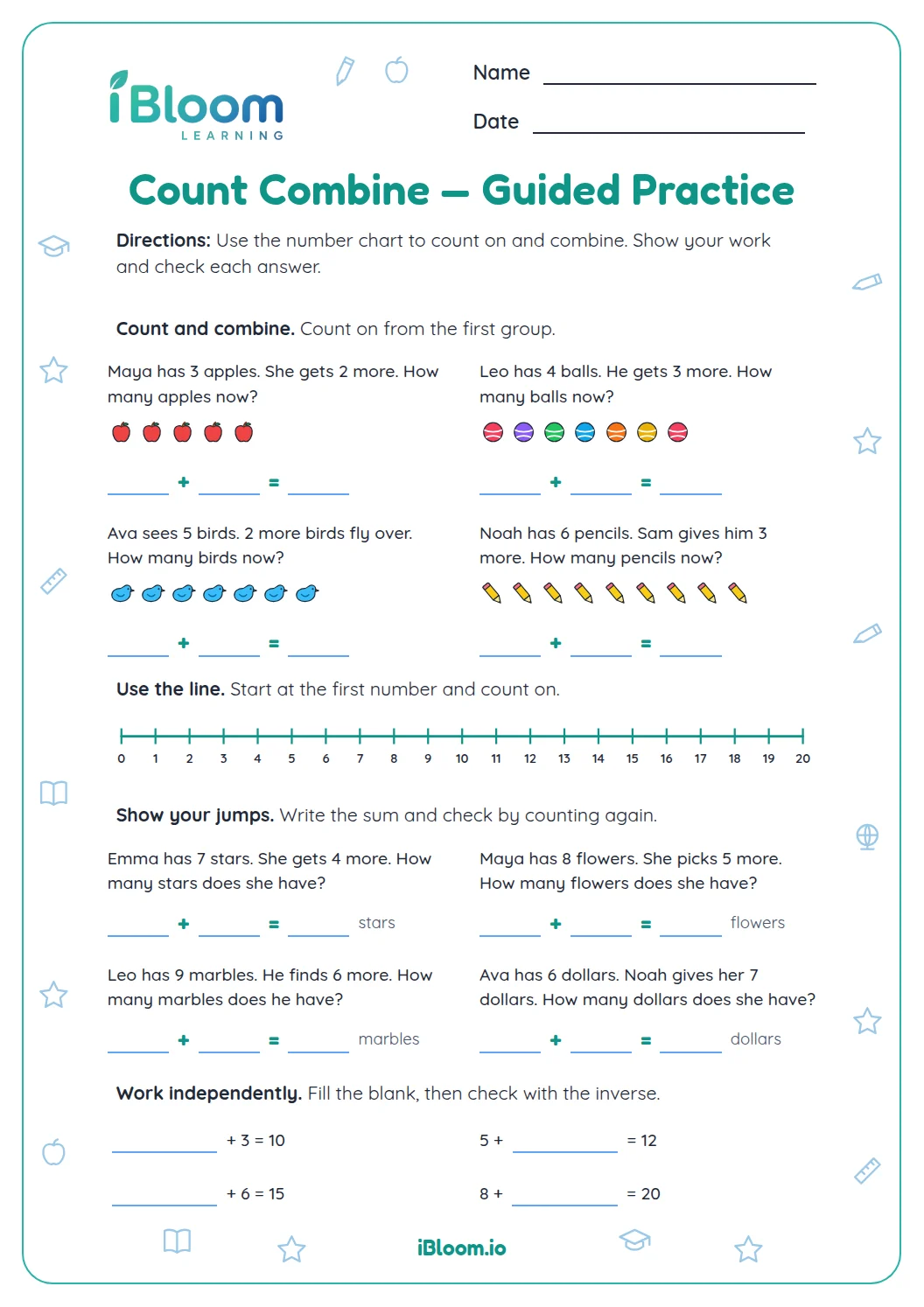
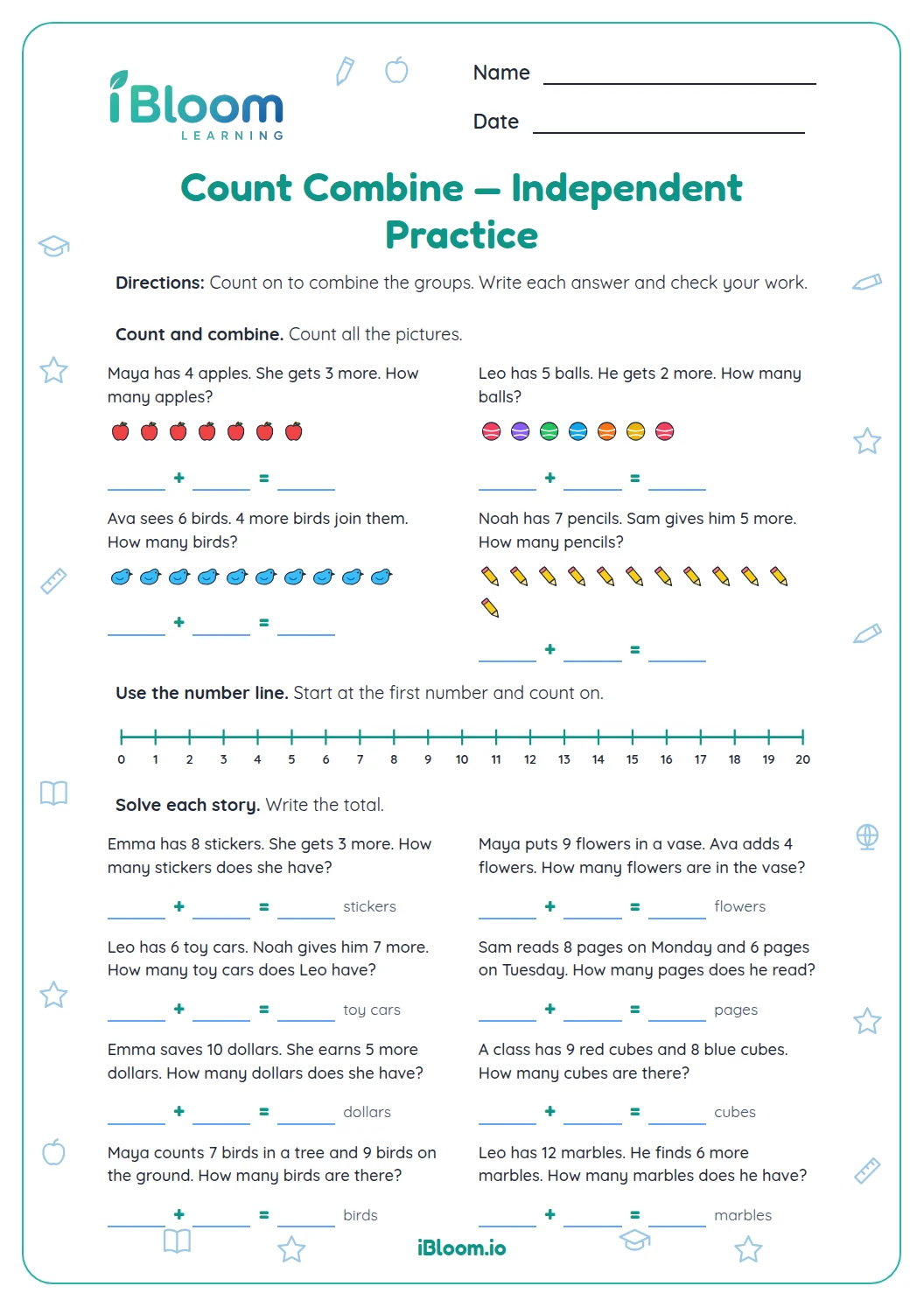
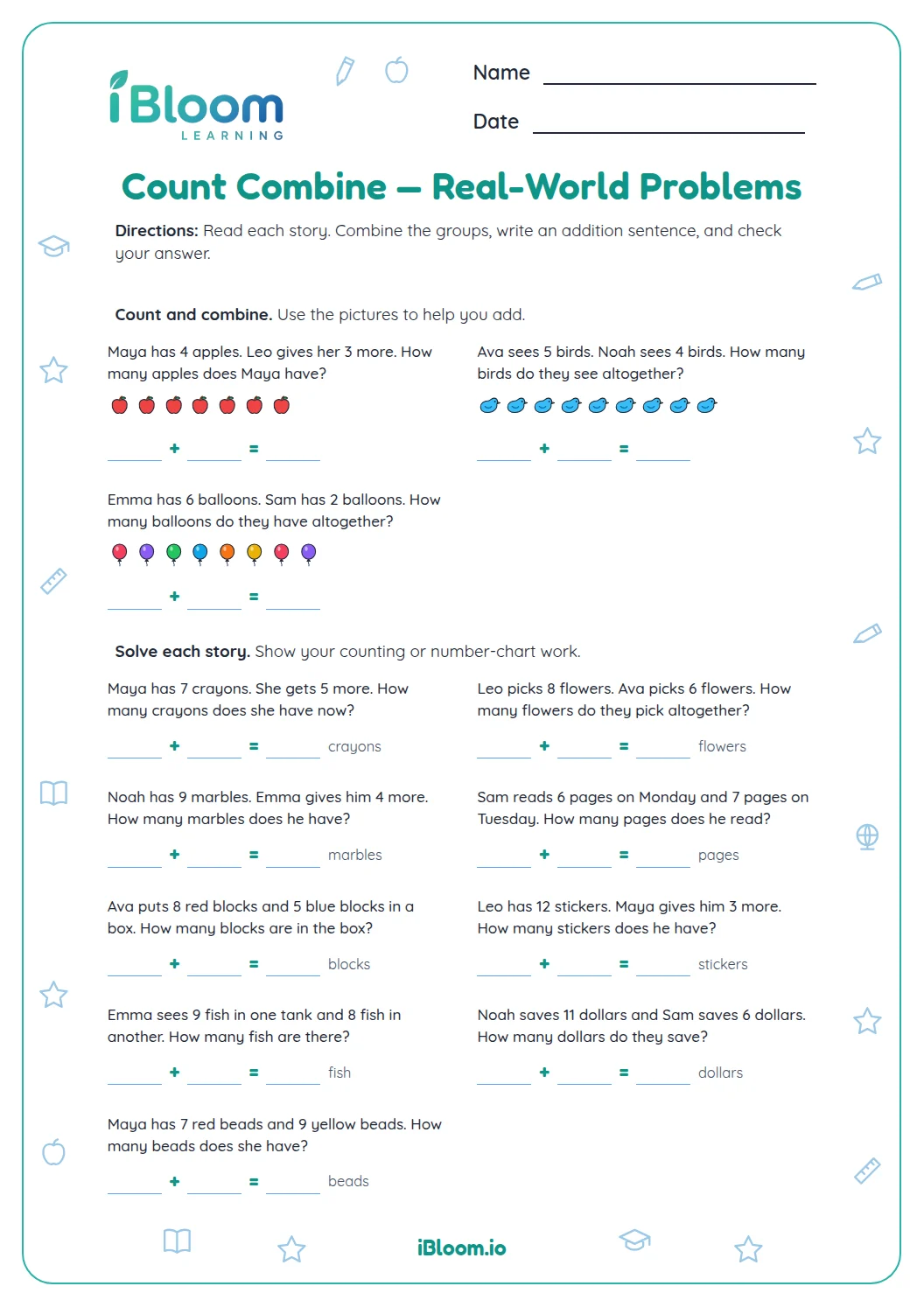
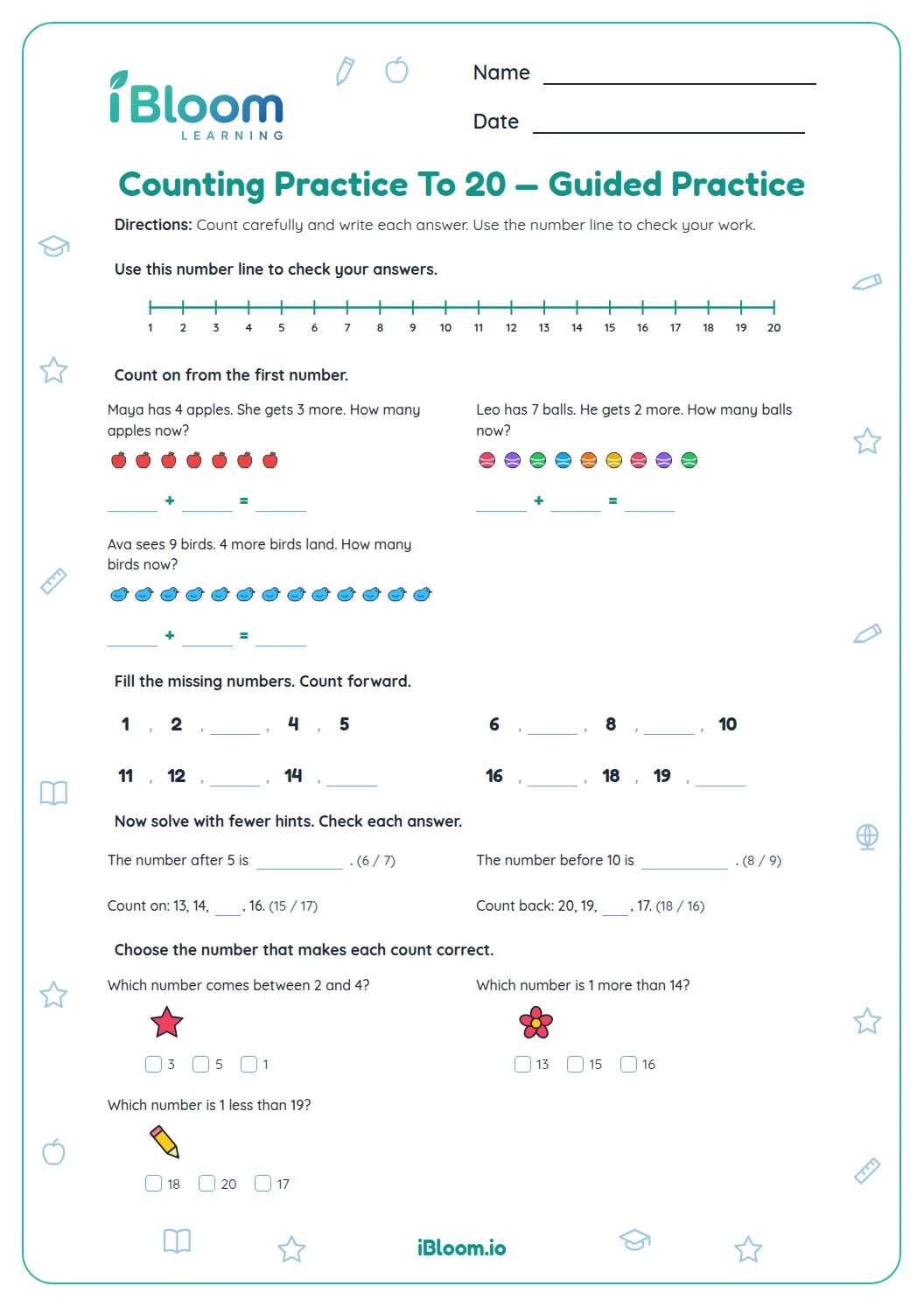
This Grade 1 printable practices putting groups together and finding a missing part. Children complete addition sentences for small groups and use subtraction to find a part when the whole is known. Twenty equations and short stories build from familiar totals to missing addends. It includes an answer key and aligns with CCSS 1.OA.A.1, solving addition and subtraction word problems within 20.
Aligned to 1.OA.A.1
How do you combine two groups?
Add the amounts in the two groups to find their total. Question 1 shows 4 + 3 = 7. A child can count on from 4: 5, 6, 7.
- 14 + 3 = ___
- 2Count on from 4: 5, 6, 7
- 3The total is 7.
How can you find a missing part?
If the whole is 9 and one part is 6, subtract 6 from 9 to find the other part: 9 − 6 = 3.
How do you solve a missing-addend sentence?
Count up to the total. For 8 + ___ = 12, count 9, 10, 11, 12: four more.
How to use this worksheet
- 1Read the equation from left to right.
- 2Add the two amounts to find the whole.
- 3For a missing part, subtract the known part from the whole.
- 4For a missing addend, count up from the known number to the total.
- 5Check that your answer makes the equation true.
Common mistakes and quick fixes
The mistake
Counting one group twice.
The fix
Point to each object once as you count.
The mistake
Adding the part and whole instead of finding the missing part.
The fix
Count from the known part up to the whole; the number of counts is the missing part.
The mistake
Stopping one number before the total when counting on.
The fix
Say the starting number, then count each next number aloud.
Common Core alignment
The word problems use addition to combine groups within 20.
Solve addition and subtraction word problems within 20.
On this sheet: Students solve addition and subtraction stories and complete equations with missing totals or parts.
Show the official wordingHide the official wording
Use addition and subtraction within 20 to solve word problems involving situations of adding to, taking from, putting together, taking apart, and comparing, with unknowns in all positions, e.g., by using objects, drawings, and equations with a symbol for the unknown number to represent the problem.
What to practice next
Make more practice
Further reading
Questions parents and teachers ask
What does count and combine mean?
Children put two groups together and find the total. The worksheet includes two direct picture-counting questions, equations, and short stories. For example, one item asks children to count a group of stars, while another combines 9 pears and 6 apples. Ask the child to count each group once.
How do number bonds help?
A whole can be split into two parts. If the whole is 9 and one part is 6, subtract 6 from 9 to find 3. The worksheet practices this relationship with subtraction equations and missing addends, including examples where the unknown part comes before or after the equal sign.
How can a child solve a missing-addend sentence?
Think about how many more are needed to reach the total. In 8 + ___ = 12, count on from 8: 9, 10, 11, 12. Four more are needed, so the missing addend is 4. The page includes several missing-part questions and group stories to connect the equation to quantities.
Is an answer key included?
Yes. A separate key gives the totals and missing numbers. Ask your child to explain an answer by counting on or subtracting, then check that adding the parts makes the whole. This reinforces how the numbers fit together. It lists expected answers by question number.
Are there picture-counting questions as well as equations?
Yes. Two questions show countable groups of stars and apples. Other items use number sentences or short stories about groups joining, separating, or having a missing part. The page connects counting quantities with writing addition and subtraction answers. The pictured objects can be counted one by one.