




About this worksheet
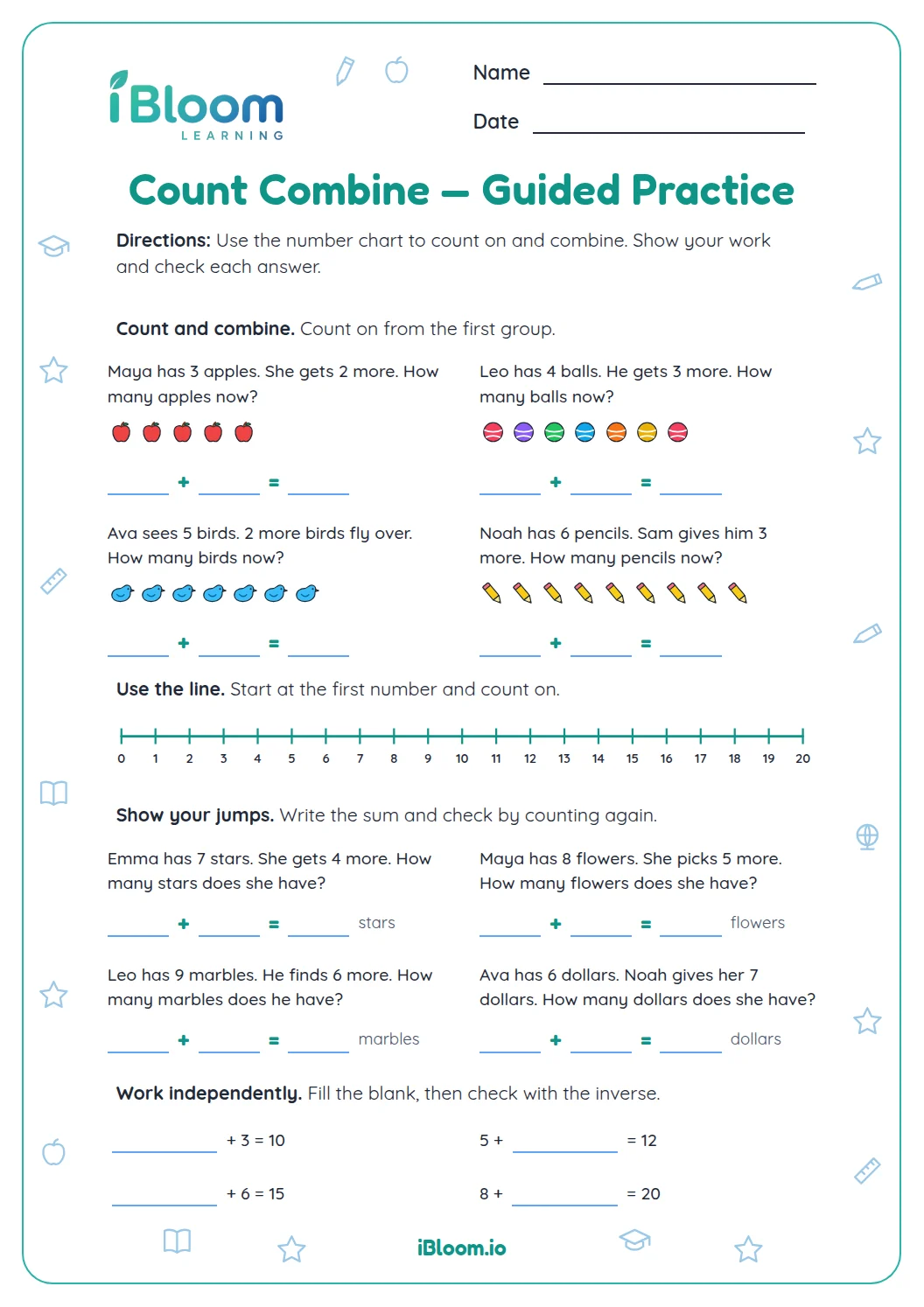
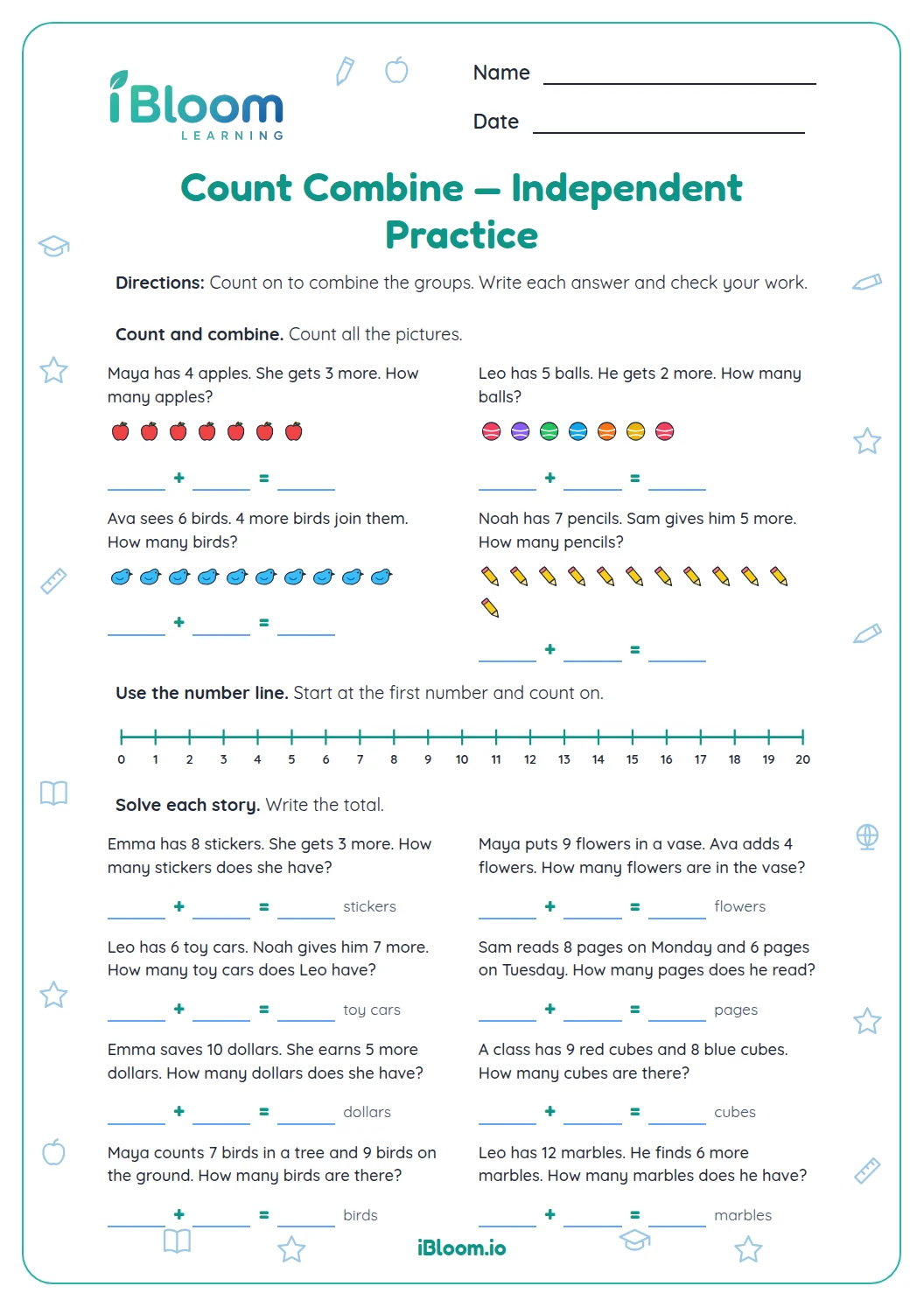
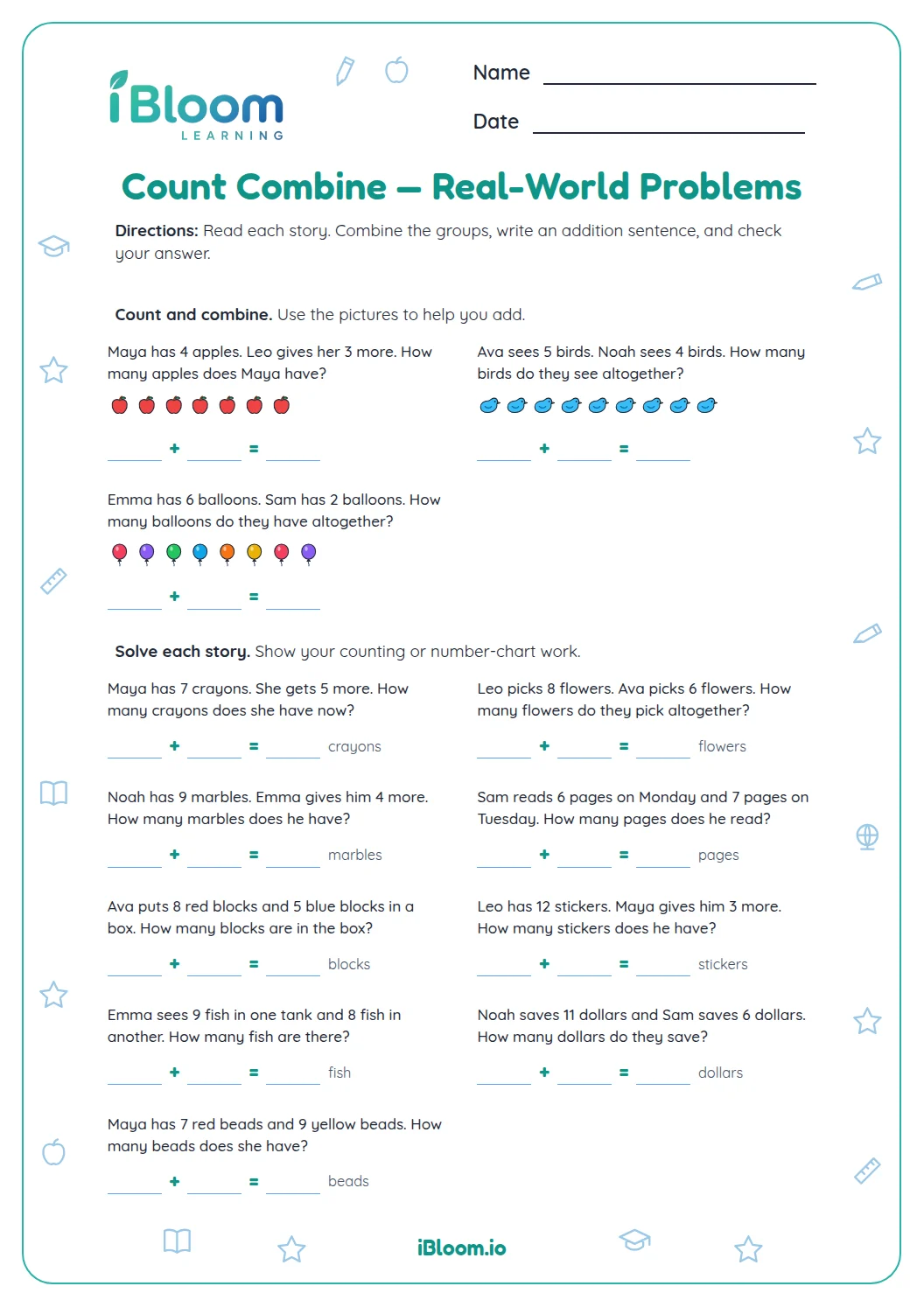
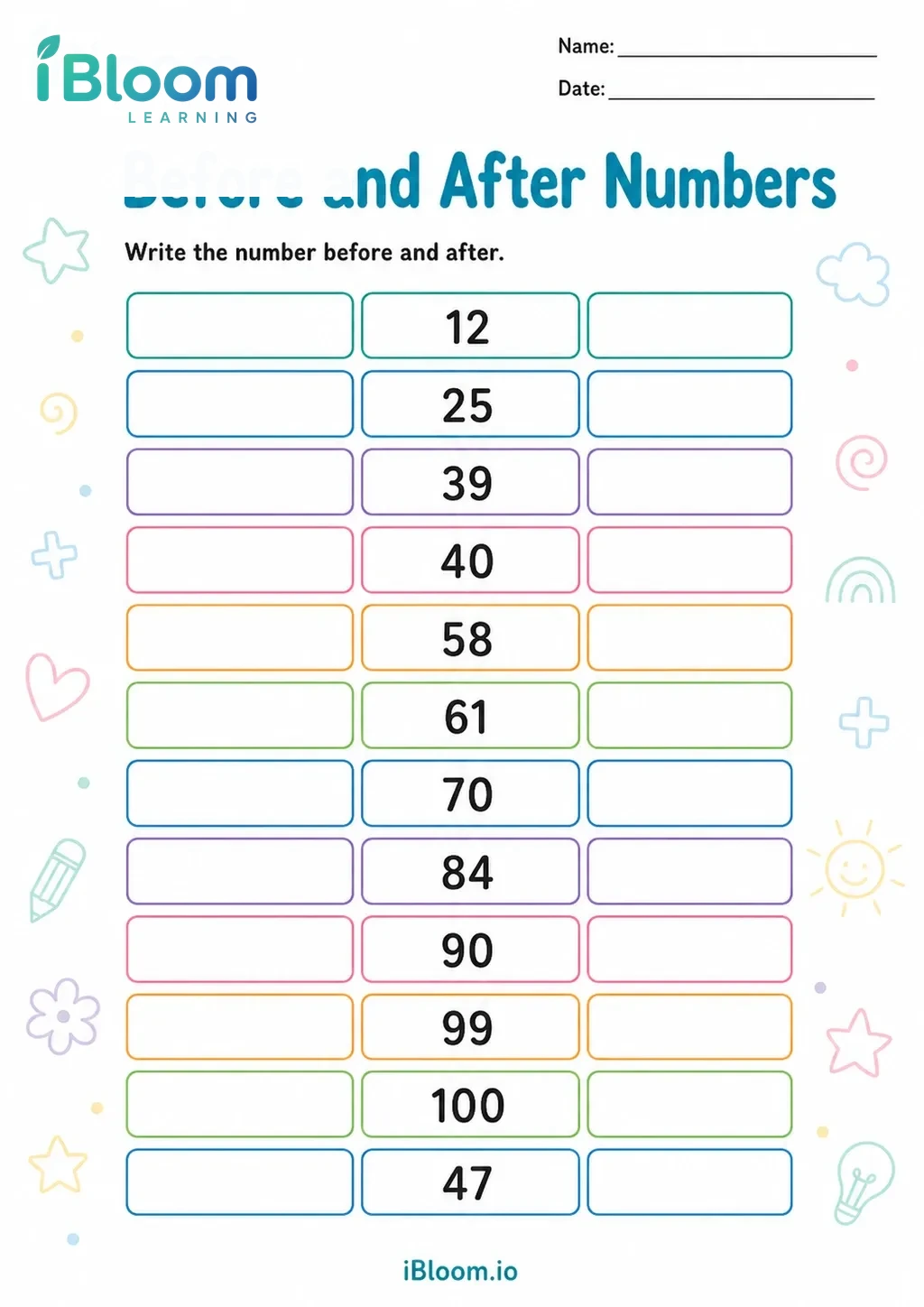
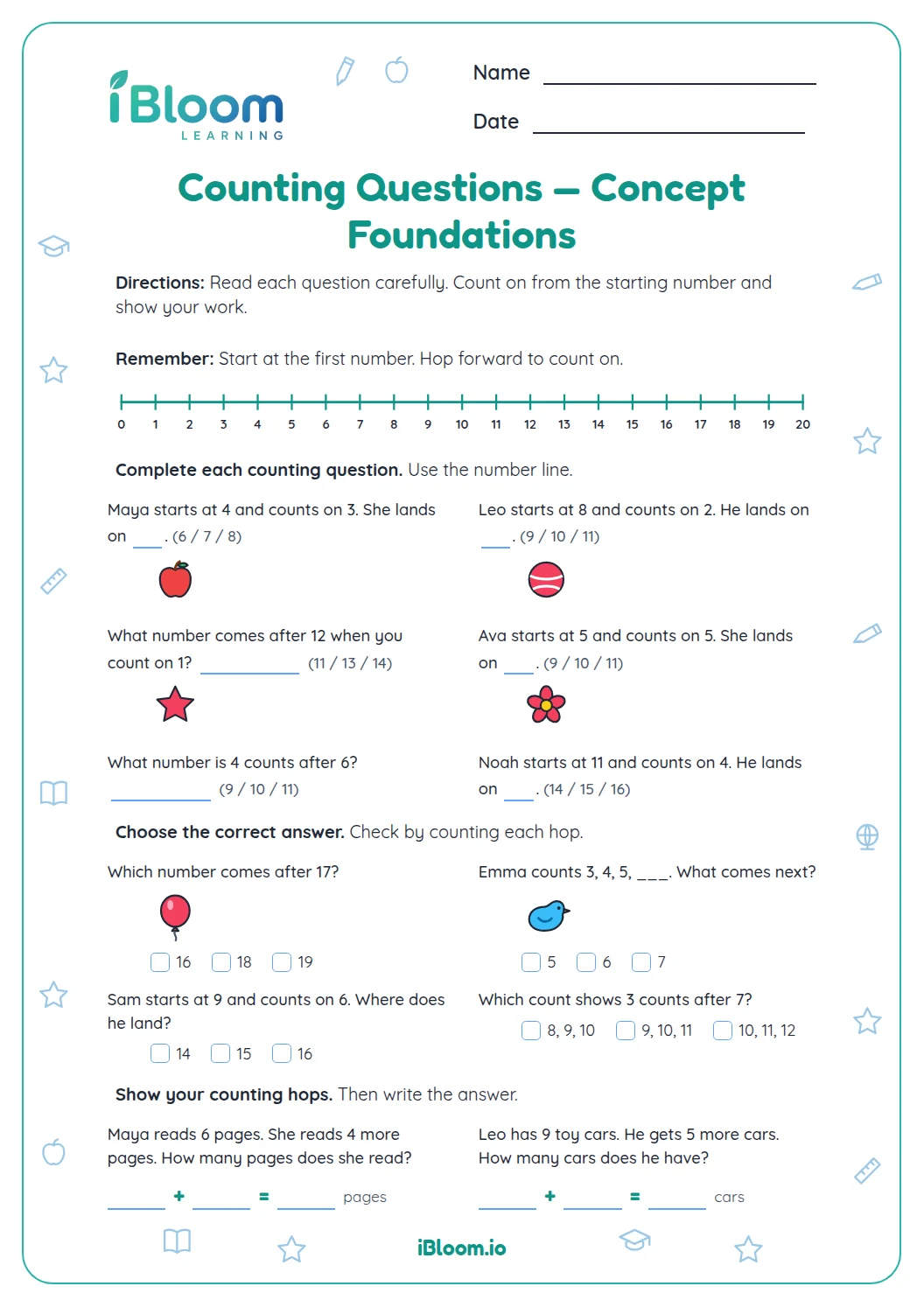
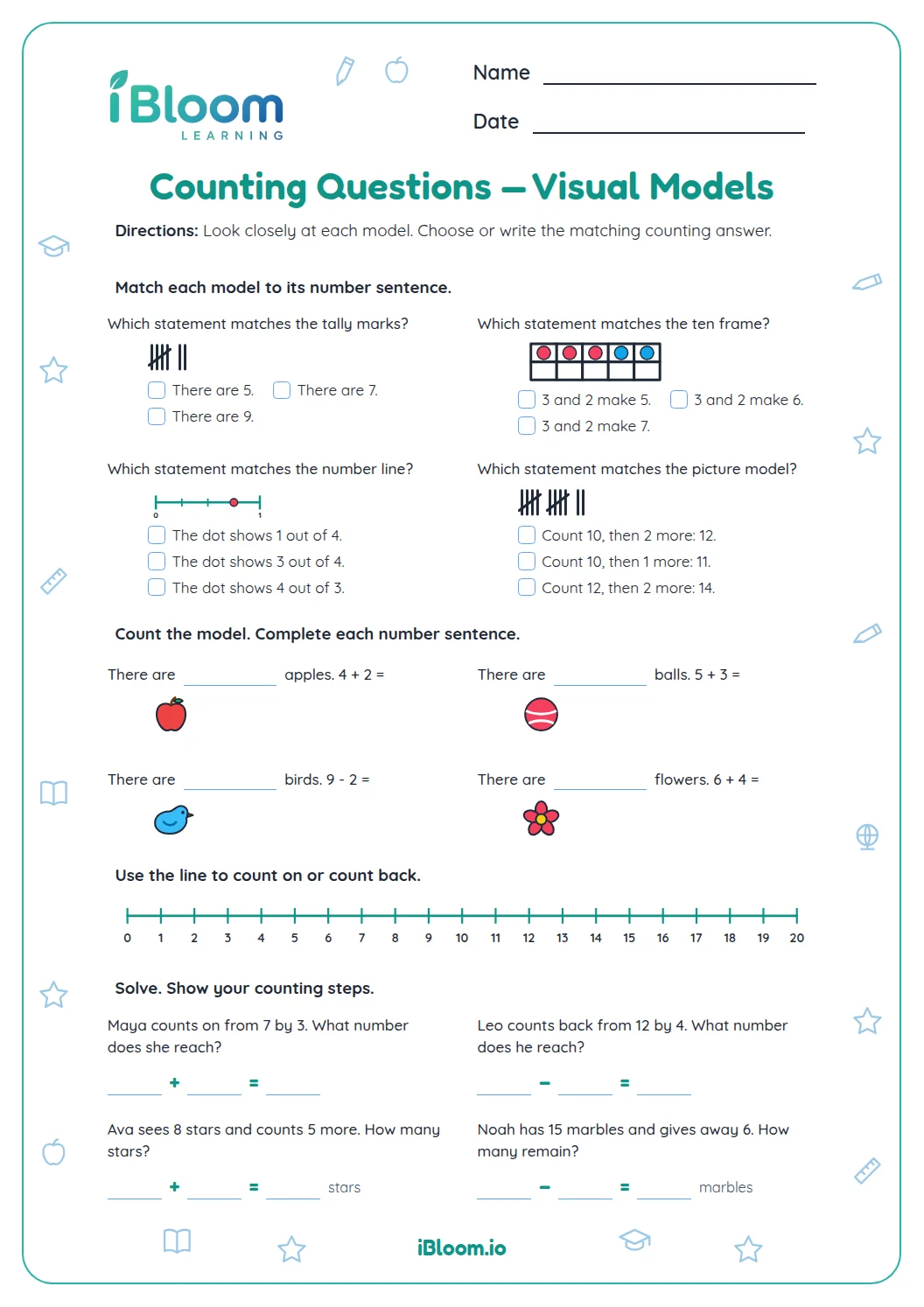
This Grade 1 printable has 14 questions on number patterns and combining groups. Children count forward on a number line, use one-more and ten-more patterns, complete addition and subtraction sentences, and choose an equation that matches a story. The answer key shows the results. It aligns with CCSS 1.OA.A.1 and 1.NBT.C.5.
Aligned to 1.OA.A.1 and 1.NBT.C.5
How can you count forward and combine groups?
A number chart organizes numbers in rows, so moving one place changes the number by 1 and moving down a row of tens changes it by 10. Counting on means taking steps after the starting number. Addition joins groups; subtraction tells how many remain or how many fewer.
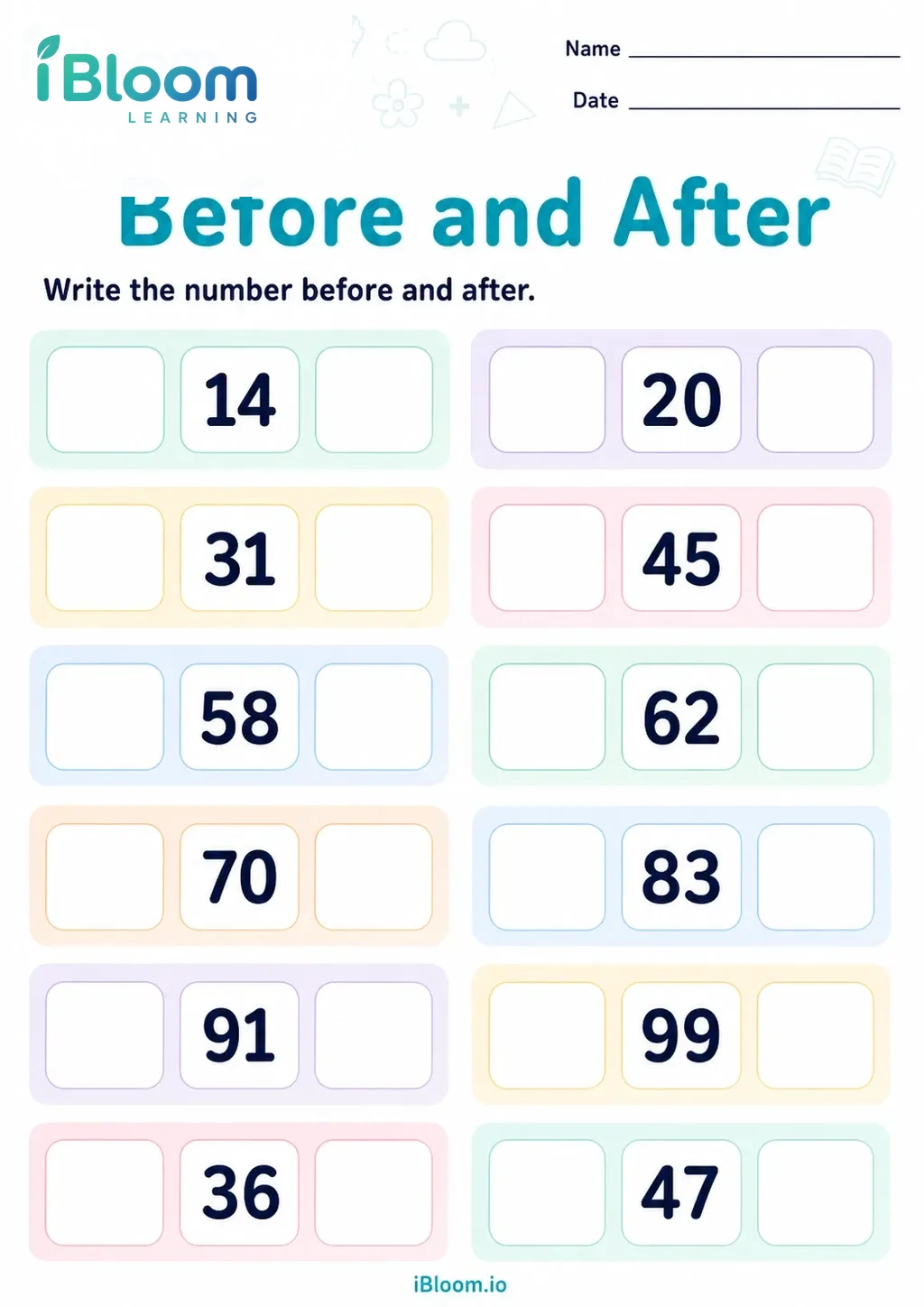
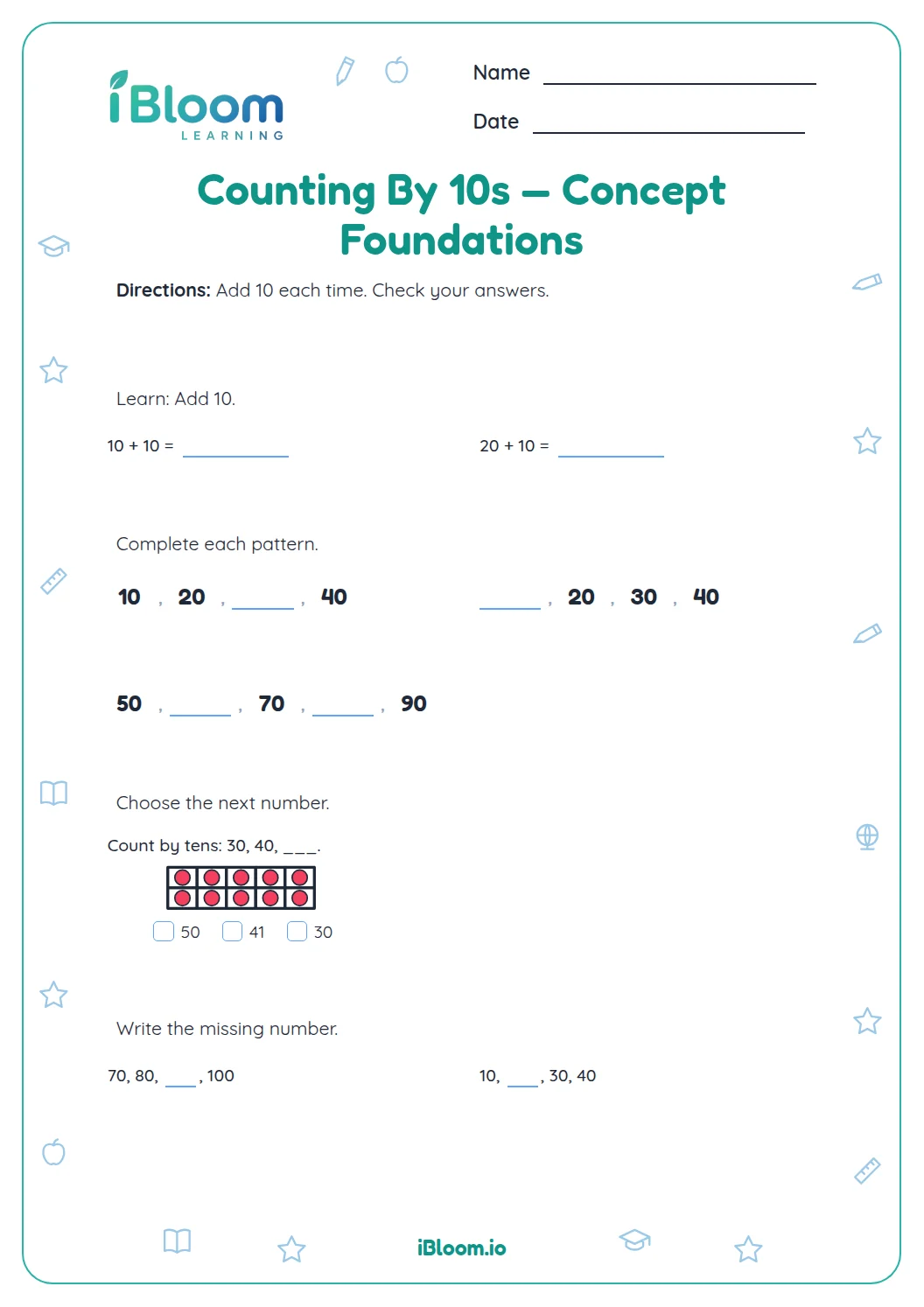
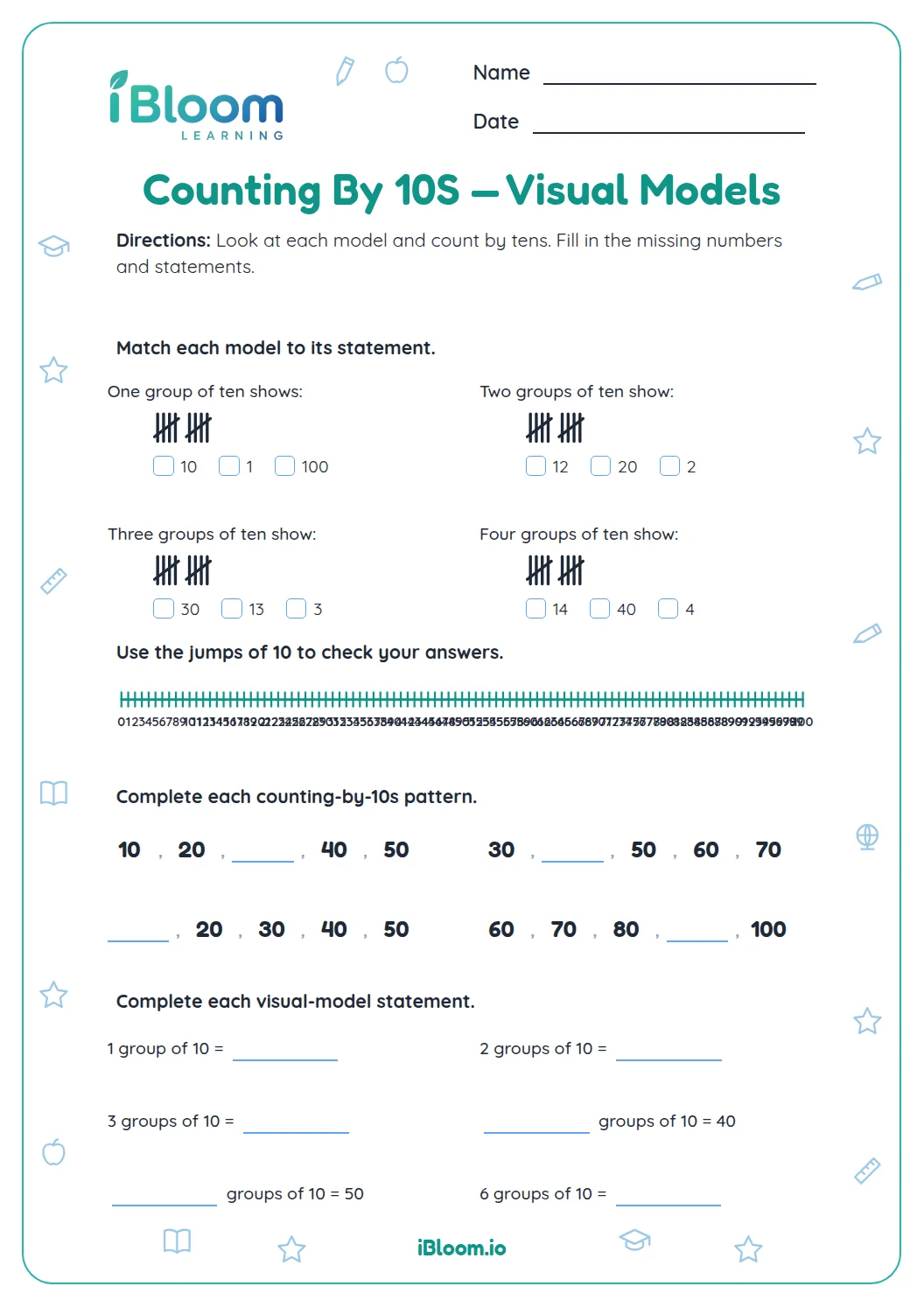
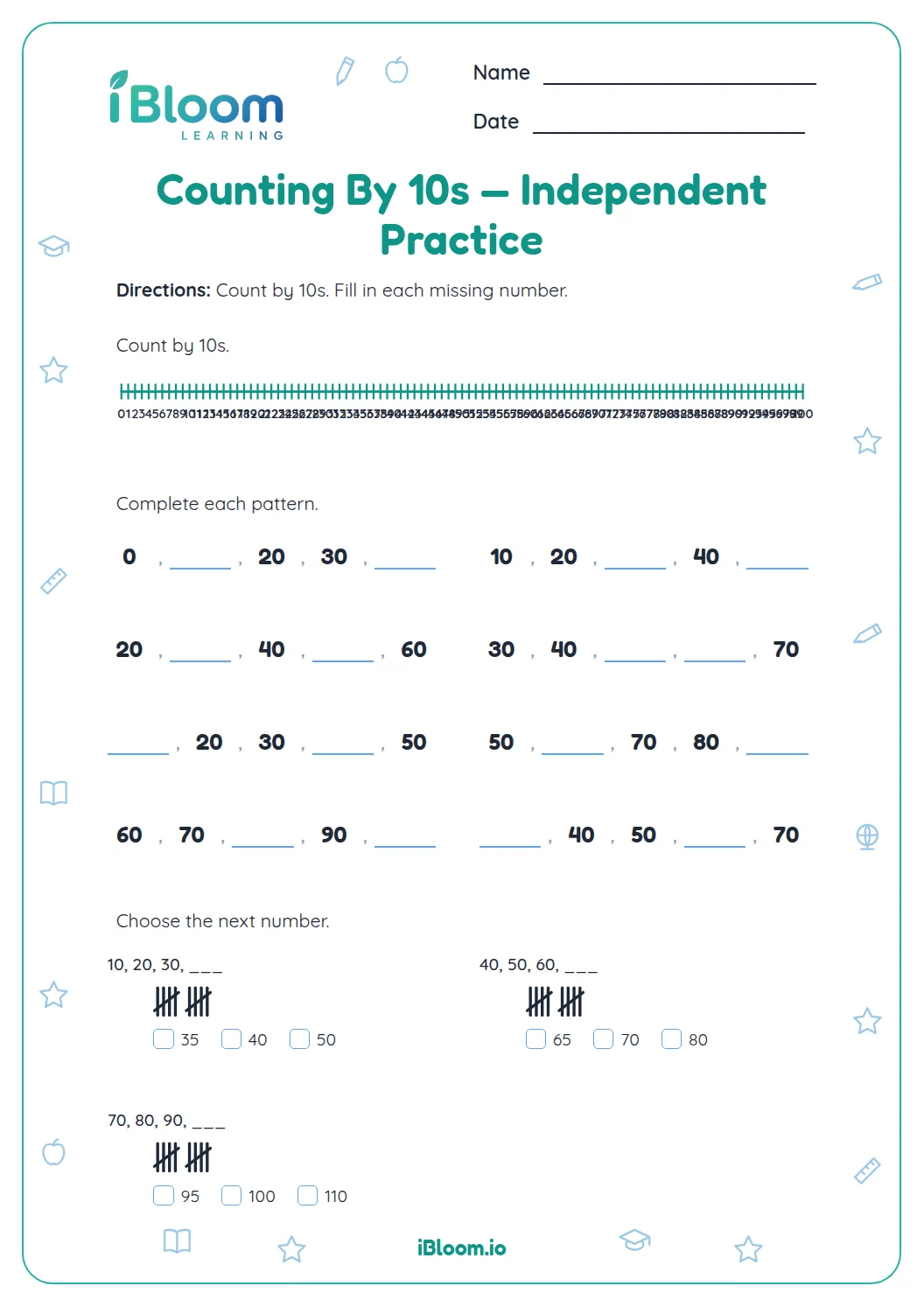
Children count forward on a number line, complete a counting sequence, use one-more and ten-more or ten-less equations, and solve addition and subtraction situations within 20 and with tens.
- 1Starting at 14 and counting on 3 lands on 17: 15, 16, 17. On the number line, each tick is one more.
What will children practice?
Children count forward on a number line, complete a number chart and number sentences, use one-more and ten-more or ten-less patterns, and solve addition and subtraction situations.
How can children check their answers?
For counting on, say the start and then count each next number as one step. For a story, identify whether objects join or leave; write the matching equation and check that its answer fits.
How to use this worksheet
- 1Say the starting number before counting on.
- 2On a chart, check whether a move changes the number by 1 or 10.
- 3For a story, decide whether groups join or separate.
- 4Write an addition or subtraction equation before solving.
- 5Check the answer against the story: more, fewer, or the same?
Common mistakes and quick fixes
The mistake
Counting the starting number as the first step.
The fix
For “count on 3 from 14,” say 15 for the first step, then 16 and 17.
The mistake
Moving down a chart row but adding only 1.
The fix
A row shift is ten more in the chart pattern; compare the column numbers.
The mistake
Adding in a take-away story.
The fix
Notice whether objects leave; if so, subtract from the starting group.
Common Core alignment
This worksheet practices counting patterns and combining groups through the skills named below.
Solve story problems that combine groups and find totals.
On this sheet: Solve story problems that combine groups and find totals.
Show the official wordingHide the official wording
Use addition and subtraction within 20 to solve word problems involving situations of adding to, taking from, putting together, taking apart, and comparing, with unknowns in all positions, e.g., by using objects, drawings, and equations with a symbol for the unknown number to represent the problem.
Find 10 more or 10 less mentally from a two-digit number.
On this sheet: Questions use ten-more and ten-less patterns with two-digit numbers.
Show the official wordingHide the official wording
Given a two-digit number, mentally find 10 more or 10 less than the number, without having to count; explain the reasoning used.
What to practice next
Make more practice
Further reading
Questions parents and teachers ask
What does “ten more” mean on a number chart?
On a number chart with ten numbers in each row, the number directly below is ten greater because the ones digit stays the same and the tens increase by one. For example, 23 becomes 33. The worksheet also uses ten-less equations.
How do children count on from 14 by 3?
Start at 14 and take three counting steps: 15, 16, 17. The starting number is not counted as a step. The first question includes a number line so a child can track one jump at a time. Use counters or a quick sketch to make each step visible.
How can a child tell whether to add or subtract in a story?
Look at what happens to the group. If more objects join, add; if some leave or are used, subtract. For example, 8 books plus 6 more is addition, while 15 birds with 4 flying away is subtraction. Use counters or a quick sketch to make each step visible.
What are missing-number equations?
They are number sentences with one unknown part, such as 6 + ___ = 13. A child can count on from 6 to 13 or use the related subtraction fact, 13 − 6, to find 7. Use counters or a quick sketch to make each step visible.
How many questions are included?
There are 14 questions across three parts: counting on along a number line, completing patterns and number sentences, then choosing an equation for a joining story. The key lists each result in order. Children can use counters or sketch groups to check.
Can my child use a drawing to solve the stories?
Yes. Children can sketch small groups, use counters, or make a number sentence before writing the answer. The printable leaves the reasoning in short steps so they can choose a method and then check that the total fits the story.