




About this worksheet
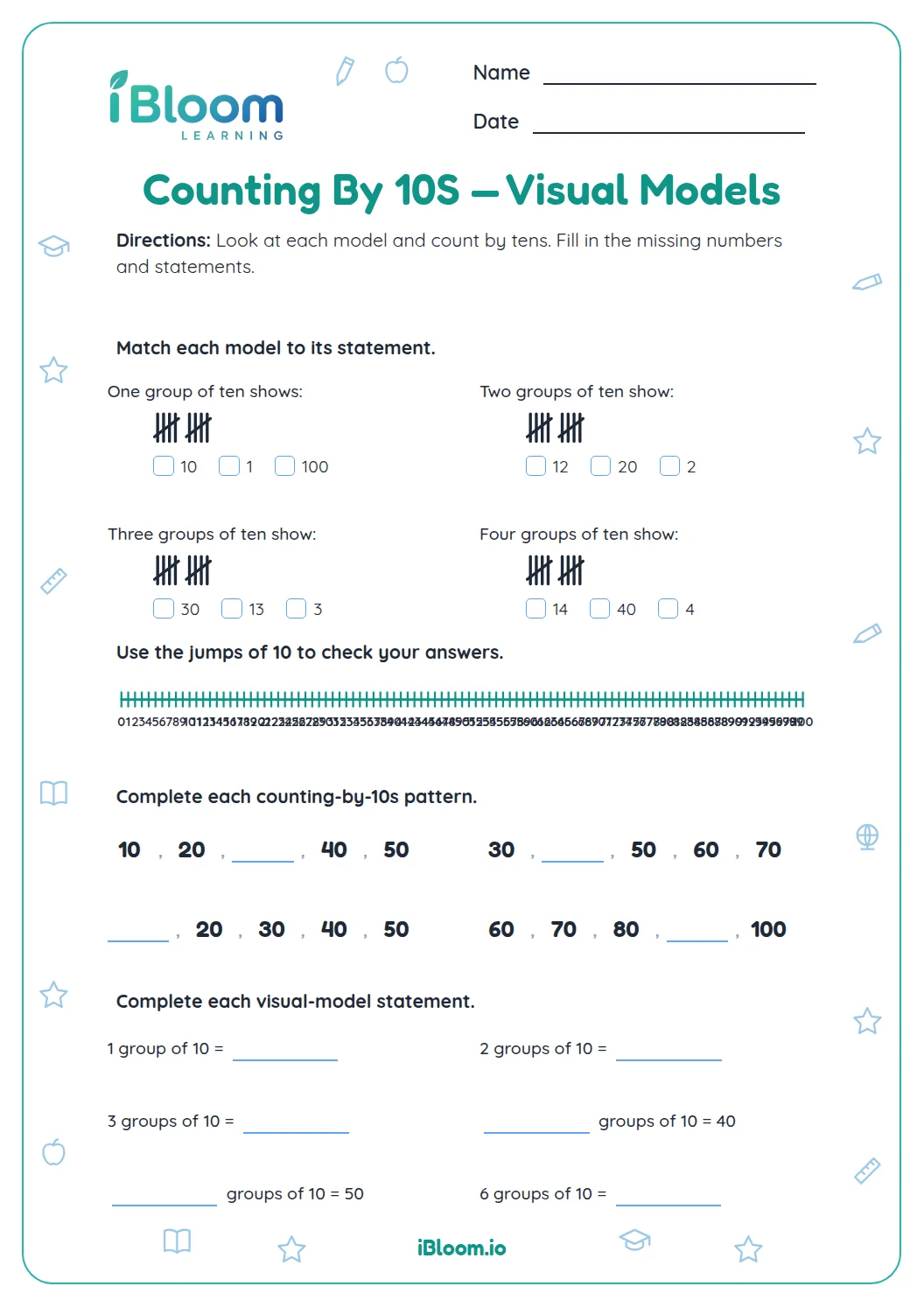
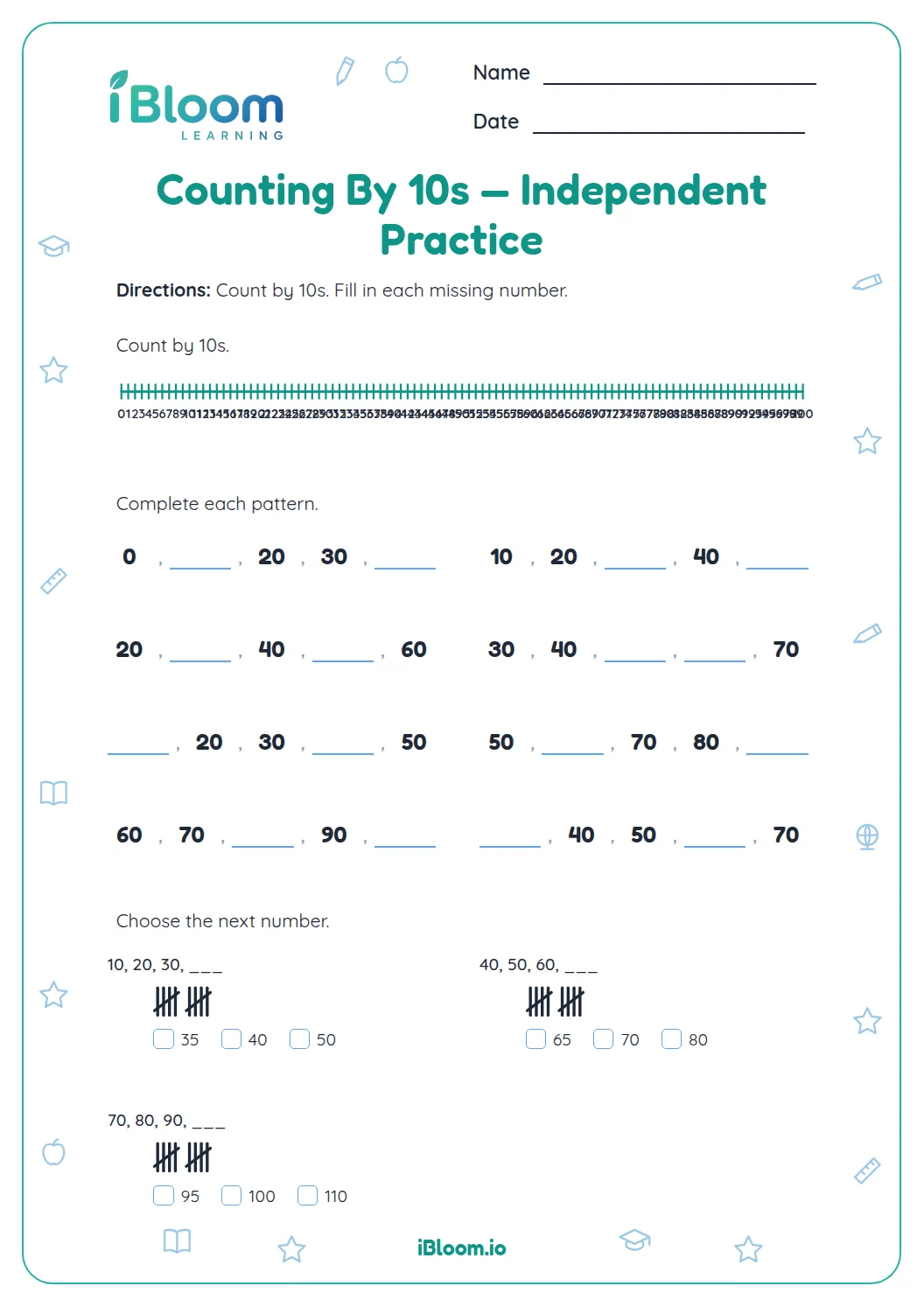
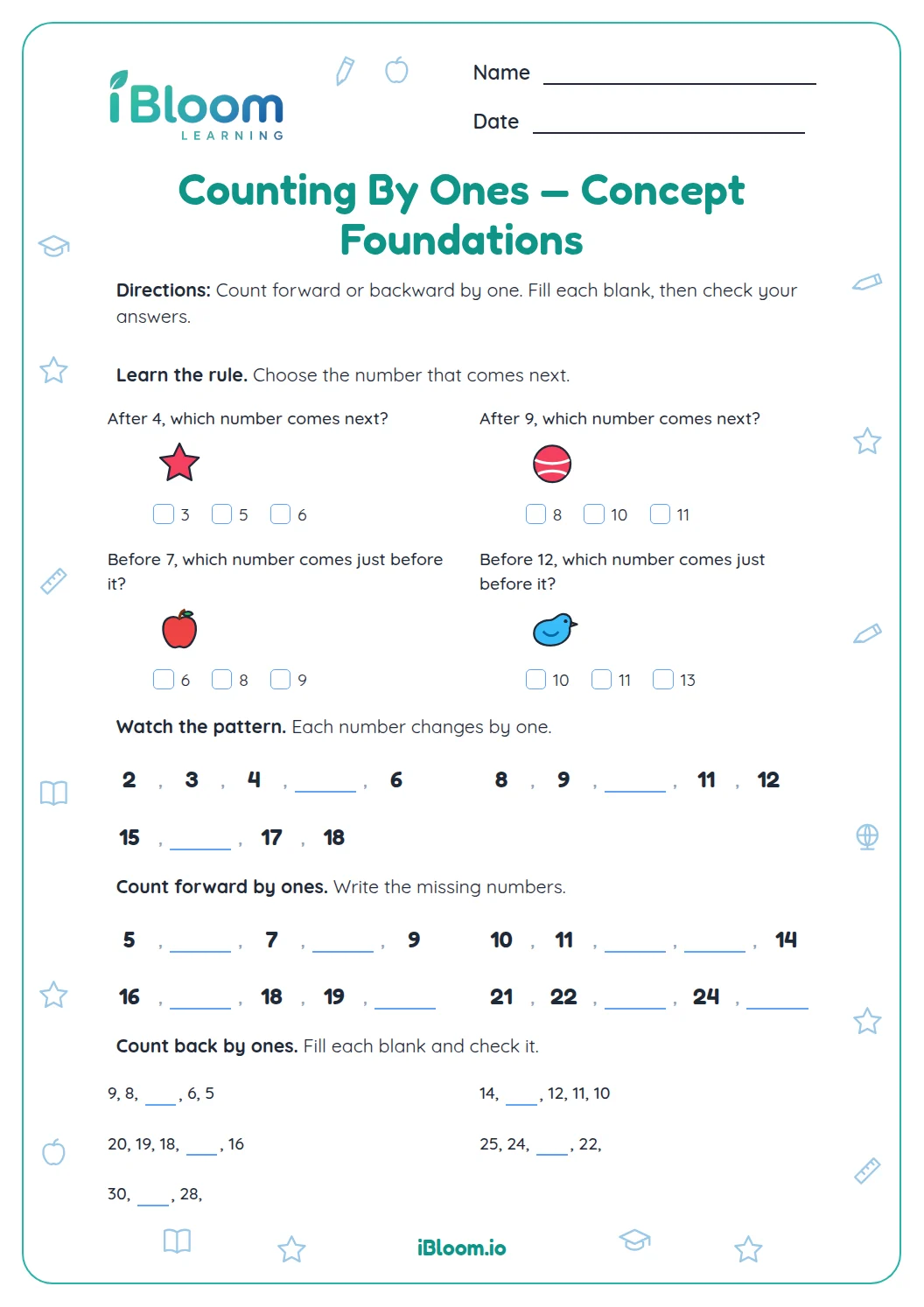
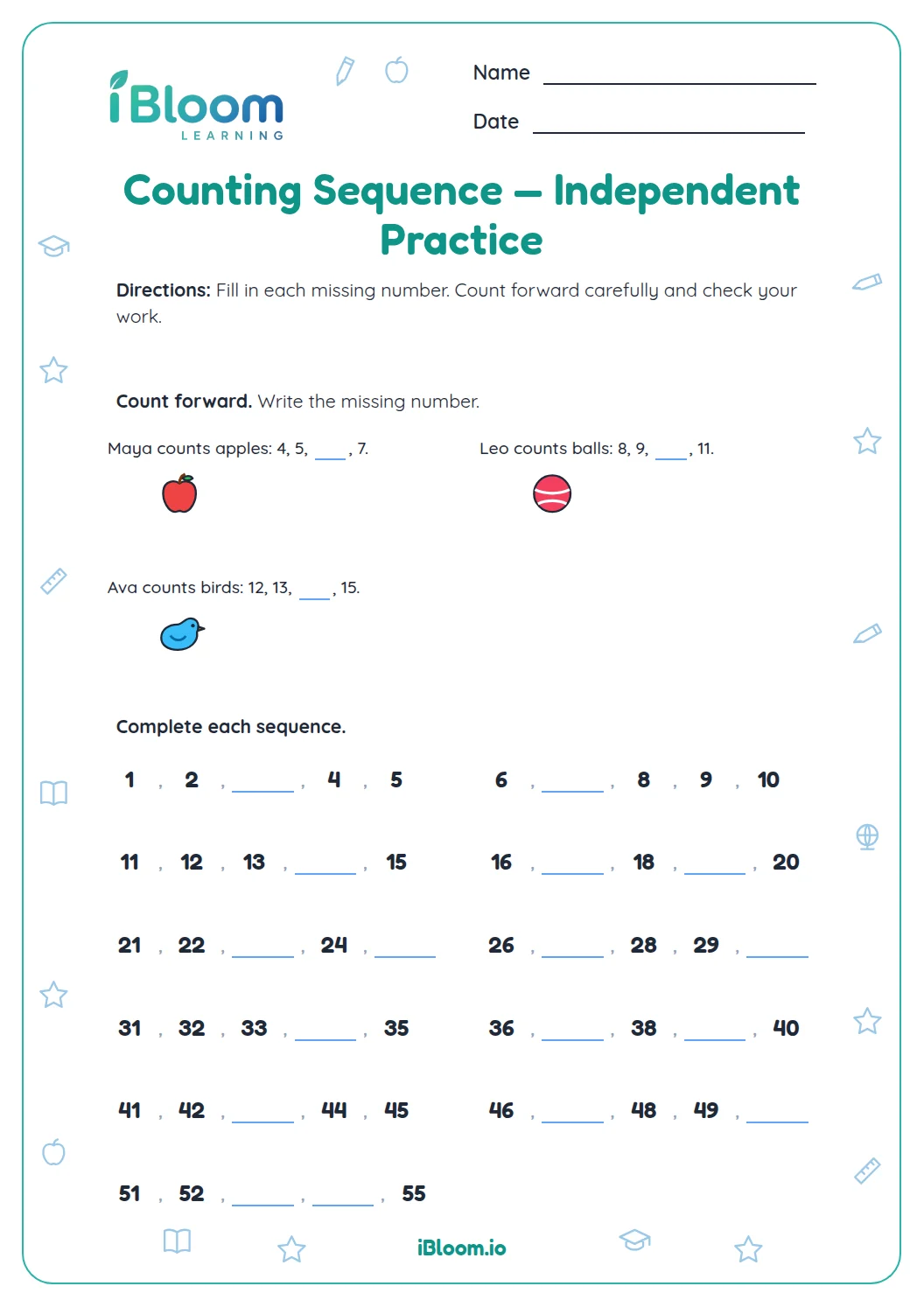
This Grade 1 number-pattern worksheet gives children 16 chances to count forward by tens. Some sequences begin at a decade; others start at numbers such as 15, 42, and 7, so children notice that the ones digit stays fixed. A separate answer key lists each missing numeral. The practice supports CCSS 1.NBT.A.1 by counting from different starting numbers.
Aligned to 1.NBT.A.1
What changes when you count by tens?
Each sequence advances by ten. Some start at a decade, while others begin with a different ones digit.
Can counting by tens start at 15?
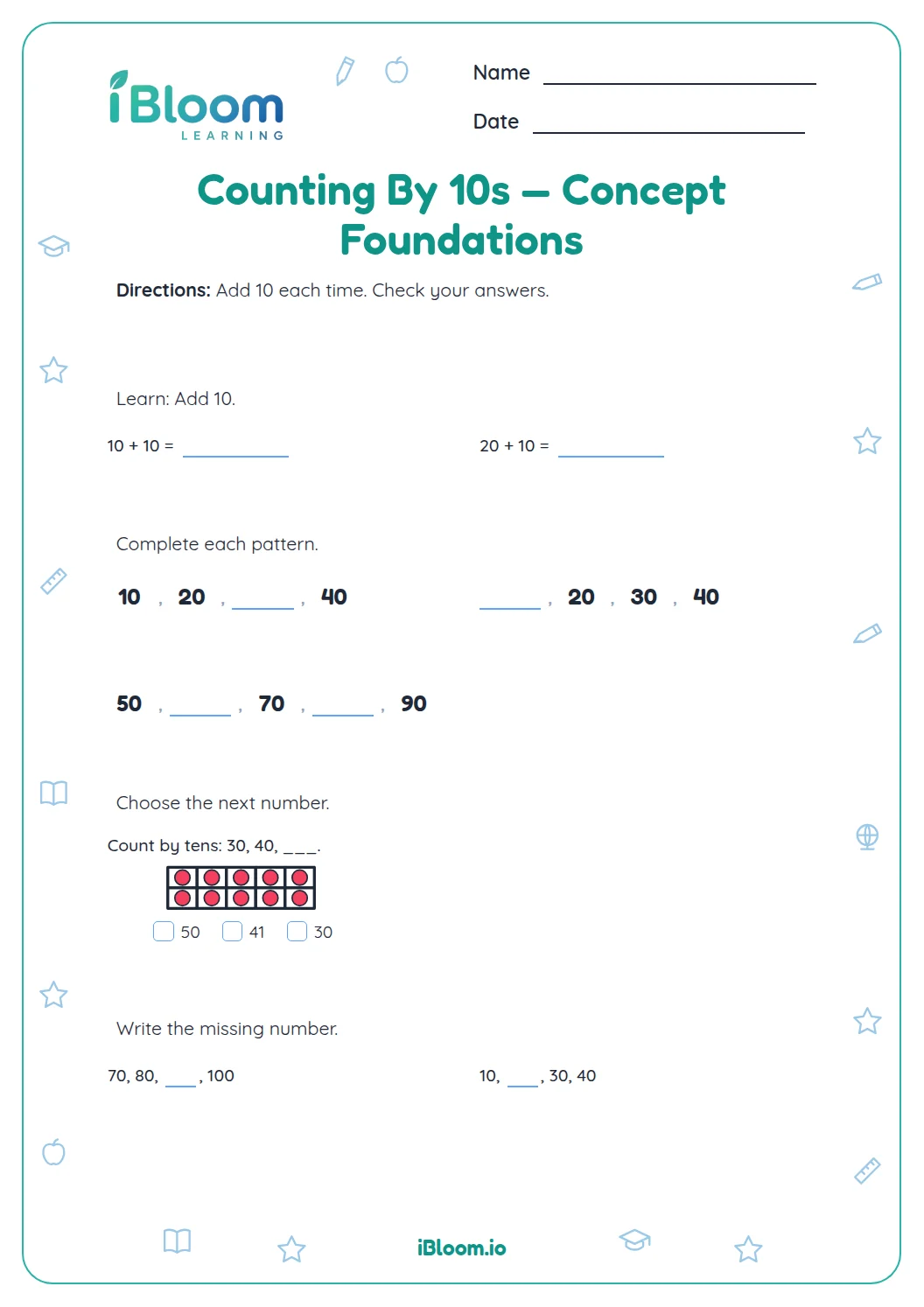
In question 1, 10, 20, ___, 40, 50 increases by ten each step. The blank is 30.
- 110, 20, ___, 40, 50
- 2Add 10 after 20: 30. Check that 30 + 10 = 40.
- 3Answer: 30
How can I check a missing number?
For the later sequences, use both neighbors around the blank to confirm that the difference stays ten.
How to use this worksheet
- 1Find the change from one number to the next.
- 2In a sequence counting by ten, keep the ones digit the same.
- 3Add ten to the number before the blank.
- 4Check by subtracting ten from the number after the blank.
- 5Read the whole sequence aloud to make sure it increases evenly.
Common mistakes and quick fixes
The mistake
Change the ones digit while counting by tens.
The fix
Keep the ones digit the same and increase the tens by one.
The mistake
Add one instead of ten.
The fix
Compare neighbors in the sequence; each step is ten more.
The mistake
Fill a blank from only one side.
The fix
Check the answer by adding ten forward and counting back ten from the next term.
Common Core alignment
Continue counting by 10s from different starting numbers and read the numerals.
On this sheet: Each sequence advances by ten, including sequences that begin at a non-multiple of ten.
Show the official wordingHide the official wording
Count to 120, starting at any number less than 120. In this range, read and write numerals and represent a number of objects with a written numeral.
What to practice next
Make more practice
Further reading
Questions parents and teachers ask
Does counting by tens always start at 10?
No. The sequences include starts such as 15, 42, and 7. Add ten at each step, keeping the ones digit the same. For example, 42, 52, 62 moves forward by ten even though it does not start at a decade.
What should stay the same when counting by tens?
The ones digit stays the same while the tens value increases by one ten. For example, 42 becomes 52, then 62. Check both parts of the pattern: the ones digit is fixed and the whole number is ten greater each time.
How many questions are included?
There are 16 missing-number questions arranged in four sets. Each sequence has five terms and one blank, with the blank appearing at the beginning, middle, or end. The starting numbers include 10, 15, 42, and 7, so children see both decade and non-decade patterns.
How can children check their work?
Use the terms on both sides of the blank. Add ten to the term before it, then subtract ten from the term after it. For example, between 42 and 62, the missing term is 52; both checks give the same result.
Is there an answer key?
Yes. A separate key gives the missing numeral for each of the 16 sequences. Have the child read a completed sequence aloud and check that every neighboring pair differs by ten. The key then makes it easy to verify the written answers.