




About this worksheet
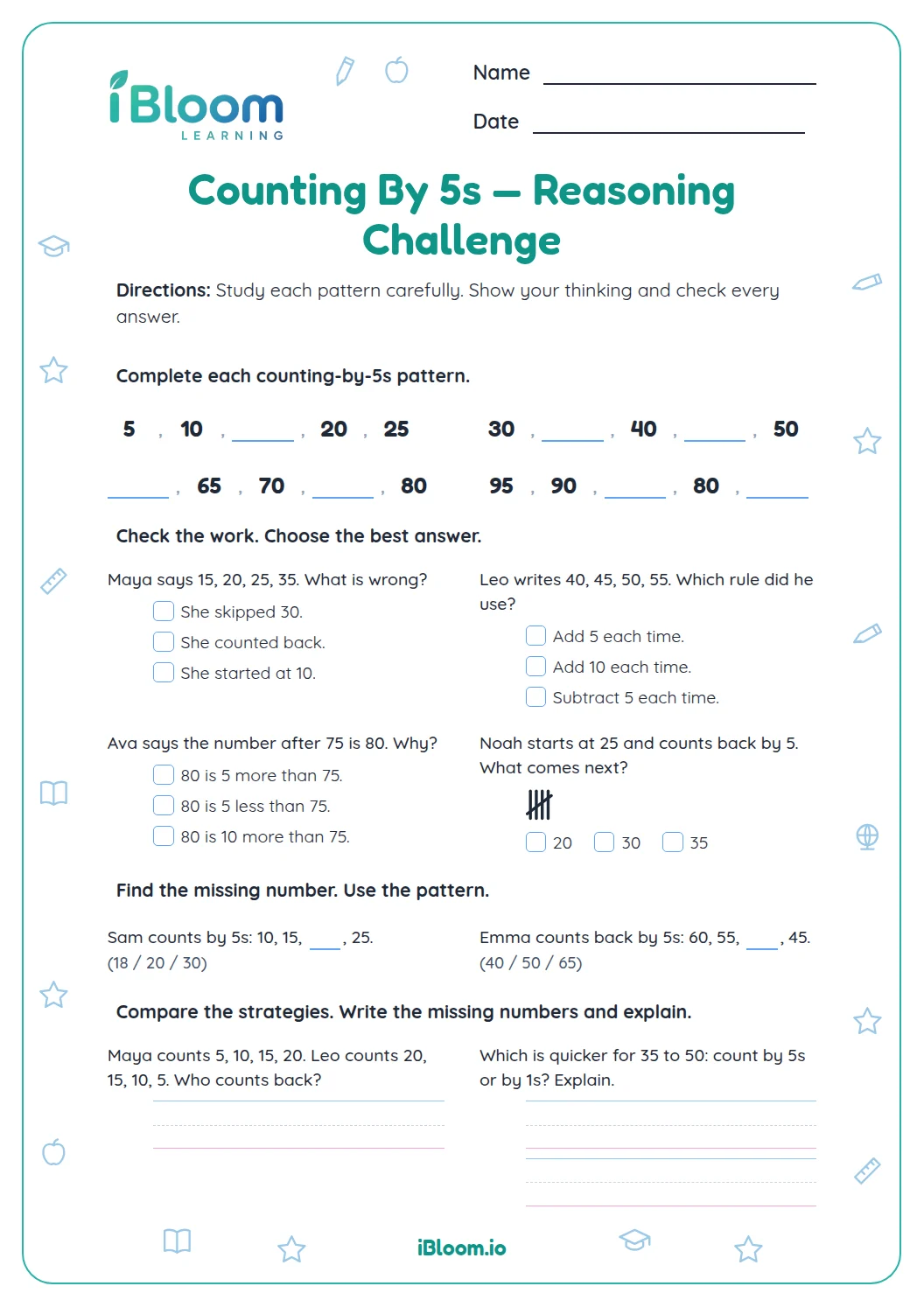
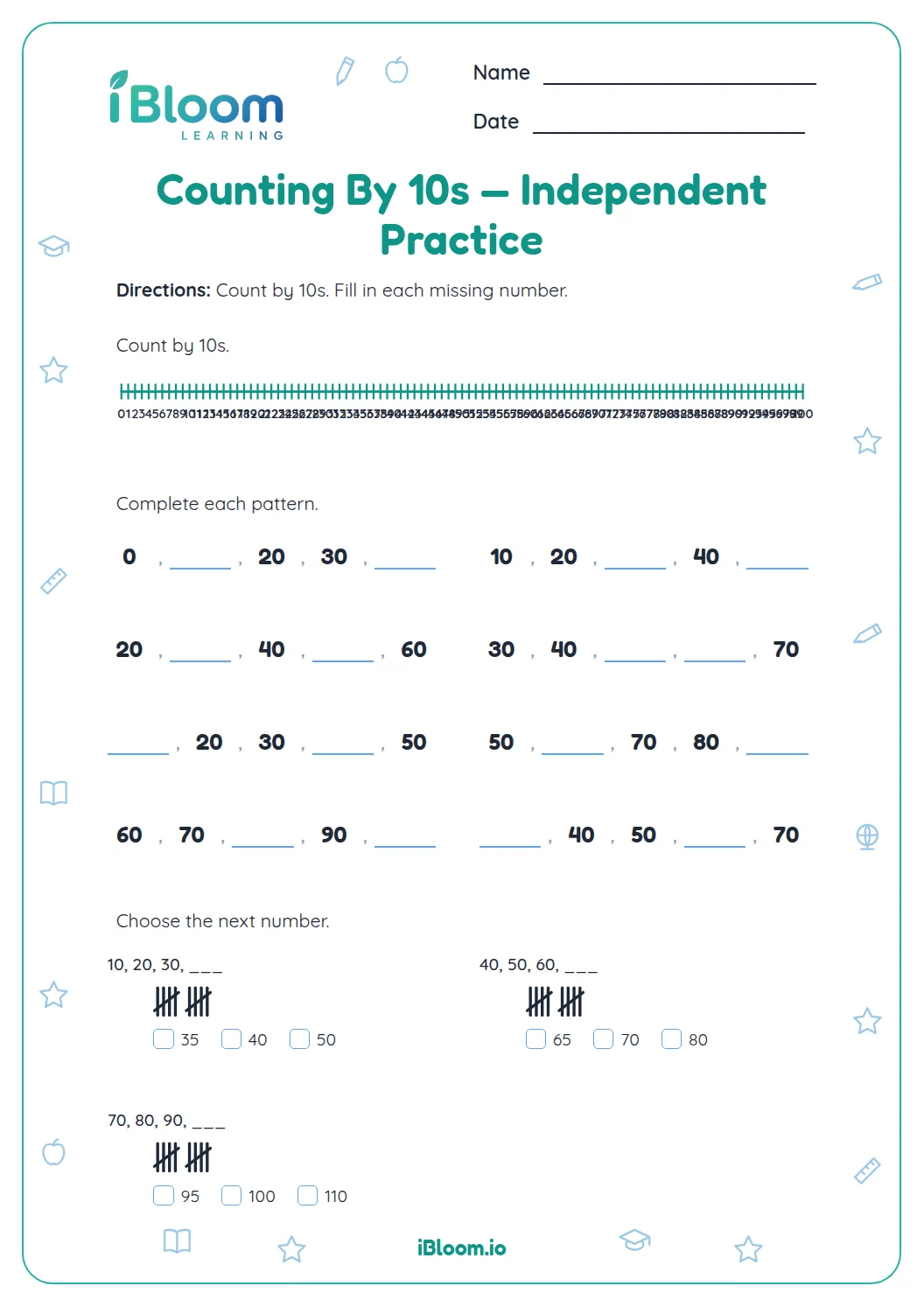
This Grade 1 worksheet practices counting by fives in number patterns and equal groups. Learners fill missing terms, count arrays and tally marks, and complete sequences that begin at zero or a later starting point. All counts stay within 100. The key shows the missing numbers and totals. Counting forward from varied starting numbers supports CCSS 1.NBT.A.1.
Aligned to 1.NBT.A.1
What stays the same when counting by fives?
Each next number is five more than the number before it. In question 1, the missing number after 10 is 15, followed by 20 and 25. Check one step at a time rather than guessing the whole pattern.
- 15, 10, 15, 20, 25
- 2Each move adds 5.
How do pictures show groups of five?
Each row in Part B contains five objects. Count one row as 5, the next as 10, and so on; question 10 has four rows of five apples, for a total of 20. Question 11 bundles tally marks in fives.
Can counting by fives begin above zero?
Yes. Start at the number printed, then add five for each next term. Question 14 begins at 60, so the count is 60, 65, 70, 75.
How to count by fives
- 1Read the first number in the sequence.
- 2Add five once for the next number.
- 3Repeat until every blank is filled.
- 4For pictures or tally marks, count one group as five.
- 5For a sequence that begins above zero, keep that starting number and add five at each step.
Counting slips to check
The mistake
Adding five to the wrong starting number.
The fix
Use the first number printed in that sequence, even when it is above zero.
The mistake
Skipping two numbers after a blank.
The fix
Write the count aloud one jump at a time: 60, 65, 70, 75.
The mistake
Counting every mark separately after already counting a group of five.
The fix
Keep a running total by fives as you move from one complete row or tally bundle to the next.
Common Core alignment
The sequences begin at different numbers and count forward by fives.
Count forward from a number below 120.
On this sheet: Learners continue by fives from starting numbers through 95.
Show the official wordingHide the official wording
Count to 120, starting at any number less than 120.
What to practice next
Make more practice
Further reading
Questions parents and teachers ask
What does counting by fives mean?
Counting by fives means adding five to the last number each time. The pattern might sound like 5, 10, 15, 20, or begin at a later number such as 60. In the number patterns, each blank continues that same five-point step.
Can a count by fives begin at a number other than zero?
Yes. Start with the first number in the sequence and add five each time. In question 14, beginning at 60 gives 65, 70, then 75. Count three moves after the start; do not restart at zero. Each jump adds five more.
How do the picture groups help?
Each row has five objects, so learners can count a row as one group of five. Three rows make 15, four rows make 20, and five rows make 25. The total is the number of objects, not the number of rows.
How can a student check a missing number?
Compare the numbers on both sides of the blank. Each step should increase by five. If a blank follows 35, the next number is 40, and the following number is 45. Read each neighboring number to confirm the step is five in the right direction.
Is an answer key included?
Yes. A separate key lists the missing numbers and the totals for the pictured groups and tally marks. It also gives the missing terms in the short sequences so an adult can check the pattern with the learner.