



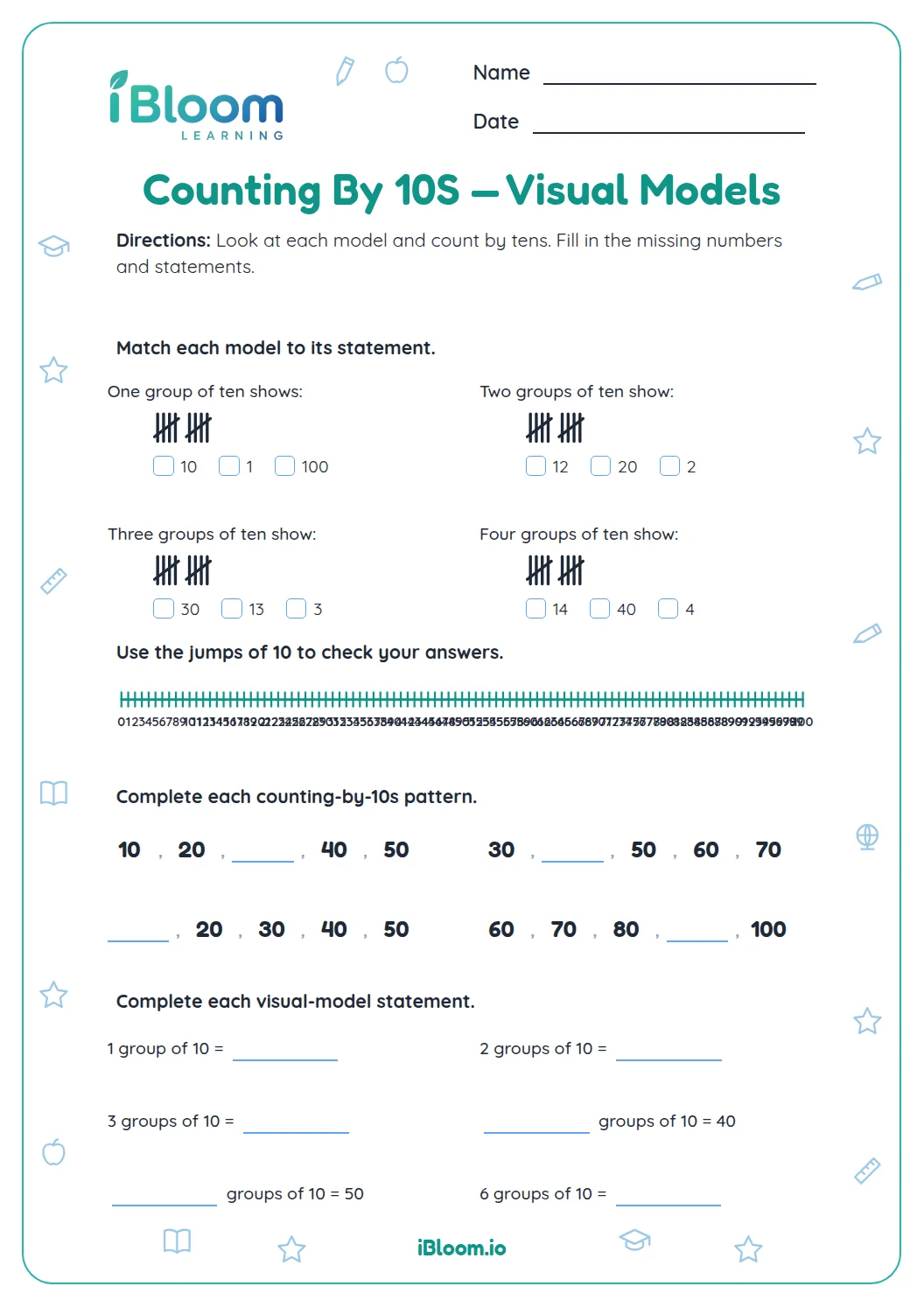
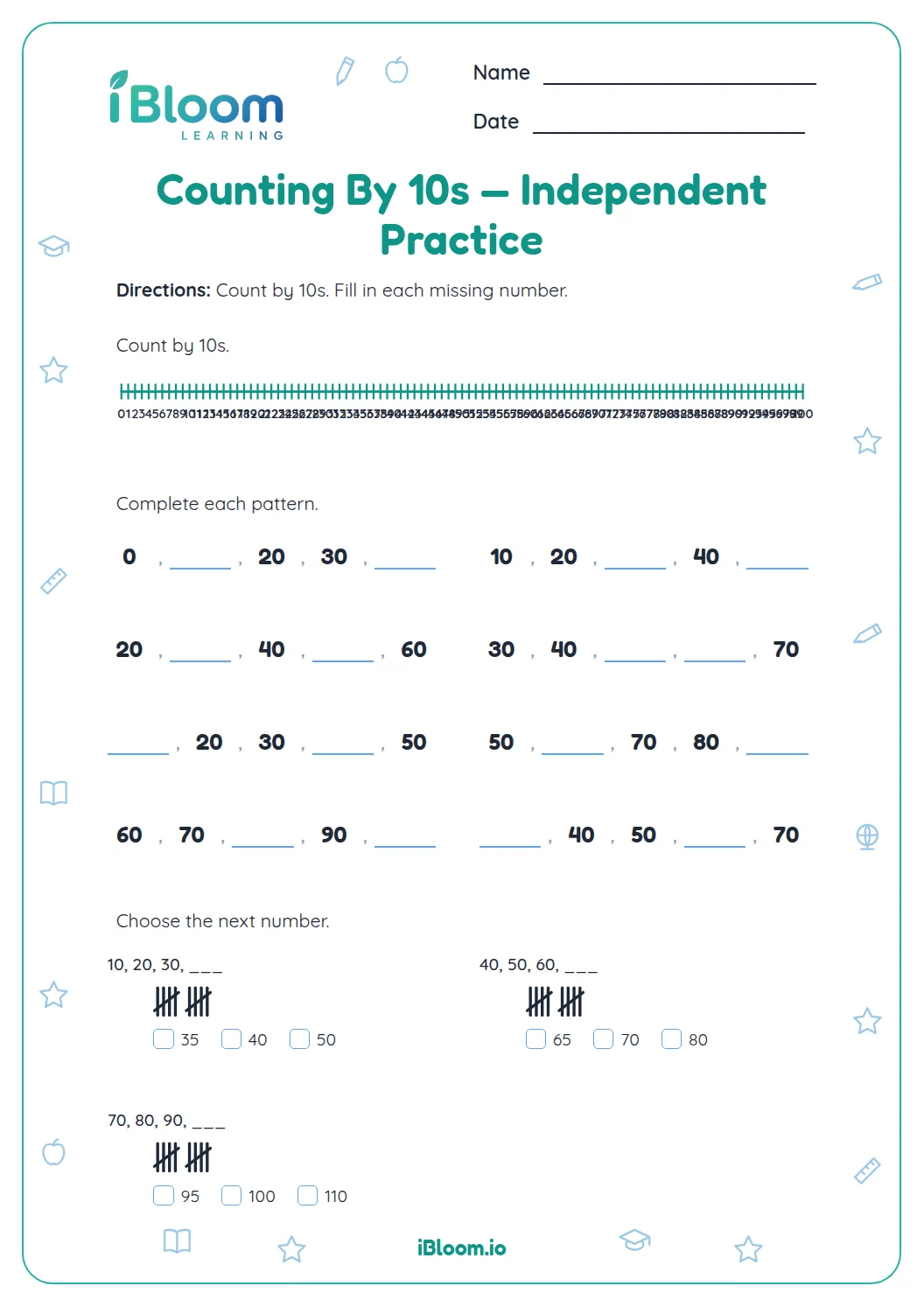


About this worksheet
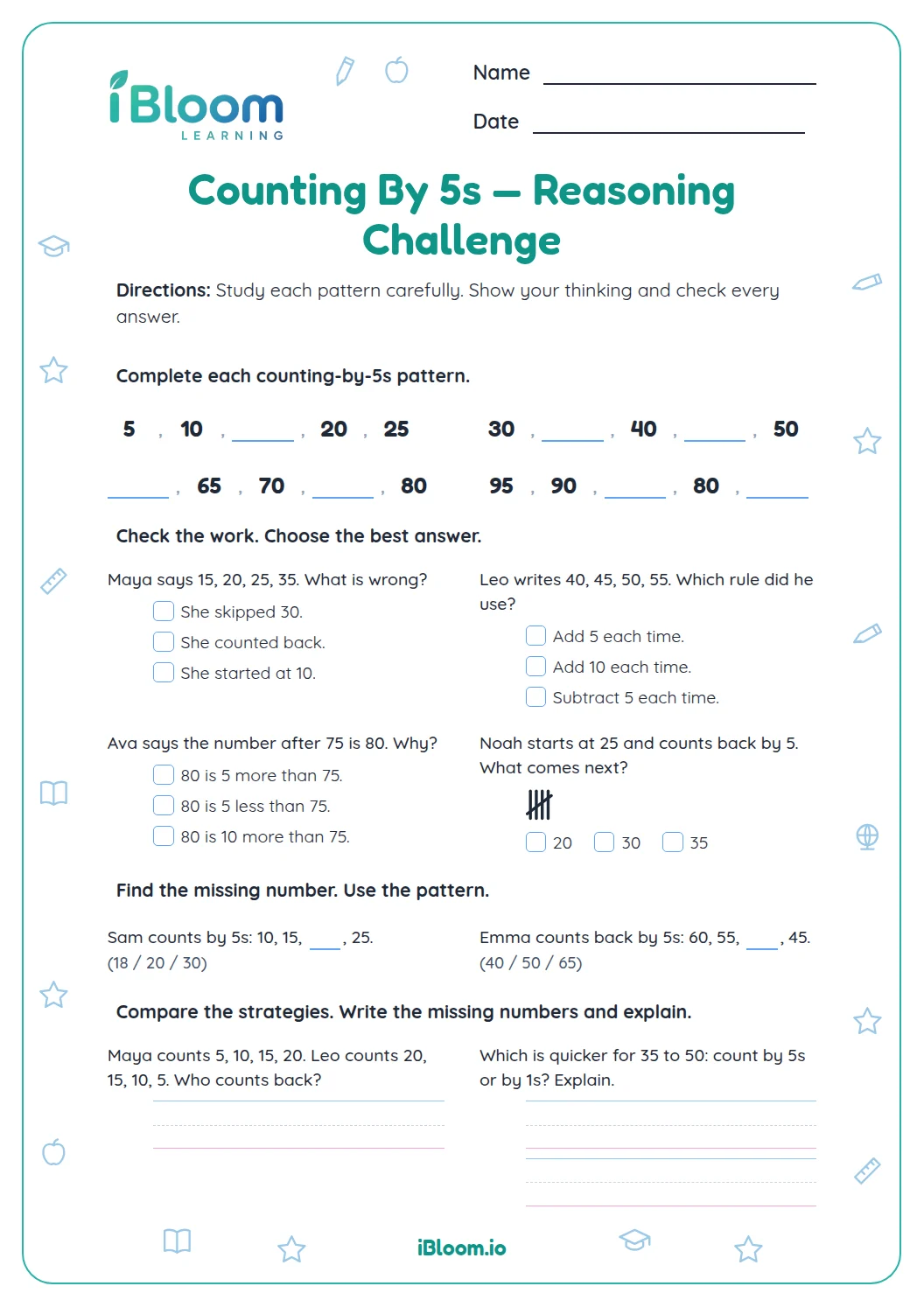
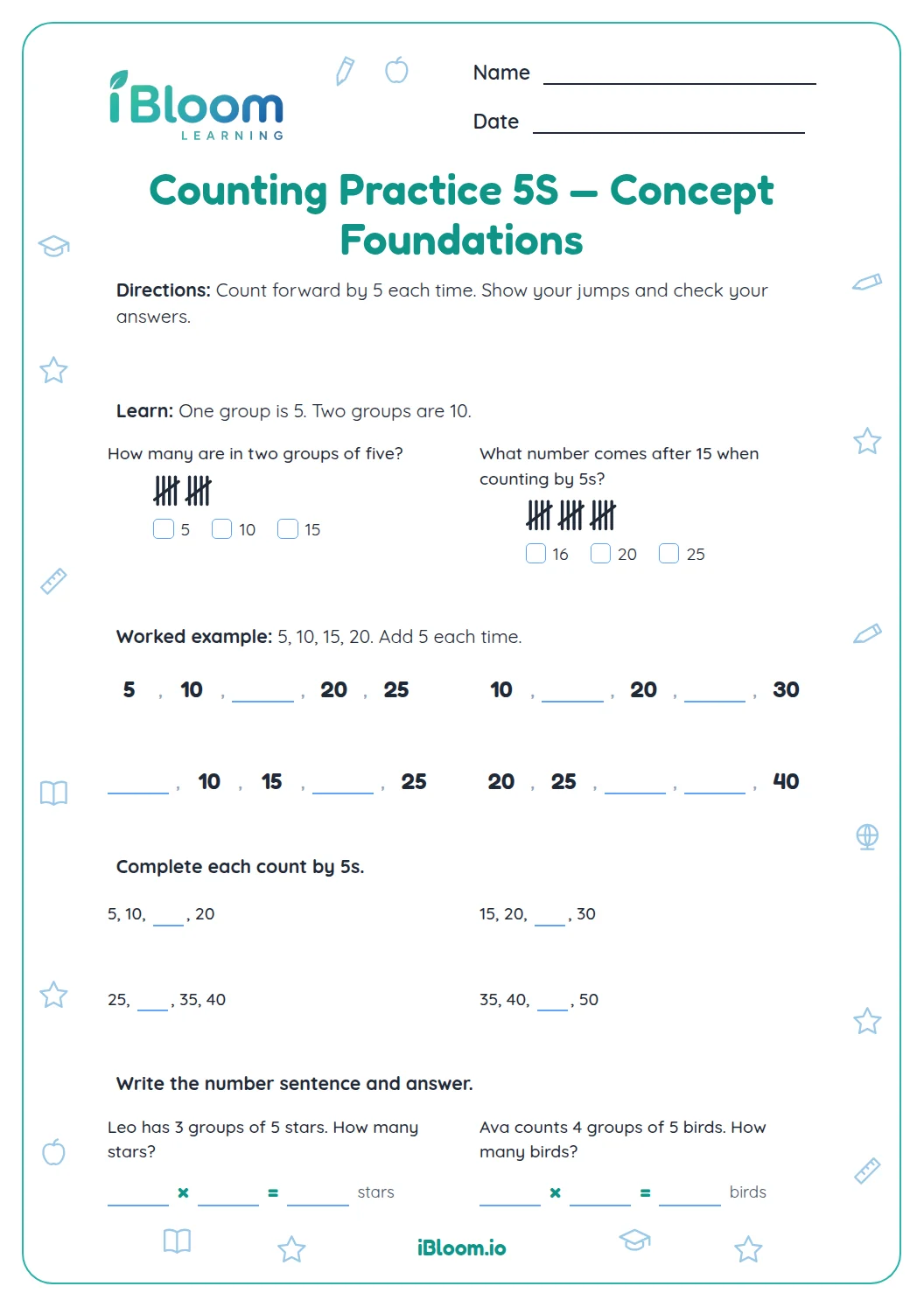
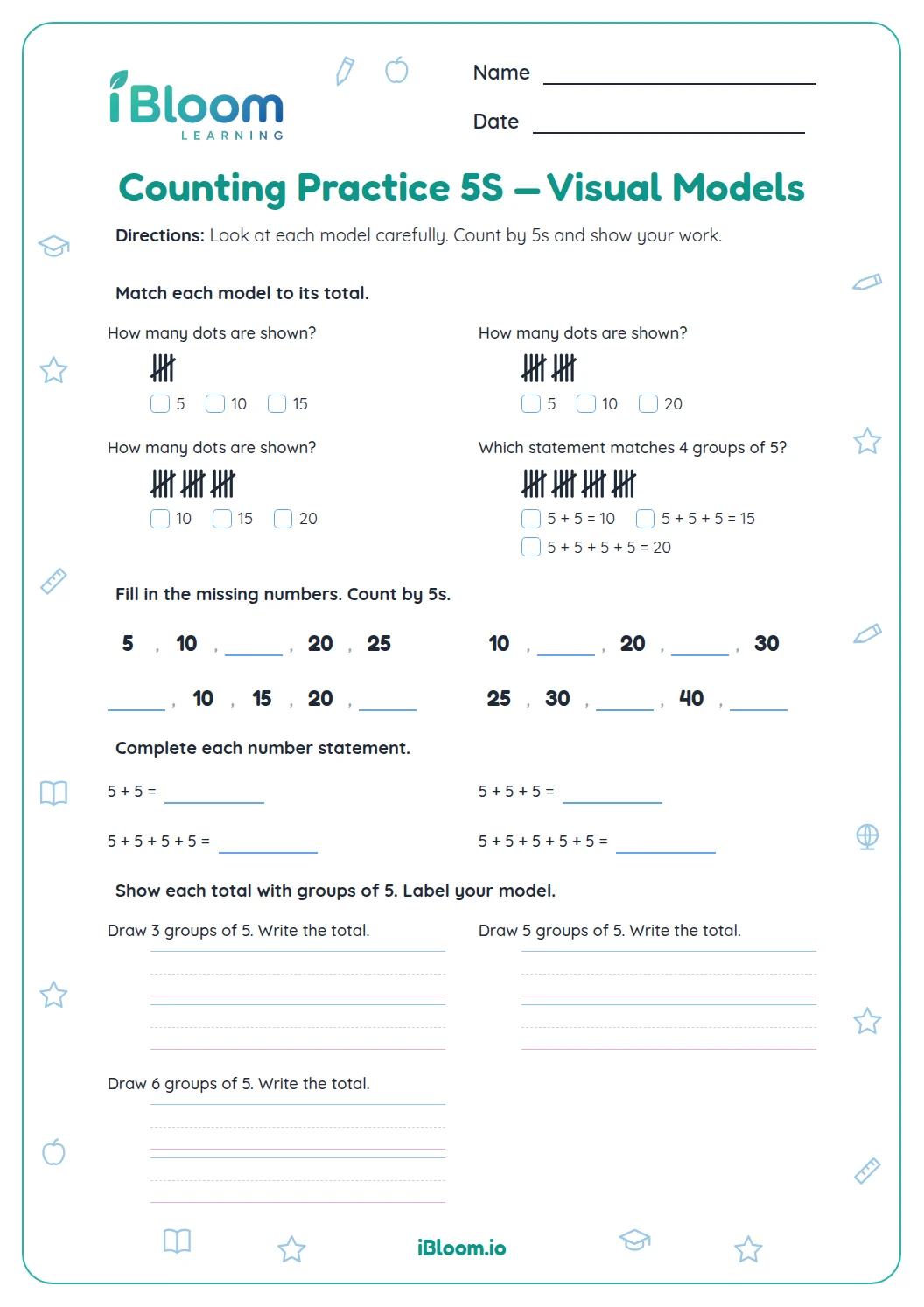
This Grade 1 printable uses 14 everyday situations to practice counting by fives. Part A asks for totals of equal groups; Part B asks for a missing number in each count. Children write one number per question. The separate answer key supports checking each jump of five. The sheet practices skip-counting under CCSS 2.NBT.A.2.
Aligned to 2.NBT.A.2
How do five-item groups become a total?
Point to one group at a time while saying the multiples of five. Stop after counting every group.
- 1Two cards have five stickers each.
- 2Count 5, 10: there are 10 stickers.
How do you find the missing count?
In Part B, move forward five from the number before the blank. Check that the next jump of five reaches the following number.
How can an adult check the strategy?
Ask the child to say the count aloud before using the key. For a group total, the number of spoken counts must match the number of groups in the story.
How to use this worksheet
- 1Read how many groups there are and how many items each holds.
- 2Count by fives once for each group in Part A.
- 3Write the total on the answer line.
- 4In Part B, fill each gap with the next count of five.
- 5Read the completed count aloud and check the key.
Common mistakes and quick fixes
The mistake
Counting one extra group.
The fix
Use one finger for each group and stop at the last one.
The mistake
Adding the group count to five.
The fix
For three groups, say 5, 10, 15 rather than adding 3 to 5.
The mistake
Jumping by one in a pattern.
The fix
Check that each step changes by five.
Common Core alignment
The questions connect skip-counting by fives with equal groups.
Skip-count by fives to find group totals and complete everyday counting patterns.
On this sheet: Each item uses equal jumps of five.
Show the official wordingHide the official wording
Count within 1000; skip-count by 5s, 10s, and 100s.
What to practice next
Make more practice
Further reading
Questions parents and teachers ask
How many questions are included?
There are 14 questions in two parts. The first seven ask children to count groups of five and write a total. The next seven place a missing number in an everyday counting pattern. A separate answer key gives one number for each response.
How do children solve the sticker story?
Two cards with five stickers each have ten stickers altogether. Have the child point to one card and say five, then point to the second and say ten. Counting once per card connects each jump of five to one complete group of stickers.
What numbers does the worksheet use?
The group totals range from 10 to 40, and the story patterns reach 50. All counts use multiples of five. Children can say the sequence aloud or make groups of five counters on a table to check the amount in a story.
Does it include an answer key?
Yes, a separate key gives the correct number for all 14 items in order. Check one part at a time after the child has tried it. If an answer differs, recount the groups or check the five-number jump on both sides of the blank.
How can I help a child who loses track?
Use one finger to track each group while saying the count aloud. For seven groups, raise seven fingers in turn as you say the multiples of five. The fingers track groups, while the spoken number tracks the total number of items counted so far.