



About this worksheet
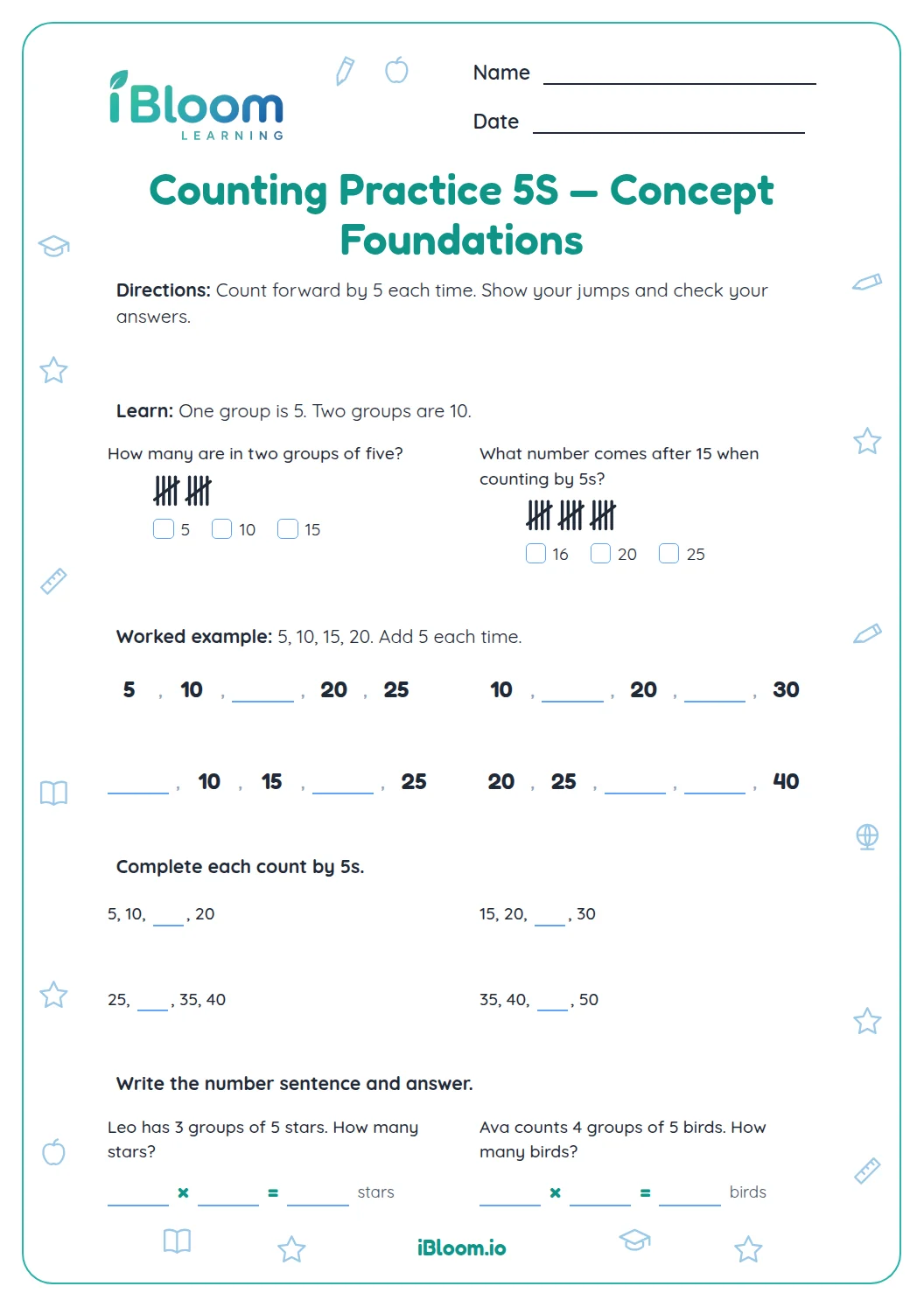
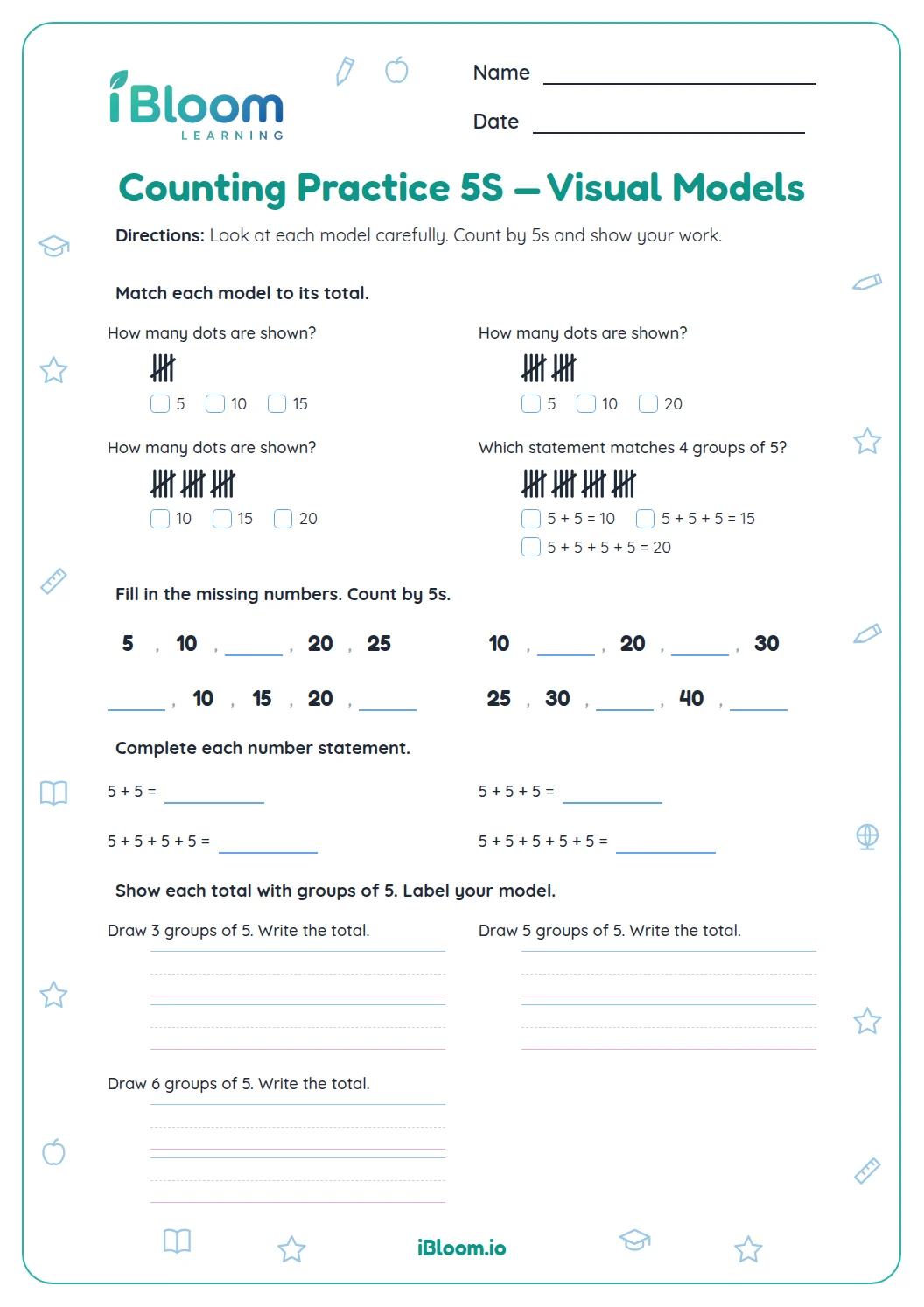
This Grade 1 printable gives guided practice counting forward by fives, including sequences that cross a new ten and continue beyond 100. Part A fills one missing number at a time, Part B asks learners to write four successive numbers from varied starts, and Part C checks before-and-after positions and applies groups of five to a hands story. The key lists every number sequence. This counting practice supports reading and writing numerals through 120 as described in Common Core 1.NBT.A.1.
Aligned to 1.NBT.A.1
How do you find a missing number in a count-by-five pattern?
Compare two neighboring numbers. Each step increases by 5. In question 3, 40, 45, ___, 55 becomes 40, 45, 50, 55.
- 1Start at 40.
- 2Add 5: 45, then add 5 again: 50.
- 3The missing number is 50.
What happens when the count crosses a ten?
Part B begins at different points so children practice the pattern instead of memorizing one chant. From 35, add five to reach 40, then 45, 50, and 55. The ones digit alternates between 5 and 0.
How does skip-counting help with equal groups?
Question 16 has four hands with five fingers each. Count 5, 10, 15, 20. There are 20 fingers altogether.
How to use this worksheet
- 1Read each printed sequence aloud before filling the blank.
- 2For a missing number, count forward by one group of five from the number before it.
- 3In Part B, write one number per step and check each jump is 5.
- 4Use the same count to solve the hands problem.
Common mistakes and quick fixes
The mistake
Adding 1 instead of 5.
The fix
Say the sequence aloud and check that neighboring numbers differ by five.
The mistake
Skipping a number at a decade change, such as 45 to 55.
The fix
Write the next number after 45: 50, then continue to 55.
The mistake
Stopping at 100 even when the count continues.
The fix
Keep adding five while the sequence remains below 120.
Common Core alignment
These activities build the stated grade-level skill through clear models and practice.
Count forward through numbers to 120 and read and write numerals.
On this sheet: Learners extend count-by-five sequences and write numerals through 115.
Show the official wordingHide the official wording
Count to 120, starting at any number less than 120. In this range, read and write numerals and represent a number of objects with a written numeral.
What to practice next
Make more practice
Further reading
Questions parents and teachers ask
What does this worksheet practice?
This Grade 1 printable gives learners focused practice with complete count-by-five sequences, continue from different starting points, and use the pattern in a short story. The answer key is included as a separate set of pages, so an adult can check each response after the child finishes.
How should we begin?
Read the one-line direction together and model the first item aloud. Point to each object or number as you say it, then let the learner try the next one independently before checking the key. The examples use familiar school and home situations, and a grown-up can read the directions aloud before independent work begins.
How long will it take?
Plan for about 15 to 20 minutes, with time to talk through any missed items. A younger learner can complete one part at a time and return to the next part after a short break. The examples use familiar school and home situations, and a grown-up can read the directions aloud before independent work begins.
Can I print just the practice pages?
Yes. The answer key follows the worksheet pages, so you can print the practice pages for the learner and keep the key nearby for checking. The pages are designed for ordinary home or classroom printing. The examples use familiar school and home situations, and a grown-up can read the directions aloud before independent work begins.
What if an answer is incorrect?
Ask the learner to explain how they decided, then point back to the model, picture, or passage clue. Let them try again before showing the answer. Correcting the reasoning helps the skill stick better than copying a number. The examples use familiar school and home situations, and a grown-up can read the directions aloud before independent work begins.
Is an answer key included?
Yes. A separate answer key gives the response to each numbered item. For open-ended written answers, the key provides an example; accept another response when it is supported by the worksheet text. The examples use familiar school and home situations, and a grown-up can read the directions aloud before independent work begins.