




About this worksheet
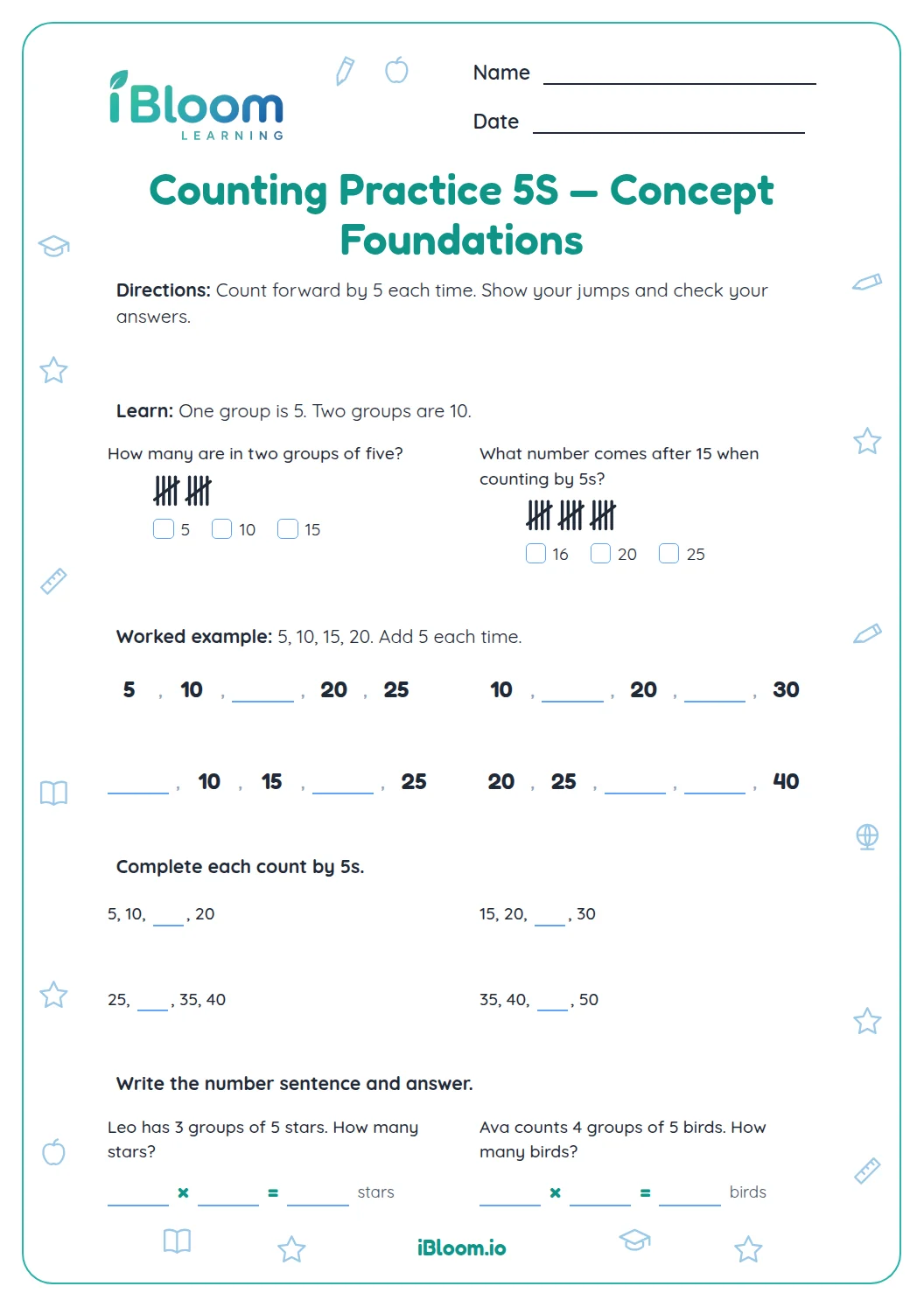
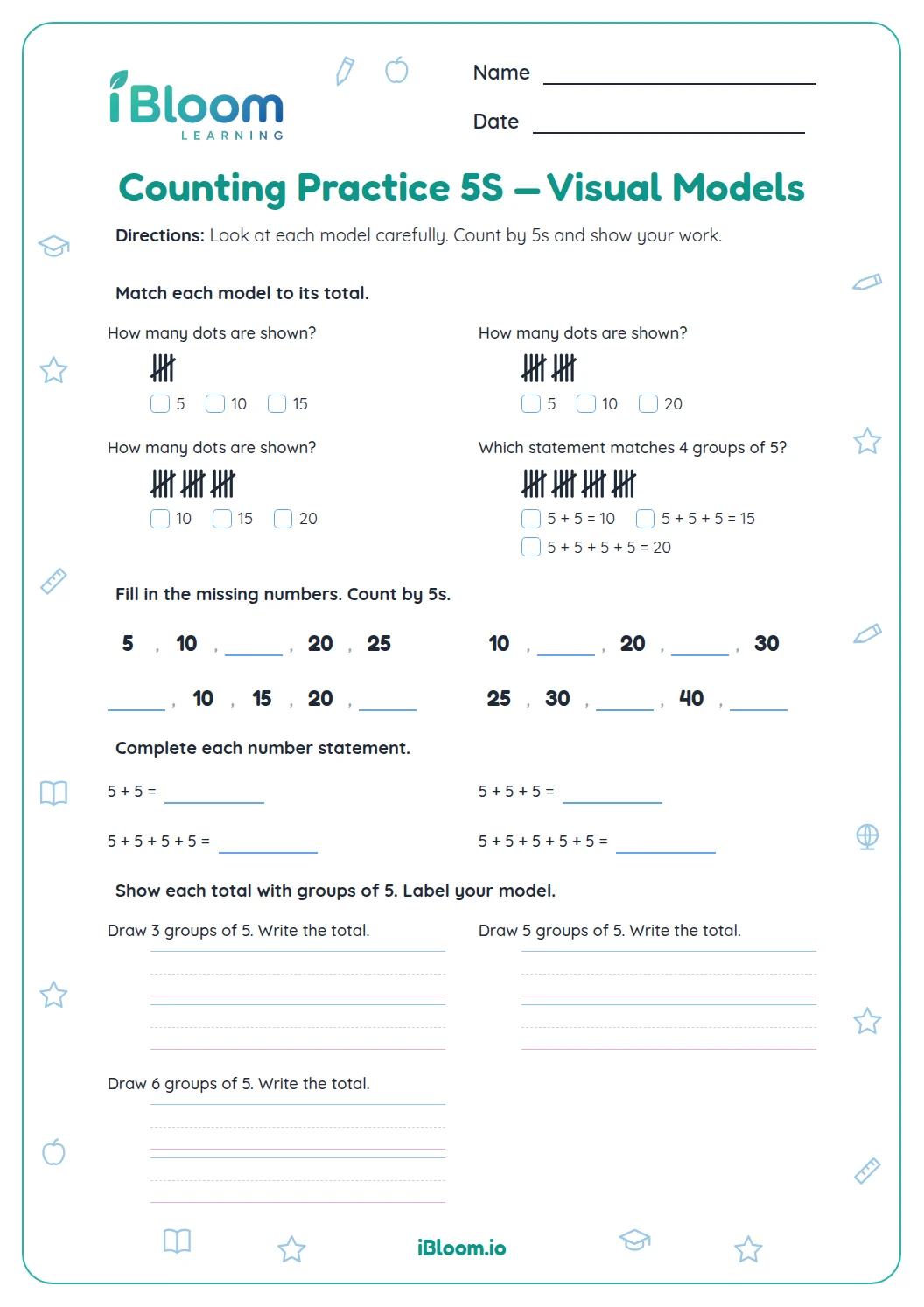
This free printable worksheet gives Grade 1 children a chance to think about counting by 5s, not only to recite it. In Part A, they fill the missing number in four patterns, one counting backward. In Part B, they find what Maya skipped, what Zoe really counted by, and which number you never say. In Part C, they use 5s to count fingers and count back. In Part D, they explain in a sentence. It practices Common Core 2.NBT.A.2, skip-counting by 5s. A separate answer key covers all 11 questions.
Aligned to 2.NBT.A.2
What does it mean to count by 5s?
Counting by 5s means saying the number that is 5 more each time: 5, 10, 15, 20. Each jump is a whole hand of fingers. Children used to counting by 1s have to learn to take bigger jumps that are always the same size.
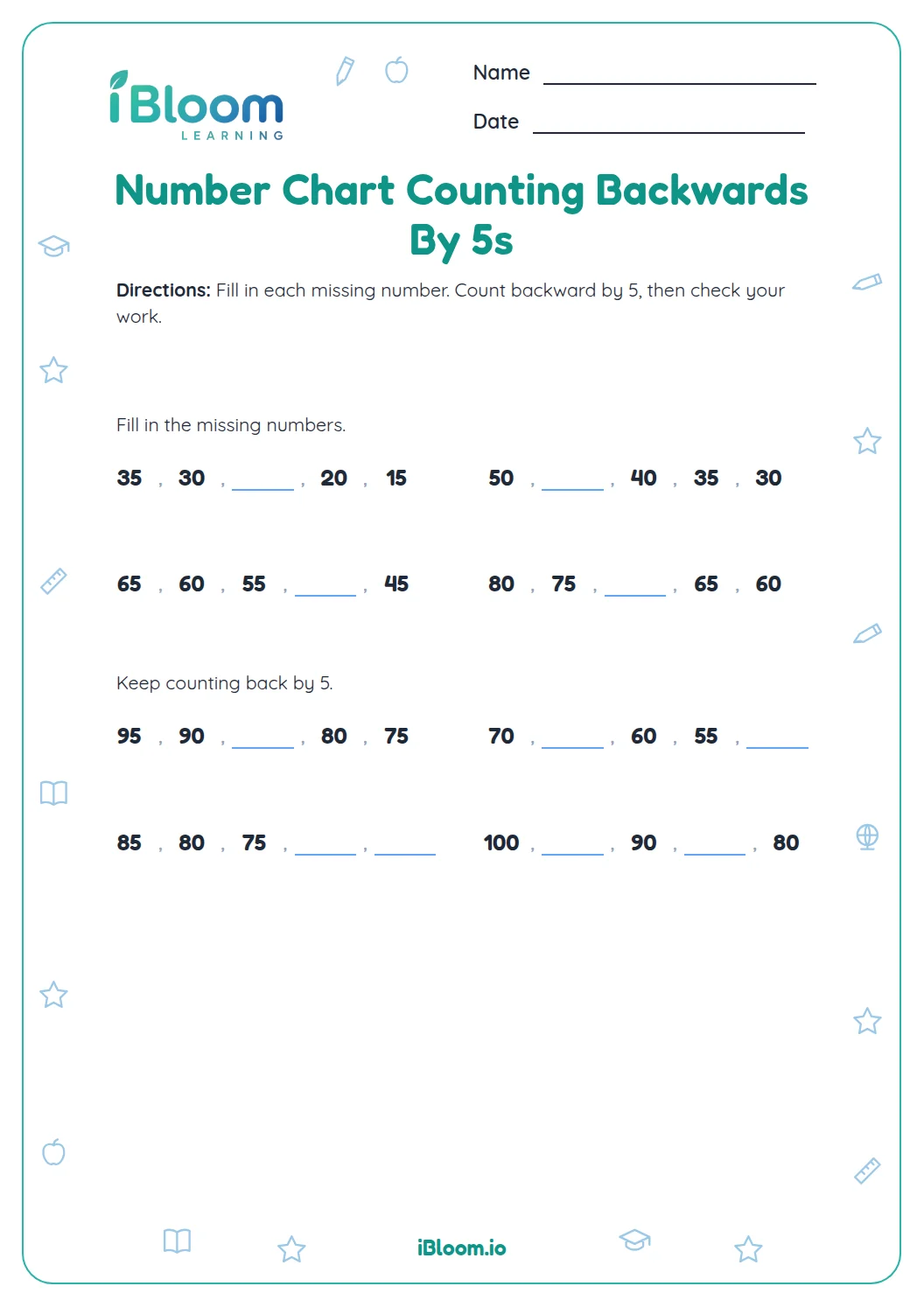
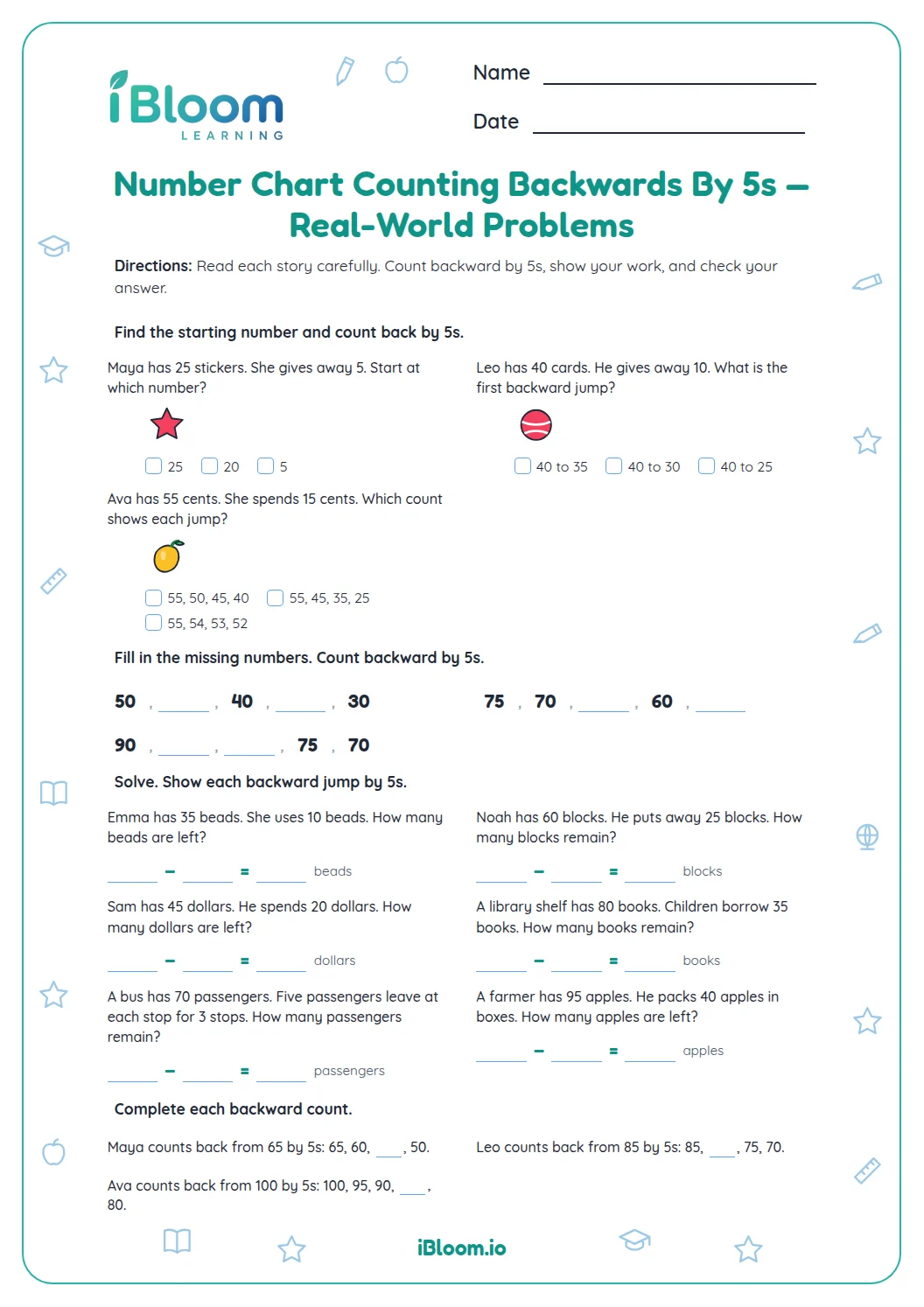
Counting backward by 5s takes 5 away each time: 100, 95, 90. The numbers you say still end in 0 or 5, which is a pattern children can notice on a number chart and use as a check.
Why does this sheet ask children to find mistakes and explain?
Plain pattern practice can turn into reciting. Questions about other children's work make a first grader decide whether a count is right and say why. In Part B, Maya skips a number, Zoe confuses 5s with 10s, and question 7 asks which number does not belong.
Part D (question 11) asks for one sentence of reasoning. It can be as simple as "I add 5 more." That sentence shows whether your child sees counting by 5s as repeated jumps of 5.
- 1Maya counts by 5s: 25, 30, 35, 45.
- 2Check the jumps: 25 to 30 is 5, 30 to 35 is 5.
- 335 to 45 is 10, which is too big a jump.
- 4The missing number is 5 more than 35: 40.
- 5Answer: 40
What is on this worksheet?
Eleven questions in four parts that grow harder. Every number stays within 100, and each pattern uses the same step of 5 forward or backward.
Part C connects counting to something children can picture, 6 hands with 5 fingers each, and Part D ends with the written explanation.
- Part A, Fill the pattern: 3 forward patterns and 1 backward pattern, with one missing number each
- Part B, Find the mistake: skipped number, 5s mixed up with 10s, the number that does not belong, and counting jumps from 45 to 60
- Part C, Think it through: fingers on 6 hands and one backward count
- Part D, Explain it: one written sentence about why 40 comes after 35
- Answer key on a separate page
How to use this worksheet at home or in class
- 1Warm up by counting fingers on both hands by 5s: 5 for the first hand, 10 for two. Hold up more hands, or use a hundred chart.
- 2Do question 1 together. Ask, "How much more is 10 than 5?" and "What is 5 more than 10?"
- 3Let your child finish Part A. For the backward pattern in question 3, ask whether the numbers get bigger or smaller.
- 4In Part B, have your child say what Maya and Zoe did, not only color a circle. Read the sentences aloud if reading is slow.
- 5In Part C, let your child count aloud, holding up a hand for each 5. In Part D, scribe the answer to question 11 if writing is tiring.
- 6Check with the answer key. For a miss, count the jumps on a hundred chart, tapping every fifth number.
Common mistakes and quick fixes
The mistake
Counting by 1s and landing on the wrong number, such as saying 5, 6, 7 or filling 5, 10, 11, 20.
The fix
Show one hand for each 5. Say, "Five, ten" with two hands, then add a hand for 15. Practice saying only the numbers at the end of each hand.
The mistake
Mixing up 5s and 10s, like Zoe, who says 10, 20, 30, 40 and thinks that is counting by 5s.
The fix
Count both ways on a number chart. By 5s you say every number ending in 5 or 0. By 10s you say only the ones ending in 0.
The mistake
Adding when counting backward, so after 85 the child says 90.
The fix
Ask, "Are we going toward 100 or toward 0?" Then say, "5 less than 85 is 80," using the chart to check.
Common Core alignment
Most US states use the Common Core standards or a close state version. This sheet practices the skip-counting standard below.
Skip-count by 5s, forward and backward, to fill gaps, spot mistakes and explain.
On this sheet: Every question uses skip-counting by 5s, forward or backward. This sheet stays within 100.
Show the official wordingHide the official wording
Count within 1000; skip-count by 5s, 10s, and 100s.
What to practice next
Make more practice
Further reading
Questions parents and teachers ask
What does counting by 5s teach a first grader?
Counting by 5s shows a child that adding 5 each time makes a pattern: every number ends in 5 or 0. This sheet practices it forward and backward within 100 (2.NBT.A.2), and the find-the-mistake and explain questions ask children to check a count and say why it is right.
What are the answers to Part B?
Question 5 is 40, because Maya skipped it between 35 and 45. Question 6 is 10s, since Zoe's numbers jump by 10. Question 7 is 42, which ends in 2 instead of 5 or 0. Question 8 is 3 jumps: 50, 55 and 60. The answer key shows all eleven answers.
Why does 42 not belong in the 5s pattern?
Every number you say when counting by 5s ends in 5 or 0, because each jump of 5 flips the last digit between those two. 35 and 40 end in 5 and 0, but 42 ends in 2. Children can use this ending-digit rule to check any answer without counting.
My child can count by 5s forward but not backward. What can I do?
Count backward on a number chart, starting at 100 and saying each number ending in 5 or 0 as you move left and up. Ask what is 5 less each time. Question 3 and question 10 give two backward patterns to try, and a 100 chart helps with checking.
Can I read the questions aloud?
Yes. Parts B, C and D have sentences, and reading is not the skill being practiced. Read each aloud and let your child count, point and answer. Part A is only numbers and blanks, so most first graders can try it alone. For question 11, you can write what your child says.
How long does this worksheet take?
Most first graders finish in about 15 minutes. Part A takes the least time. Part B and the written question in Part D take longer if your child explains out loud, which is worth doing. Stop after Part B and finish Parts C and D later if your child tires.