



About this worksheet
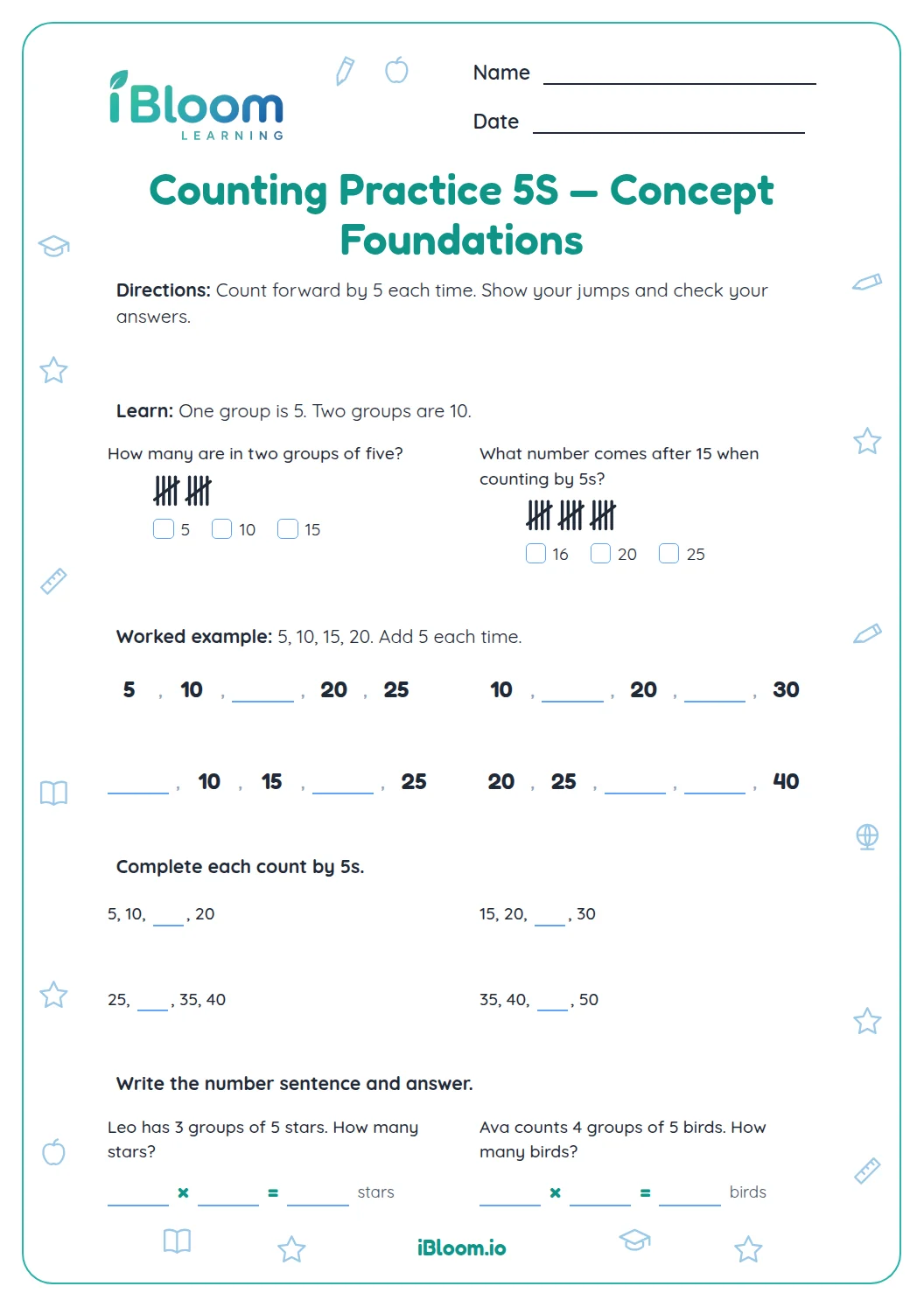
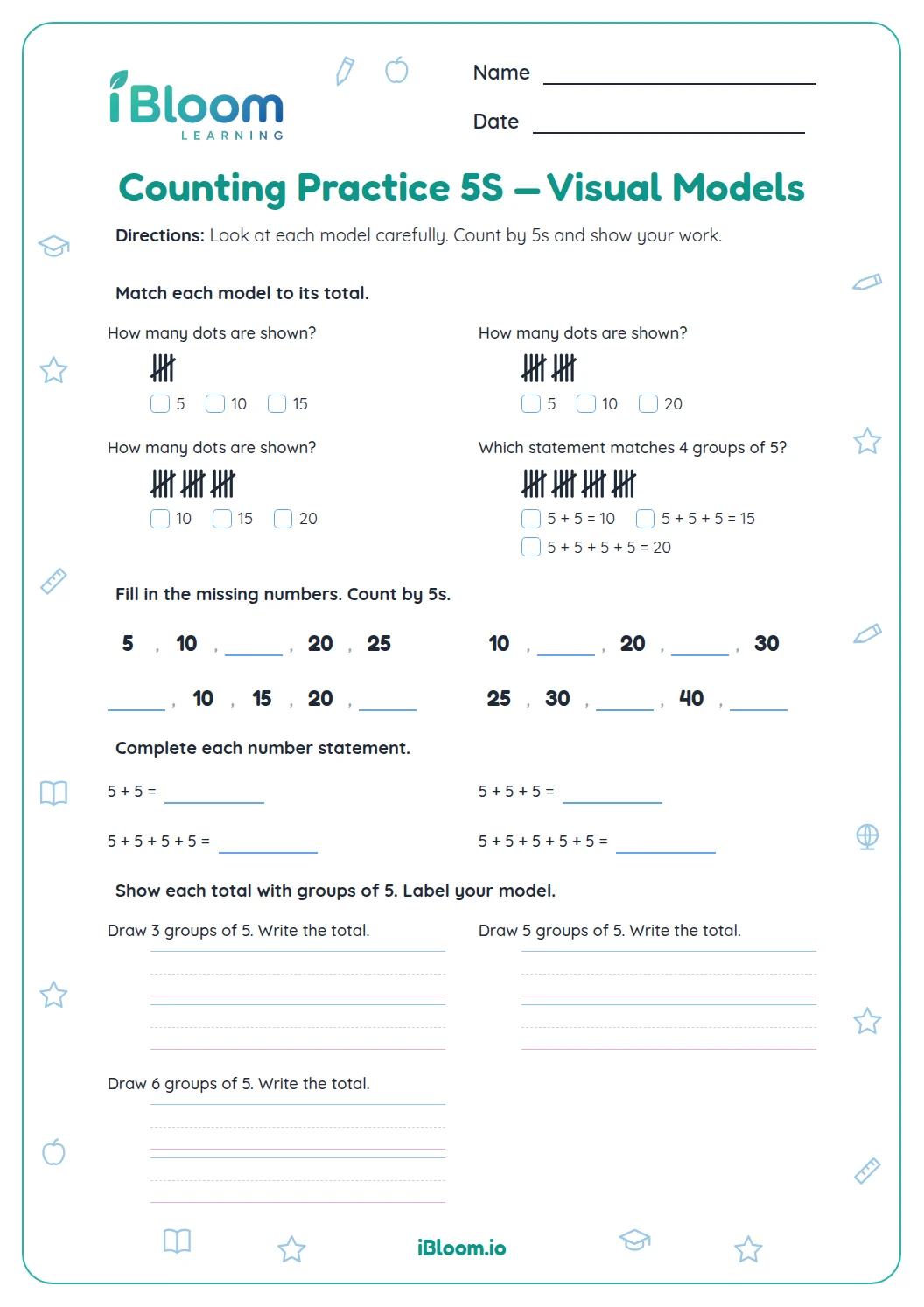
This free Grade 1 counting-by-fives worksheet links skip-counting patterns to equal groups. Children fill missing multiples, use arrays to match groups with addition, and find totals in short stories about marbles, pencils, birds, points, and cans. The 14 questions are arranged in three parts, with an answer key for checking each response. Counting each group by five connects to CCSS 1.OA.C.5, which relates counting to addition and subtraction.
Aligned to 1.OA.C.5
How do you count groups of five?
Say one multiple for each group: 5, 10, 15, and so on. In question 6, the array shows three baskets with five apples each, so the matching addition sentence is 5 + 5 + 5.
- 1One basket has 5 apples.
- 2Count a five for each of 3 baskets: 5, 10, 15.
- 35 + 5 + 5 = 15 apples.
What will children practice in each part?
The first part fills gaps in forward and backward sequences. Picture groups and expression choices come next. The last part turns familiar equal groups into number sentences.
- Part A: complete counting patterns by fives
- Part B: find totals in pictured and equal groups
- Part C: solve five everyday group stories
How can I help my child keep track?
Point to each row, basket, or group while counting aloud. If a learner loses the count, start over at the first group and say one multiple of five per group.
How to use this worksheet
- 1Say the pattern aloud before filling a blank.
- 2Point to each group as you count one five.
- 3Match picture groups with repeated addition.
- 4Check a story total by counting its groups again.
Common mistakes and quick fixes
The mistake
Saying 14 after 10 when counting by fives.
The fix
Add five each time: after 10 comes 15.
The mistake
Counting every object individually and losing the group count.
The fix
Point to one full group at a time and say its multiple.
The mistake
Using the number of groups as the total.
The fix
Count five for every group; four groups make 20, not 4.
Curriculum alignment
The sheet connects skip-counting groups with repeated addition.
Connect counting by fives with addition for equal groups.
On this sheet: Learners count groups of five and represent three groups with repeated addition.
Show the official wordingHide the official wording
Relate counting to addition and subtraction (e.g., by counting on 2 to add 2).
What to practice next
Make more practice
Further reading
Questions parents and teachers ask
What numbers come next when counting by fives?
The sequence goes 5, 10, 15, 20, 25, 30, and continues by adding five each time. The first part of the sheet asks children to fill missing numbers in these patterns, including one sequence that counts backward. Ask the learner to explain the step and point to the matching question before checking the answer key.
How do pictures help with counting by fives?
The apple, star, and crayon arrays show equal groups. A child can point to one row or group while saying the next multiple of five. For three groups, the count is 5, 10, 15, which also matches 5 + 5 + 5.
How can my child solve a group story?
Find how many are in one group and how many groups there are. Count by five once for each group, then label the total with the object. For example, four boxes with five pencils each contain 20 pencils. Ask the learner to explain the step and point to the matching question before checking the answer key.
Does this worksheet use multiplication?
The story questions can be solved by skip-counting or repeated addition, such as 5 + 5 + 5. Children do not need a multiplication fact to complete the sheet. The arrays make the equal groups visible before learners solve the word problems.
What is on the answer key?
The answer key lists the missing multiples, the picture-based expression choices, and the totals for all five stories. Check that a response names the item as well as the total, such as 20 pencils or 25 birds. Ask the learner to explain the step and point to the matching question before checking the answer key.