






About this worksheet
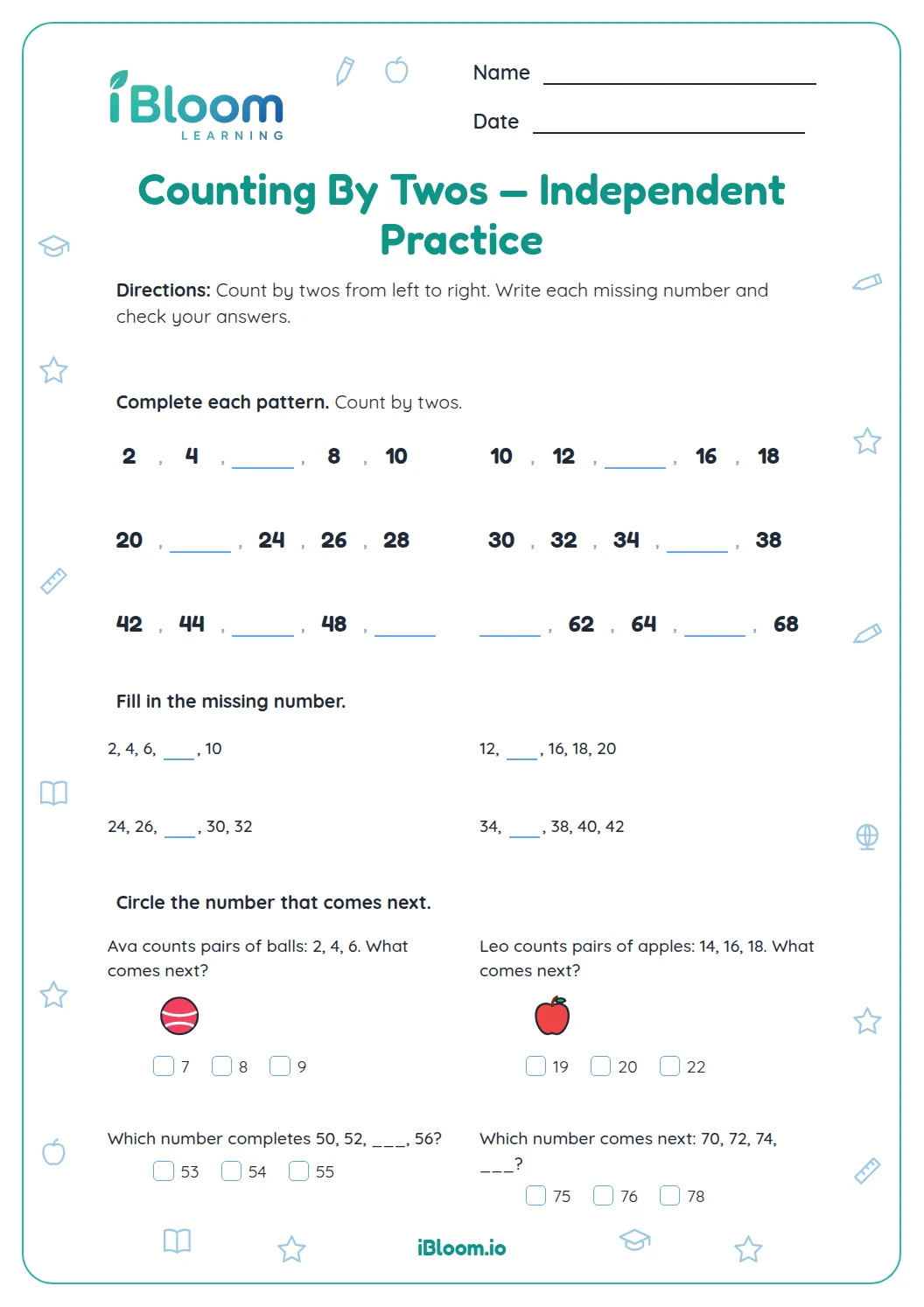
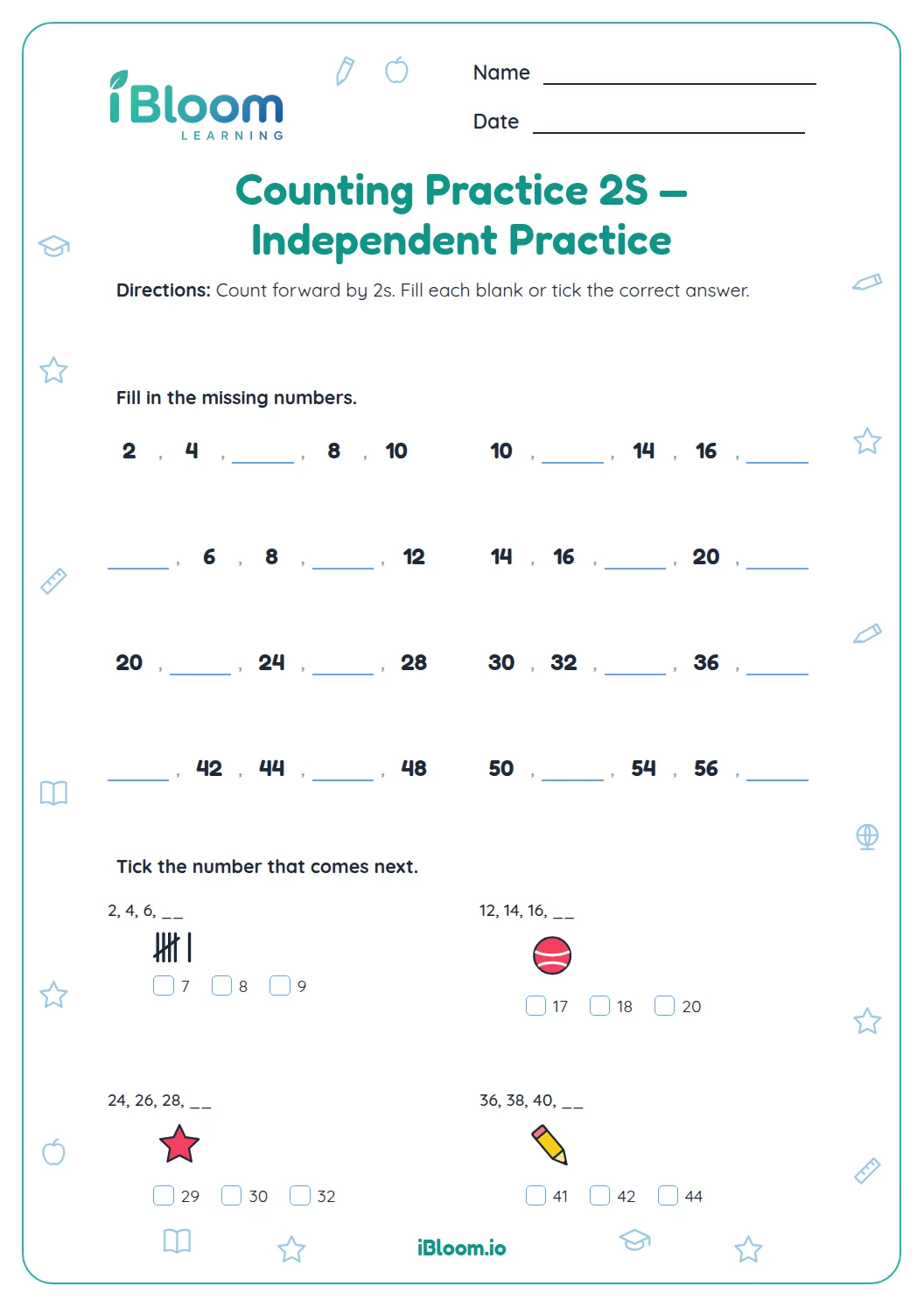
This Grade 1 worksheet connects counting by twos to visible pairs of dots. Part A has eight drawings with two dots in every row. Part B has six missing-number patterns through 50. Learners write one number for each question, then use a separate answer key to check their totals and counting order.
How do the pictures show counting by twos?
Each row contains one pair of dots. Move down one row each time you say the next number in the count.
- 1The third model has three rows of two dots.
- 2Count 2, 4, 6: there are 6 dots.
How do children continue without a picture?
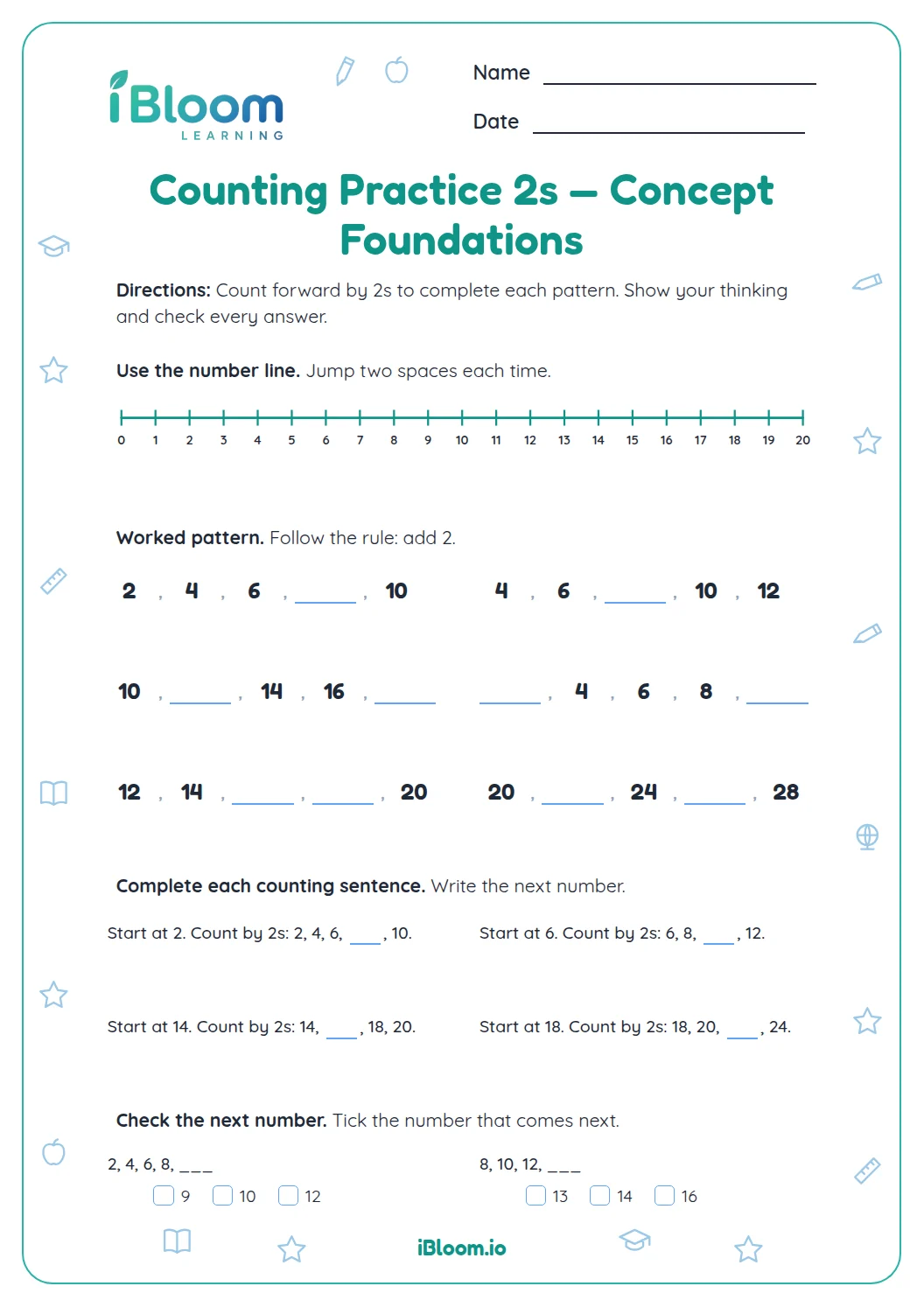
In Part B, add two to the number before the gap. Read the completed sequence and check that every neighboring pair of numbers is two apart.
How can you check a model total?
Count the same dots one at a time after counting by pairs. Both methods should give the same total. Use the key only after the child has counted the complete drawing.
How to count by pairs
- 1Find the two dots in the first row.
- 2Say two and point to that whole row.
- 3Move down the rows, saying two more each time.
- 4Write the final count as the total.
- 5Complete Part B with jumps of two, then check the key.
Common mistakes and quick fixes
The mistake
Counting rows instead of dots.
The fix
Say two for the first row, four for the second, and keep going.
The mistake
Counting a row twice.
The fix
Move a finger down the drawing one row at a time.
The mistake
Using jumps of one in Part B.
The fix
Compare neighboring terms: each step must add two.
What to practice next
Make more practice
Questions parents and teachers ask
What does counting by twos mean?
Counting by twos means adding two at every step. This worksheet starts with pairs of dots, so the count begins 2, 4, 6. Pointing to one row for each spoken number helps children connect the counting pattern to the total number of dots.
How many models are included?
There are eight paired-dot drawings in Part A, followed by six number patterns in Part B. Each drawing has two dots in every row. Children count the rows by twos and write the total, then use the same step size to complete each pattern.
How far do the number patterns go?
The number patterns go through 50. The drawings first establish smaller totals from 2 through 16, and the patterns continue with larger even numbers. Children can say each sequence aloud and check that every move adds two, including the move across the blank.
Does the sheet include an answer key?
Yes, the separate answer key gives all 14 answers in worksheet order. Check a drawing by counting its rows in twos and then counting every dot individually. For a pattern, read the completed numbers aloud and compare each step with the two-number counting rule.
What if a child writes the number of rows?
Ask the child to touch both dots in the first row and say two. Move to the next row and say four. Continue until all rows are counted, then explain that the last spoken number tells how many dots are in the whole drawing.