






About this worksheet
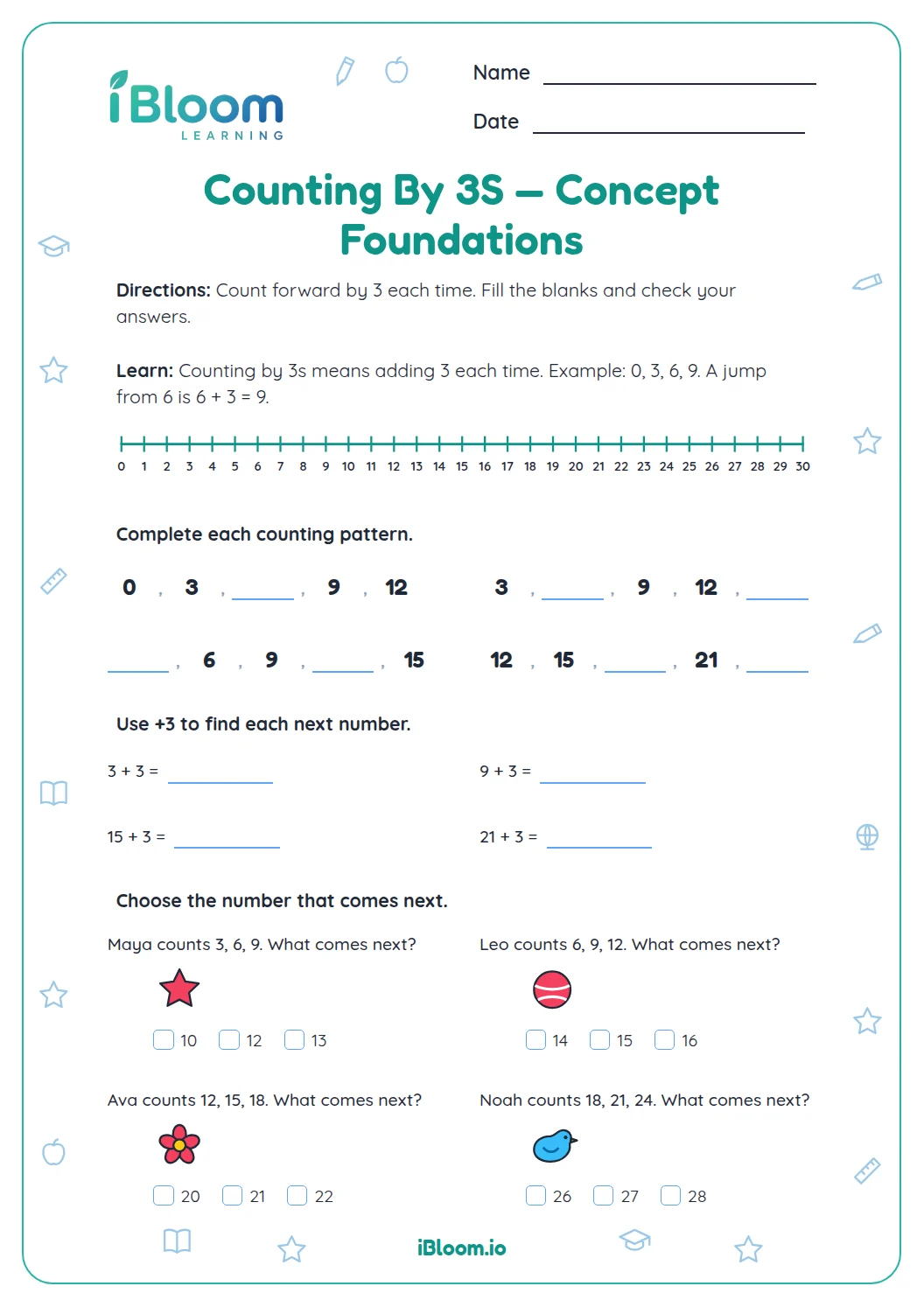
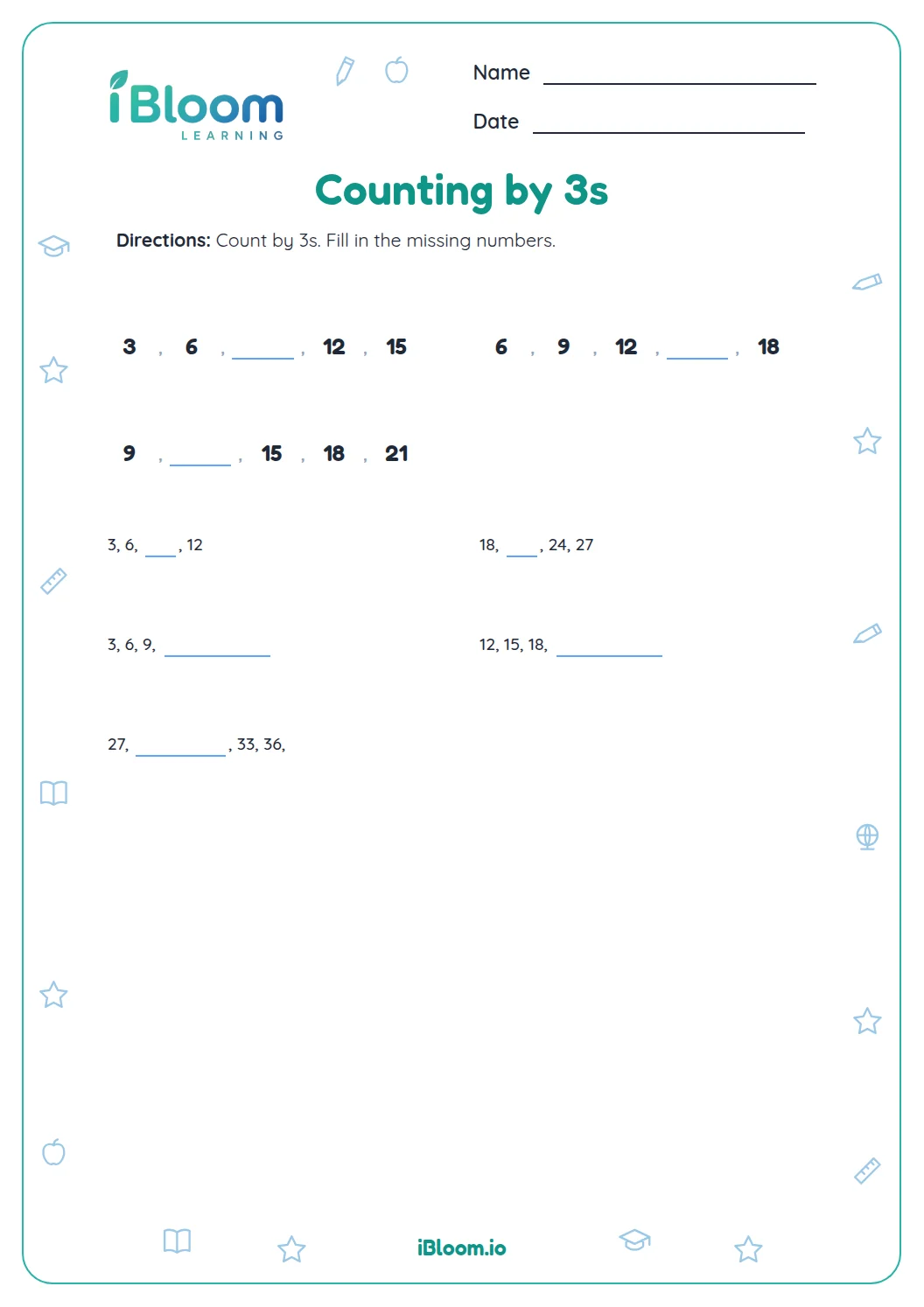
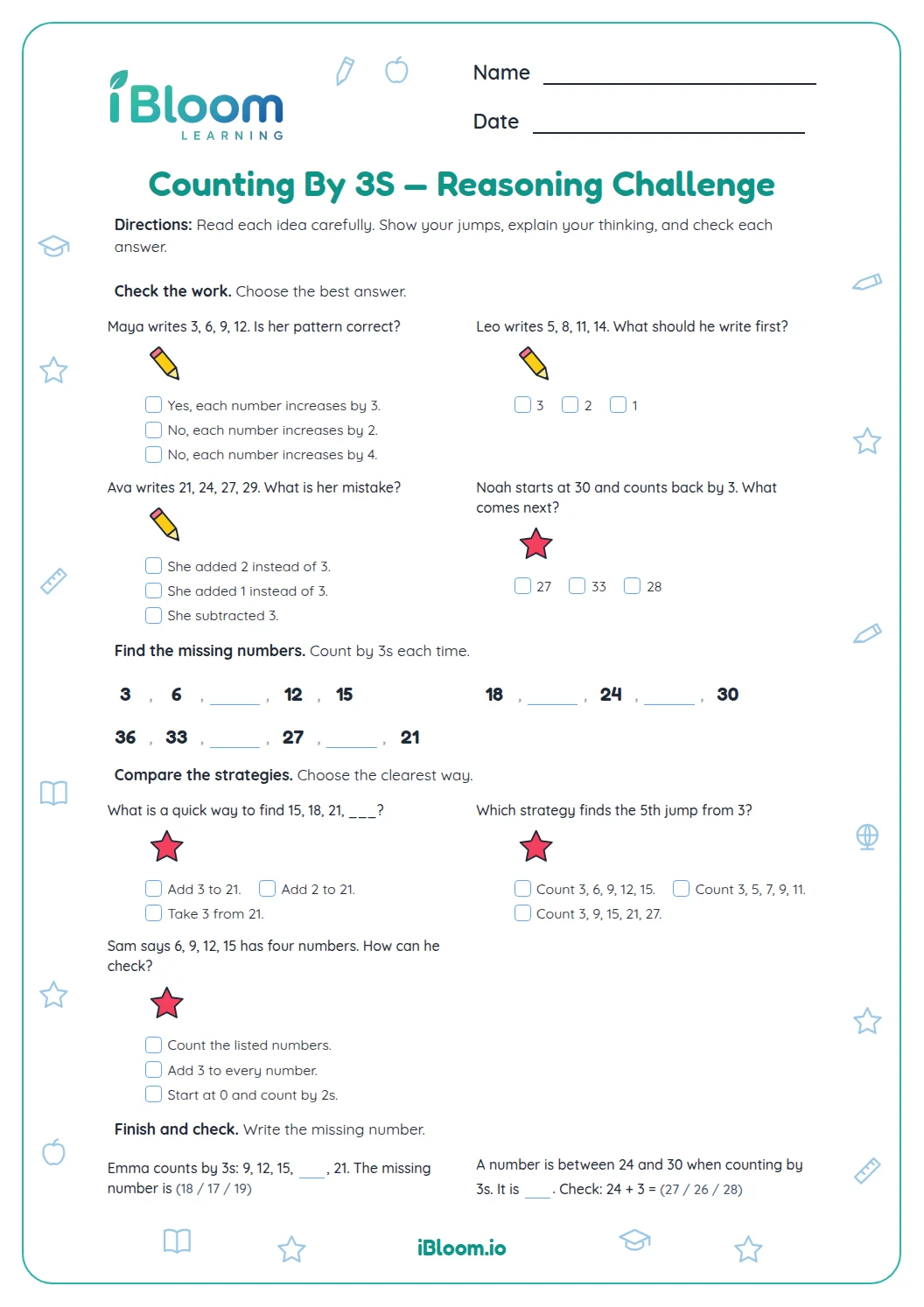
This Grade 1 printable practices counting forward and backward by 3. Students read a marked number line, complete six skip-counting patterns, identify positions in a count, and solve four equal-group questions. It includes 14 questions across three parts and a separate answer key.
What will students practice?
Students begin by reading point A on a number line marked in jumps of 3. Next they fill missing terms in forward and backward sequences and identify positions in the count. The final part connects equal groups to repeated jumps of 3.
The apple array in Question 11 shows four rows of three, so students can count each row or add 3 four times.
- Part A: Read the Line (1 question)
- Part B: Complete the Count (9 questions)
- Part C: Groups of Three (4 questions)
How can students work through an example?
Question 1 places point A at the fourth jump after 0. Counting 3, 6, 9, 12 gives 12.
- 1Question 1: What number does point A show?
- 2Count four jumps of 3 from 0.
- 3Answer: 12
How can an adult support practice?
For a missing term, compare neighboring numbers and check that each jump changes by 3. In a backward pattern, subtract 3 each time.
For equal groups, count the same-sized groups or add 3 once for each group. In Question 11, four groups of 3 make 12 apples.
What can students do next?
Use a related worksheet to practice the next small step, then return to this page later for a quick review.
How to use this worksheet
- 1Read the one-sentence directions together.
- 2Complete the first item and explain the clue used.
- 3Work through each part in order.
- 4Check answers with the key after finishing a part.
- 5Redo any missed item and say what changed.
Common mistakes and quick fixes
The mistake
Answering before reading the whole prompt.
The fix
Read it once for meaning, then look for the specific clue.
The mistake
Using a familiar pattern without checking every detail.
The fix
Compare the answer with the prompt one piece at a time.
The mistake
Treating a missed answer as a reason to stop.
The fix
Use the key to find the rule, then try the item again without looking.
What to practice next
Make more practice
Questions parents and teachers ask
How many questions are on this worksheet?
There are 14 questions in three parts: one number-line question, nine skip-counting questions, and four equal-group problems. The patterns include forward and backward counts by 3. The last part applies the same count to groups, including an apple array and crayon trios.
Can students use the answer key while working?
Students can try each section before checking the separate key. For a missed pattern, look at two neighboring terms and decide whether the count moves forward or backward by 3. Then check the next term using that same step to confirm the pattern.
How long should this worksheet take?
About 15 minutes is a reasonable estimate for the number line, sequence practice, and four group problems. Students can pause between parts and say each count aloud before writing the missing number. The answer key is useful for checking each pattern afterward.
What if a student misses an item?
Check the direction of the count first. In a forward pattern, add 3; in a backward pattern, subtract 3. For Question 11, use the four rows of three apples to verify that 3 + 3 + 3 + 3 equals 12, then compare the result with the key.
Can I use the worksheet in a small group?
A teacher or parent can model one jump of 3, then ask students to take turns saying the next number. For the array question, students can point to each row as they count by threes, then complete the remaining problems independently.