




About this worksheet
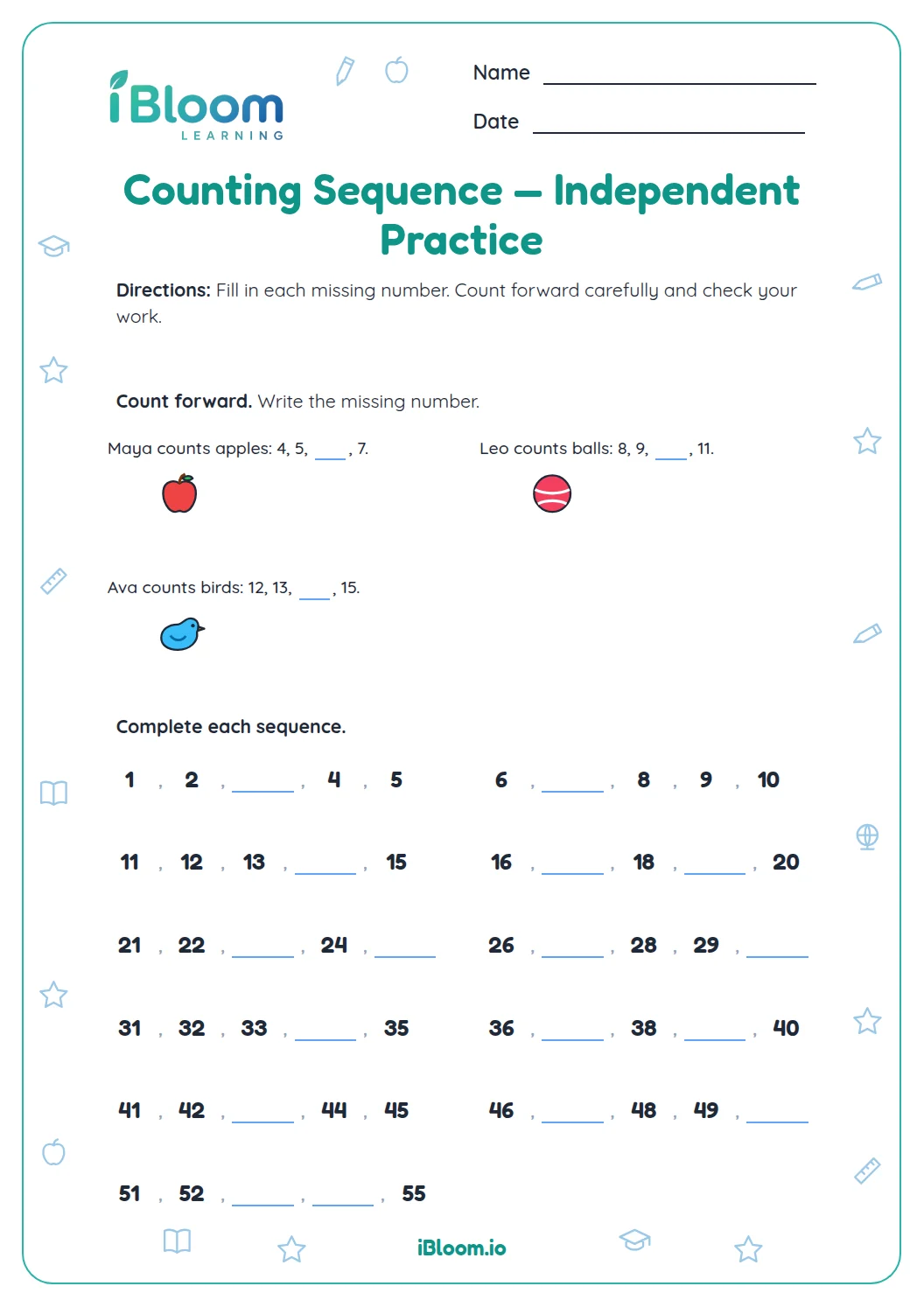
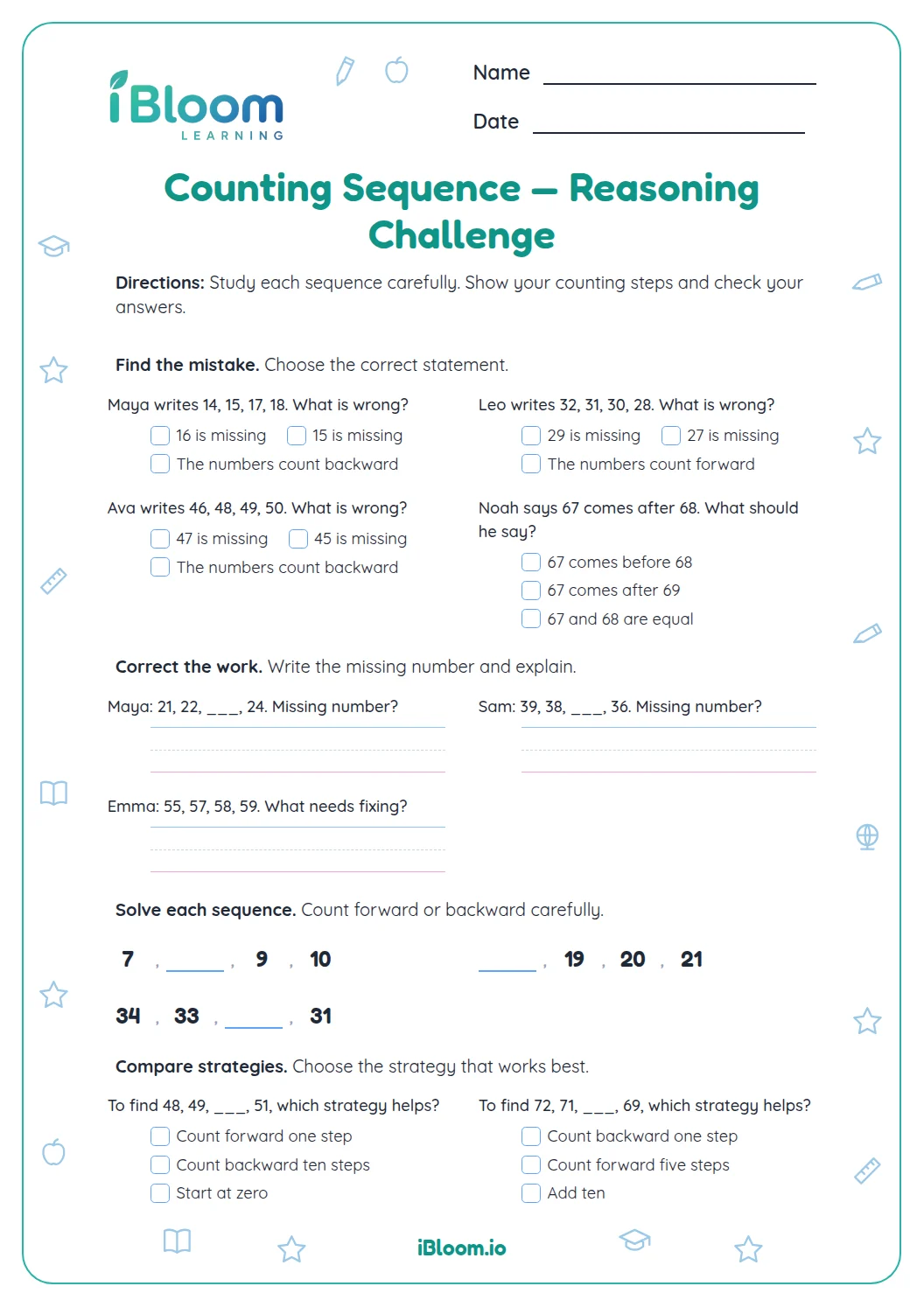
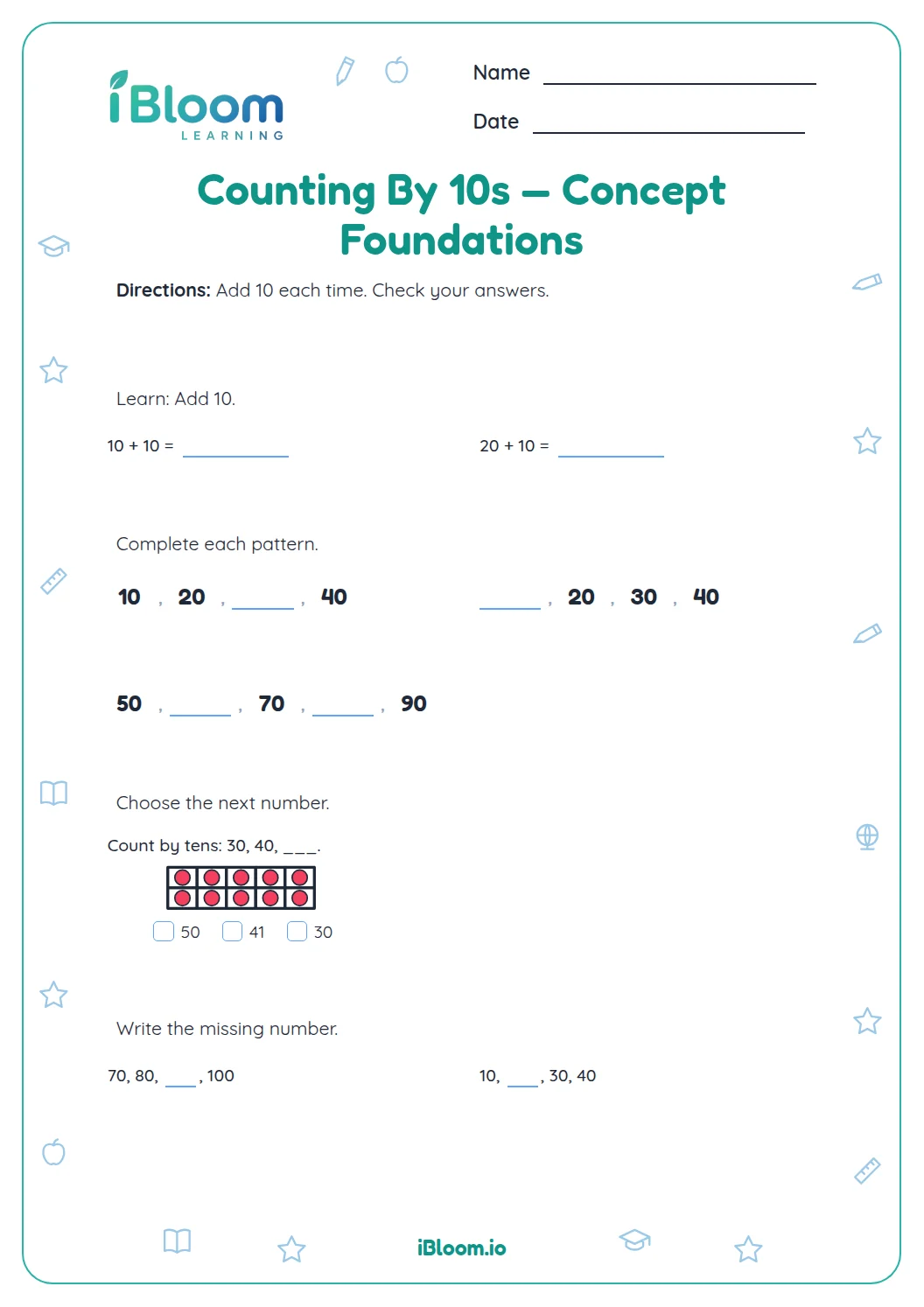
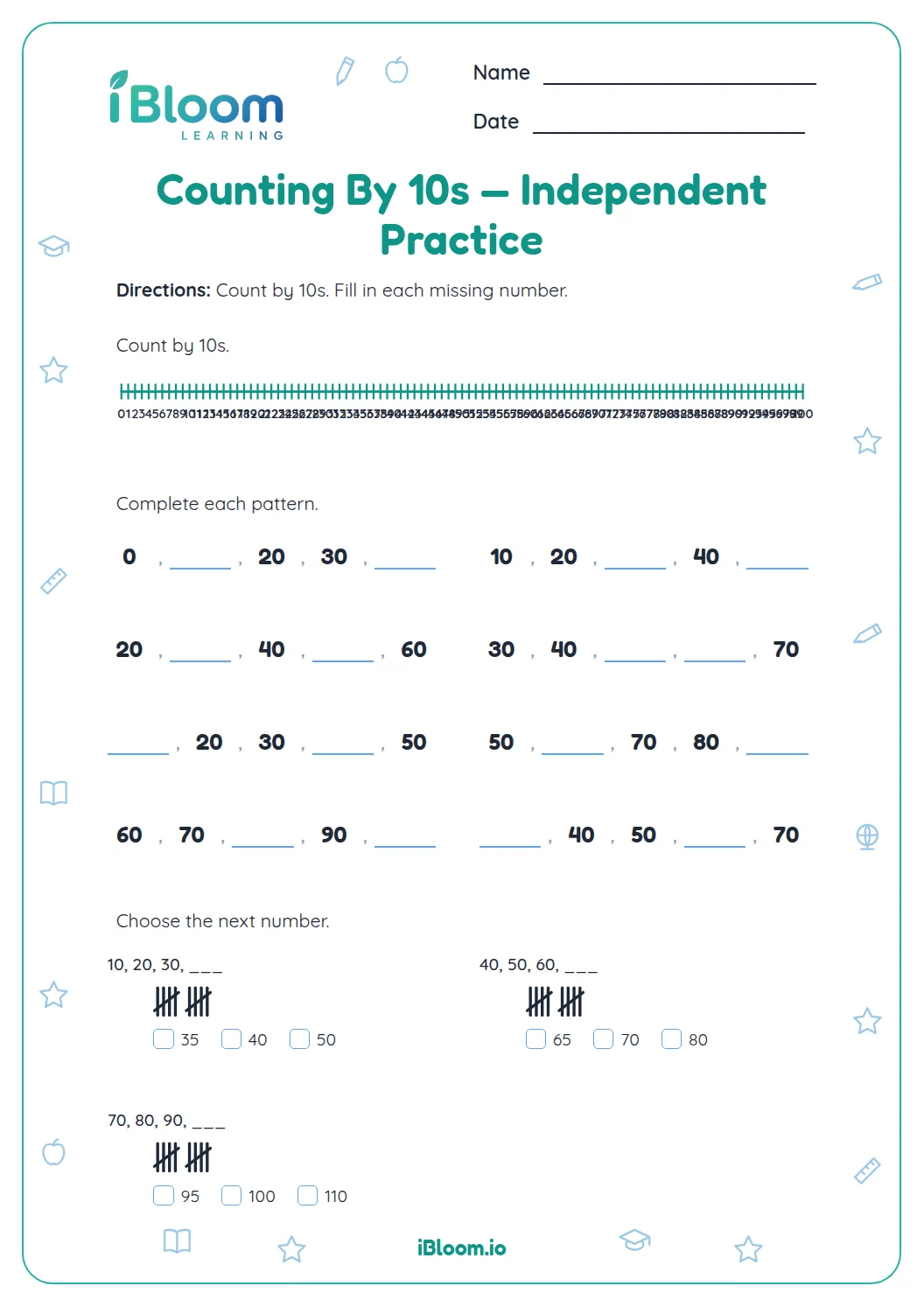
This Grade 1 number-sequence worksheet has 16 missing-number questions across two parts. Students count forward by ones, then use equal jumps of two, five, or ten to continue each sequence. Every sequence stays at or below 120. A separate answer key follows the two worksheet pages.
Aligned to 1.NBT.A.1
What does the counting sequence page cover?
The first part fills gaps in counts by ones. The second part uses repeated jumps of two, five, or ten. The blank appears at different positions, so students must follow the sequence rather than copy a fixed final number.
- Part A: count forward by ones (8 questions)
- Part B: continue counts by equal jumps (8 questions)
- All numbers stay at or below 120
How do you find the missing number?
Compare two neighboring numbers that are already printed. The amount of change is the step. For 42, 44, __, 48, the count goes up by 2, so the missing number is 46. Keep that same jump through the blank.
- 15, 10, __, 20
- 2The numbers go up by 5 each time, so the missing number is 15.
How can a number chart support counting?
A hundred chart can help children check a count by ones or tens. Point to each number while saying the sequence aloud, and look for the same jump each time. The worksheet also includes counts by twos and fives.
How to use this worksheet
- 1Read the directions for the part before starting it.
- 2Work through the questions in order and say what clue helped you decide.
- 3Use the separate answer key to check each response.
- 4For any missed question, explain the corrected answer in your own words.
Common mix-ups
The mistake
Guessing from only one number.
The fix
Check the step using two neighboring numbers, then continue the same pattern.
The mistake
Filling the blank before checking two neighboring numbers.
The fix
Find the repeated jump first, then continue the count into the blank.
The mistake
Changing the step halfway through.
The fix
Read the full sequence and keep the same jump between every pair.
Curriculum alignment
This worksheet practices the skill named in the standard below. State and district pacing can vary.
Count to 120, starting at any number less than 120.
On this sheet: Part A practices counting forward from numbers within 120, starting from different points in the sequence.
Show the official wordingHide the official wording
Count to 120, starting at any number less than 120. In this range, read and write numerals and represent a number of objects with a written numeral.
What to practice next
Make more practice
Further reading
Questions parents and teachers ask
How many sequences are on the worksheet?
The worksheet has 16 missing-number questions in two parts, spread over two practice pages. Eight count by ones, and eight continue equal jumps by twos, fives, or tens. A separate answer key lists the missing number for every sequence.
What counting steps do students practice?
Part A focuses on counting forward by ones. Part B includes forward counts by twos, fives, and tens. Each sequence has one blank, and every number stays at or below 120 so students can focus on finding the repeated step.
How can a child find the counting step?
Compare two neighboring numbers that are already printed. The amount of change is the step. Continue the same step to fill the blank, then check the full sequence aloud from beginning to end to confirm the count stays consistent.
Can a number chart help?
Yes. A hundred chart can make counts by ones and tens easier to track. Children can point to each number and say it aloud. For jumps by twos or fives, they can still use the chart to check each number in order.
What should we do if the sequence does not sound right?
Read the sequence slowly and compare each neighboring pair. If the jumps change, revisit the printed numbers and identify the step again. Once the blank is filled, read the entire count to confirm the same step continues throughout.