




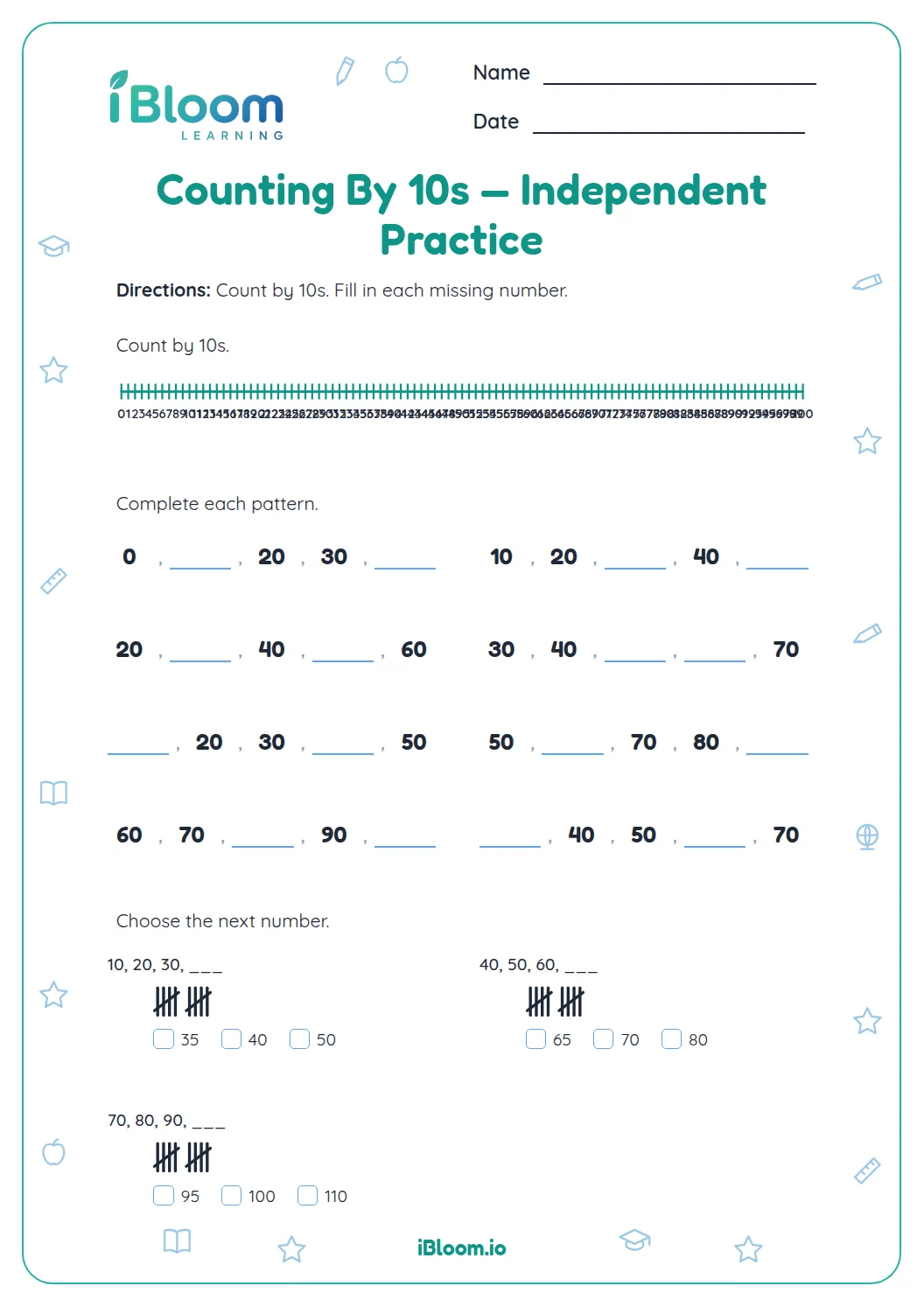
About this worksheet
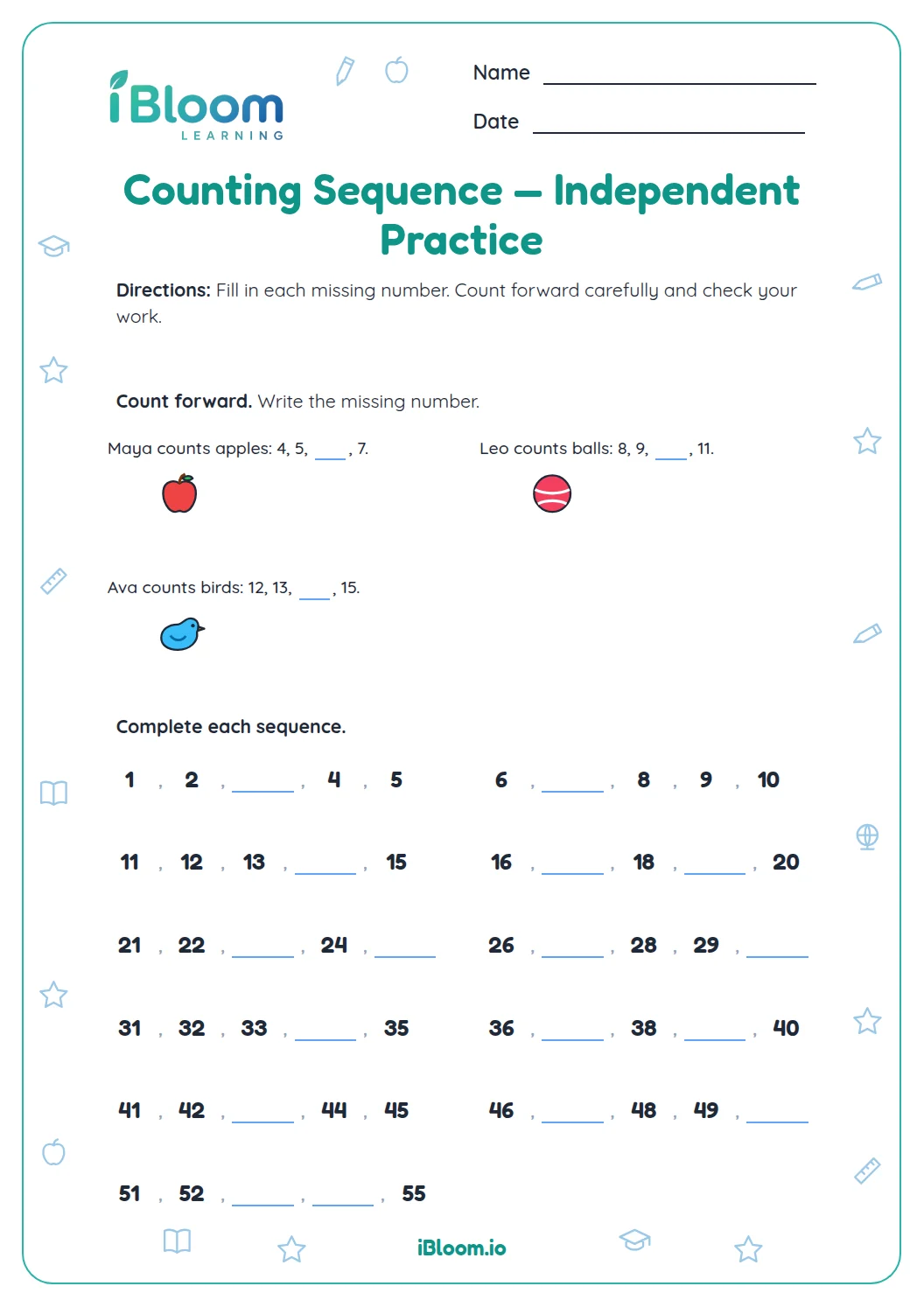
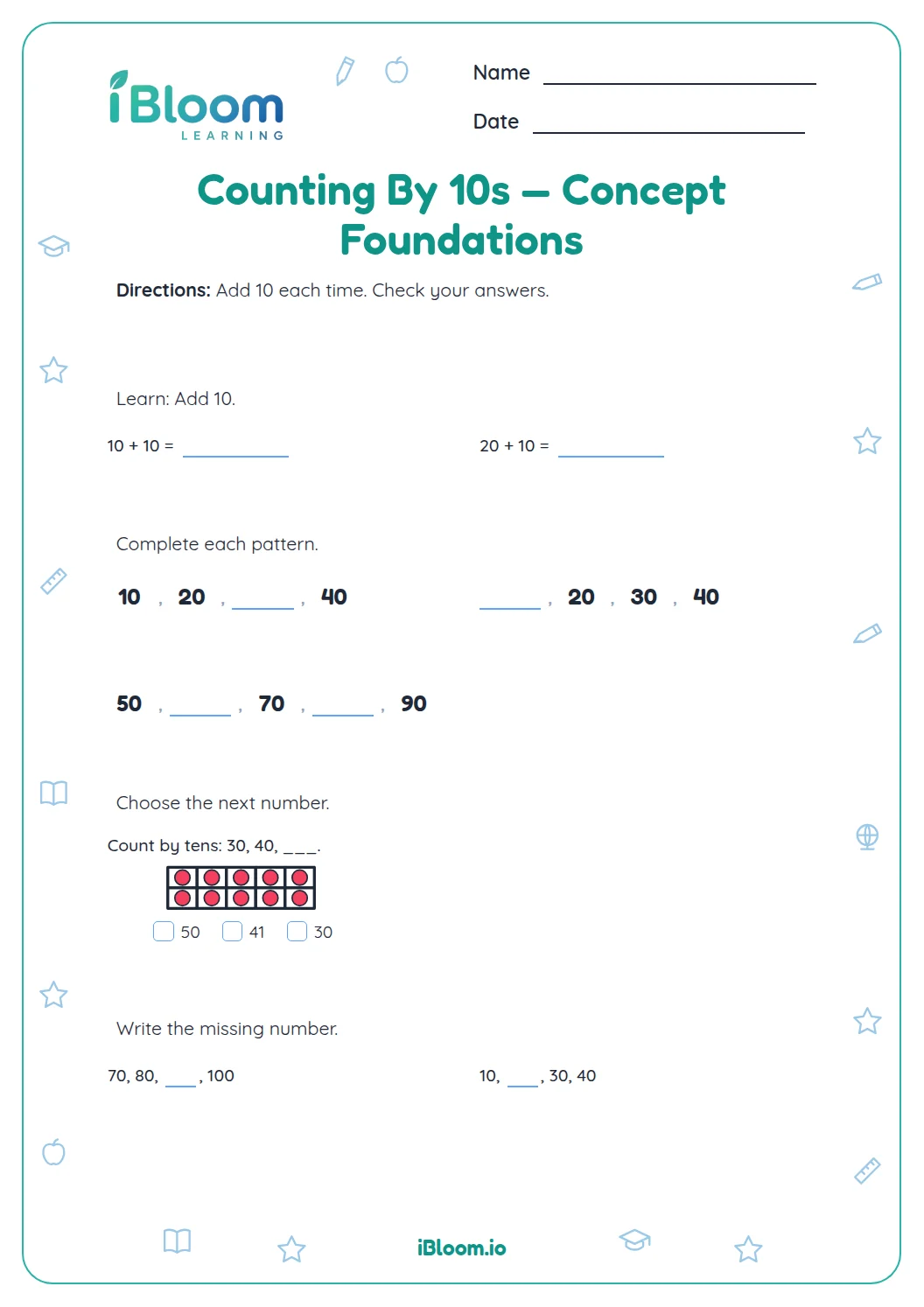
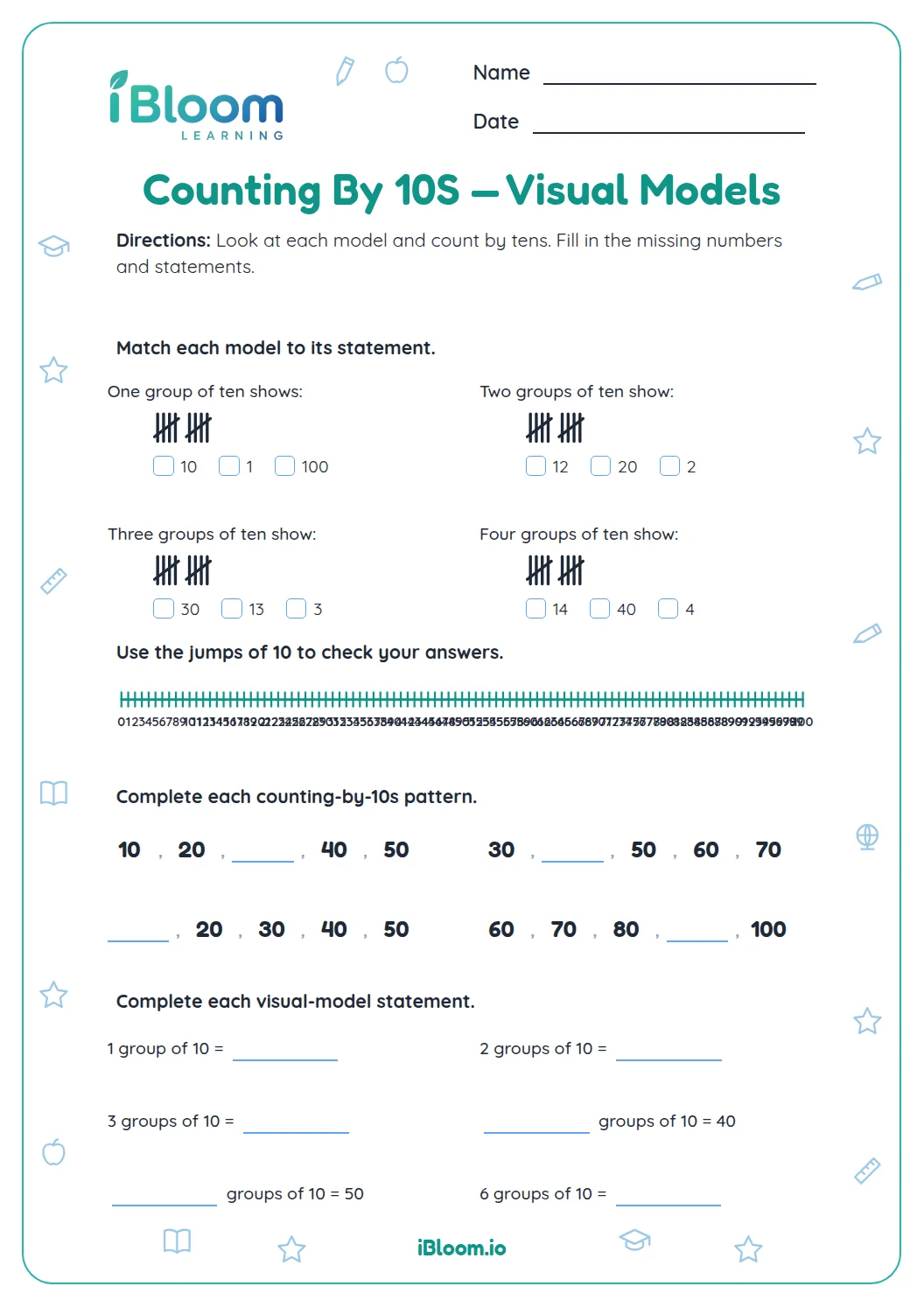
This free Grade 1 worksheet uses number lines and chart rows to make counting sequences visible. Children fill in one missing number while counting by ones, twos, fives, or tens. The 14 questions include eight number-line sequences and six number-chart rows, all within 120. A separate answer key shows each missing numeral. The worksheet practices Common Core 1.NBT.A.1 by asking children to count forward from a starting number and write numerals in order.
Aligned to 1.NBT.A.1
How do equal jumps show a sequence?
Each tick marks one equal step. A line counting by twos moves two numbers at a time.
- 18, 9, ___, 11, 12
- 2Count forward by ones: 8, 9, 10, 11, 12
- 3The missing number is 10
How do you use a number-chart row?
Compare two neighboring numbers to identify the step. In 5, ___, 15, 20, the row counts by fives, so the missing term is 10.
How can you check the missing number?
Count forward from the first term and make sure the number before and after the blank both fit the same step.
How to use this worksheet
- 1Compare neighboring numbers to find the step size.
- 2Follow the number line or chart from left to right.
- 3Say each number as you count.
- 4Write the missing numeral.
- 5Check that the next number follows the same step.
Common mistakes and quick fixes
The mistake
Counting by ones when the sequence skips numbers
The fix
Compare the first two terms and repeat that same jump.
The mistake
Changing the step halfway through
The fix
Move one equal tick or chart position at a time.
The mistake
Writing a neighboring number in the blank
The fix
Count from the beginning and check both neighbors.
Curriculum alignment
Count forward from a number and write numerals through 120.
On this sheet: The sequence tasks practice counting forward and writing numerals in order.
Show the official wordingHide the official wording
Count to 120, starting at any number less than 120. In this range, read and write numerals and represent a number of objects with a written numeral.
What to practice next
Make more practice
Further reading
Questions parents and teachers ask
What is a counting sequence?
A counting sequence is a list of numbers that follows a consistent step. In a sequence that counts by twos, each number is two more than the one before it. The worksheet uses number lines and chart rows to make those repeated steps visible.
How can a child find the step size?
Compare the first two numbers. If they are 8 and 9, the step is one; if they are 20 and 22, the step is two. Repeat that same change to reach the blank, then check that the number after the blank also fits.
What do the number lines show?
The ticks show equal jumps between the labeled endpoints. Children can count each tick to follow the sequence, including jumps of one or two. The sequence in the prompt provides the starting values, and the blank asks for the next term in that pattern.
How do the number-chart rows work?
Each row has four positions with one missing number. Read neighboring values to identify the step, then fill the blank. For 5, blank, 15, 20, the numbers increase by five, so 10 belongs in the second position. The answer key confirms the pattern.
What numbers are included?
The worksheet counts by ones, twos, fives, and tens. Its sequences stay at or below 120, including the final chart row from 90 to 120. The answer key lists all 14 missing numerals so children can check each pattern after completing it.