


About this worksheet
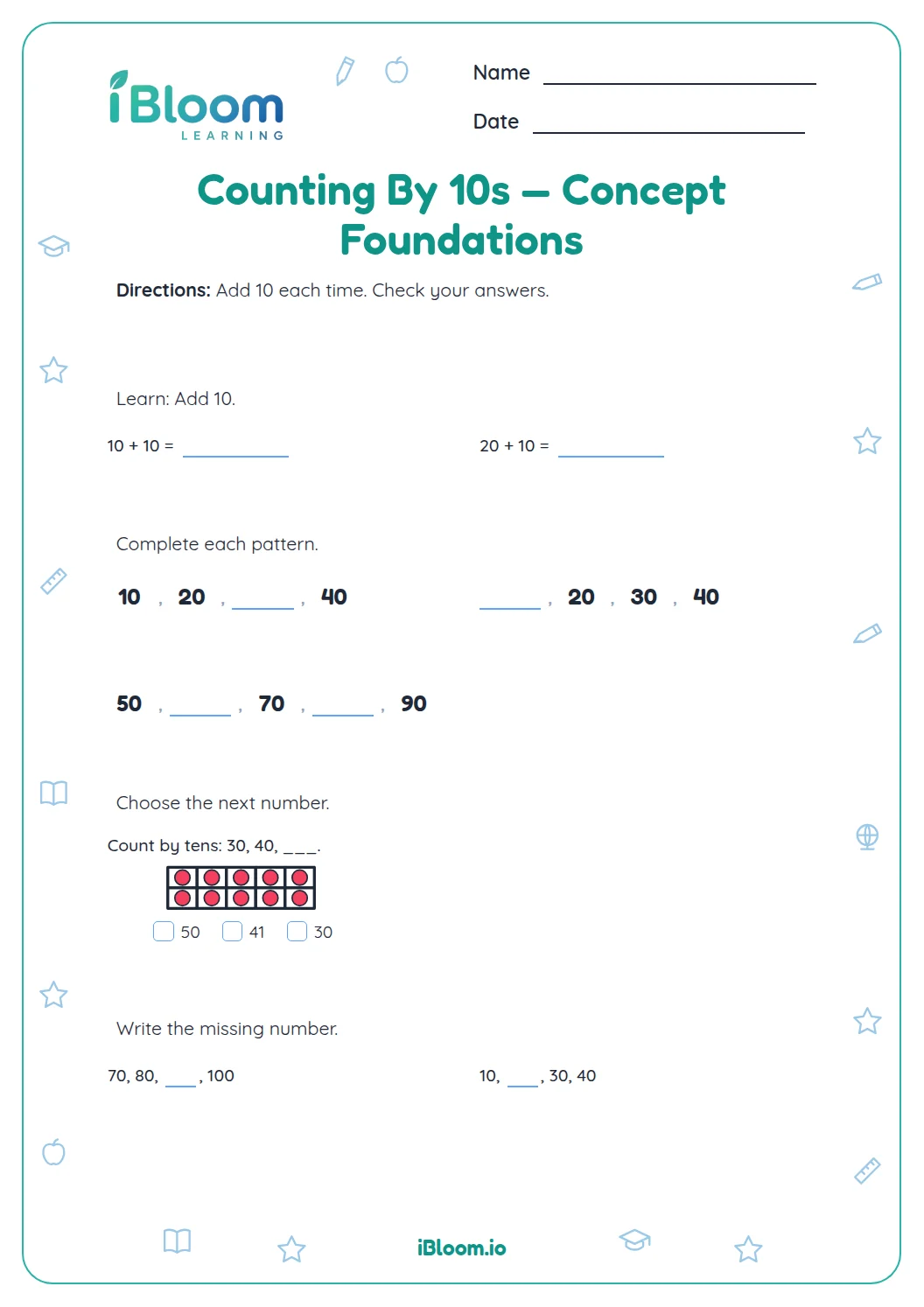
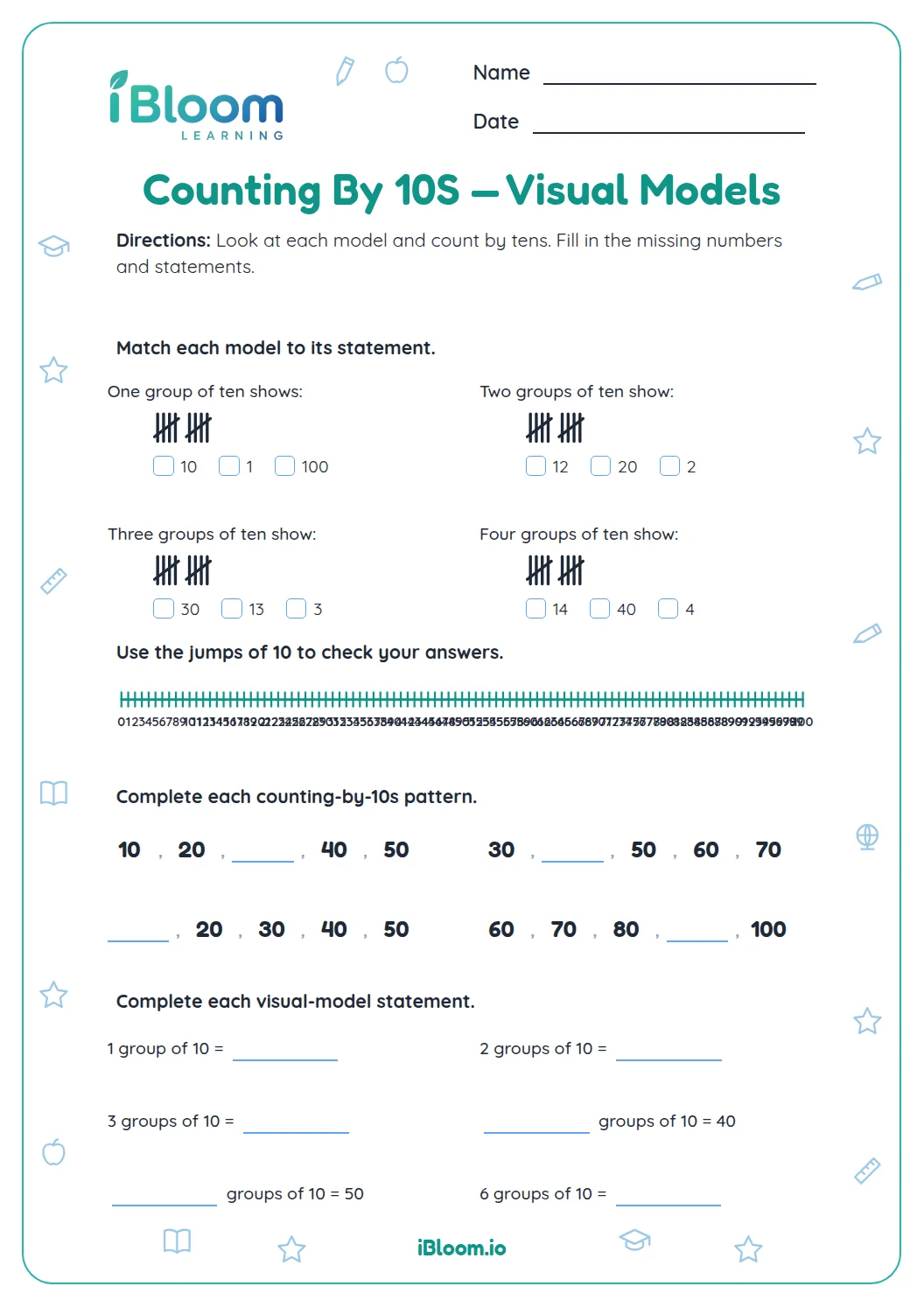
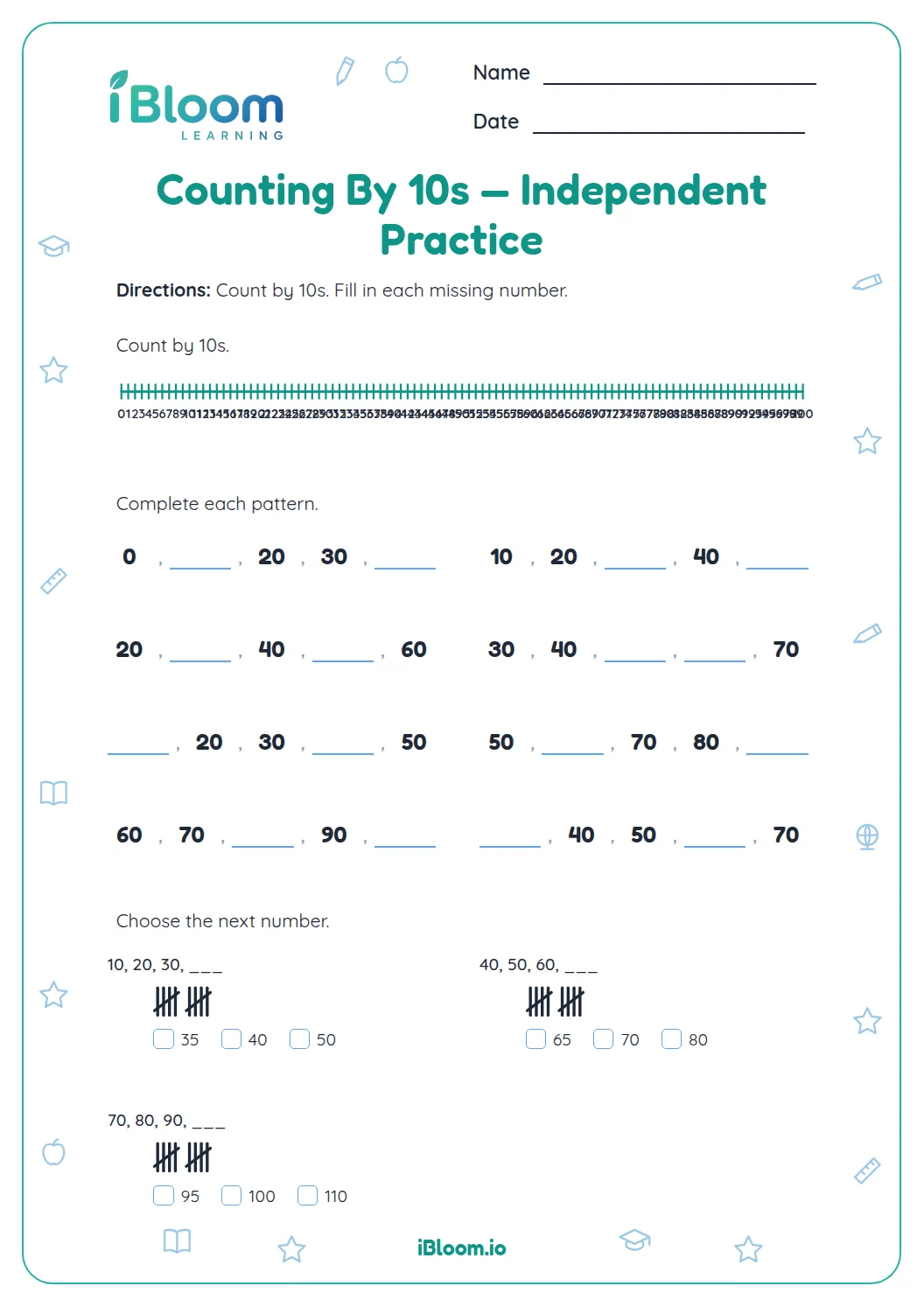
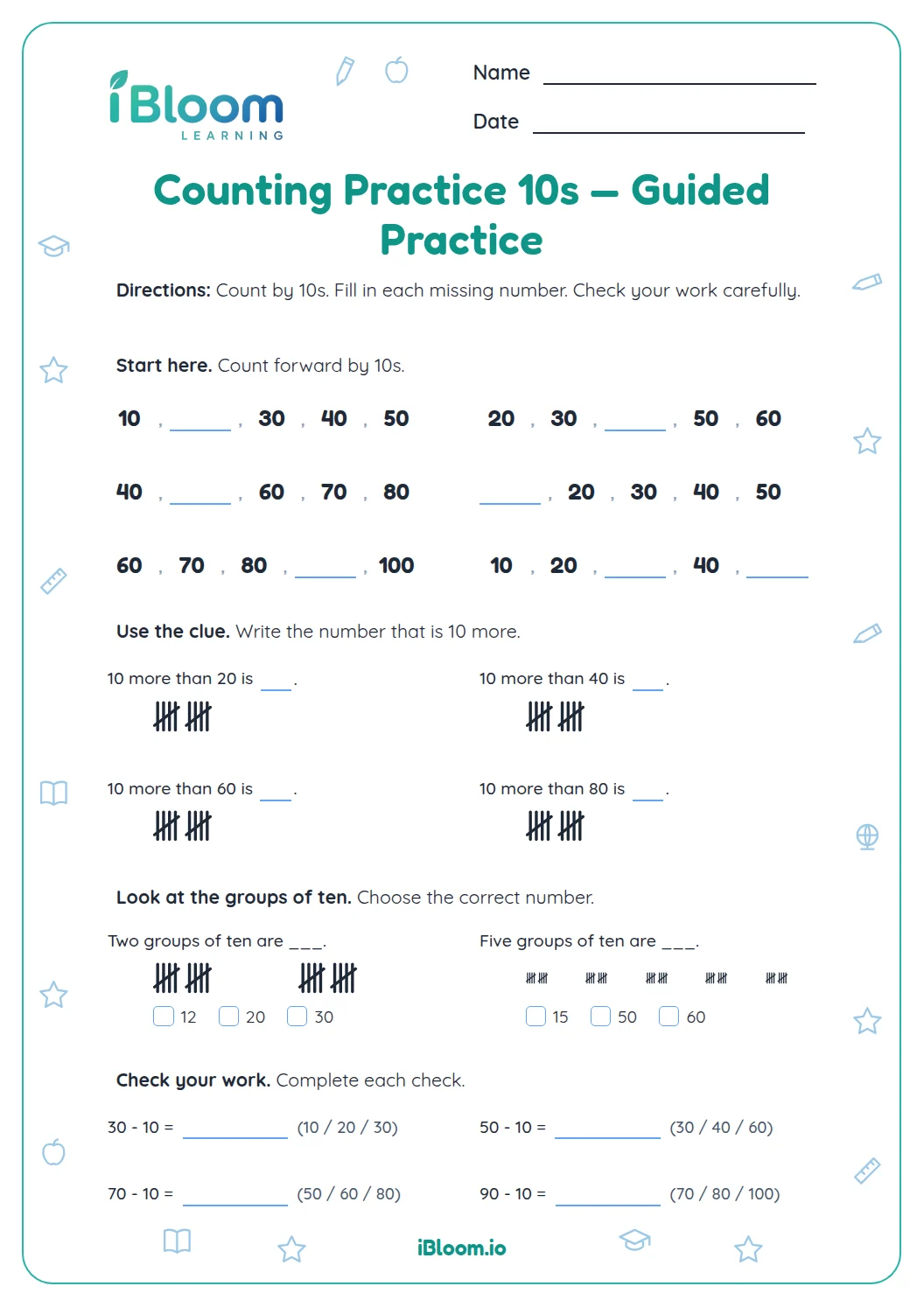
This Grade 1 printable gives children real situations for counting by 10s. They find totals and leftovers for crayons, books, eggs, seats, savings, and more, then complete sequences and count on or back from a number. The questions keep the focus on tens as jumps along the number sequence. The sheet includes 16 problems and a separate answer key.
Aligned to 1.NBT.A.1
What changes when we add one group of ten?
Counting by tens follows a steady pattern: 10, 20, 30, 40. Each new group adds ten objects, so the total grows by ten. In a story, identify how many groups of ten are added before counting.
The first part asks children to connect groups to totals and to subtraction stories. Money examples use ten cents at a time.
- 14 boxes × 10 crayons each
- 210, 20, 30, 40
- 3There are 40 crayons.
How can a number sequence show jumps of ten?
A sequence makes the repeated jump visible. In 10, 20, ___, 40, each step adds ten, so the blank is 30. When the starting number is not a multiple of ten, keep the ones digit the same: 18, 28, 38, 48, 58.
- 110, 20, ___, 40
- 2Count by tens: 10, 20, 30, 40
- 3The missing number is 30.
What happens when groups of ten are taken away?
Subtracting groups of ten is counting backward by tens. From 90, four jumps back are 80, 70, 60, 50. Keep track of each jump so the number of groups matches the story.
For a problem with a starting amount, cross out or subtract one ten for each group removed.
- 190 beads − 4 tens
- 280, 70, 60, 50
- 350 beads remain.
How to use this worksheet
- 1Underline the number of groups and note that each group has 10.
- 2Write the starting amount before counting.
- 3Say or write each jump of ten in order.
- 4For take-away stories, count backward one ten at a time.
- 5Write the answer with the object or money unit.
- 6Check the total by grouping tens or adding 10 repeatedly.
Common slips and ways to check
The mistake
Adding one instead of ten for each group.
The fix
Point to each full group and say “10 more” as the count changes.
The mistake
Changing the ones digit when counting by tens from a number like 18.
The fix
Keep the ones digit and add ten to the tens value: 18, 28, 38.
The mistake
Counting backward the wrong number of jumps.
The fix
Mark one jump for each group removed, then read the landing number.
Common Core alignment
Counting forward and backward through these number situations supports the Grade 1 number sequence goal.
Count through 120 from a starting number and represent quantities with numerals.
On this sheet: The sequence and count-on questions have children continue number names from starting values.
Show the official wordingHide the official wording
Count to 120, starting at any number less than 120. In this range, read and write numerals and represent a number of objects with a written numeral.
What to practice next
Make more practice
Further reading
Questions parents and teachers ask
What does counting by 10s mean?
Counting by 10s means adding ten each time. Starting at 10 gives 10, 20, 30, 40; starting at 18 gives 18, 28, 38, 48. This worksheet uses those jumps to find totals, solve stories, and complete number sequences. Each jump adds one more group of ten.
Can children start at a number that does not end in zero?
Yes. Add ten to the whole number and keep its ones digit the same. Starting at 18, four jumps land on 28, 38, 48, and 58. Question 11 practices this count-on strategy from a number that is not a multiple of ten.
How do the story problems use groups of ten?
Each story names groups that contain ten objects, seats, points, cents, or another amount. Multiply the number of groups by ten when adding groups, or subtract ten for each group removed. The first section has eight real-world situations. Then match the operation to the story.
Why are there questions with money?
The money questions treat each 10¢ as one group of ten cents. Five toys at 10¢ each cost 50¢, or $0.50; saving 10¢ for eight weeks totals $0.80. The answer key writes both amounts clearly. A child can write the jumps as an addition sentence to check the total.
Does the worksheet include a number chart?
The worksheet contains written number sequences and real-world problems, not a printed number chart. A child may use a separate chart as a counting aid, but each answer can be found by tracking jumps of ten from the number in the question.
Is an answer key included?
Yes. The separate key gives the missing sequence numbers and the total or amount left in each story. For money problems, it shows dollar amounts; for object-counting stories, the answer includes the item, such as crayons or beads. The item counted stays named in each answer.