




About this worksheet
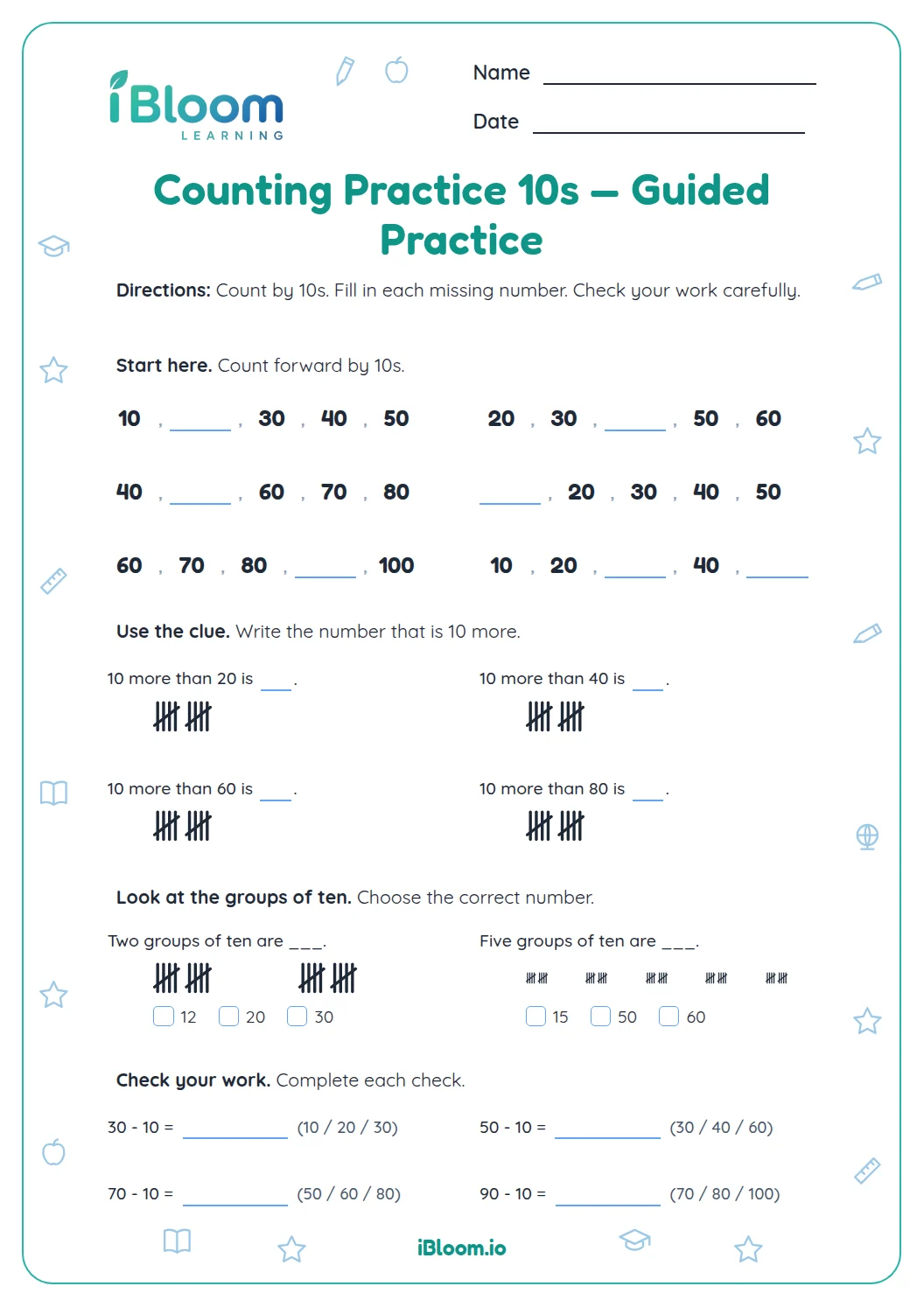
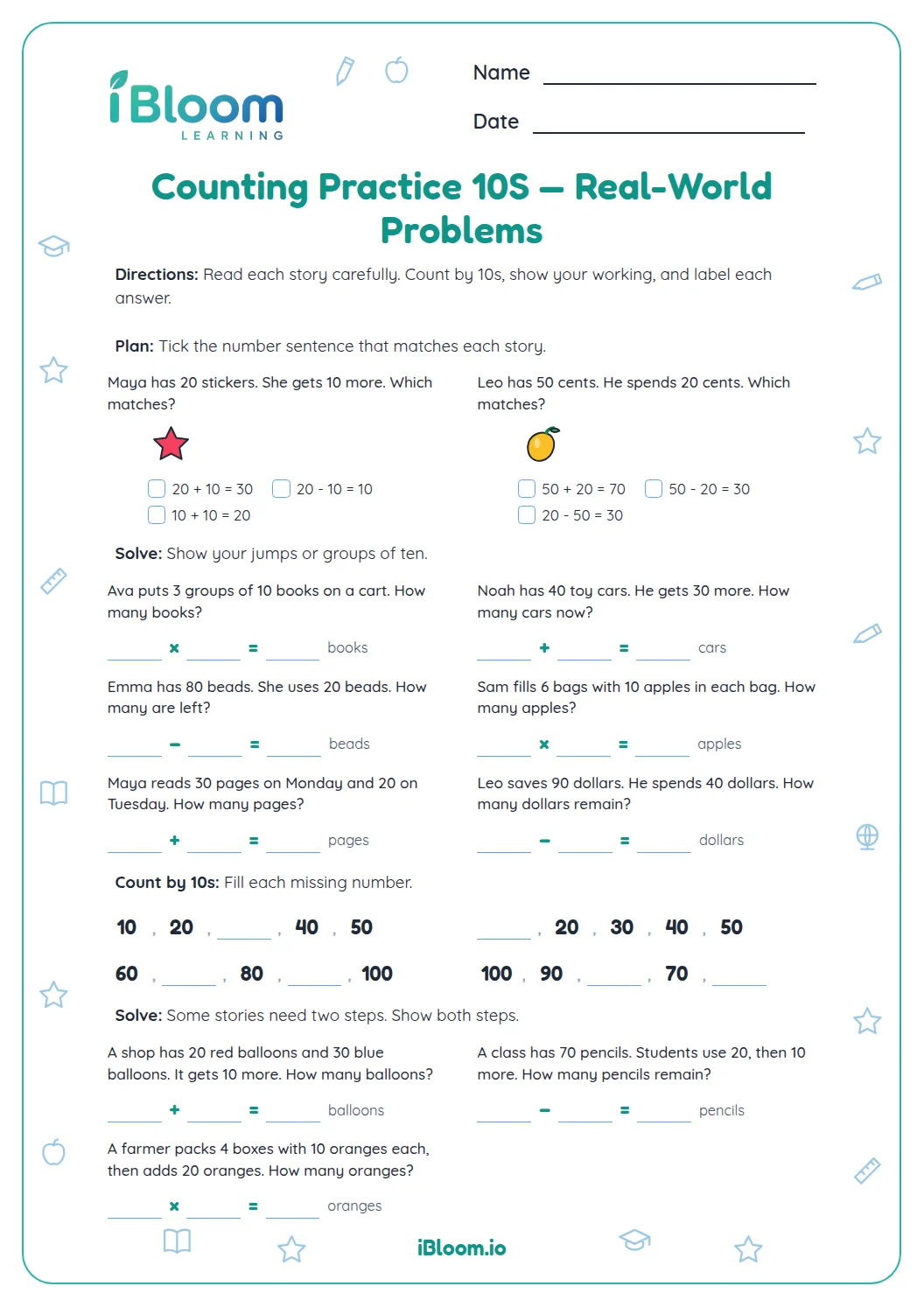
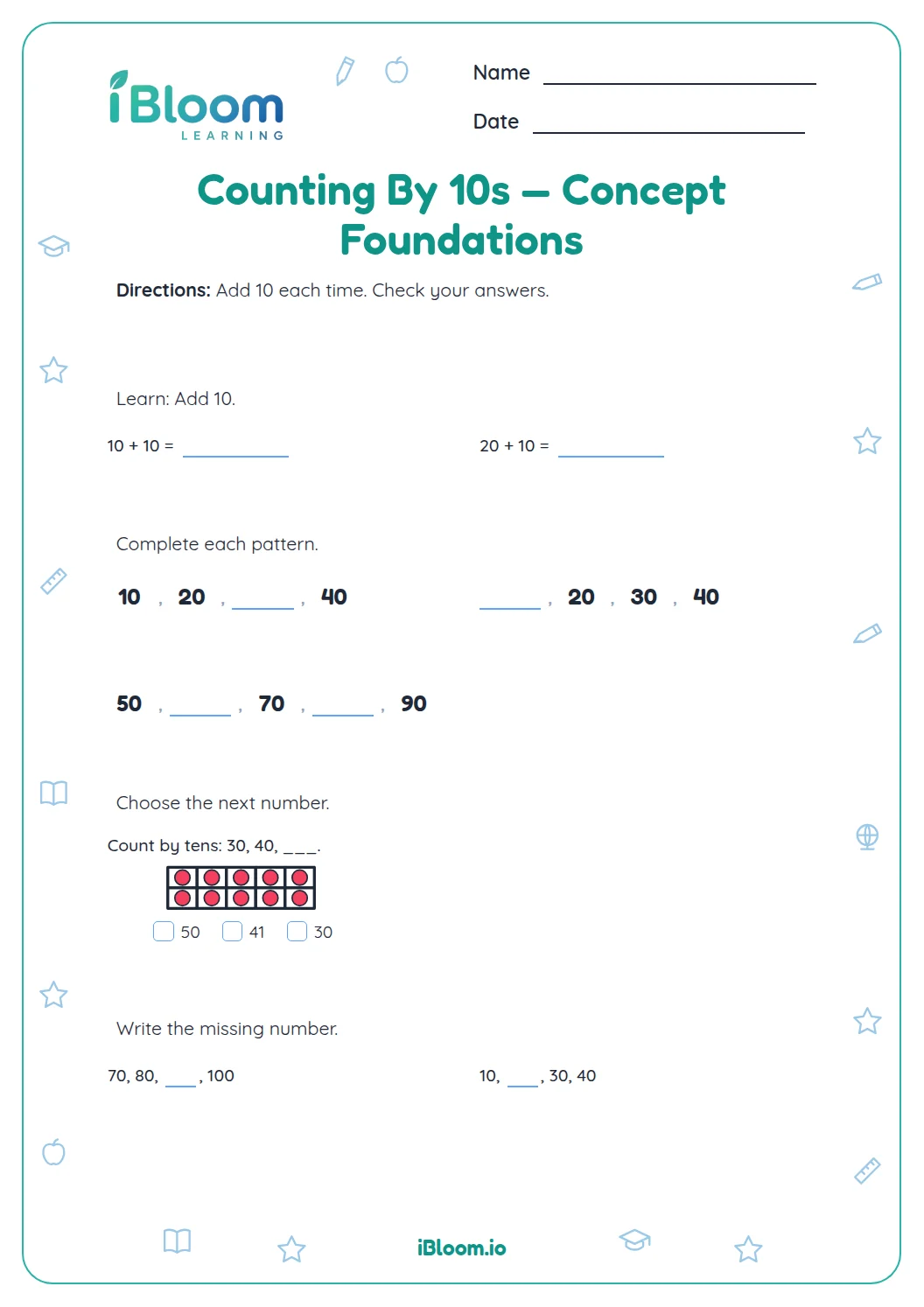
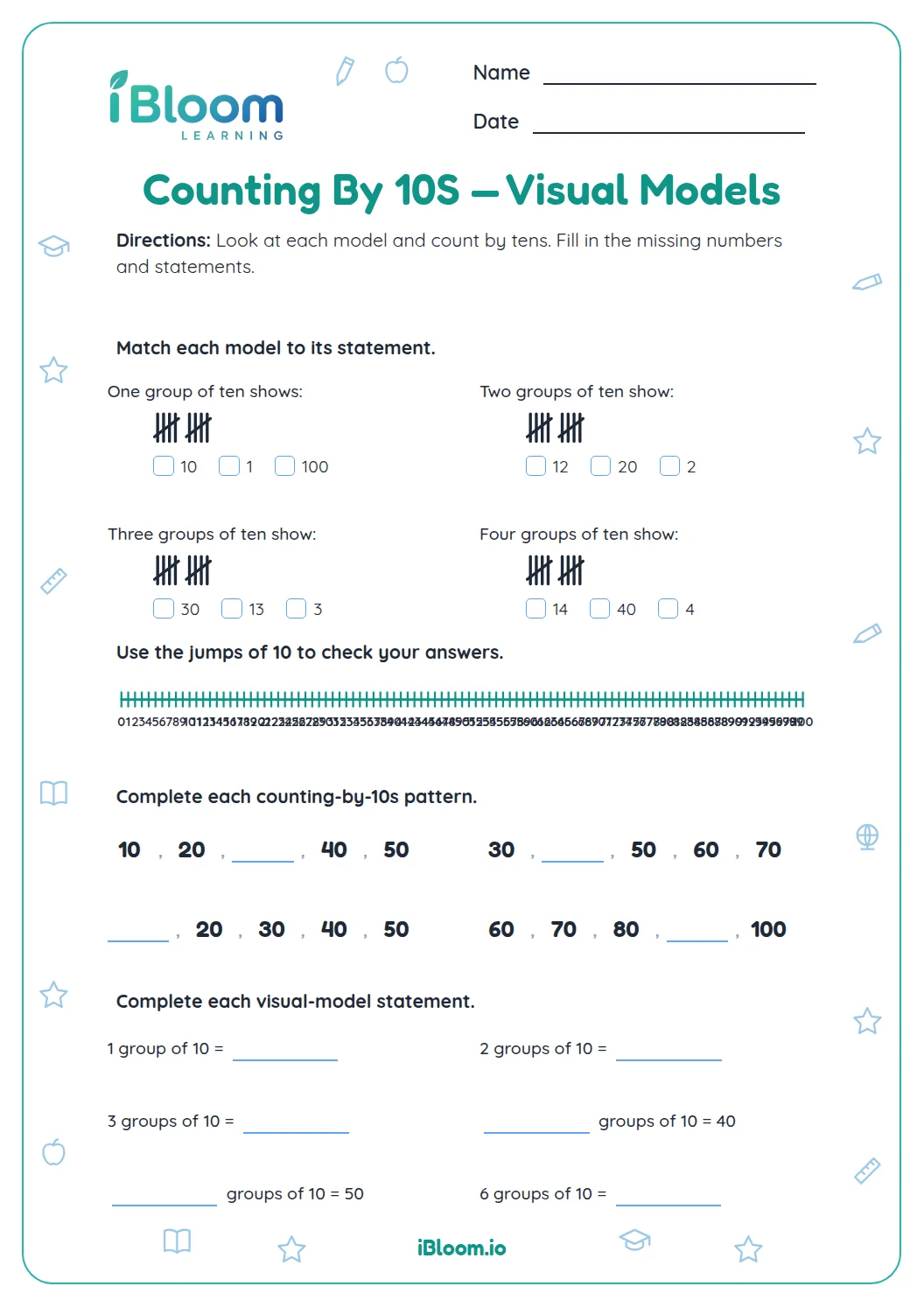
This free Grade 1 worksheet builds counting by tens from visible groups. Part A shows four sets of tens rods, each made of ten small squares. Part B has six missing-number sequences using multiples of ten through 100. Part C asks four questions about groups of ten and the change from one group to the next. The 14 questions practice the tens-and-ones relationship in Common Core 1.NBT.B.2c. Children can say each count aloud before writing. The answer key records the totals, missing numbers, and correct choices for quick checking.
Aligned to 1.NBT.B.2c
How do tens rods help children count?
Each rod has ten squares, so the child can count the squares in one rod to establish its value. Then the child can touch whole rods while saying 10, 20, 30, and so on.
In question 4, seven rods make 70. The word seven tells how many groups there are; seventy tells how many individual squares those groups contain.
- 1Question 4 shows 7 tens rods.
- 2Count the rods: 10, 20, 30, 40, 50, 60, 70.
- 37 tens = 70.
What changes when the count increases by ten?
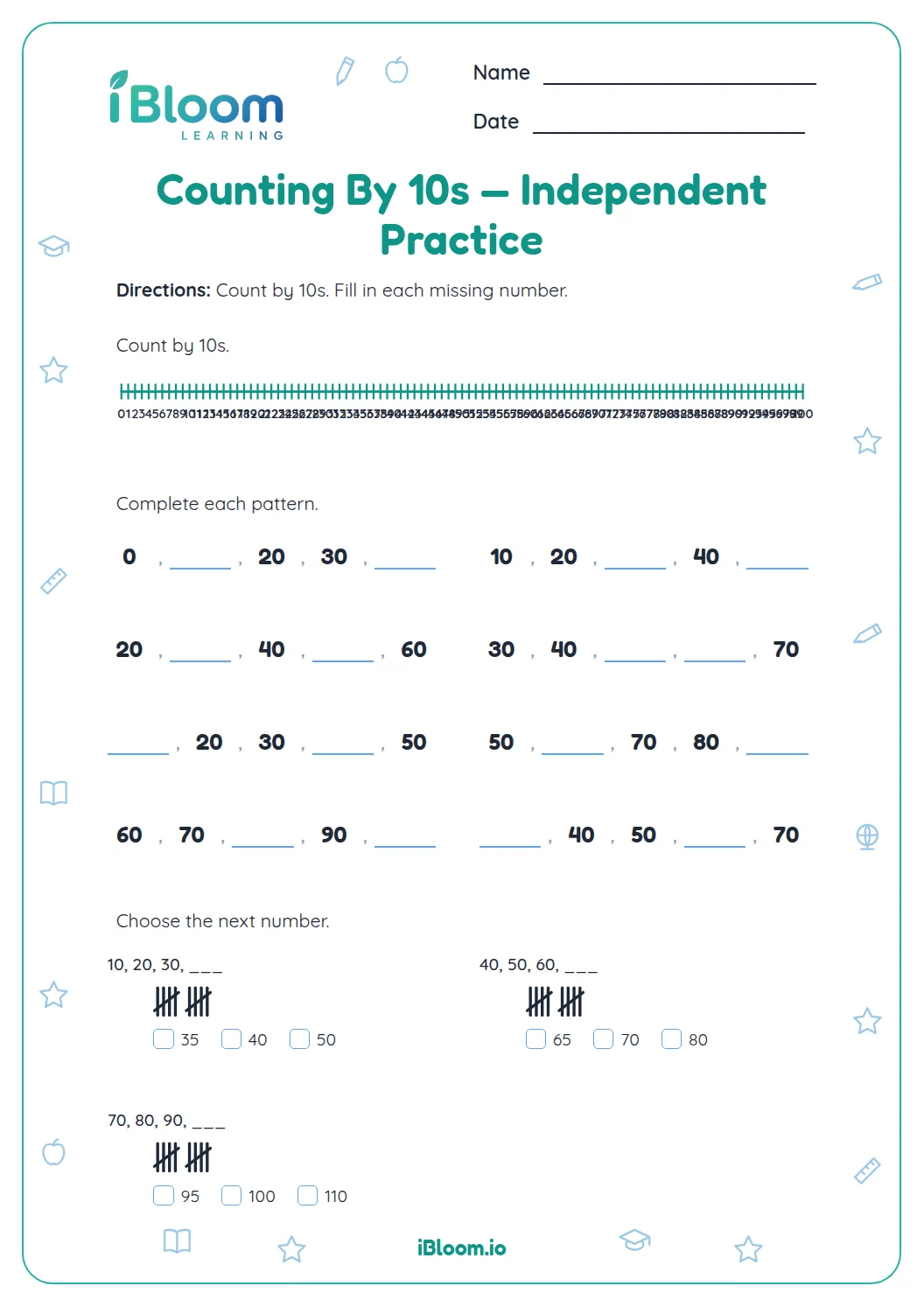
Each new group raises the total by ten. In these sequences, every number ends in zero because the groups are all complete tens. Part B includes both interior gaps and an ending gap, so children must follow the pattern across the row.
Ask the child to read the full row after filling it. For 60, 70, 80, 90, every step should represent one more group of ten.
How can I tell whether my child understands the groups?
Ask for both the number of rods and the number of squares they represent. A child who answers seven and seventy for the last rod model is distinguishing groups from individual units.
Part C checks group thinking without drawings. The choices 6 and 16 in the six-groups question help reveal whether the child has connected six tens to 60. Question 12 adds one ten to 80; the last two questions connect 3 tens to 30 and 50 to five groups of ten.
How to use this worksheet
- 1Count the ten squares in one rod together.
- 2Touch each rod once while saying the running total by tens.
- 3Write the total represented by each of the four models.
- 4Complete each missing-number row and read it aloud.
- 5Answer the four group questions without counting individual squares.
- 6Use the key to check answers and revisit a rod model if a total is unclear.
Mistakes to notice and fix
The mistake
Writing 7 for seven tens rods.
The fix
Name what is being counted: seven rods, with ten squares each, represent 70 squares.
The mistake
Filling the row 10, 20, ___, 40 with 21.
The fix
Say the size of each jump: ten more than 20 is 30.
The mistake
Choosing 81 when adding one group of ten to 80.
The fix
Use one whole tens rod to represent the added group; the new total is 90.
Common Core alignment
Connect groups of ten with the numbers 10 through 90.
On this sheet: Children count tens rods and complete sequences that increase by one ten.
Show the official wordingHide the official wording
The numbers 10, 20, 30, 40, 50, 60, 70, 80, 90 refer to one, two, three, four, five, six, seven, eight, or nine tens (and 0 ones).
What to practice next
Make more practice
Further reading
Questions parents and teachers ask
What numbers does this worksheet use?
The missing-number rows use multiples of ten from 10 through 100. The four block models represent 10, 20, 40, and 70. Four final choices check totals, adding a ten, and the number of groups. Children encounter the full tens sequence while connecting selected numbers to visible groups.
Should children count every small square in every rod?
Begin by counting the ten squares in one rod, then count the remaining rods as whole groups. Touching each rod while saying the next multiple of ten helps connect the spoken count to quantity. If a child is unsure, recount one rod and try the group count again.
Why does every number in the sequences end in zero?
Every number represents complete groups of ten with no extra ones. The tens rods show that structure directly. When a new rod is added, the total rises by ten and still has zero extra ones. Ask the child to compare 20 and 30 to describe that change.
How can I help with a blank in the middle of a row?
Read the number before the blank and add one ten, then check the number after it. In 30, 40, blank, 60, the missing number is 50. Reading the completed row aloud gives a second check that every step adds the same amount, including the step after the blank.
Is this a speed exercise?
No, the worksheet is intended for explaining and practicing the idea of groups of ten. Allow time to touch the rods, say the sequence, and check a missing number. The suggested time is about 15 minutes, but a useful explanation matters more than finishing within a particular number of minutes.