


About this worksheet
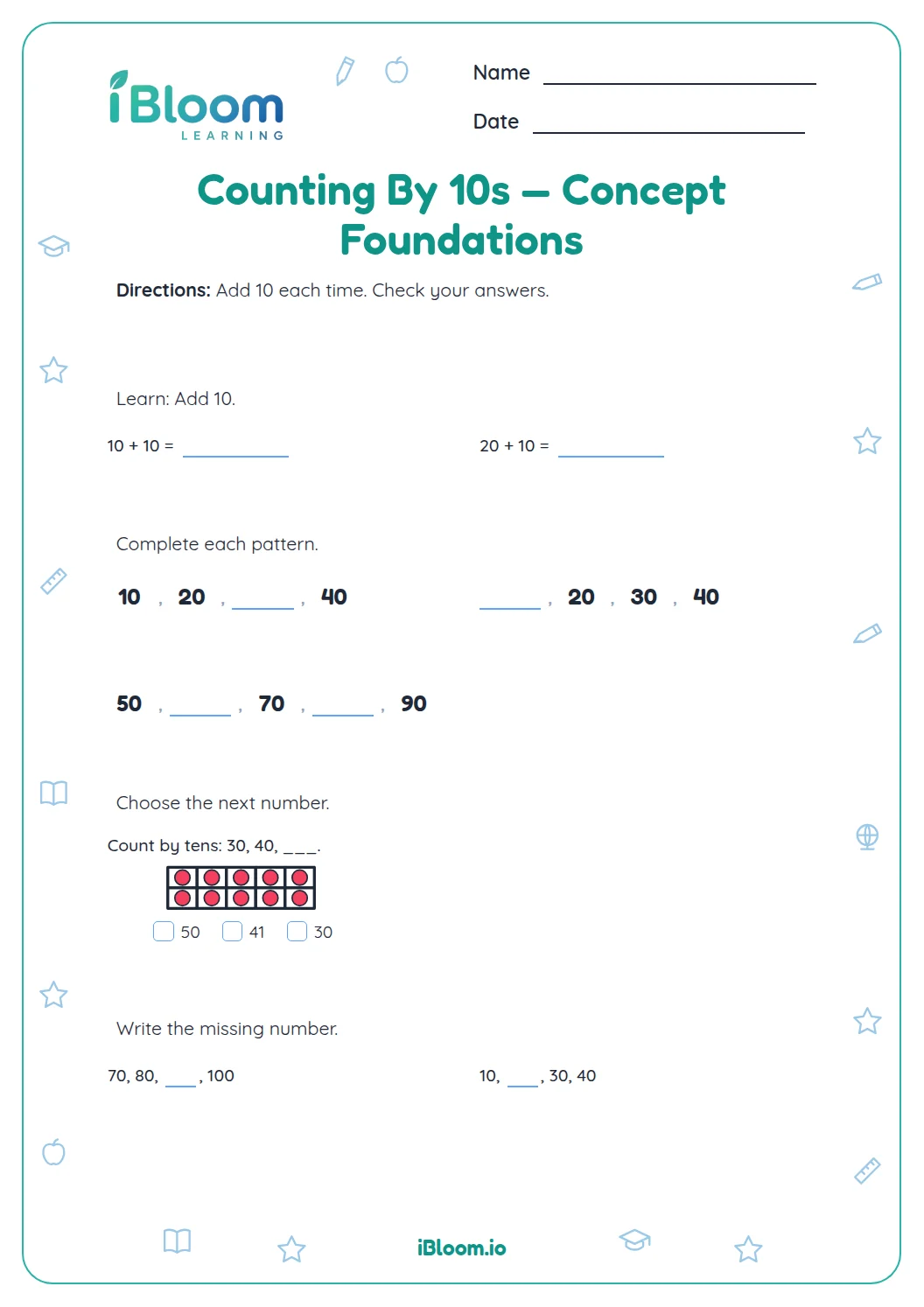
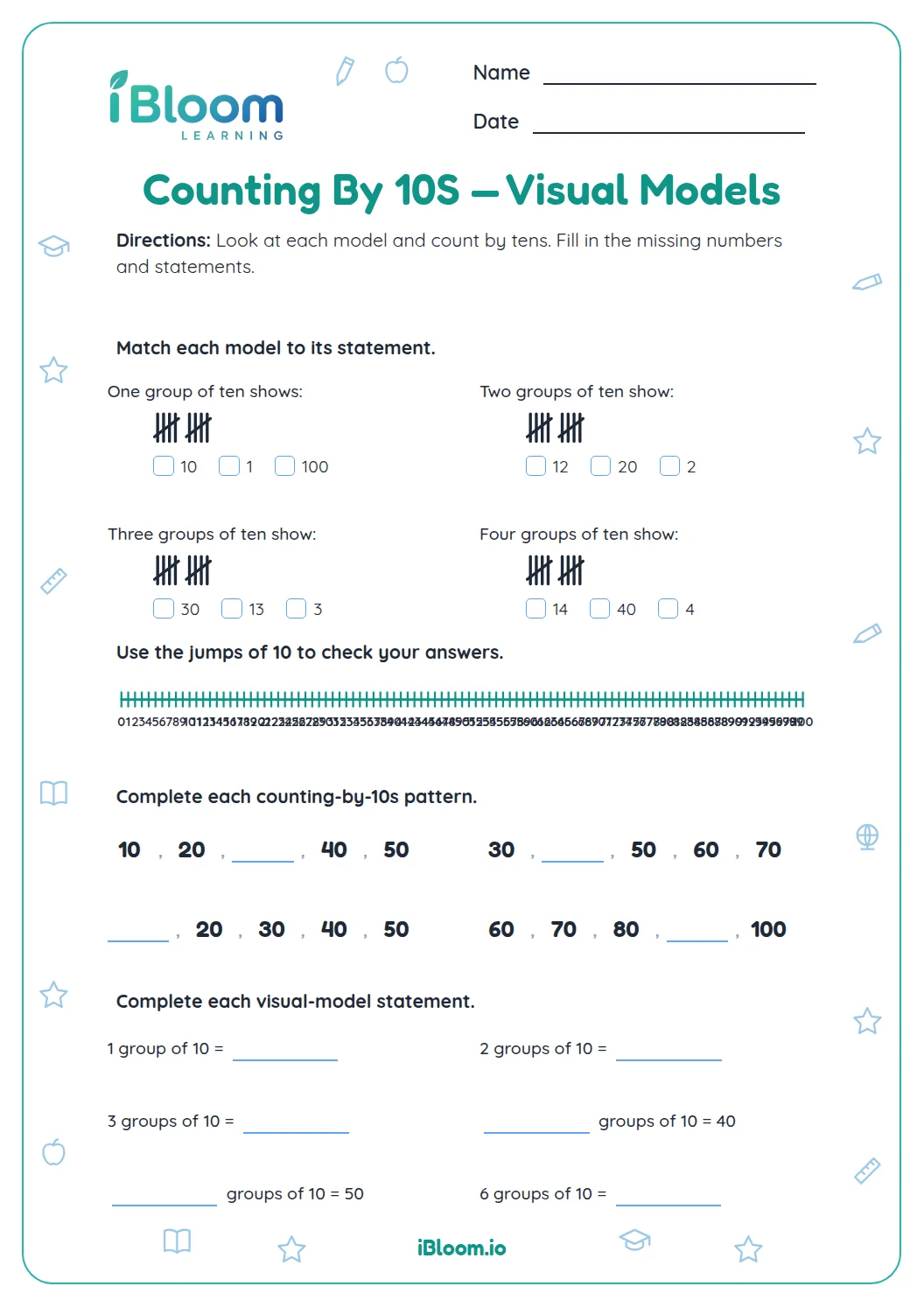
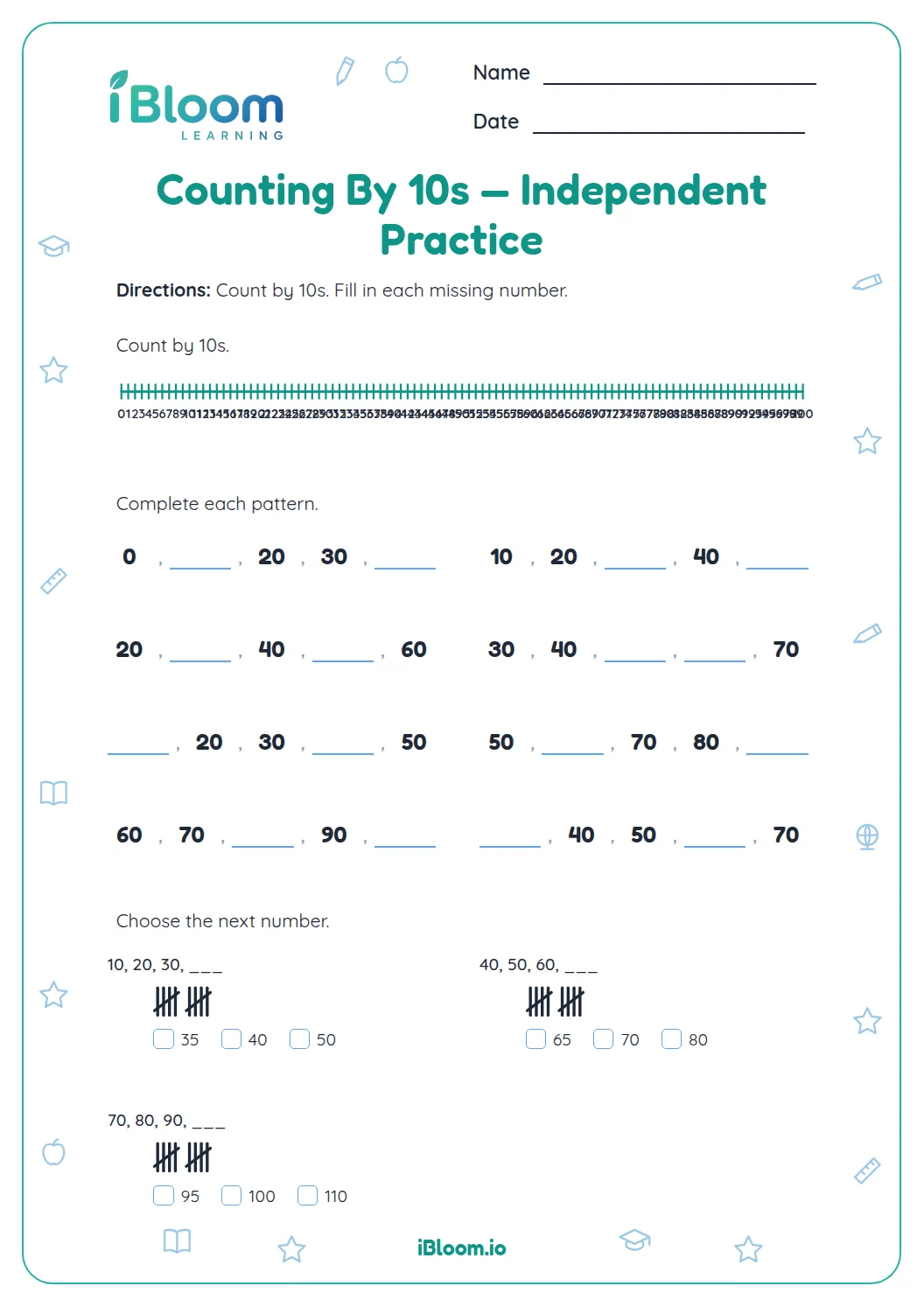
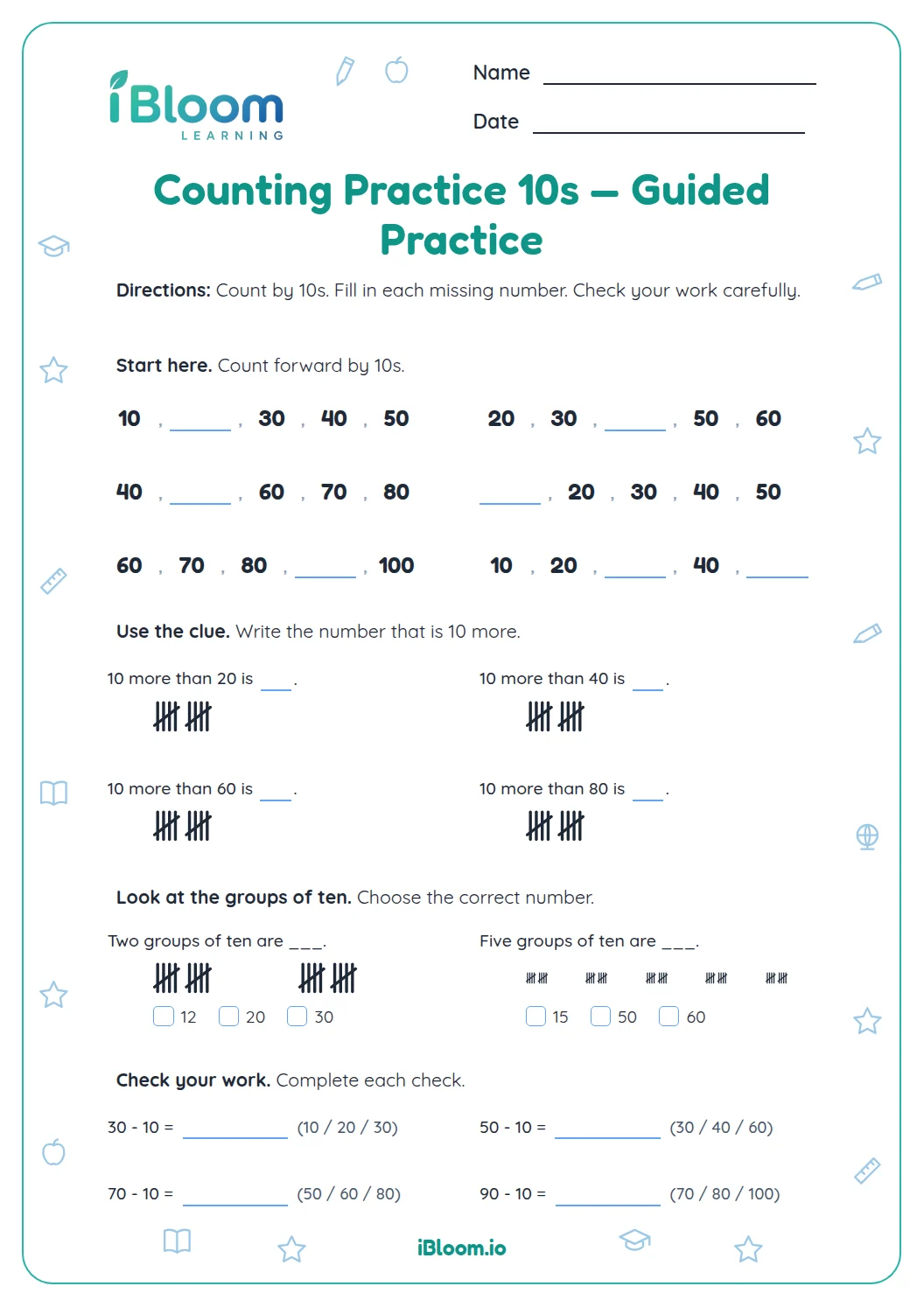
This free printable Grade 1 worksheet builds reasoning with counting by 10s. Children finish forward and backward patterns, choose a rule that fits a count, and check a classmate’s claim about a skipped number. Questions use familiar tens from 10 to 120, with one count beginning at 25 to prompt children to think about adding ten rather than naming only multiples of ten. The sheet practices Common Core 1.NBT.A.1 and includes a separate answer key.
Aligned to 1.NBT.A.1
How can you find a missing number in a count by tens?
Look at the numbers on both sides of the blank. Ask how much the count changes each time. In question 1, 10 becomes 20, so the count adds 10; 20 + 10 is 30, and 30 + 10 is 40.
For a count going backward, take away 10 each time. In 100, 90, ___, 70, the missing number is 80.
- 110, 20, ___, 40, 50
- 220 + 10 = 30
- 3Check: 30 + 10 = 40
How do children reason about a counting rule?
Compare a number with the one right before it. If 30 changes to 40, the increase is 10. A count that jumps from 50 to 70 has skipped 60, so it does not show every number in a count by tens.
Question 8 starts at 25. Adding 10 gives 35. This checks whether children understand the size of each jump, even when a count does not start at a multiple of ten.
What kinds of questions are on the sheet?
The 14 questions build from completing patterns to explaining a counting idea. The worksheet includes forward and backward counts and uses tens through 120.
- Part A: Fill six missing numbers in forward and backward patterns.
- Part B: Choose the rule or number that makes five counting statements correct.
- Part C: Check a claim about the change in a count.
- Part D: Compare two numbers in tens and explain a counting pattern.
- A separate answer key covers the worksheet pages.
How can I help a child use this worksheet?
- 1Say a few tens aloud together, pointing to one number at a time.
- 2For Part A, have the child name whether the count moves forward or backward before filling a blank.
- 3Ask the child to compare neighboring numbers instead of guessing from the whole row.
- 4In Part B, read each choice aloud and test it against the count.
- 5For Part C, encourage a complete sentence that names the change: ten more or ten less.
- 6Use the key to check answers, then revisit any pattern by counting aloud from its first number.
Common counting-by-10s mistakes
The mistake
Adding 1 instead of 10, such as saying 26 after 25.
The fix
Say 25, then ten more: 35. Keep the tens digit change in view.
The mistake
Continuing forward when the pattern is counting backward.
The fix
Check whether the numbers get larger or smaller, then add 10 or take away 10.
The mistake
Skipping a number in the pattern, such as jumping from 50 to 70.
The fix
Compare each pair of neighbors. A count by tens changes by exactly 10 at every step.
Common Core alignment
This worksheet practices the Grade 1 counting sequence standard.
Continue the counting sequence by tens, including from a number such as 25.
On this sheet: Children continue and reason about counting sequences that change by ten.
Show the official wordingHide the official wording
Count to 120, starting at any number less than 120. In this range, read and write numerals and represent a number of objects with a written numeral.
What to practice next
Make more practice
Further reading
Questions parents and teachers ask
How do you count by 10s?
Start at a number and add 10 for each forward step. For example, after 40 comes 50, then 60. When counting backward by tens, take away 10 at each step, as in 100, 90, 80. On this worksheet, children use both directions to complete number patterns.
Can a count by 10s start at 25?
Yes. Starting at 25 and adding 10 gives 35, then 45. Question 8 uses this kind of start so children focus on the size of each jump instead of only reciting familiar tens. They can check by adding ten again to 35.
What should a child do if a pattern has a blank?
Look at the neighboring numbers and determine the direction and step. In 50, 60, 70, blank, 90, the count moves forward by 10, so the missing number is 80. Check by adding 10 once more to reach 90.
How is counting backward by 10s different?
The numbers get smaller by 10 at each step. For example, 100, 90, 80, 70 moves backward. On this sheet, children see a backward pattern and use its direction to decide whether to add or subtract 10 before filling the blank.
What is included in the answer key?
The separate answer key gives the missing numbers, correct multiple-choice options, and short model answers for the explanation questions. For open responses, a child’s wording can differ while still describing the same ten-step pattern. Use the key to check the idea, not just the exact wording.
Which standard does the worksheet practice?
It practices Common Core 1.NBT.A.1, which asks first graders to count to 120 starting from any number less than 120. The worksheet focuses on continuing and explaining patterns that move by tens, including a count that begins at 25.