



About this worksheet
This Grade 1 printable connects number stories with reading and writing numerals from 1 through 25. Learners solve addition and subtraction situations, write the full numeral range in order, and answer before-and-after clues. Fourteen questions include a separate answer key.
Aligned to 1.NBT.A.1 and 1.OA.A.1
How do you solve the number stories?
Find the starting amount, then notice whether the story adds to it or takes some away. In the bus problem, 20 seats with 2 empty means 20 − 2 seats are filled. Write the answer as a numeral and include the named object when asked.
- 1The bus has 20 seats. 2 are empty.
- 2Subtract the empty seats: 20 − 2 = 18.
- 3There are 18 filled seats.
How does the page cover numerals 1 through 25?
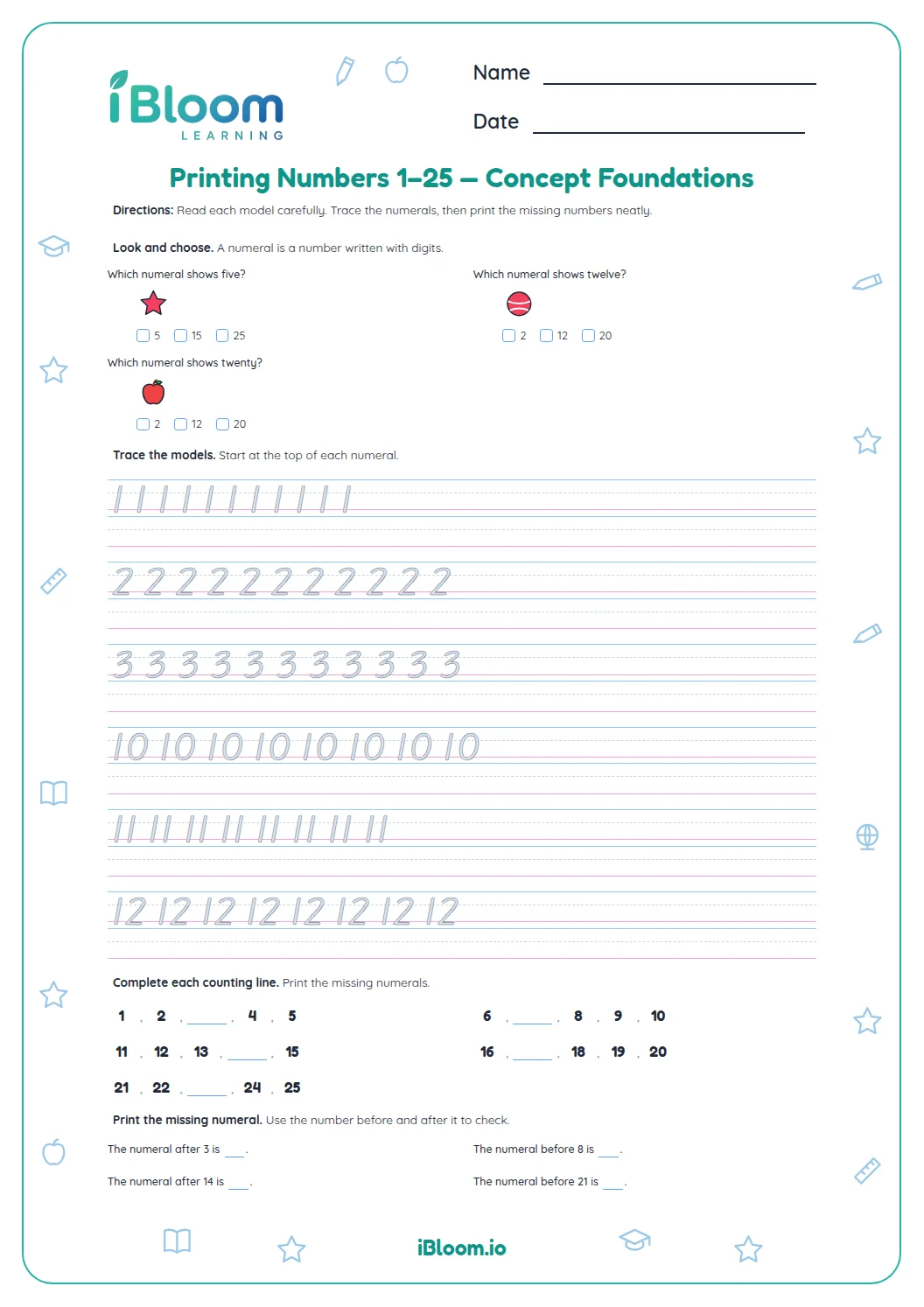
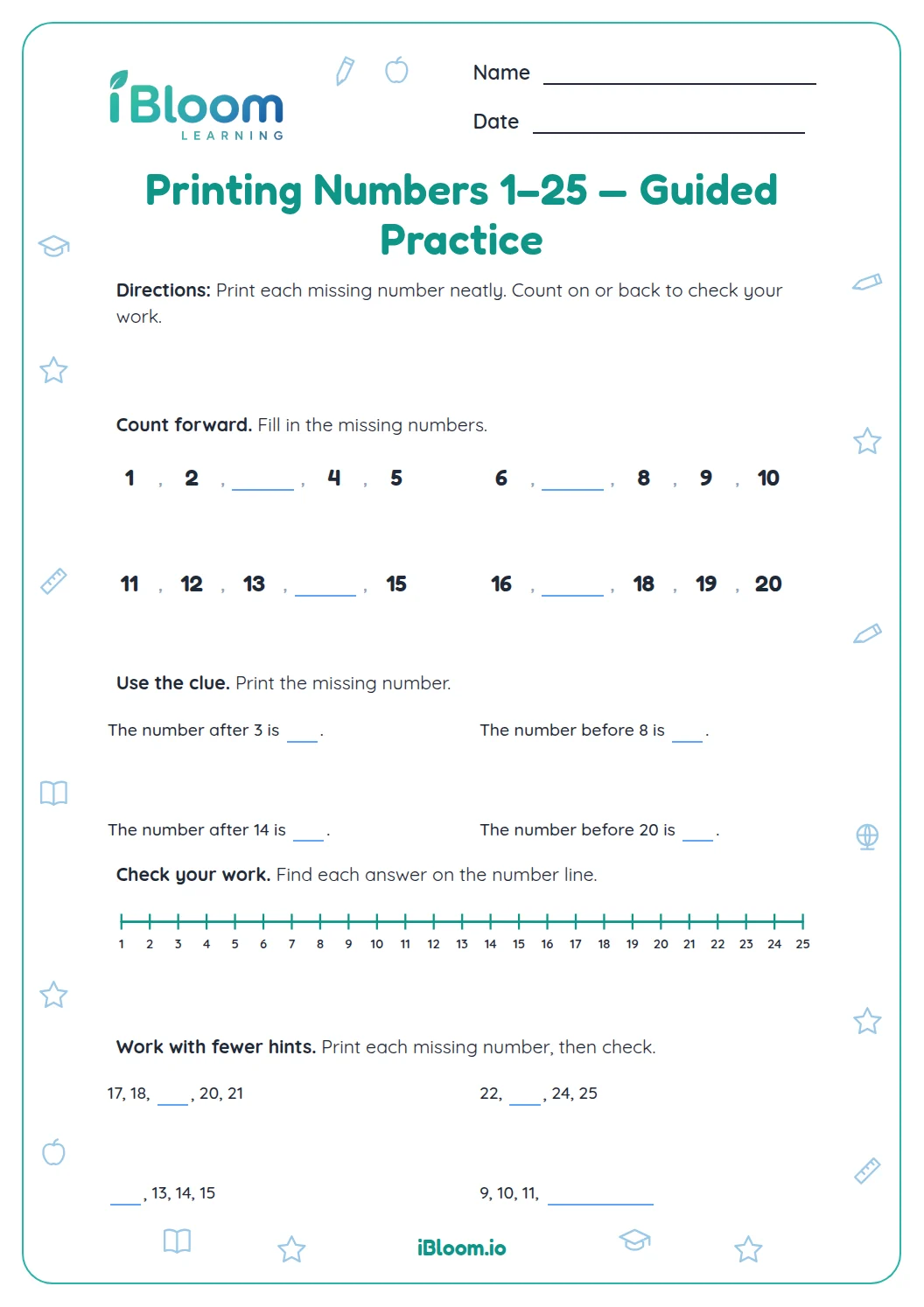
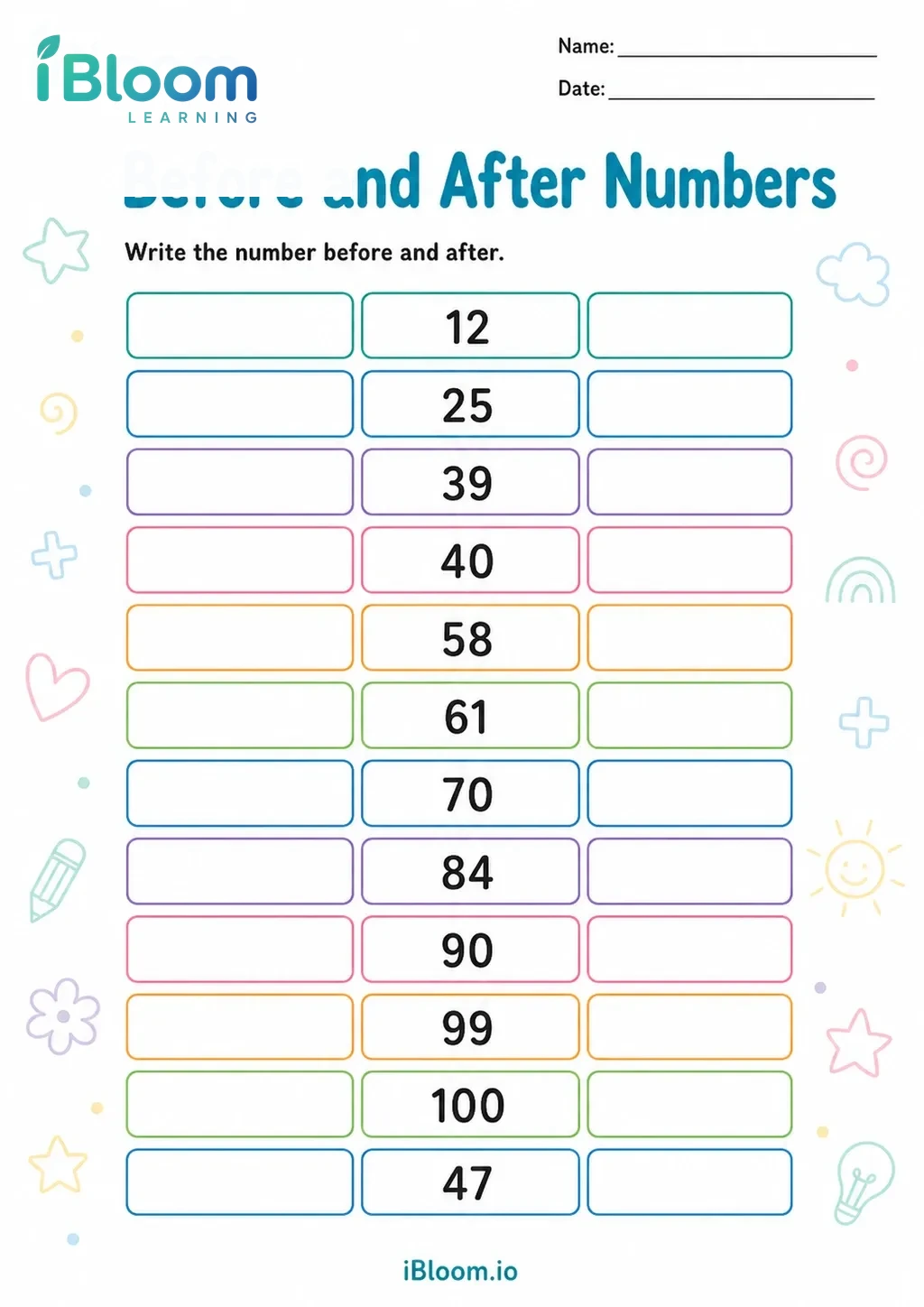
Five writing prompts ask learners to print 1–5, 6–10, 11–15, 16–20, and 21–25 in order. Together, the sequences include every numeral in the title’s range. The final clues ask learners to notice a skipped or neighboring number.
How can an adult support numeral writing?
Have the learner say each number while writing it, especially at the transitions from 9 to 10 and 19 to 20. In a story, ask whether the amount grows or shrinks before choosing an operation. Check that the written sequence includes each number once and in order.
How to use this worksheet
- 1Read the story and identify the starting amount.
- 2Decide whether the amount increases or decreases.
- 3Write the numeral answer and the requested label.
- 4Print the five number sequences in order, checking each transition.
- 5Use the answer key to review stories and sequence order.
Common mistakes and quick fixes
The mistake
Adding when the story says some leave or are empty.
The fix
Look for what is taken away or not included, then subtract from the starting amount.
The mistake
Skipping or repeating a numeral in a sequence.
The fix
Say the numbers aloud in order while pointing to each written numeral.
The mistake
Choosing an operation without using the story details.
The fix
Underline the starting amount and the change, then decide whether the amount grows or shrinks.
Common Core alignment
This printable practices the standard below through focused questions.
Read the story or sequence, then write the numeral that fits.
On this sheet: The worksheet questions use this skill directly.
Show the official wordingHide the official wording
Count to 120, starting at any number less than 120. In this range, read and write numerals and represent a number of objects with a written numeral.
Solve addition and subtraction stories within 20.
On this sheet: Seven short stories use adding to and taking from within 20.
Show the official wordingHide the official wording
Use addition and subtraction within 20 to solve word problems involving situations of adding to, taking from, putting together, taking apart, and comparing, with unknowns in all positions, e.g., by using objects, drawings, and equations with a symbol for the unknown number to represent the problem.
What to practice next
Make more practice
Further reading
Questions parents and teachers ask
Does the worksheet include every number from 1 to 25?
Yes. Five prompts ask learners to write 1–5, 6–10, 11–15, 16–20, and 21–25. Together those sequences cover each numeral in the range. Other questions connect number reading and writing to short everyday stories. The worksheet provides room to record each group in order.
What kinds of number stories are included?
The page includes joining, separating, and putting groups together situations. Examples involve crayons, shells, seats, birds, balloons, books, and points. Learners choose or write an answer based on what happens to the amount in each story. The stories use familiar objects and amounts within the practice range.
How many questions are there?
There are 14 numbered questions in three parts: number stories, numeral sequences, and number clues. The sequence items each ask for a group of five numerals. A separate answer key supports checking the stories and the full range.
What does “printing numbers” mean here?
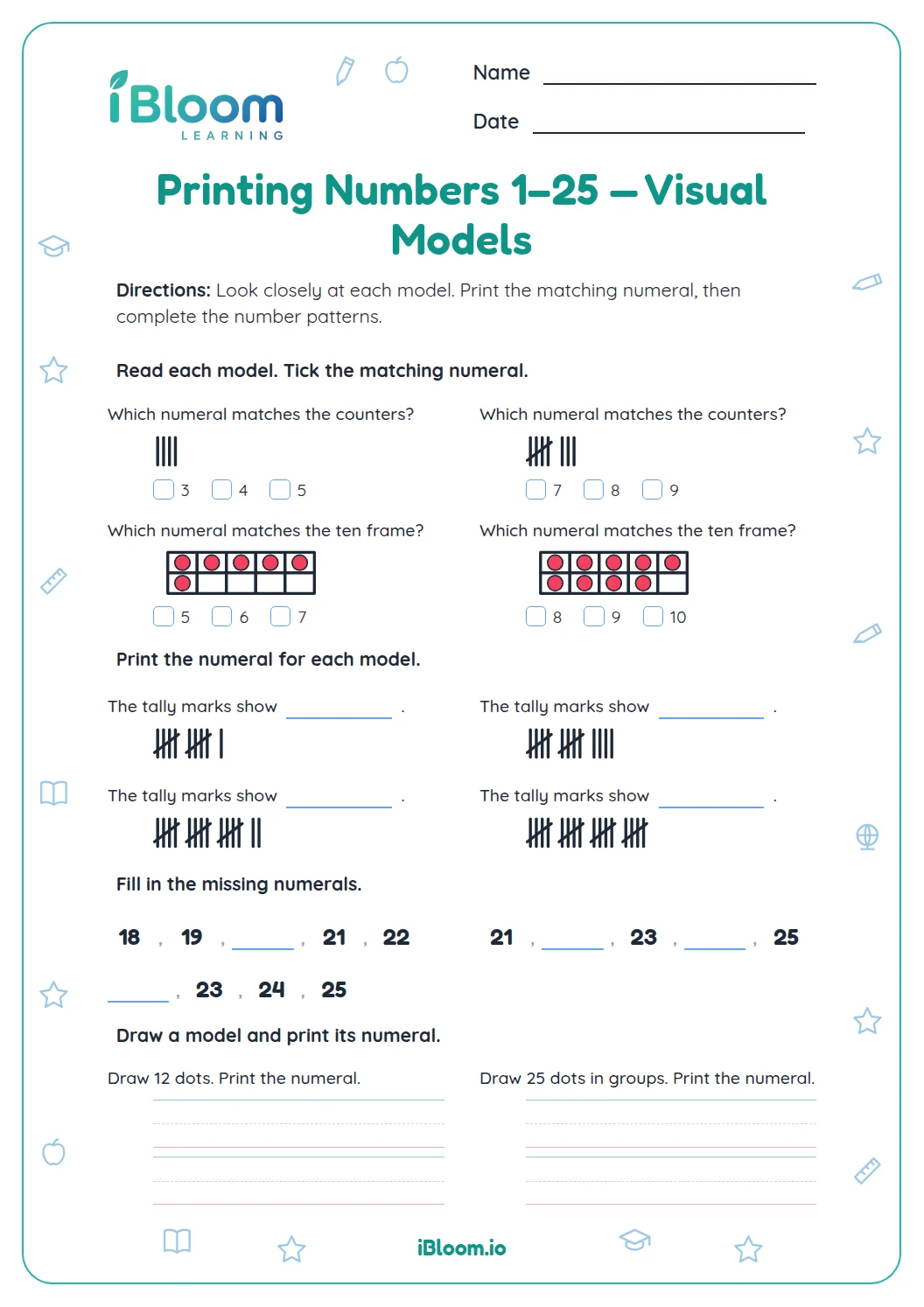
It means writing numerals clearly. Learners write each numeral from 1 to 25 in order across five short sequences, then use numerals in answers to the stories. The page focuses on numerals rather than spelling number words. Clear numeral formation makes each answer easier to read and check.
Can an adult read the stories aloud?
Yes. An adult can read a story aloud and invite the learner to point out the starting number and what changes. The child can then choose addition or subtraction and record the numeral. The writing sequences can be completed independently or read aloud together.