
About this worksheet
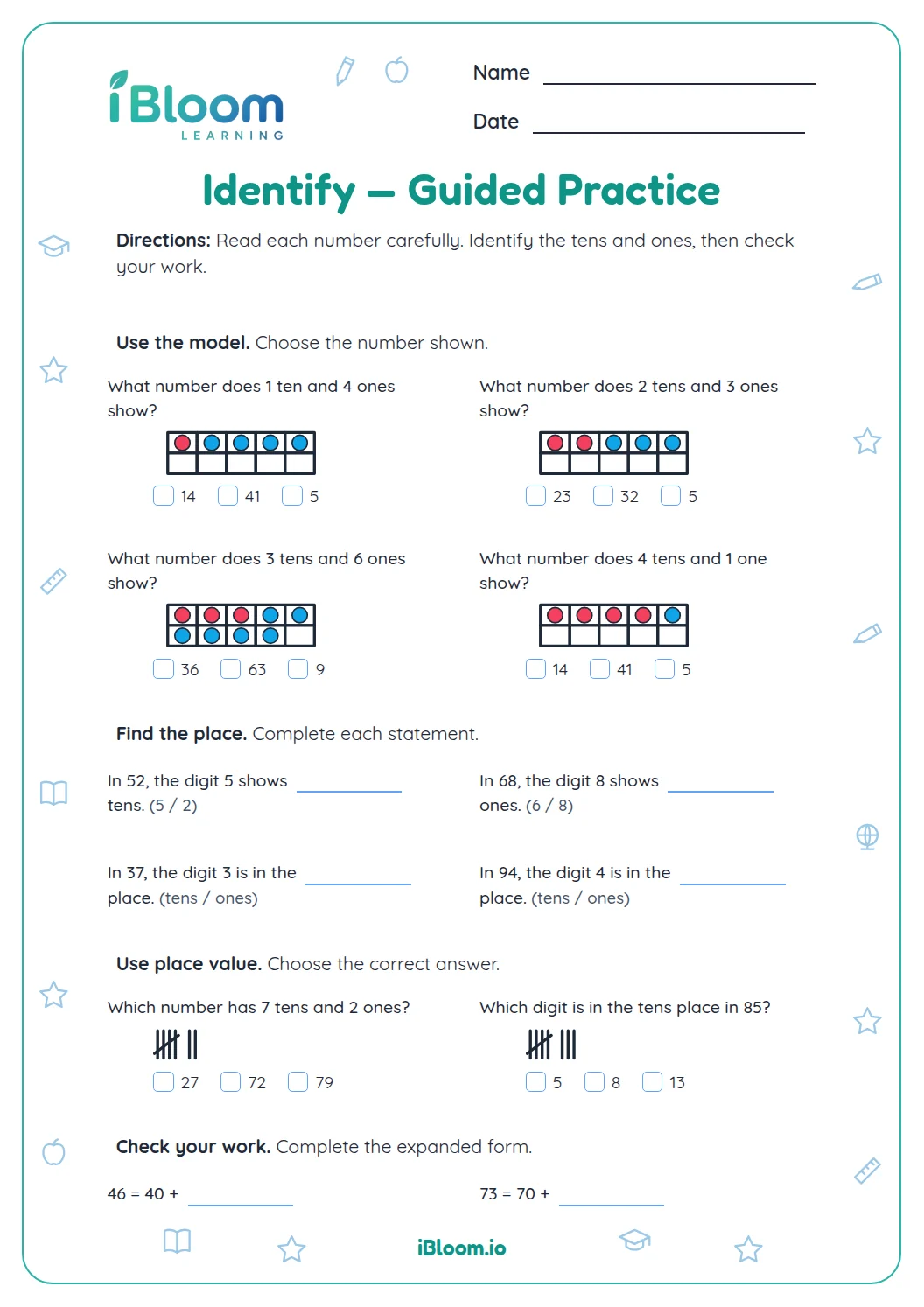
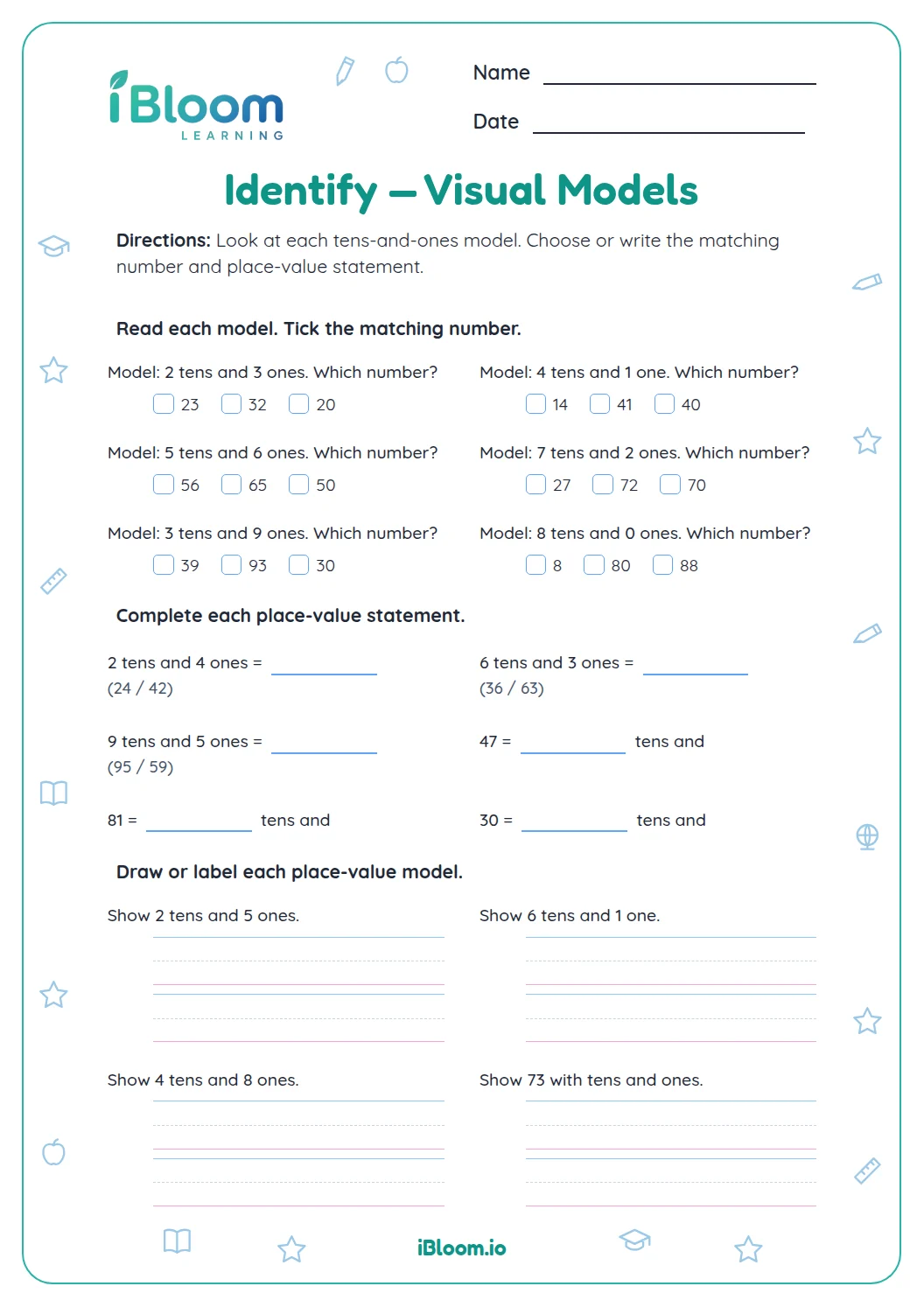
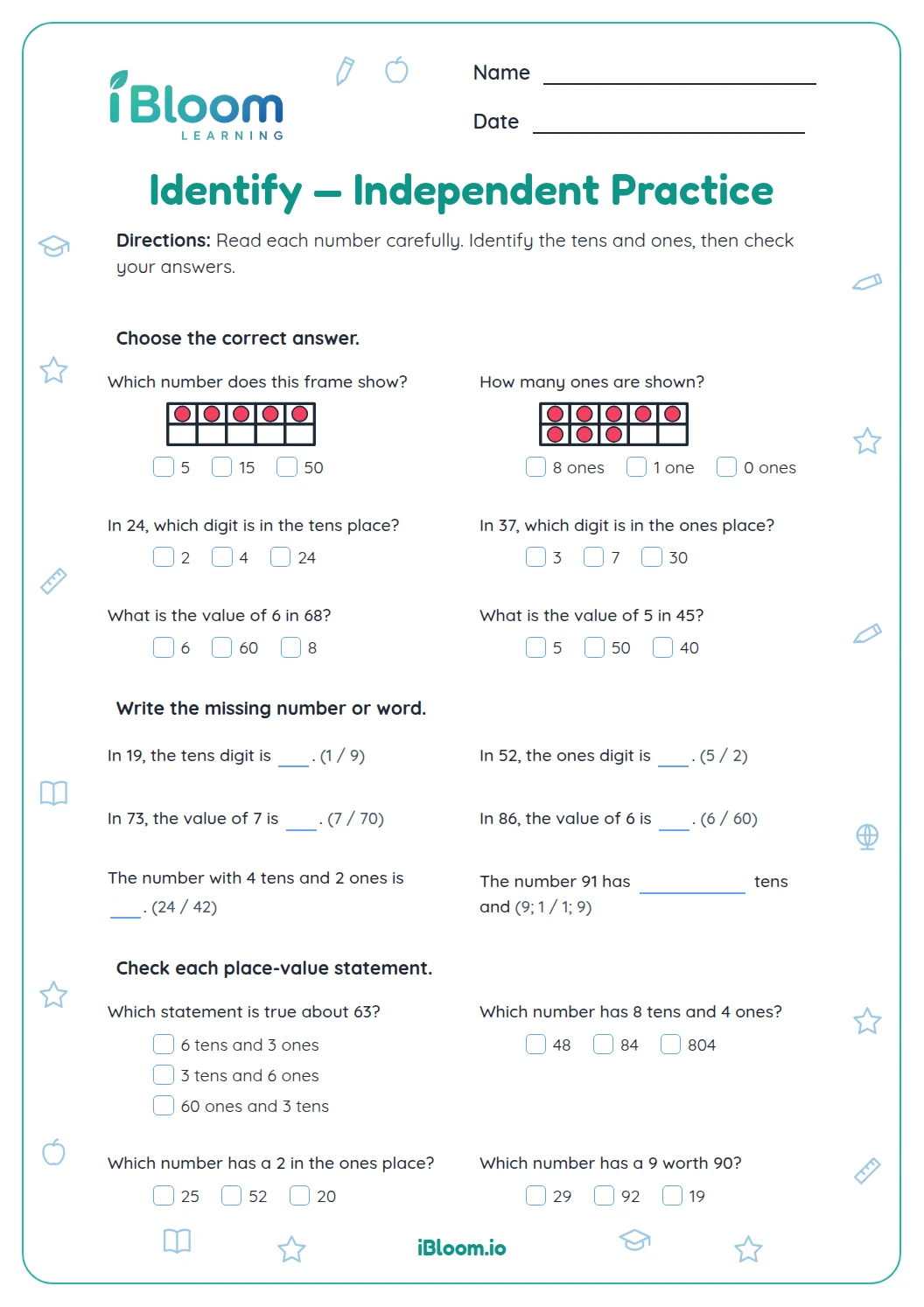
This free Grade 1 worksheet helps children connect two-digit numerals with groups of tens and leftover ones. Students read base-ten blocks, identify a digit’s place, build numbers from tens and ones, and write an expanded form. Its 15 questions move from pictured models to number sentences and choices. The separate key makes it easy to check whether each digit is in the right place.
Aligned to 1.NBT.B.2
How do base-ten blocks show a number?
A long is one ten and each small cube is one. In question 1, three tens and four ones make 34, so there are 4 ones. Read the blocks by naming the tens first and the single cubes second.
- 13 tens and 4 ones
- 2The ones digit counts the single cubes.
- 3Answer: 4 ones
How can you tell what each digit means?
A digit’s position tells its value. In 67, the 6 is in the tens place, so it represents six tens; the 7 is in the ones place. A zero in the ones place means there are no single ones.
How do you build a number from tens and ones?
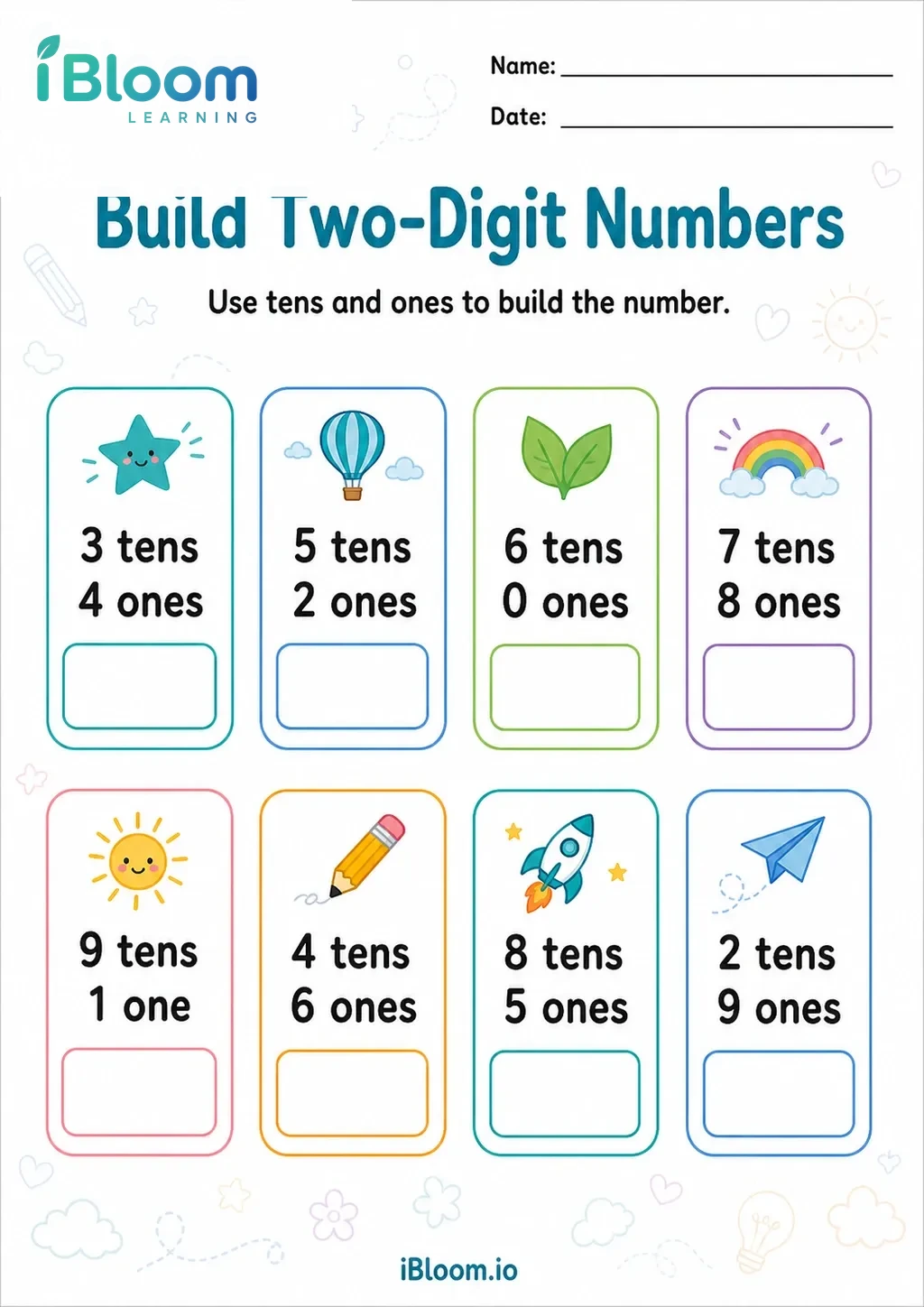
Put the tens digit in the tens place and the ones digit in the ones place. Four tens and eight ones make 48. Expanded form shows the same amount as 40 + 8.
How to use this worksheet
- 1Start with the base-ten blocks and count each ten before counting single cubes.
- 2Say the number aloud, then name its tens and ones.
- 3For a missing digit, use the other place value and the full number to find what is missing.
- 4For a number built from tens and ones, write the tens digit first and the ones digit second.
- 5Use the answer key to check the place of each digit.
Common place-value mix-ups
The mistake
Reading 34 as 4 tens and 3 ones.
The fix
Point to the left digit first: it is in the tens place, so 34 has 3 tens.
The mistake
Saying 6 ones for the 6 in 67.
The fix
Check the digit’s position; the 6 is in the tens place and represents 60.
The mistake
Adding a one when a number ends in zero.
The fix
In 40, the 0 means there are zero ones.
Common Core alignment
This worksheet practices representing two-digit numbers as tens and ones.
Read and compose two-digit numbers by identifying the tens and ones each digit represents.
On this sheet: Students read base-ten models, identify place values, and compose two-digit numbers.
Show the official wordingHide the official wording
Understand that the two digits of a two-digit number represent amounts of tens and ones.
What to practice next
Make more practice
Further reading
Questions parents and teachers ask
What does the tens digit mean?
The tens digit tells how many groups of ten are in the number. In 67, the 6 means six tens, or 60, and the 7 means seven ones. Several questions ask learners to name one place value or build the full number from both digits.
How many questions are on the worksheet?
There are 15 questions in three parts. Children begin by reading base-ten blocks, then identify tens or ones, and finish by composing and decomposing two-digit numbers. The answer key is included on two separate pages. The separate answer key gives a place to check this example.
Does the worksheet use base-ten blocks?
Yes. The first questions show blocks so students can connect a pictured group of tens and ones to a written number. Later questions use number sentences and choices to practice the same place-value idea without a block model. The separate answer key gives a place to check this example.
What does zero mean in a two-digit number?
A zero in the ones place means there are no single ones. For example, 60 has six tens and zero ones. Question 10 asks learners to identify the ones in 40, and question 12 asks them to write six tens and no ones as a number.
How can I check the answers?
Use the separate answer key after the learner finishes a part or the whole sheet. For any missed answer, return to the tens and ones named in the prompt, then check whether each digit was written in its correct place.
How long should this take?
Plan for about 15 minutes, adjusting for how much time the learner needs with the base-ten models. The questions move from pictured examples to written place-value practice, so an adult can pause after the first part and talk through the model.