

About this worksheet
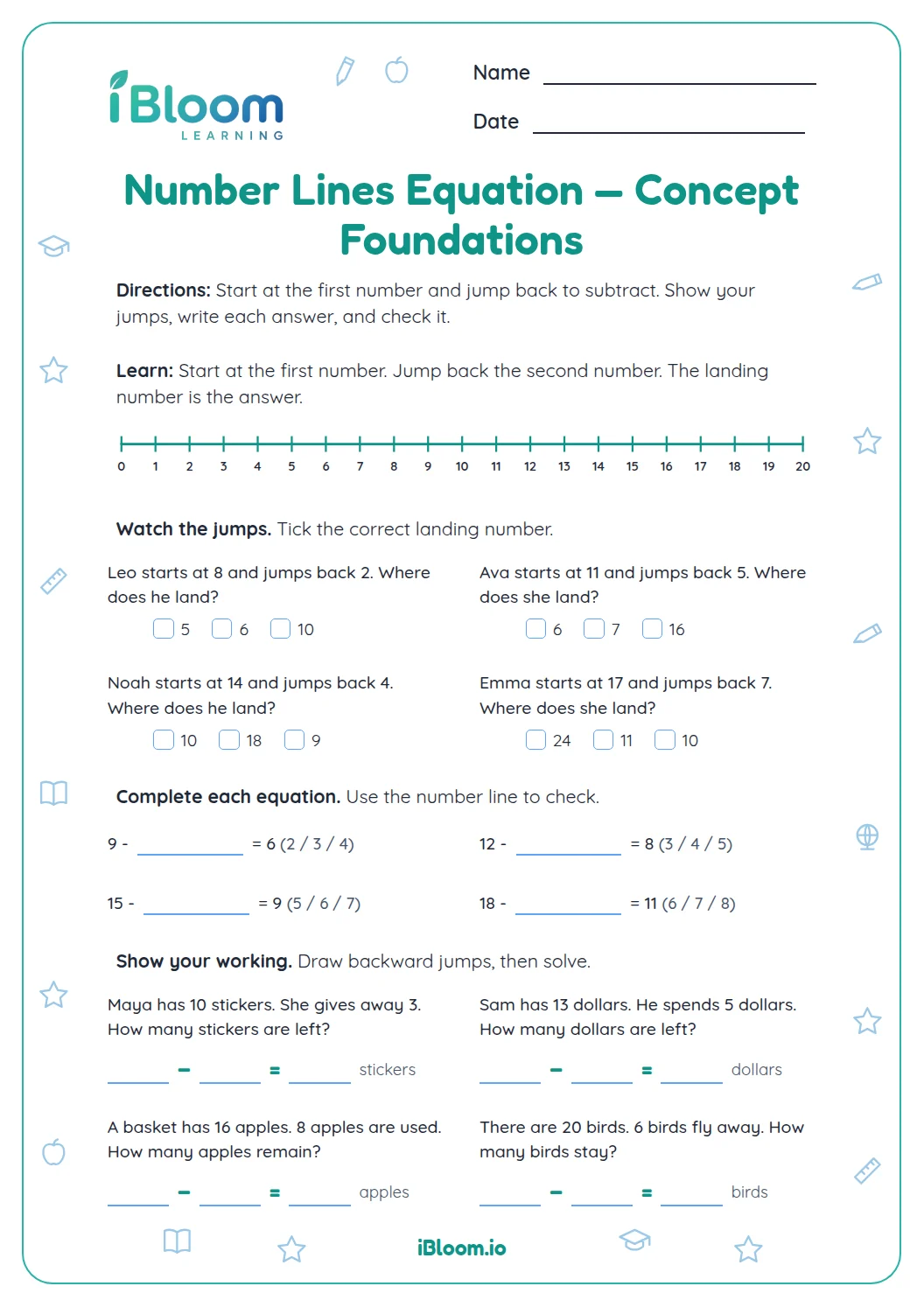
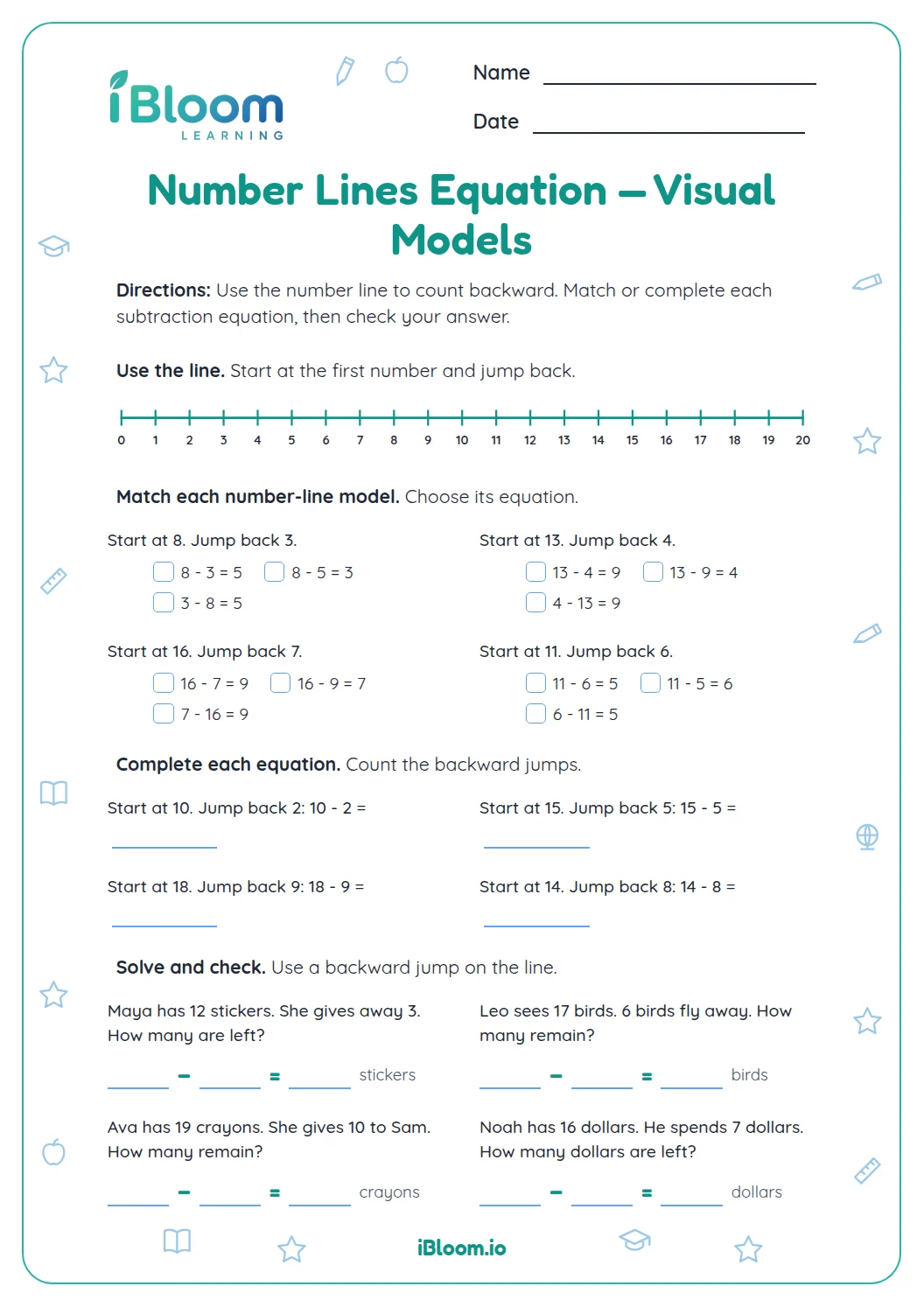
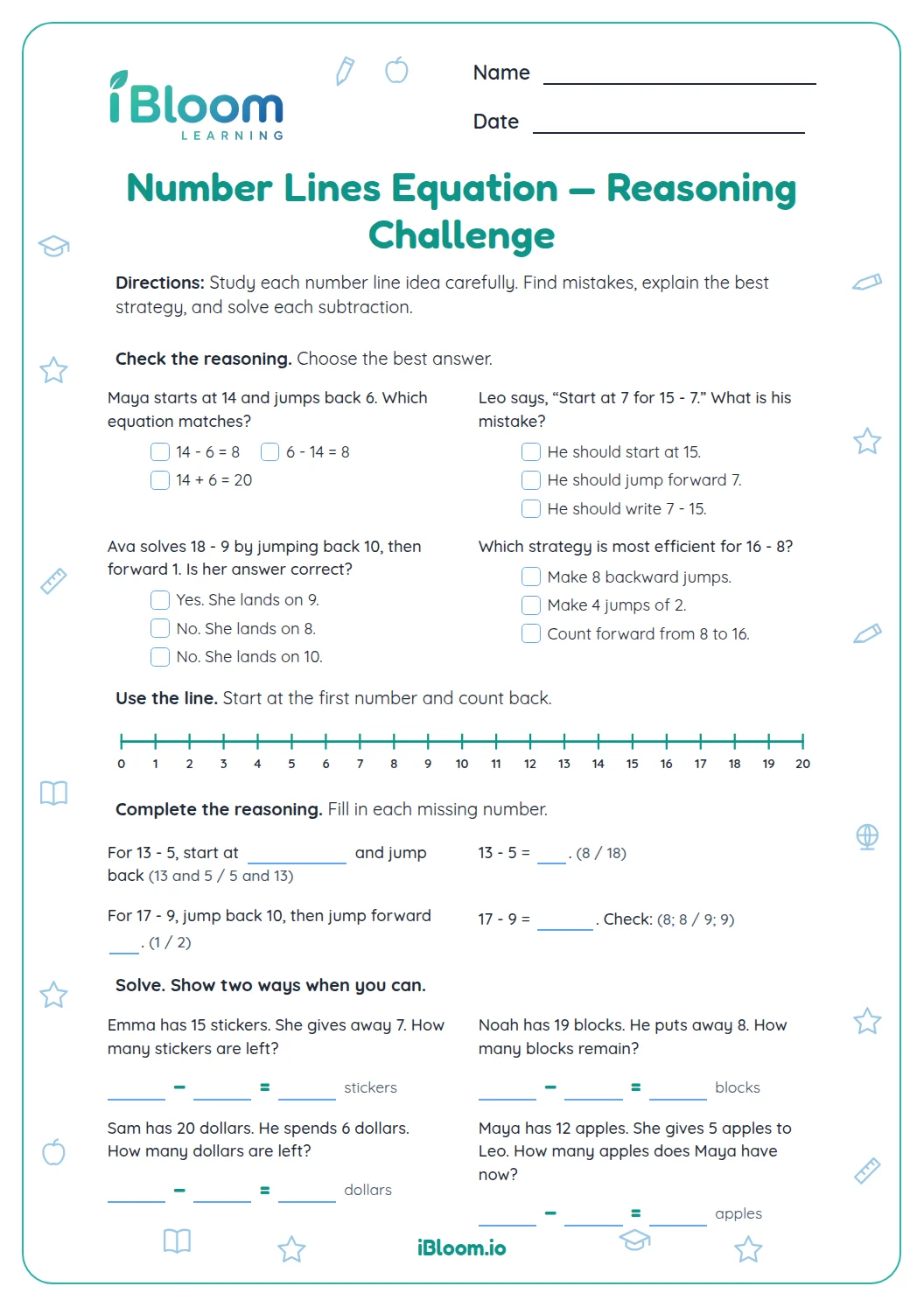
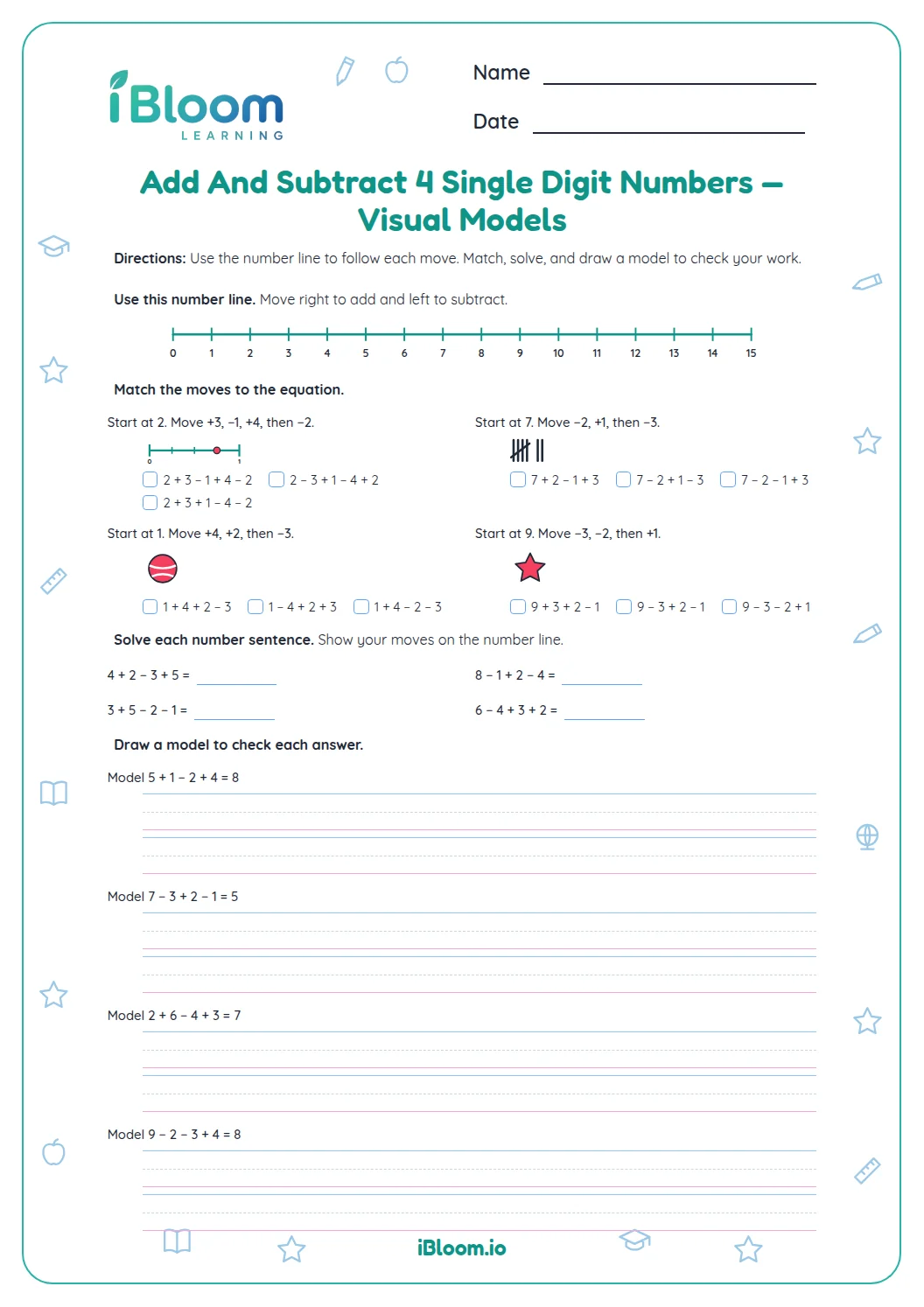
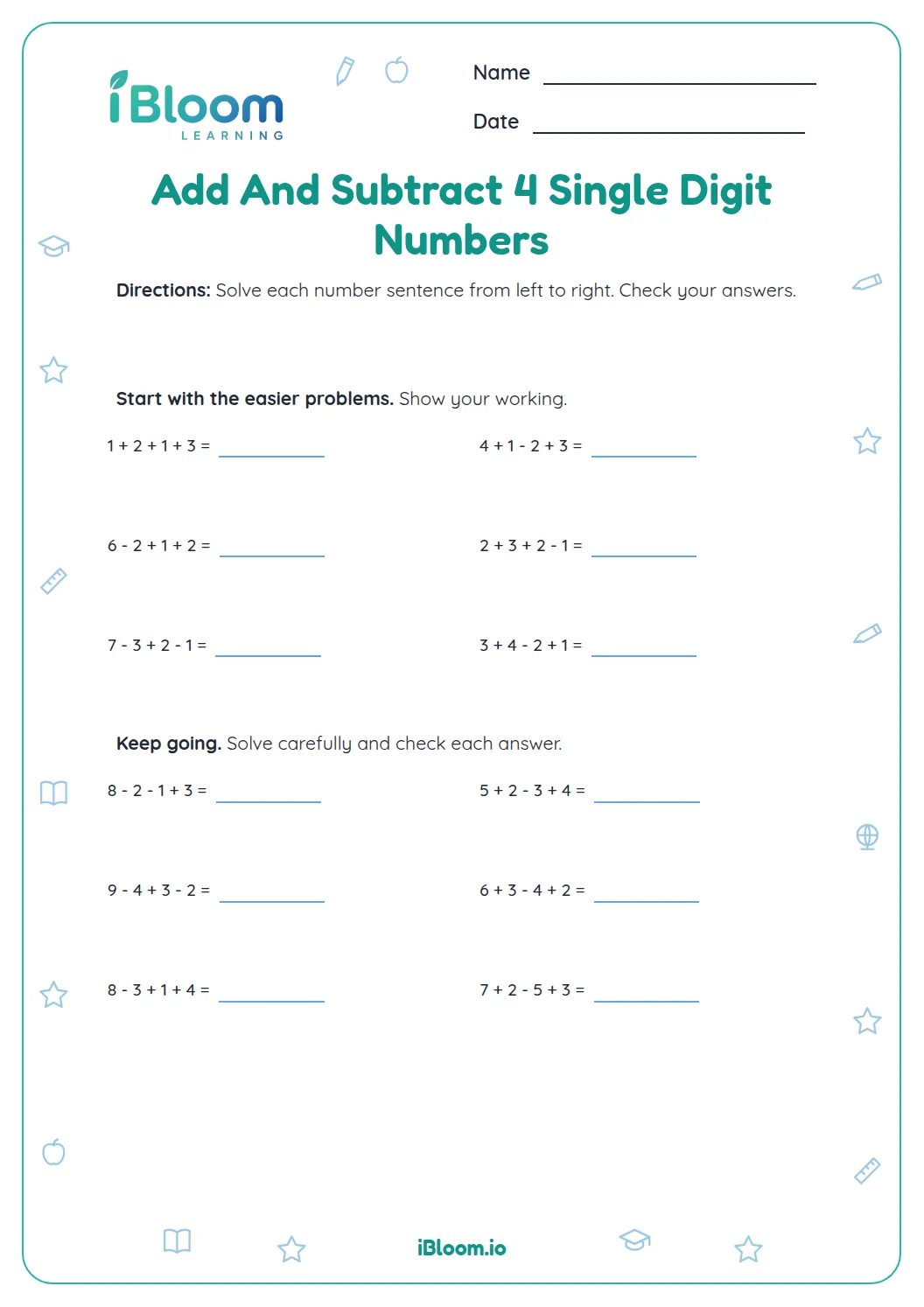
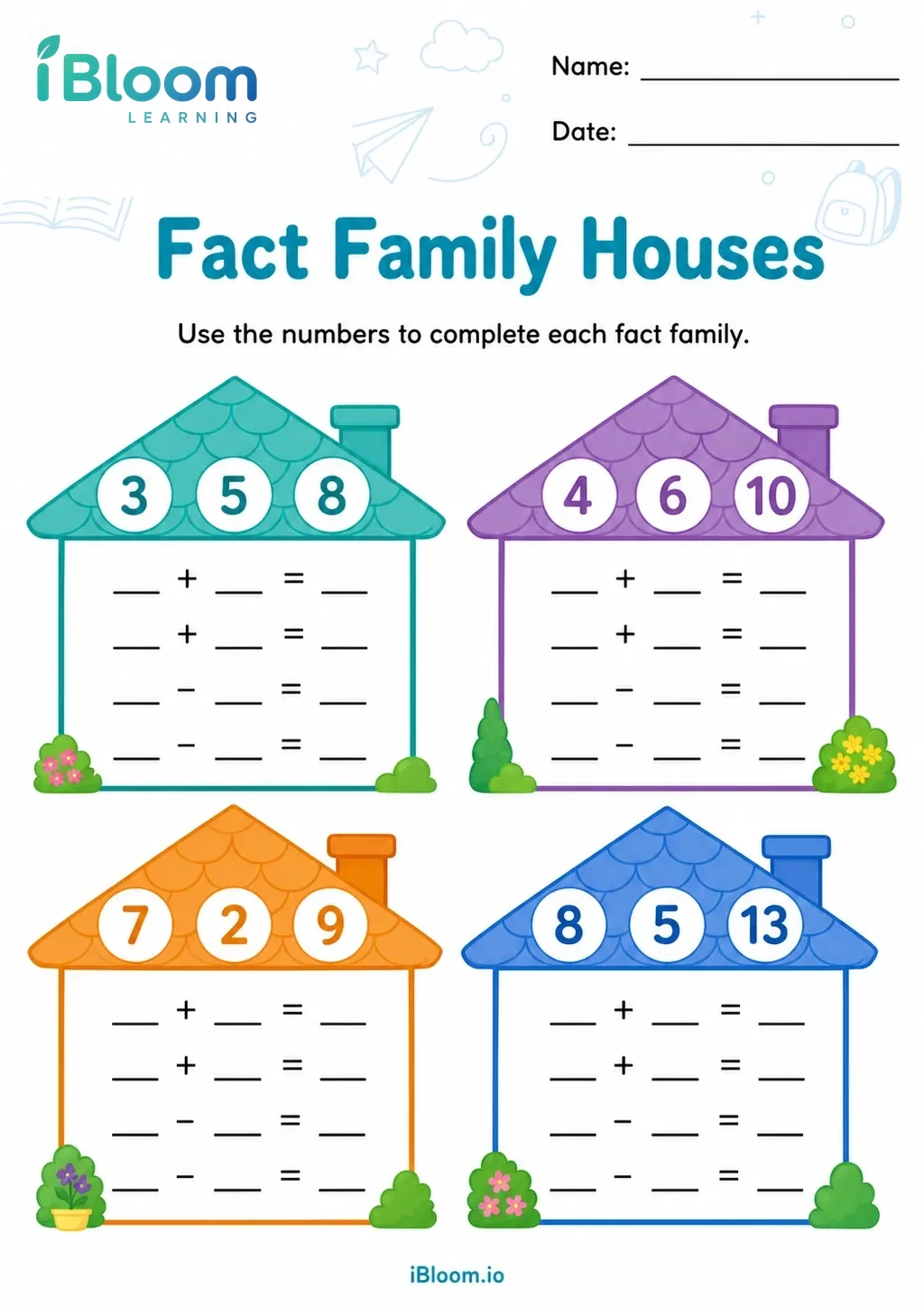
This Grade 1 worksheet gives guided practice with subtraction equations and number lines. Children count back from the starting number, find a missing number in a subtraction sentence, and solve short stories using differences within 20. Several problems pair the equation with a number line model so students can connect each backward count to the subtraction. The activities practice counting relationships described in Common Core 1.OA.C.5. A separate answer key is included.
Aligned to 1.OA.C.5
How does a number line show subtraction?
Begin at the first number and count backward one tick for each number being taken away. Question 2 starts at 15 and subtracts 7. The marker shows the starting value; the child counts back to find the difference.
- 1Start at 12 on the number line.
- 2Count back 4 steps: 11, 10, 9, 8.
- 3So 12 − 4 = 8.
How do you find a missing number?
For 14 − ___ = 8, count back from 14 to 8 to find the amount taken away. For ___ − 6 = 9, add 6 to 9 to find the starting number. Each sentence has one unknown.
How can a subtraction story be checked?
Write an equation using the amount at the start and the amount given away or used. Ava’s 12 shells minus 5 given away leaves 7. Check by adding the 5 shells back to the 7 that remain.
How to use this worksheet
- 1For each number-line equation, find the starting number marked on the line.
- 2Count back one tick for each number being subtracted, then write the difference.
- 3For a missing-number sentence, identify whether the starting number or amount taken away is unknown.
- 4Write a subtraction equation for each short story and solve it.
- 5Check a difference by adding the amount taken away to the answer.
Common mistakes and quick fixes
The mistake
Starting at zero instead of at the first number.
The fix
Place a finger on the marked starting value, then move left one tick per count back.
The mistake
Counting the starting tick as the first backward step.
The fix
Say the number at the start, then move one tick left and say the next number.
The mistake
Mixing up the missing starting number and missing amount taken away.
The fix
Use the known equation: for ___ − 6 = 9, add 6 to 9; for 14 − ___ = 8, count the steps from 14 back to 8.
Common Core alignment
This worksheet gives focused practice with the following Common Core skill.
Relate counting to addition and subtraction.
On this sheet:
Show the official wordingHide the official wording
Relate counting to addition and subtraction (e.g., by counting on 2 to add 2).
What to practice next
Make more practice
Further reading
Questions parents and teachers ask
How do number lines help with subtraction?
A number line makes each backward count visible. Start at the first number, then move left one tick for each number being subtracted. The ending number is the difference. In this worksheet, the marked point gives the starting value for each of the first 10 equations.
How do I solve 14 − ___ = 8?
Start at 14 and count backward until you reach 8. The number of steps is 6, so 14 − 6 = 8. Check by adding 6 back to 8 to get 14. The missing number names the size of the backward jump.
How do I solve ___ − 6 = 9?
The missing starting number must be 6 more than 9, because taking 6 away leaves 9. Add 9 + 6 to get 15, then check: 15 − 6 = 9. The starting number is the total before the backward move.
How can children check a subtraction story?
Use addition to check the answer. If Ava has 12 shells and gives away 5, then 7 remain. Add the 5 shells back to 7; the total is 12, matching the story’s starting amount. This confirms the subtraction.
What should a child do when a count-back goes wrong?
Return to the marked starting point and count each tick once, moving left. Say the number at every tick aloud. If the answer still seems off, use addition to check that the difference plus the amount subtracted equals the starting number.