


About this worksheet
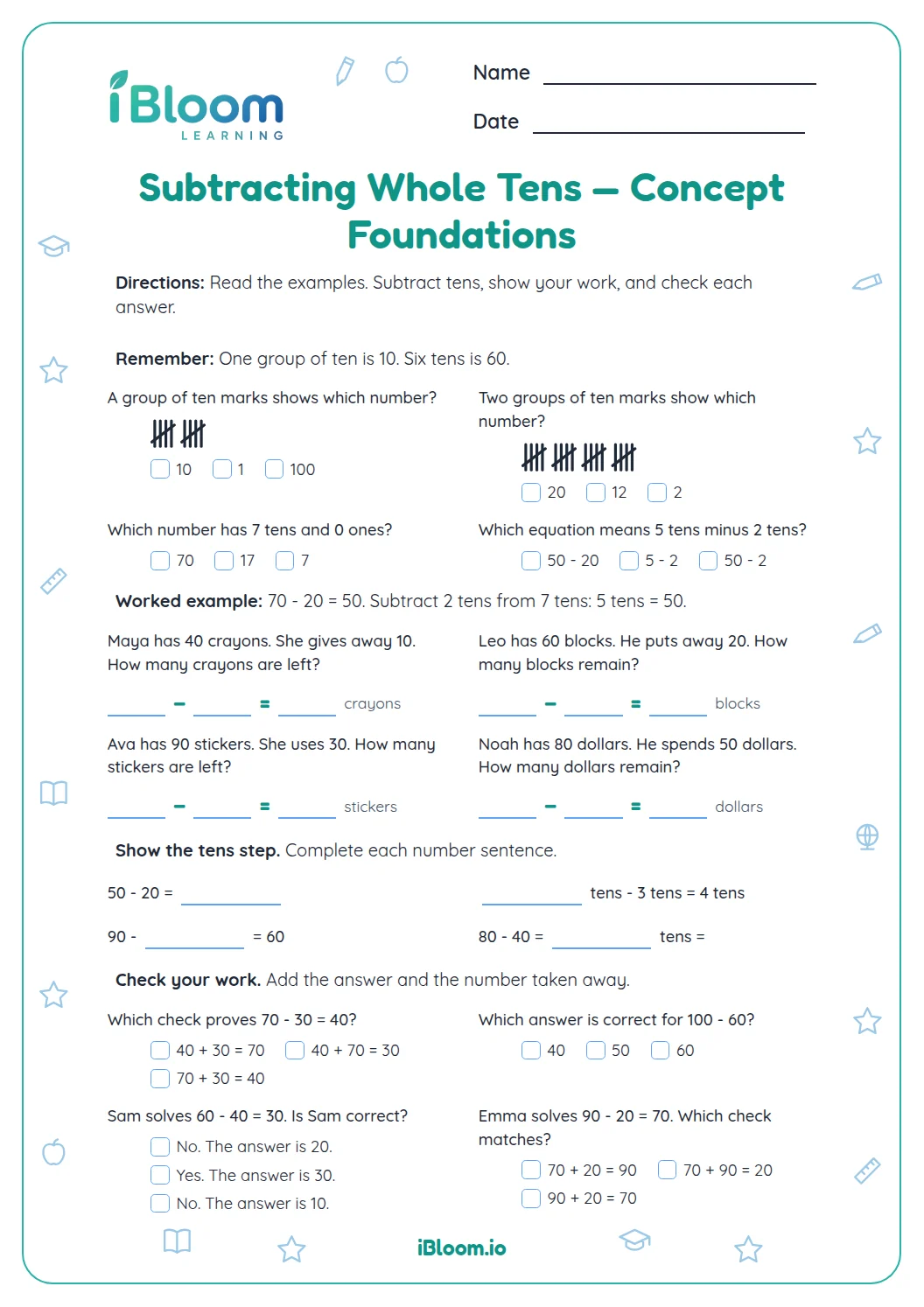
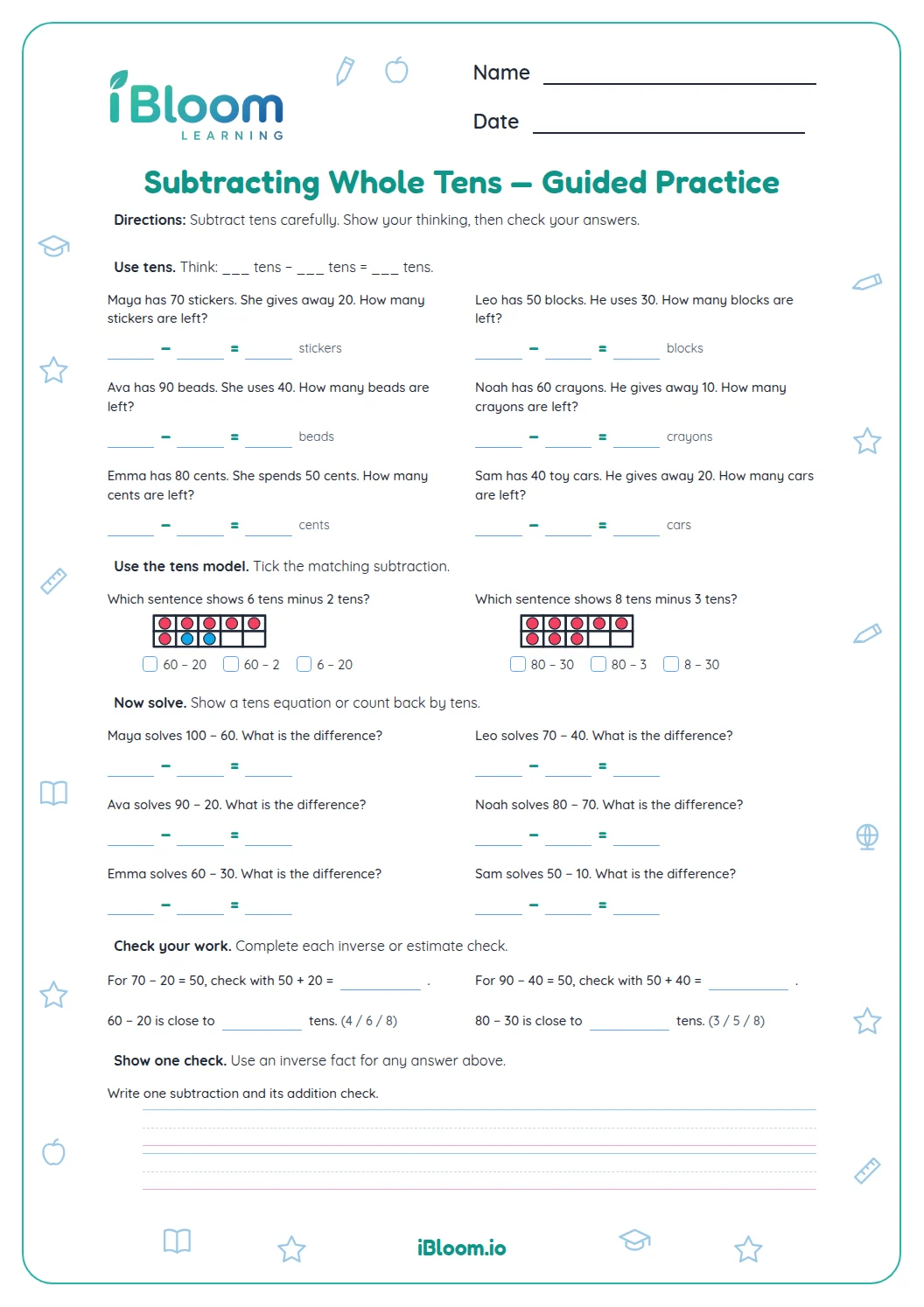
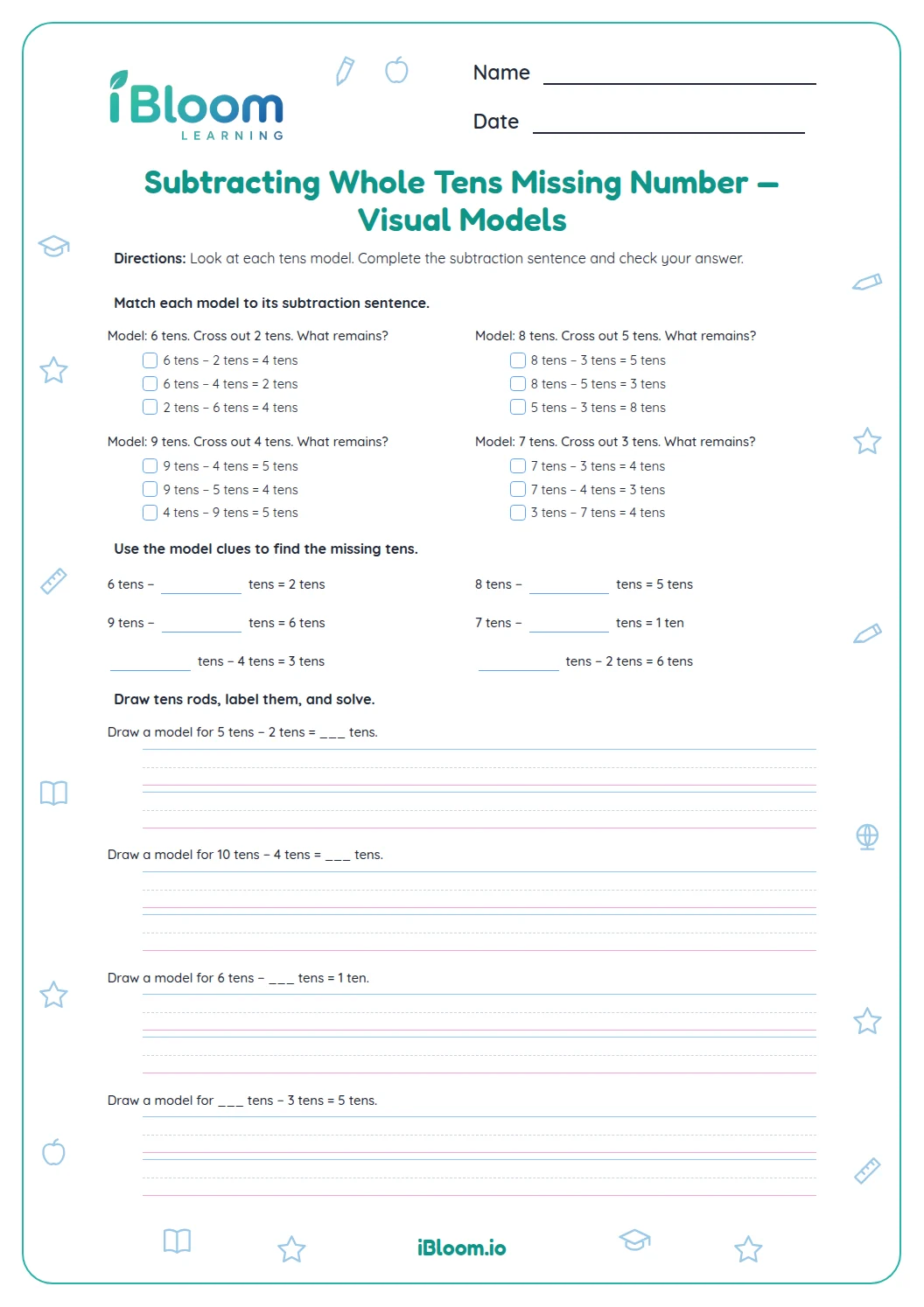
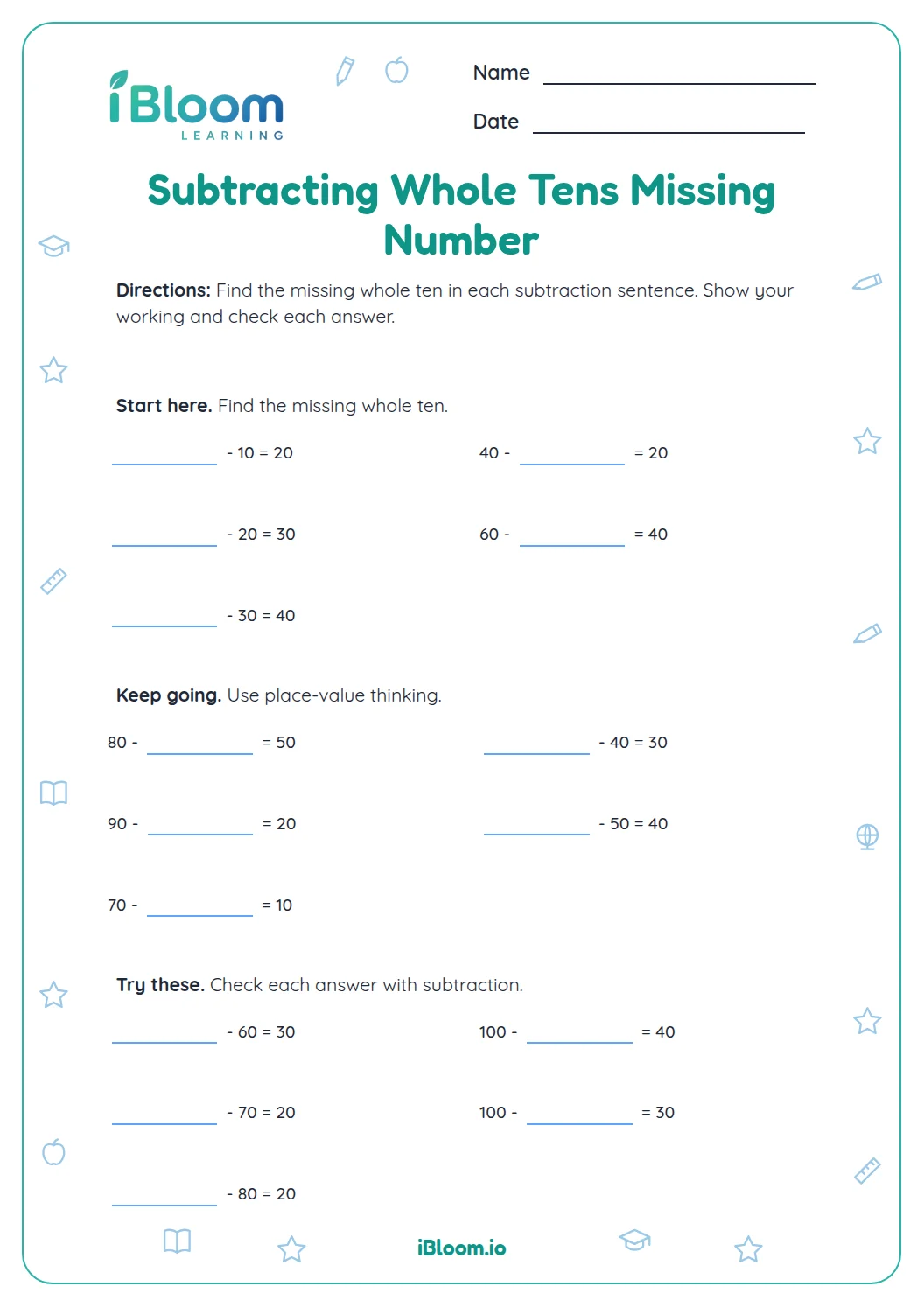
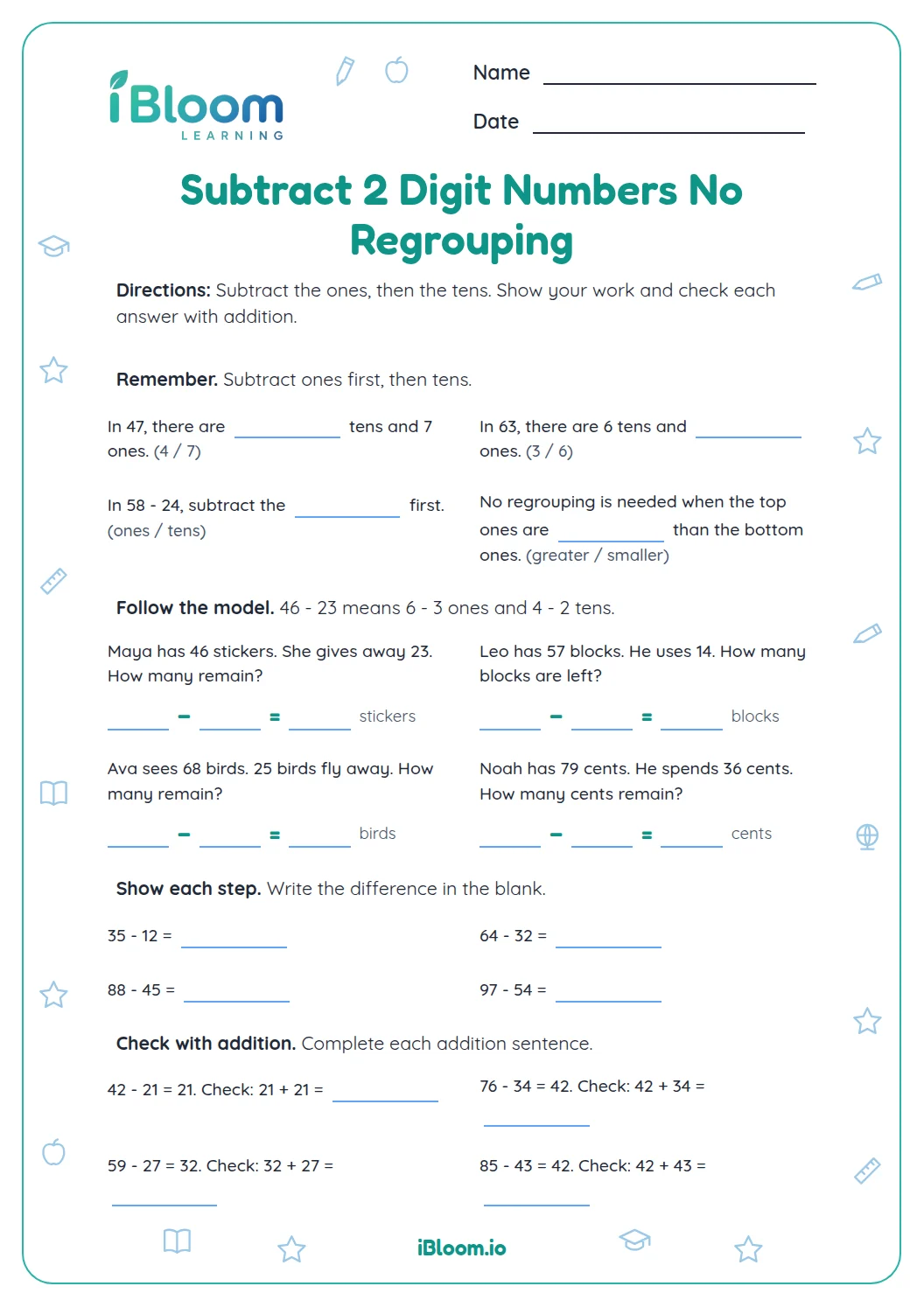
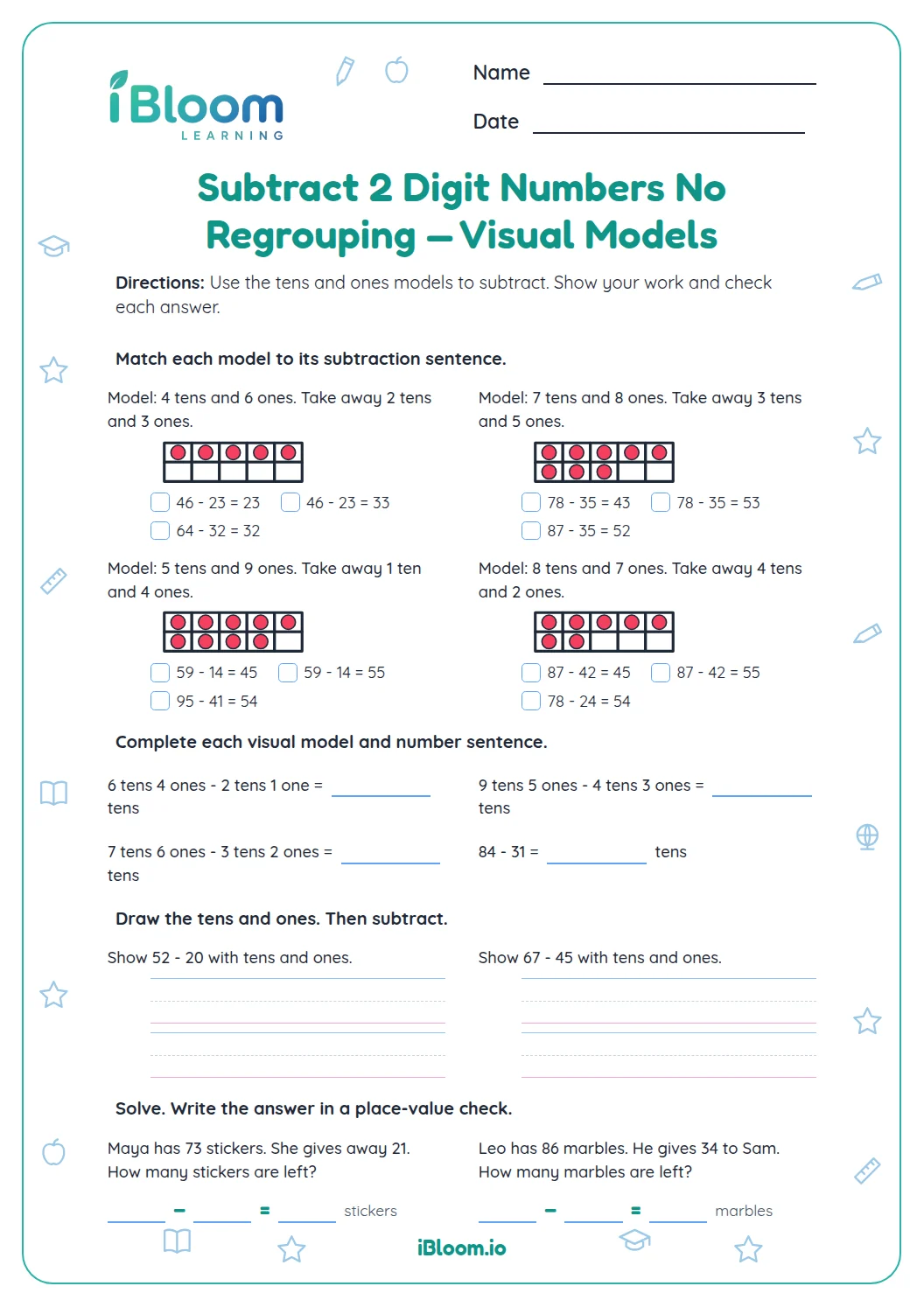
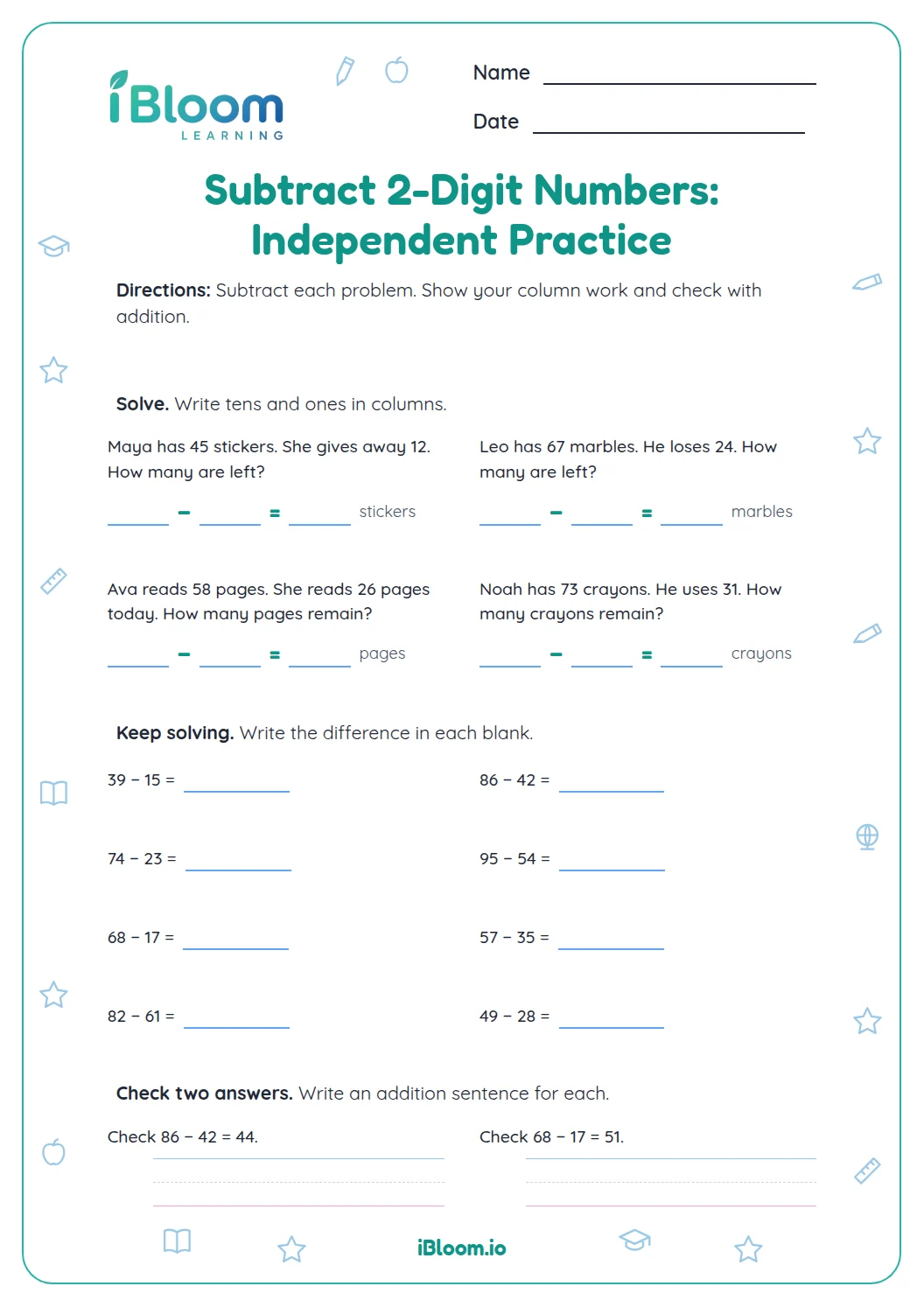
This Grade 1 worksheet gives students 16 items for subtracting whole tens. Students choose an equation for four stories, solve eight more take-away stories, and find four missing differences. The numbers use multiples of ten from 10 through 90. The practice aligns with CCSS 1.NBT.C.6, which focuses on subtracting multiples of ten using place-value strategies.
Aligned to 1.NBT.C.6
How are the subtraction stories set up?
In Part A, students read each short take-away story and choose the subtraction equation that matches it. The distractors are also true number sentences, so students must attend to which quantities the story names.
Part B has eight stories with a blank for the number left. Part C has four missing differences. Students explain their tens reasoning aloud and say an addition fact to check each Part C answer.
How do you write an equation for a story?
Name the starting amount first, then subtract the group that leaves or is used.
- 1Question 1: Maya starts with 60 stickers and gives away 20.
- 2The matching equation is 60 − 20 = 40.
How can students check a difference?
Add the number removed to the amount left. If the total returns to the starting amount, the subtraction is consistent. Remember to include the object or unit counted.
How to use this worksheet
- 1Find the starting amount and the amount taken away.
- 2Say each amount as a number of tens.
- 3Choose the matching subtraction in Part A; fill the number blanks in Parts B and C.
- 4Explain aloud how subtracting the tens gives the answer.
- 5Check Part C by saying an addition fact that returns to the starting amount.
Common mistakes and quick fixes
The mistake
Subtracting the starting amount from the amount taken away.
The fix
Begin with the amount the story says there was at first.
The mistake
Treating 30 as three ones instead of three tens.
The fix
Read the tens digit and subtract three tens.
The mistake
Writing 5 when the answer is 5 tens.
The fix
Five tens is 50. Write the number of objects in the blank.
Common Core alignment
Subtract multiples of ten using place value and the relationship between subtraction and addition.
On this sheet: Students subtract multiples of ten and check differences by adding the amount taken away.
Show the official wordingHide the official wording
Subtract multiples of 10 in the range 10-90 from multiples of 10 in the range 10-90 (positive or zero differences), using concrete models or drawings and strategies based on place value, properties of operations, and/or the relationship between addition and subtraction; relate the strategy to a written method and explain the reasoning used.
What to practice next
Make more practice
Further reading
Questions parents and teachers ask
What numbers are used in these problems?
All starting amounts and amounts taken away are multiples of ten from 10 through 90. The stories include a zero result when Noah gives away all his cards. Students can reason in tens, then write the number of objects remaining in each answer blank.
How many problems are included?
There are 16 problems in three parts: four equation choices, eight take-away stories, and four missing differences. Each problem uses a different subtraction calculation. The separate key shows the correct equation or number, so an adult can check both the story choices and written answers.
What should students write in Part B?
Students write the number left in each story blank. The object being counted, such as crayons or beads, is already printed after the blank. Ask students to explain their tens reasoning aloud before writing: seven tens minus two tens leaves five tens, or fifty crayons.
How can I help my child get started?
Read a story aloud and ask how many objects there were at first. Next, identify how many were taken away. Name both amounts in tens. Let the child explain the subtraction aloud, then write the result and reread the completed sentence to check its meaning.
How does Part C check subtraction?
Students fill the missing difference and say an addition fact to check it. For 80 minus 50, the difference is 30. Adding 30 and 50 returns to 80. Saying this relationship aloud gives students a way to explain why their subtraction answer makes sense.