







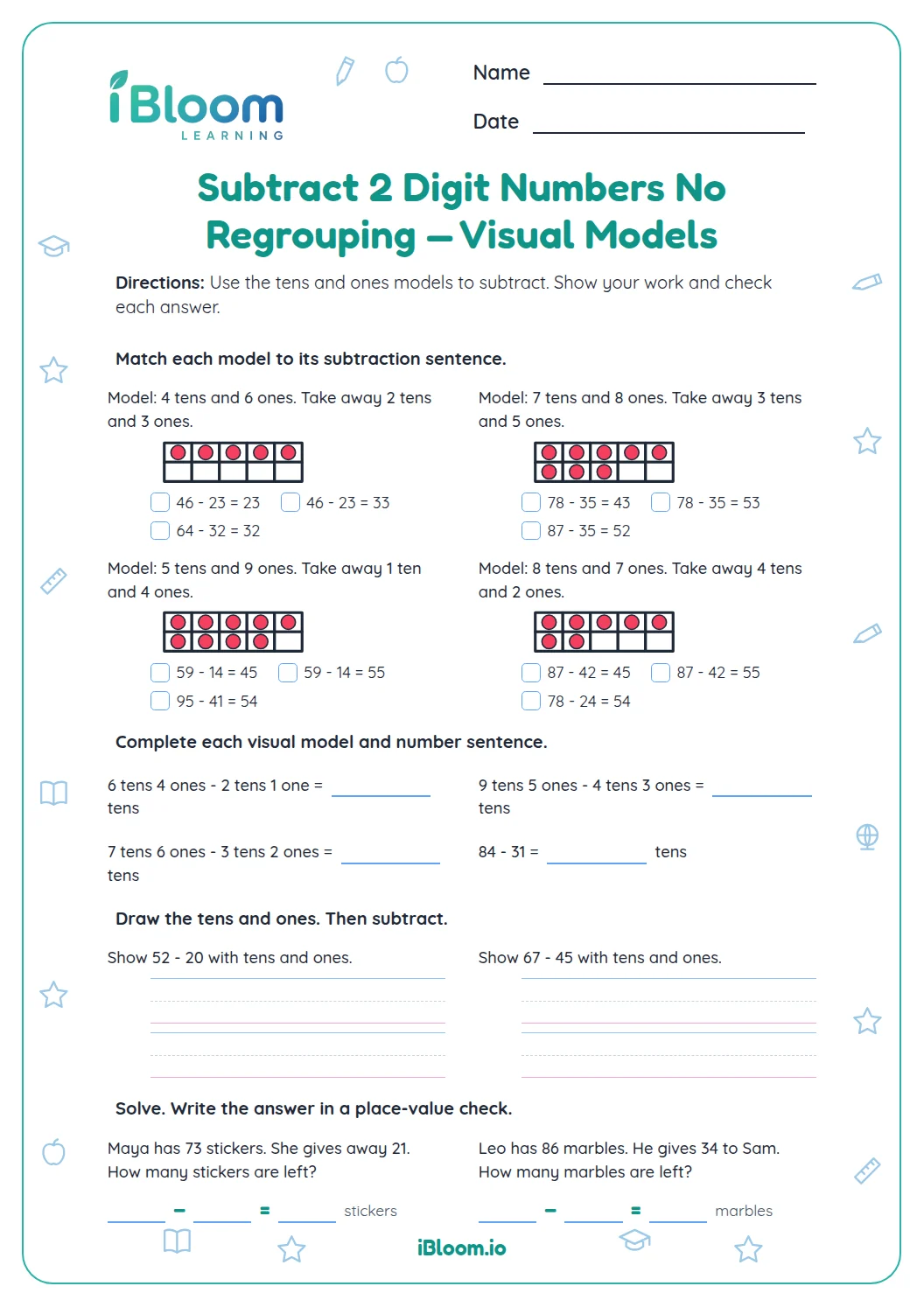
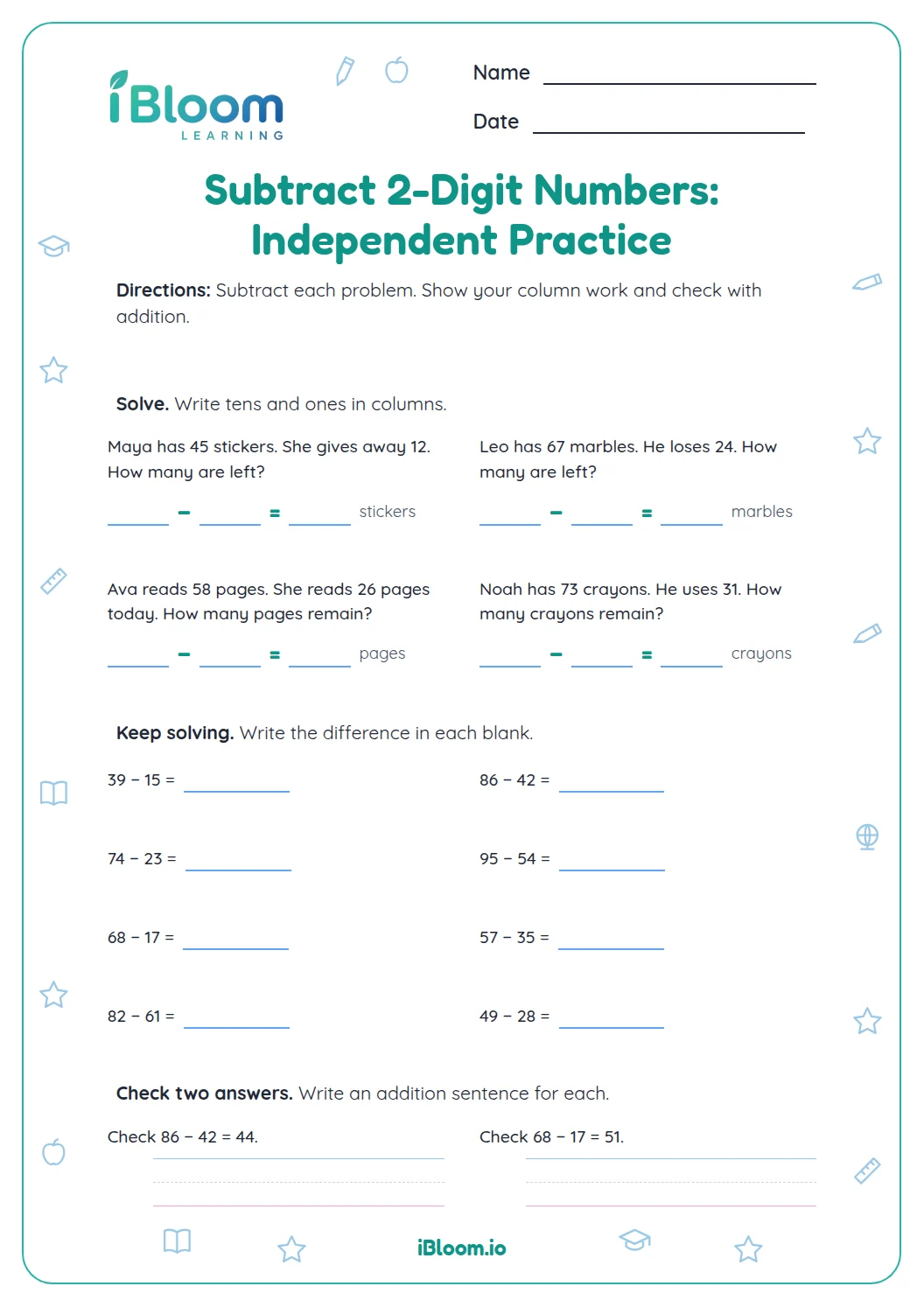
About this worksheet
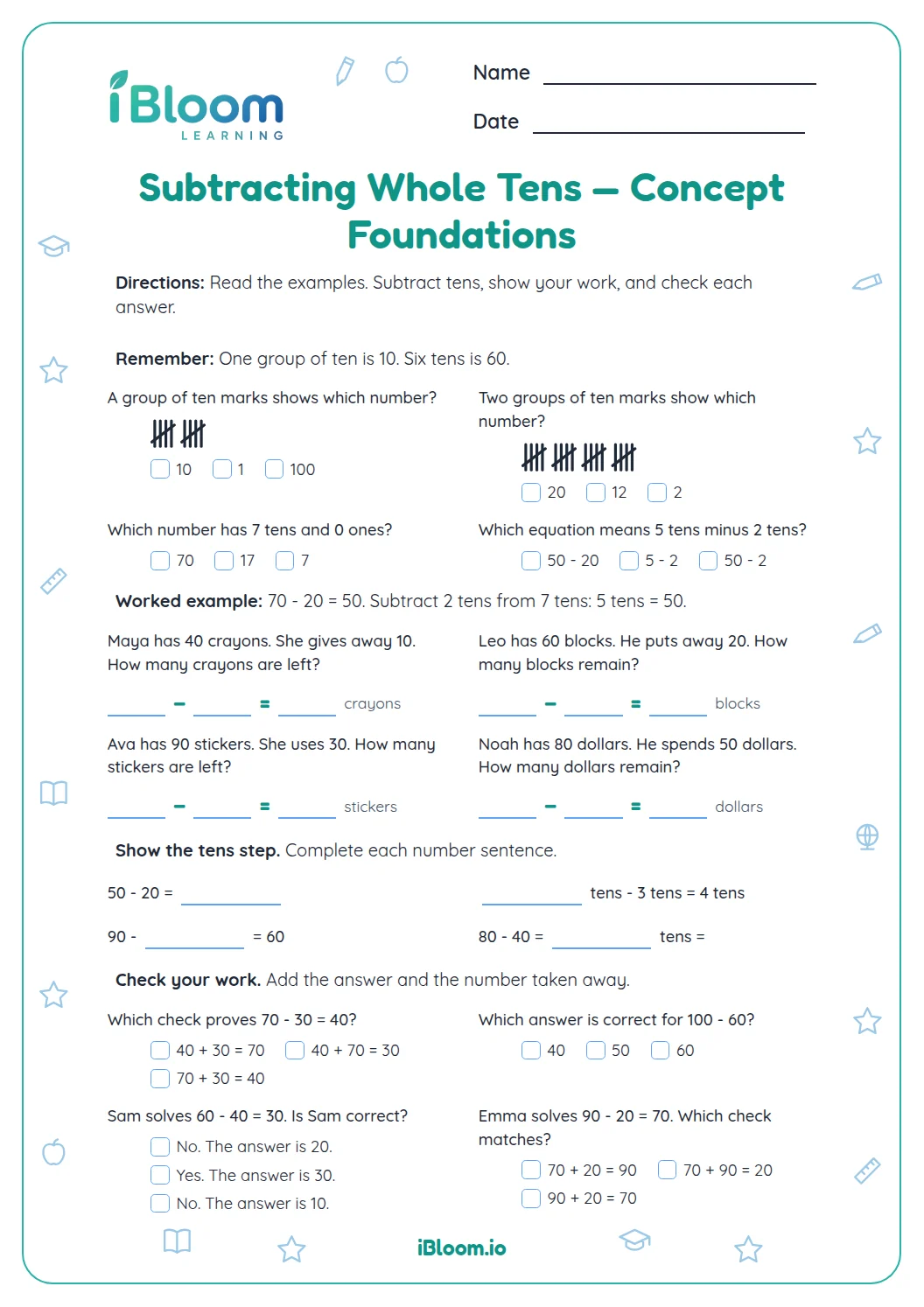
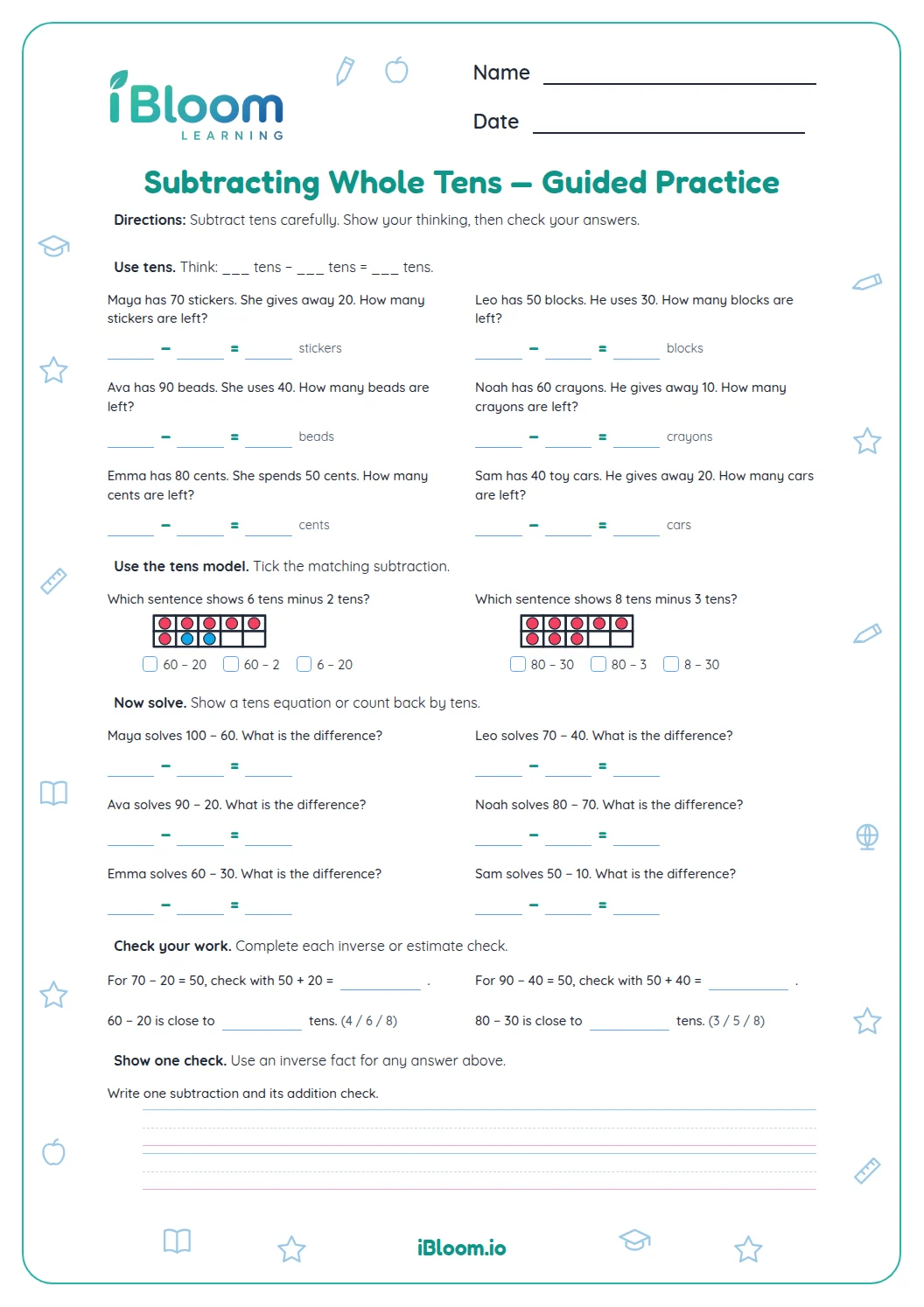
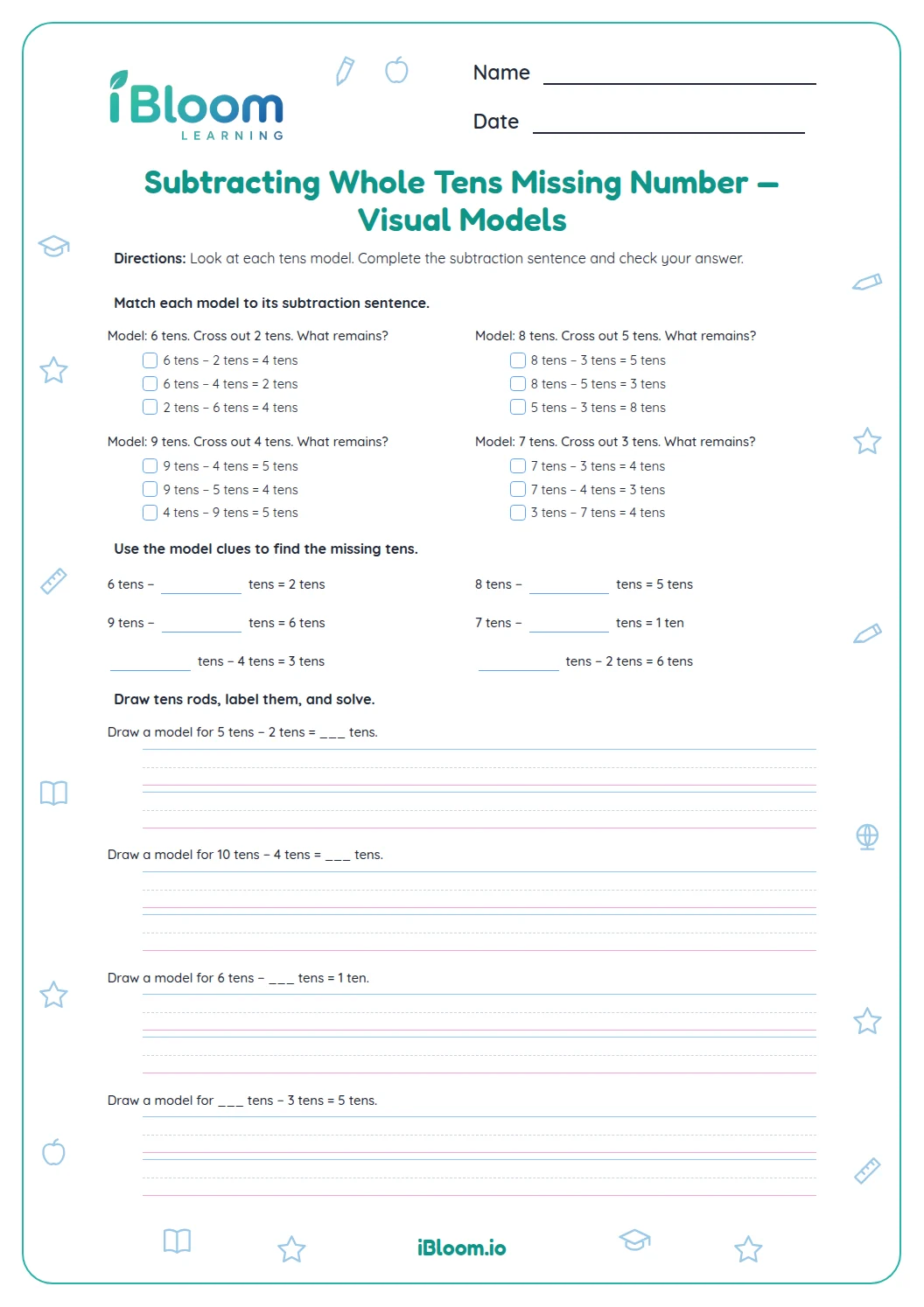
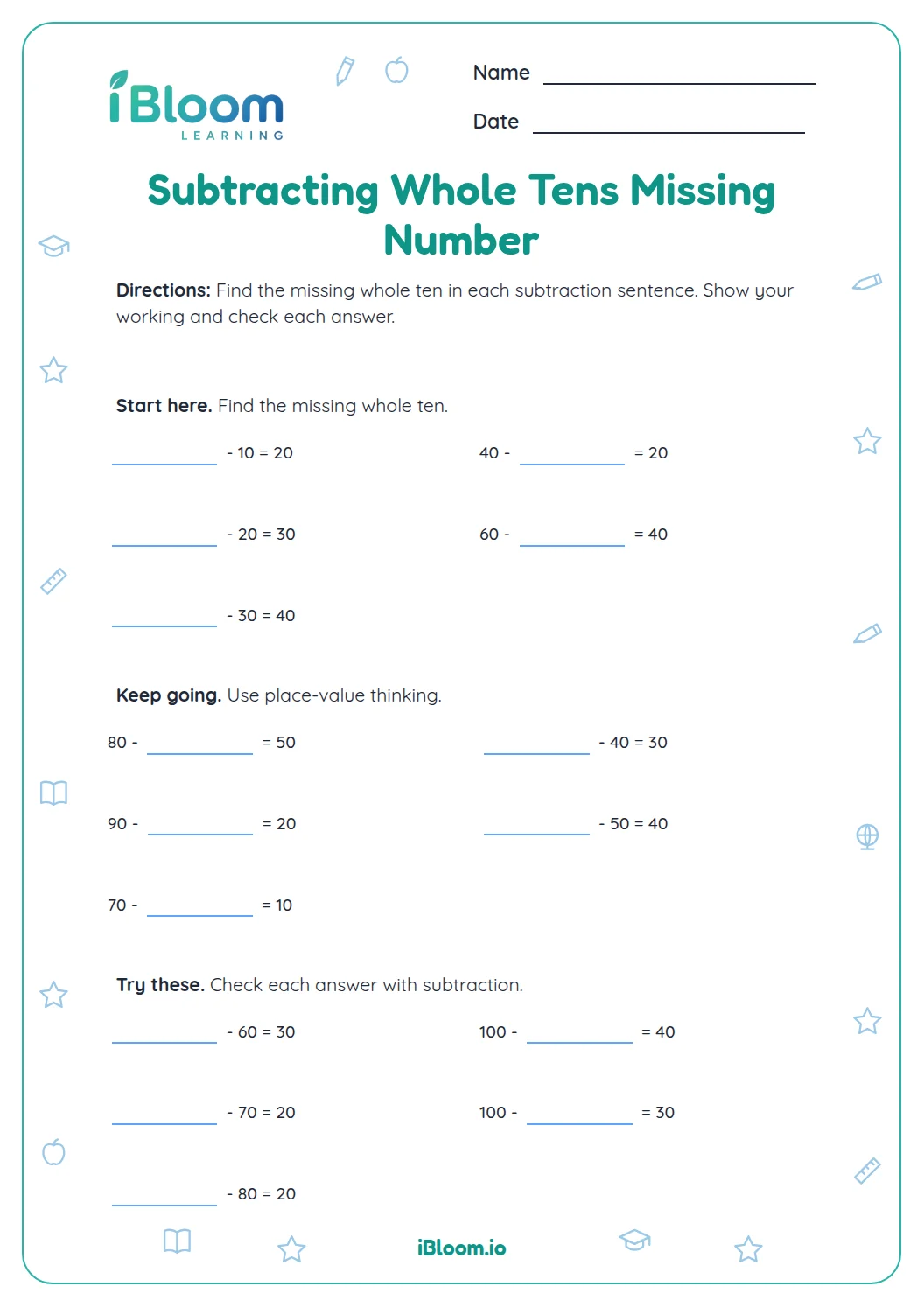
This free printable worksheet gives Grade 1 children a chance to reason about subtracting multiples of 10, such as 80 − 30. Part A shows four answers from other children, like "60 − 20 = 4," and asks what went wrong. Part B has four missing-number sentences, including one that compares 60 − 20 with 60 − 40. Part C has four word problems with room to write a number sentence. It practices Common Core 1.NBT.C.6, subtracting multiples of 10 from 10 to 90 and explaining the thinking. The answer key has its own pages.
Aligned to 1.NBT.C.6
How do first graders subtract whole tens?
Whole tens work like facts they already know, because 80 is 8 tens and 30 is 3 tens. Children subtract 8 − 3 = 5, and then say what they are counting: 5 tens, or 50. Counting back by tens on a hundred chart or with tens sticks shows the same answer.
A common slip is forgetting that the numbers are tens. A child who writes 60 − 20 = 4 has done 6 − 2 and left out the tens, which is the mistake question 2 asks children to fix.
- 1Mia says 60 − 20 = 4.
- 260 is 6 tens and 20 is 2 tens.
- 36 tens − 2 tens = 4 tens
- 44 tens is 40.
- 5Right answer: 40
Why does this sheet ask children to find mistakes?
Standard 1.NBT.C.6 asks children to explain the reasoning they use, and checking someone else's answer is a good way to practice that. In question 1, Leo wrote 80 − 30 = 110. His answer is bigger than the number he started with, so he must have added. Spotting that is a different skill from getting 50 once.
Question 4 asks children to pick the sentence that explains Tia's correct answer. The choice 6 tens − 3 tens = 3 tens is the place-value reasoning the standard asks children to use.
What is on this worksheet?
Twelve questions on two pages: Parts A and B on page 1, the word problems on page 2. The numbers in the problems are multiples of 10 from 10 to 90. The sheet starts with the thinking and ends with stories.
- Part A, Check the thinking: 4 multiple-choice questions about other children's answers
- Part B, Fill in the missing part: 3 missing numbers and 1 comparison with >, < or =
- Part C, Word problems: 4 stories, one of them worked backward to find the start
- Answer key on separate pages
How to use this worksheet at home or in class
- 1Warm up with ten-cube towers or tens sticks: show 8 towers and take away 3. Say "5 tens is 50."
- 2Read question 1 aloud and ask whether 110 can be right when you start with 80 and take away.
- 3Let your child finish Part A, asking for each answer, "How do you know?"
- 4In Part B, ask your child to say the tens first: "8 tens take away 3 tens." For question 8, ask which one takes away more.
- 5For the word problems, have your child write a number sentence, then solve it. Question 12 works backward, so a drawing of tens can help.
- 6Check with the answer key and talk about any miss using tens words.
Common mistakes and quick fixes
The mistake
Writing the digit difference only, such as 60 − 20 = 4.
The fix
Have your child say "6 tens − 2 tens = 4 tens." Then ask how many that is: 40.
The mistake
Adding instead of subtracting, as in 80 − 30 = 110.
The fix
Ask whether the answer should be more or less than 80. Taking away always leaves less than you started with.
The mistake
Subtracting again when the start is missing. In ___ − 40 = 30, children may write 30 − 40 or 10.
The fix
Ask, "What number, when you take away 4 tens, leaves 3 tens?" Count up from 3 tens by 4 tens to reach 7 tens, or 70.
Common Core alignment
Most US states use the Common Core math standards or a close state version, so this sheet fits Grade 1 place-value work in most classrooms.
Subtract tens from tens, such as 80 − 30, and explain the thinking.
On this sheet: Every question is about subtracting tens from tens, and Part A asks children to explain why an answer is right or wrong.
Show the official wordingHide the official wording
Subtract multiples of 10 in the range 10-90 from multiples of 10 in the range 10-90 (positive or zero differences), using concrete models or drawings and strategies based on place value, properties of operations, and/or the relationship between addition and subtraction; relate the strategy to a written method and explain the reasoning used.
What to practice next
Make more practice
Further reading
Questions parents and teachers ask
What is subtracting whole tens in first grade?
It means taking one multiple of 10 away from another, such as 90 − 40 = 50. Grade 1 children think of 9 tens take away 4 tens, which leaves 5 tens. This sheet adds a reasoning layer: children check other children's answers, fill in missing numbers and solve stories.
Why does the sheet show wrong answers from other children?
Explaining a mistake asks for more than getting one answer right. In question 2, Mia wrote 60 − 20 = 4, which is 6 − 2 without the tens. When children can say what went wrong, they have a check they can run on their own answers: is it tens, and is it less than the start?
What are the answers to Part B?
The answers are 5 tens, 30, 70, and the greater-than sign. 8 tens take away 3 tens leaves 5 tens. 50 − 30 = 20, and 70 − 40 = 30. For 60 − 20 and 60 − 40, taking away less leaves more, so 40 is greater than 20.
Can my child use tens sticks or a hundred chart?
Yes, and it is a good idea. Standard 1.NBT.C.6 names concrete models and drawings as ways to solve these problems. Children can lay out 8 tens sticks, take away 3, and count what is left, then write the number sentence in the working space for the word problems.
Question 12 asks how many pears Mom started with. How do I explain it?
Tell your child that the start is hidden, so the story is an addition in disguise. Mom used 30 and has 20 left, so putting them back gives 30 + 20 = 50. A quick drawing of 3 tens and 2 tens makes the unknown start easy to see.
Is there an answer key, and how long does the sheet take?
Yes, the answer key is a separate set of pages showing the right answer for all twelve questions. Most first graders finish in about 15 minutes. The word problems take the longest, so it can help to do Parts A and B in one sitting and Part C in another.