



About this worksheet
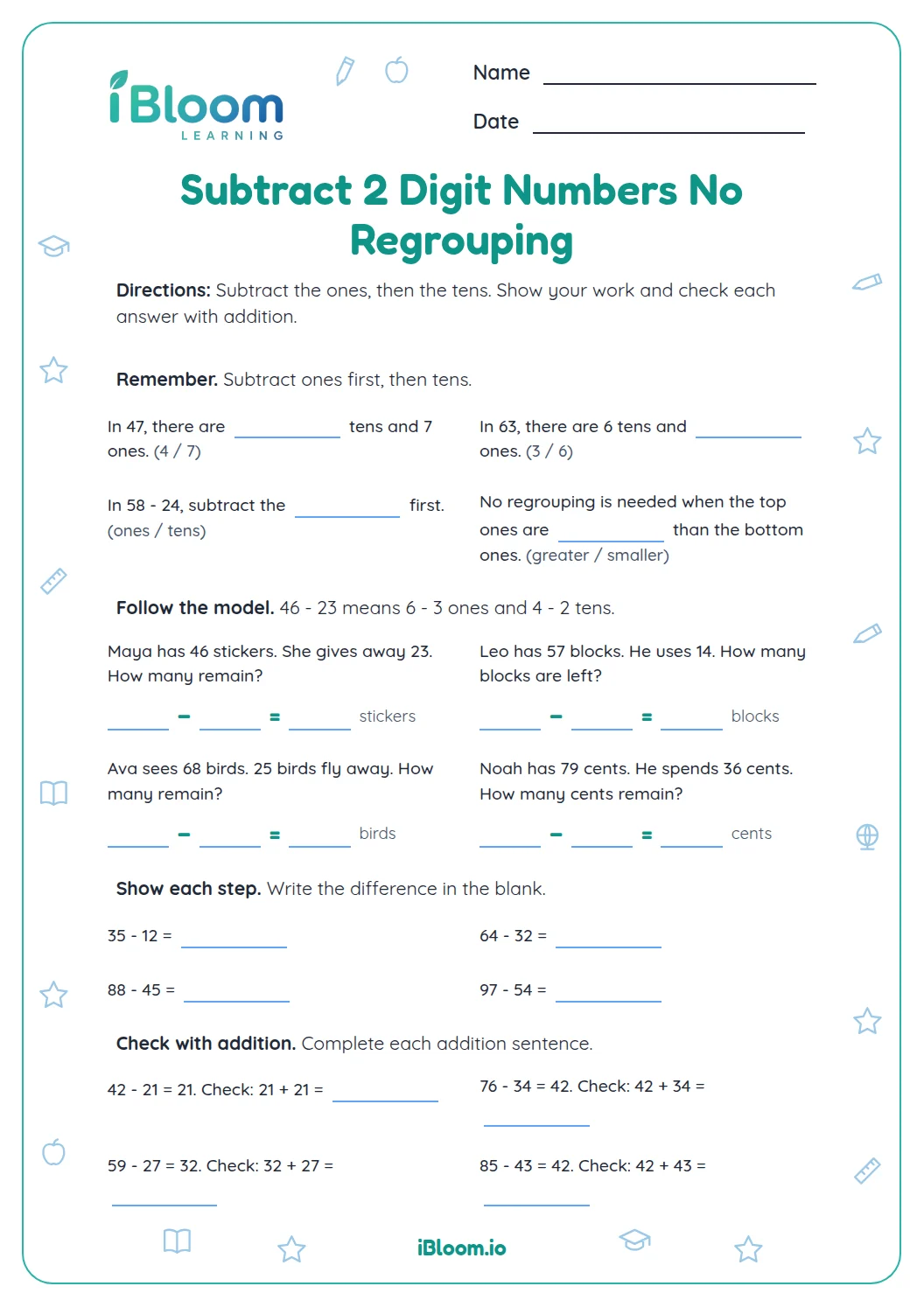
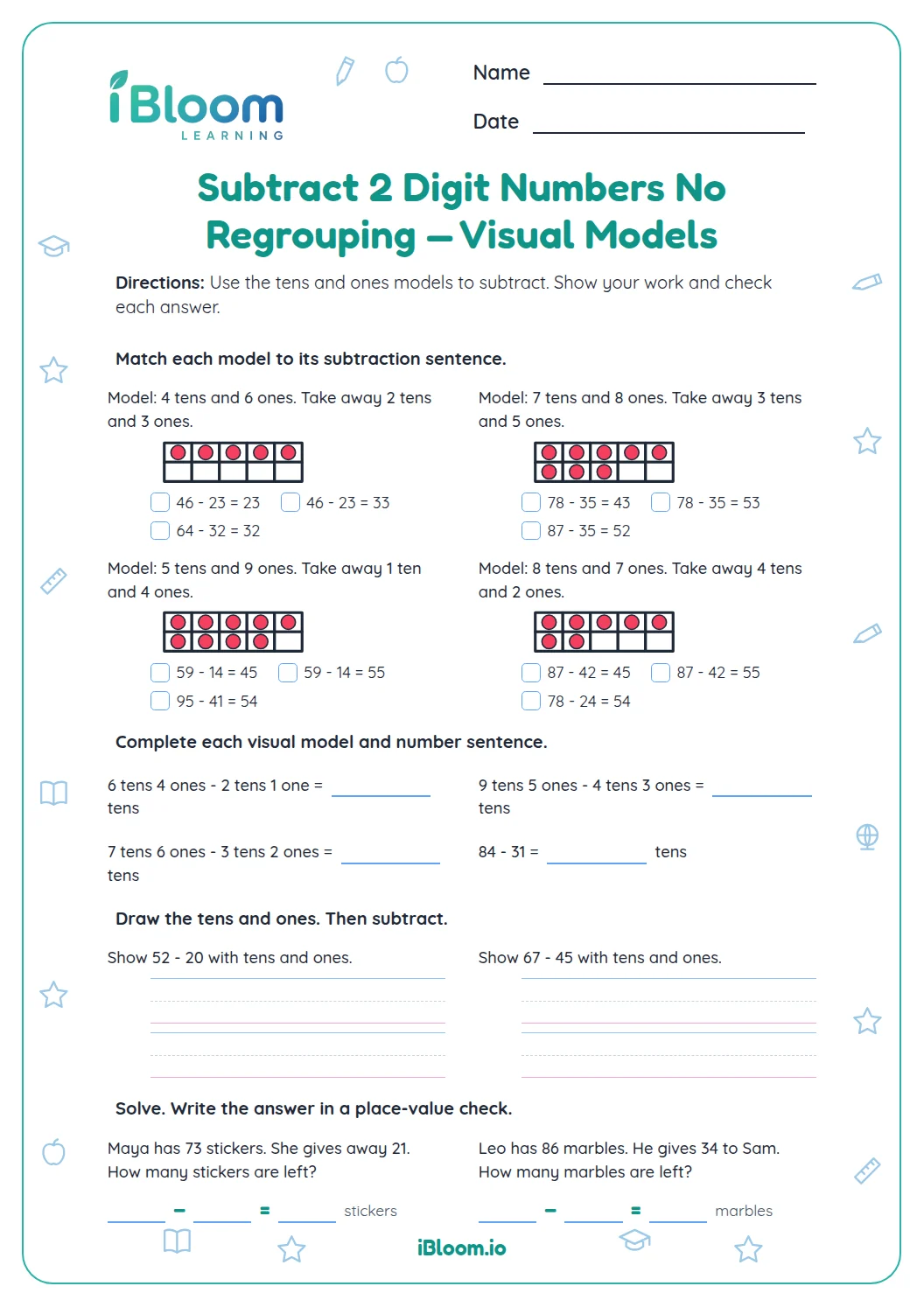
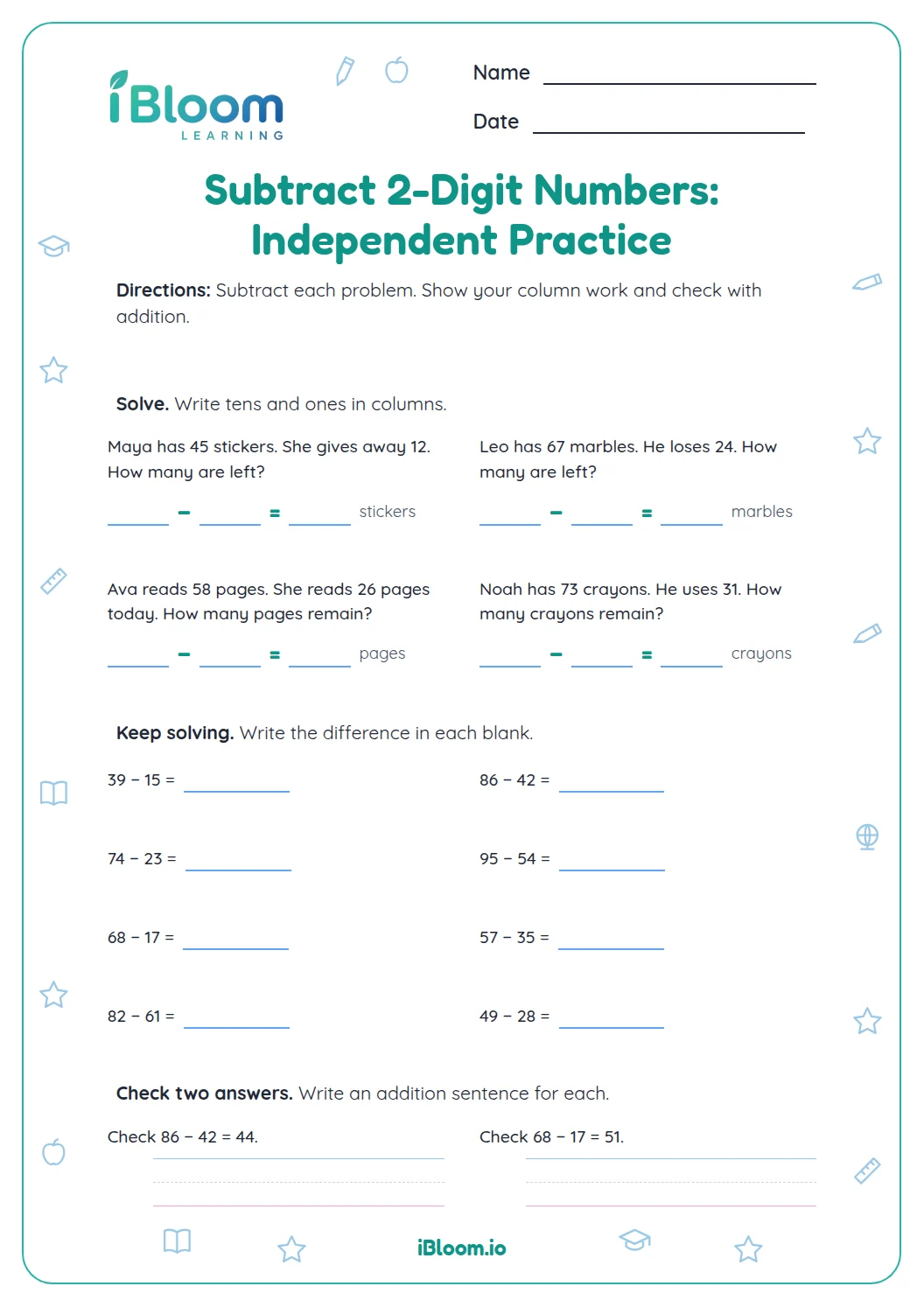
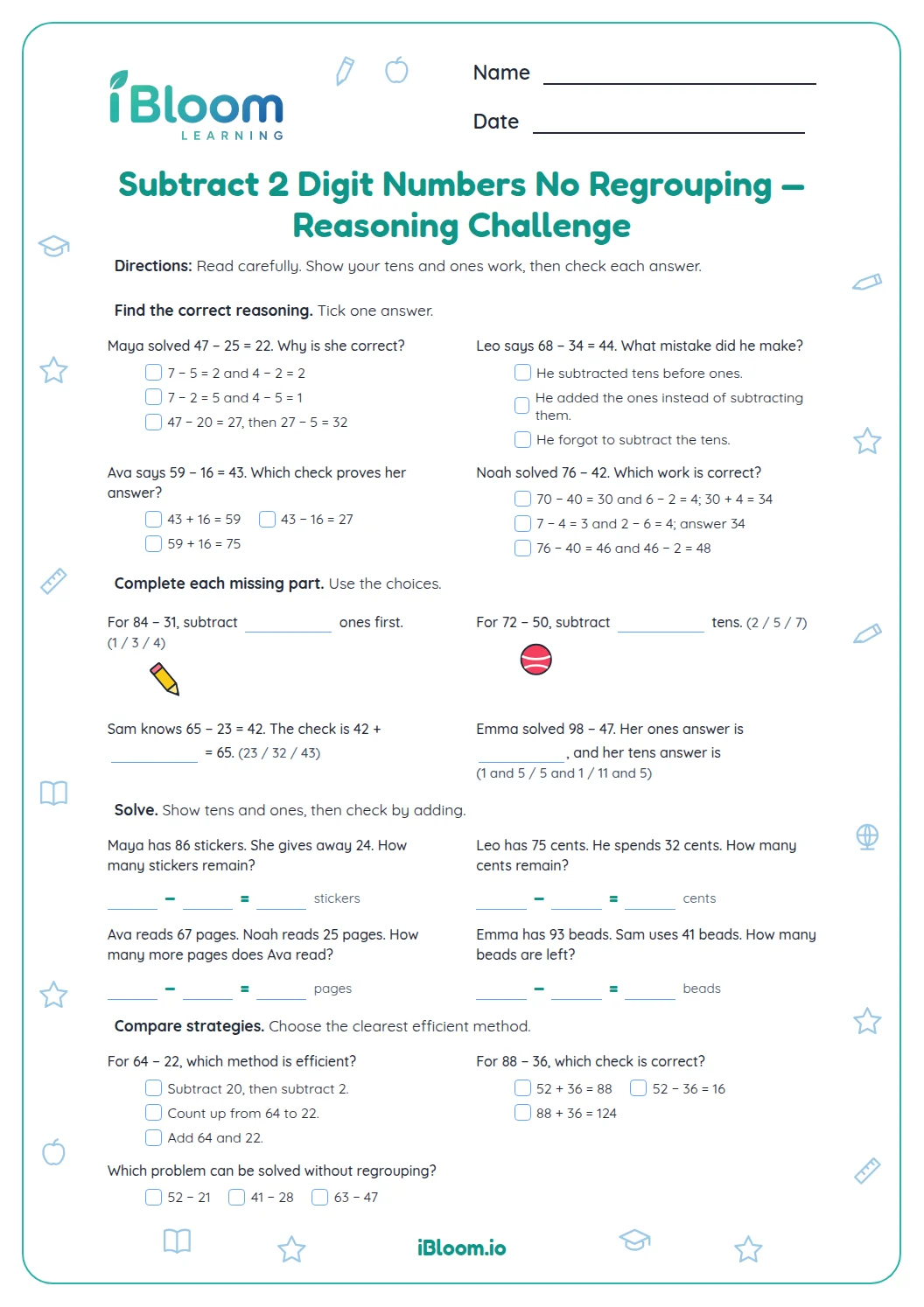
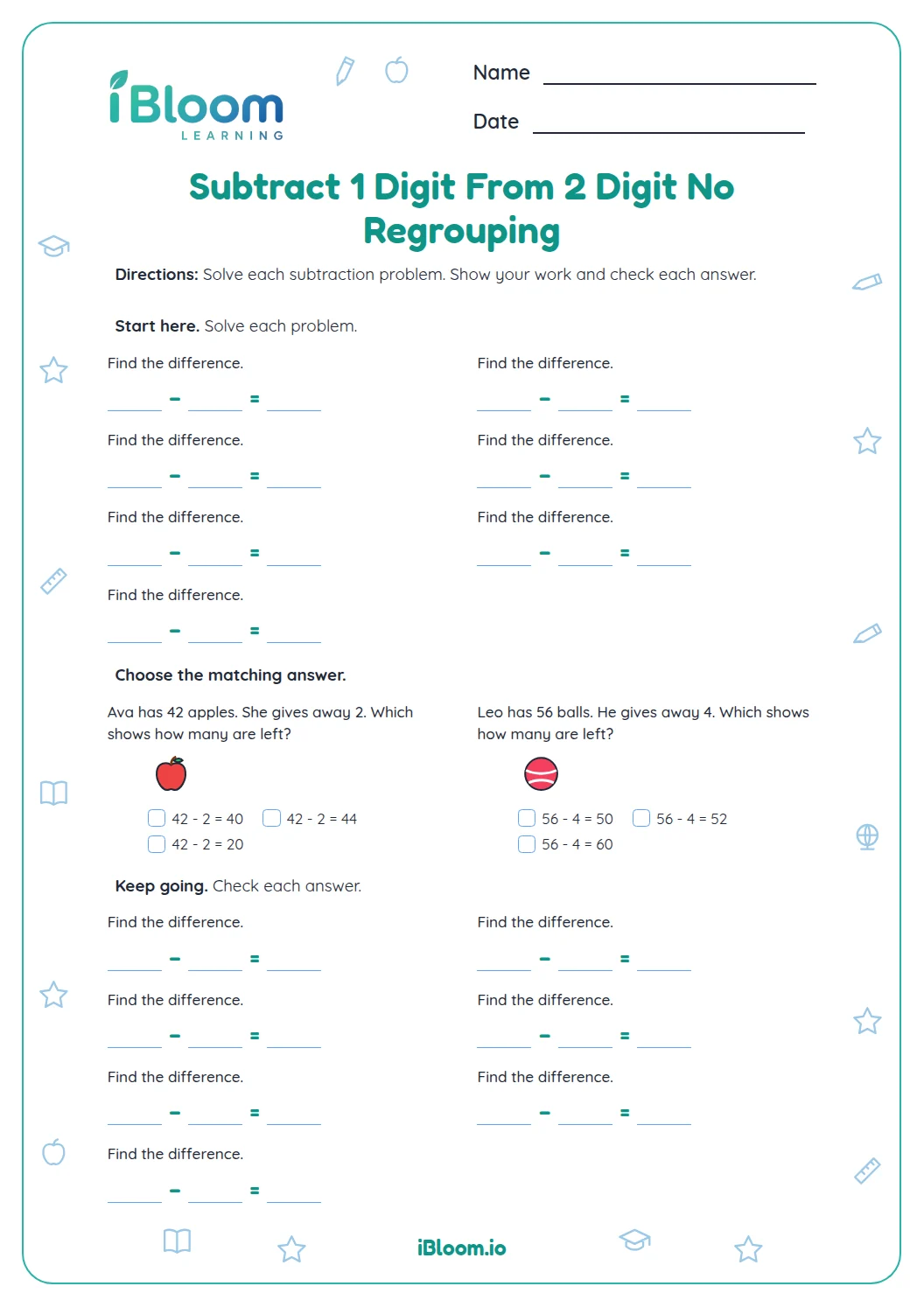
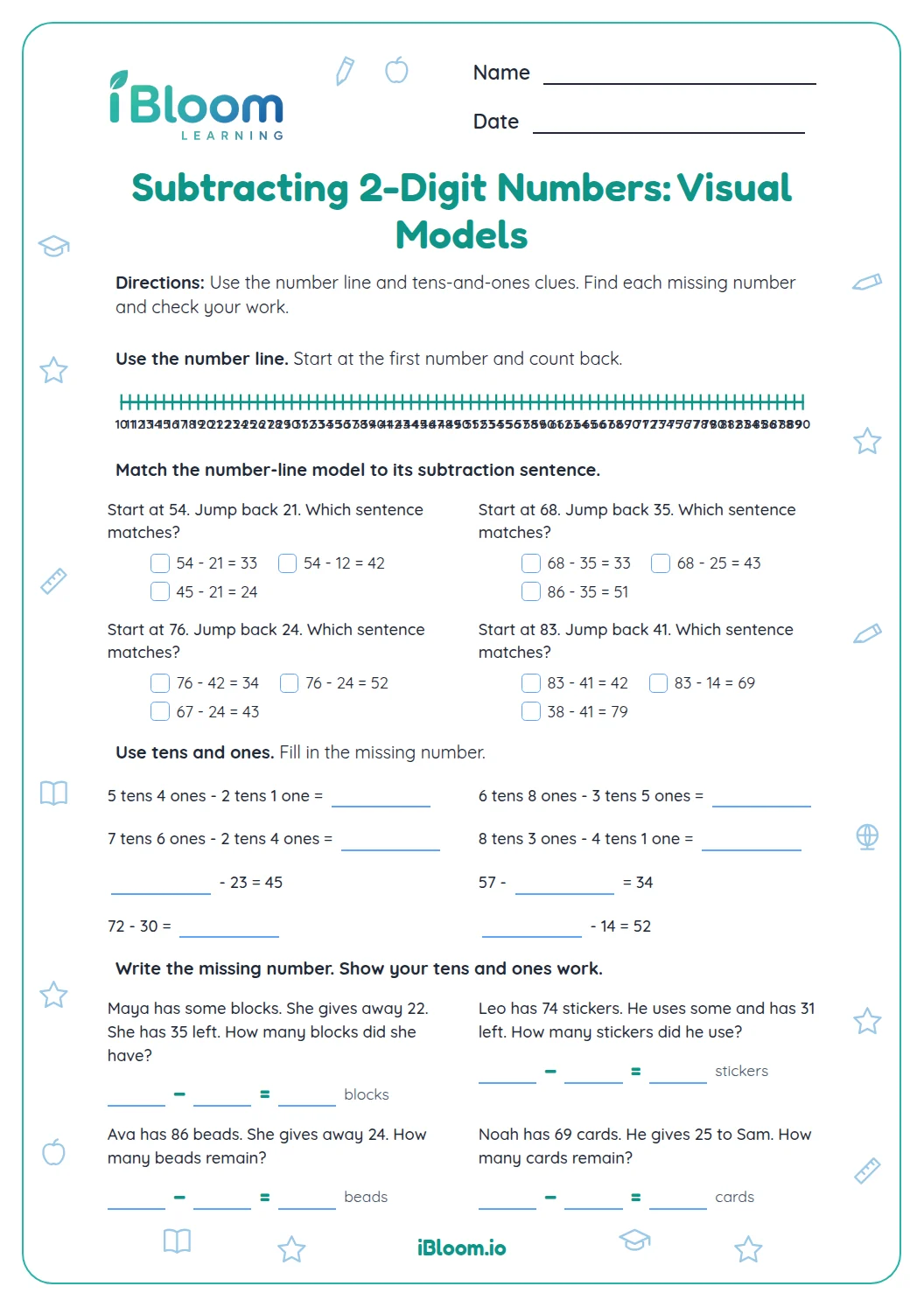
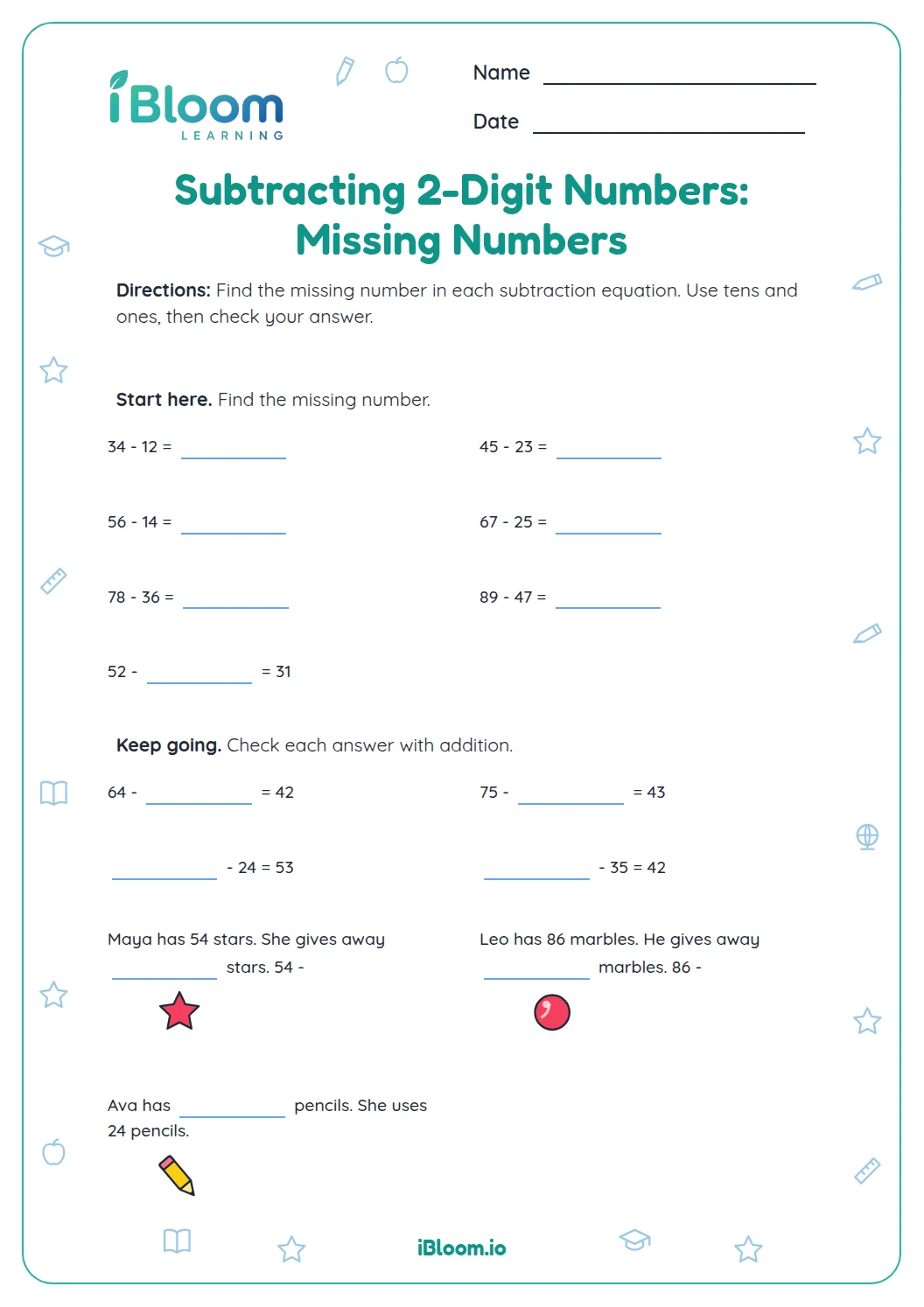
This printable practices two-digit subtraction without regrouping, using the place-value method named in the original sheet directions: subtract the ones, then the tens. Its 14 questions move from a place-value prompt to independent equations, short word problems, and one check. The listed standard is Grade 2 2.NBT.B.5, the standard for adding and subtracting within 100.
Aligned to 2.NBT.B.5
How do you subtract without regrouping?
Subtract the ones digits first, then subtract the tens digits. In 56 − 24, 6 − 4 = 2 ones and 5 tens − 2 tens = 3 tens, so the difference is 32. The top digit in each place is large enough, so no trade is needed.
- 156 − 24
- 26 − 4 = 2 ones
- 35 tens − 2 tens = 3 tens
- 4The difference is 32.
How do subtraction stories use place value?
Find the starting amount and the amount taken away, then subtract. In the shelf story, 76 books − 24 books = 52 books remain. Keeping the unit with the answer makes the result easy to understand.
How can you check a difference?
Add the difference to the amount taken away. For 76 − 24 = 52, the check is 52 + 24 = 76. If the sum returns to the starting amount, the subtraction is consistent.
How to use the worksheet
- 1Read the whole prompt before writing an answer.
- 2Use the method named in the part direction.
- 3Keep work lined up or organize it on the response lines.
- 4Use the answer key after attempting the page and revisit any missed step.
Common slips to check
The mistake
Subtracting the tens before the ones are clear
The fix
Work one place at a time and keep the digits in their columns.
The mistake
Subtracting the smaller digit from the larger in every column
The fix
Keep the order from the problem: subtract the bottom digit from the top digit.
The mistake
Forgetting the context unit
The fix
Write books, beads, or points when the story names that unit.
Curriculum alignment
This worksheet practices a focused skill that supports grade-level learning.
Subtract ones and tens by place value without trading between places.
On this sheet: Subtract ones and tens by place value without trading between places.
Show the official wordingHide the official wording
Fluently add and subtract within 100 using strategies based on place value, properties of operations, and/or the relationship between addition and subtraction.
What to practice next
Make more practice
Further reading
Questions parents and teachers ask
What does “without regrouping” mean?
The ones can be subtracted from the ones, and the tens from the tens, without trading a ten for ones. For example, in 68 − 35, subtract 5 ones from 8 ones and 3 tens from 6 tens. Each story and equation on this sheet follows that rule.
How should a student solve 68 − 35?
Subtract the ones first: 8 − 5 = 3. Then subtract the tens: 6 tens − 3 tens = 3 tens. Put the digits together to get 33. The first part asks students to notice the place-value steps before completing the later equations. This is the same place-value method used in the first section.
What grade is this skill for?
The page title names Grade 1, and the worksheet uses the simplest two-digit subtraction examples without regrouping. The listed Common Core alignment is Grade 2 standard 2.NBT.B.5, which covers adding and subtracting within 100. The answer key supports independent checking after practice.
How many problems are on the sheet?
There are 14 questions arranged in four parts across two worksheet pages. Students start with a place-value prompt, continue with subtraction equations, solve short stories, and finish with a brief explanation. A separate answer key follows the worksheet pages. The sheet uses examples that keep the digits easy to compare.
What is a good way to check a subtraction answer?
Add the difference to the number that was taken away. For example, if 76 − 24 = 52, check that 52 + 24 returns to 76. Students can also estimate whether the result is reasonable before looking at the answer key. The stories use familiar amounts and name the unit in each answer.