



About this worksheet
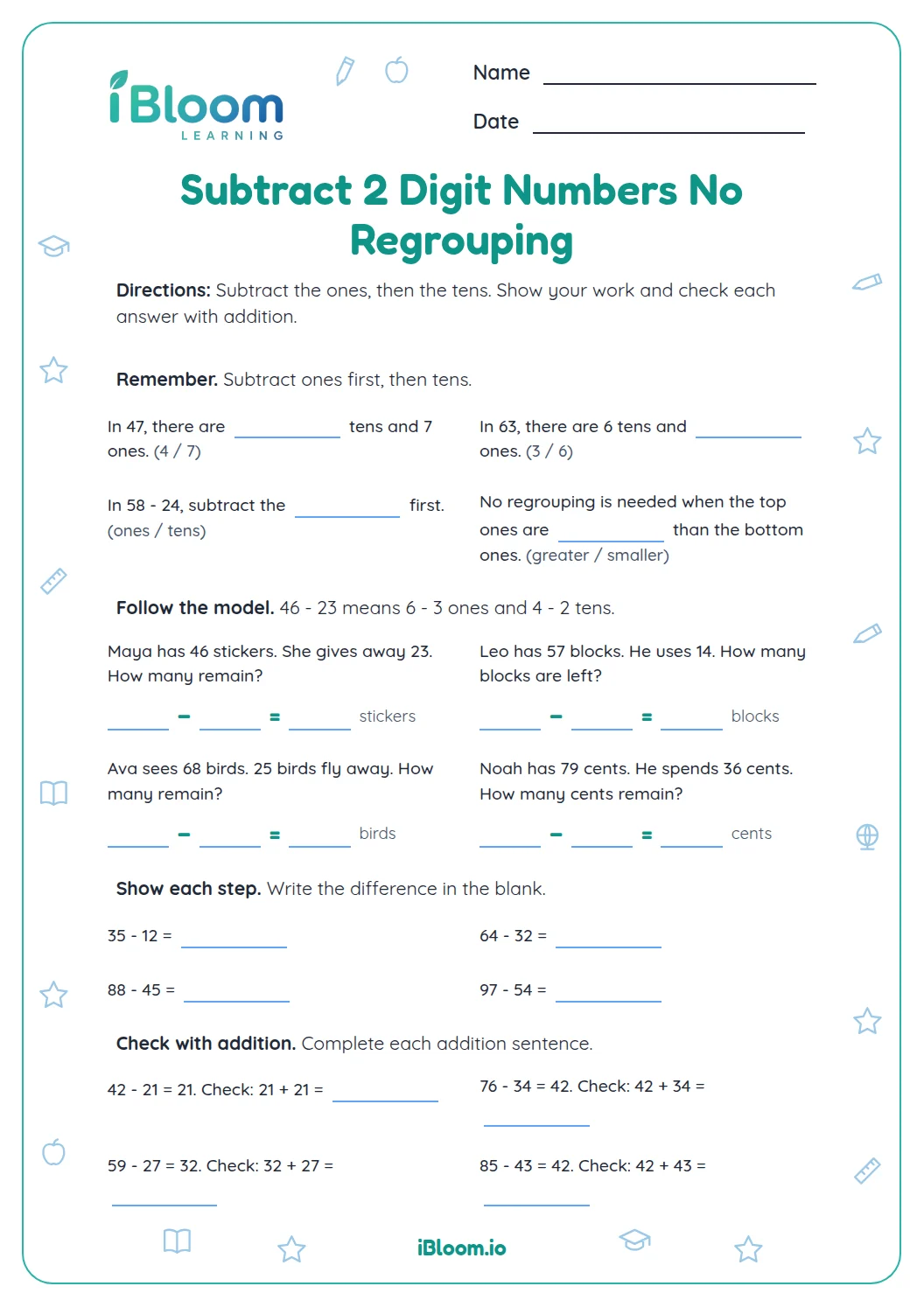
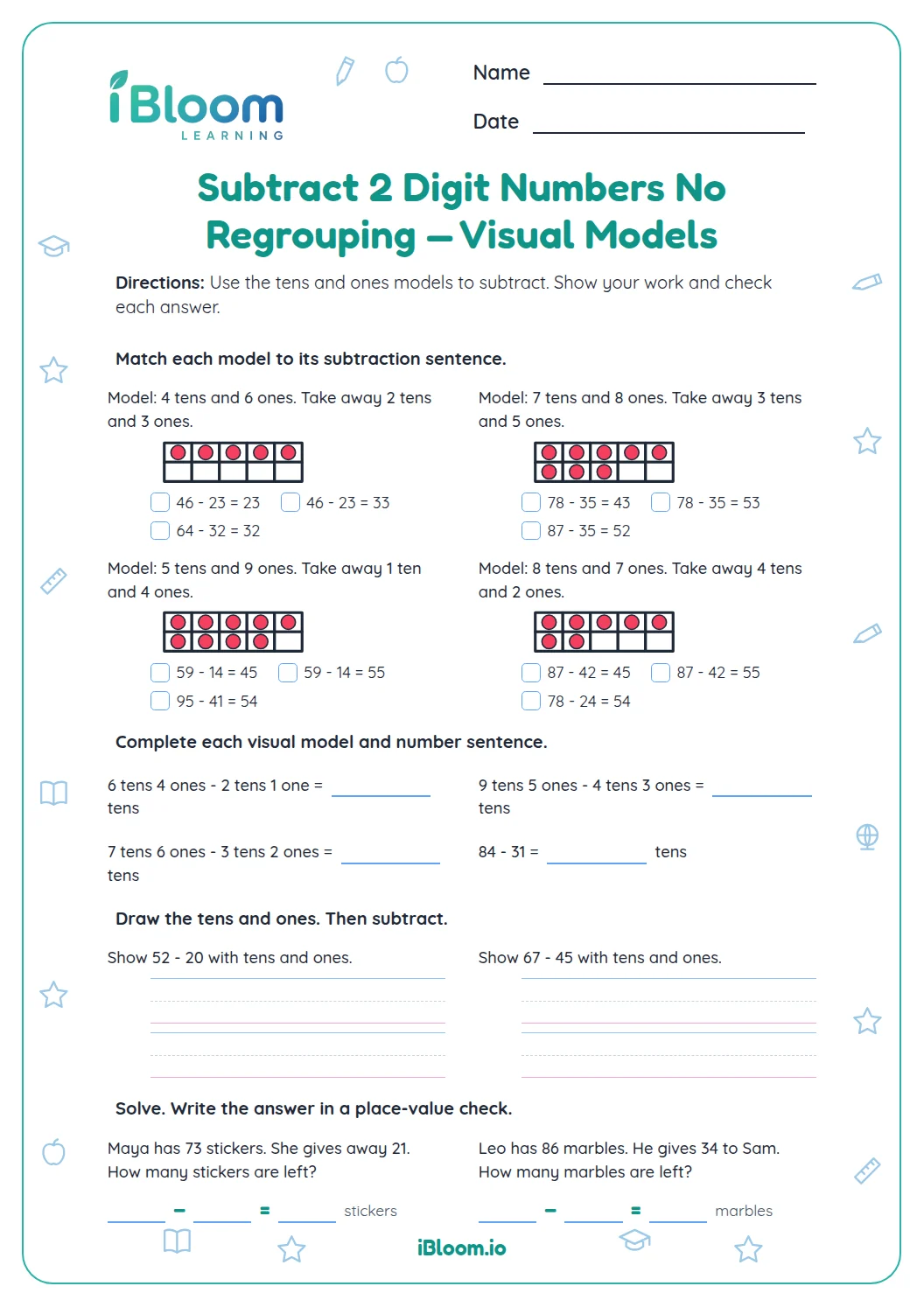
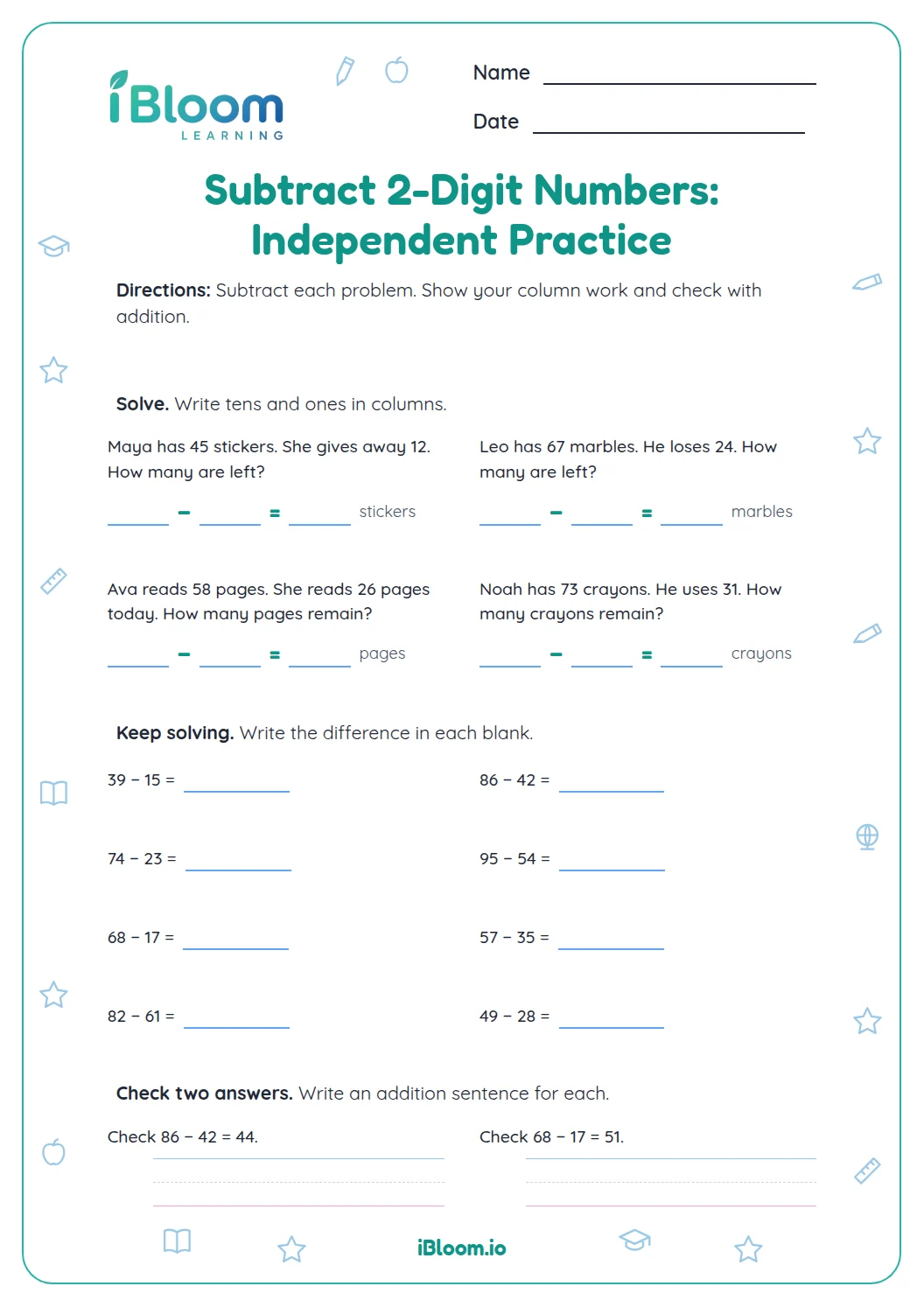
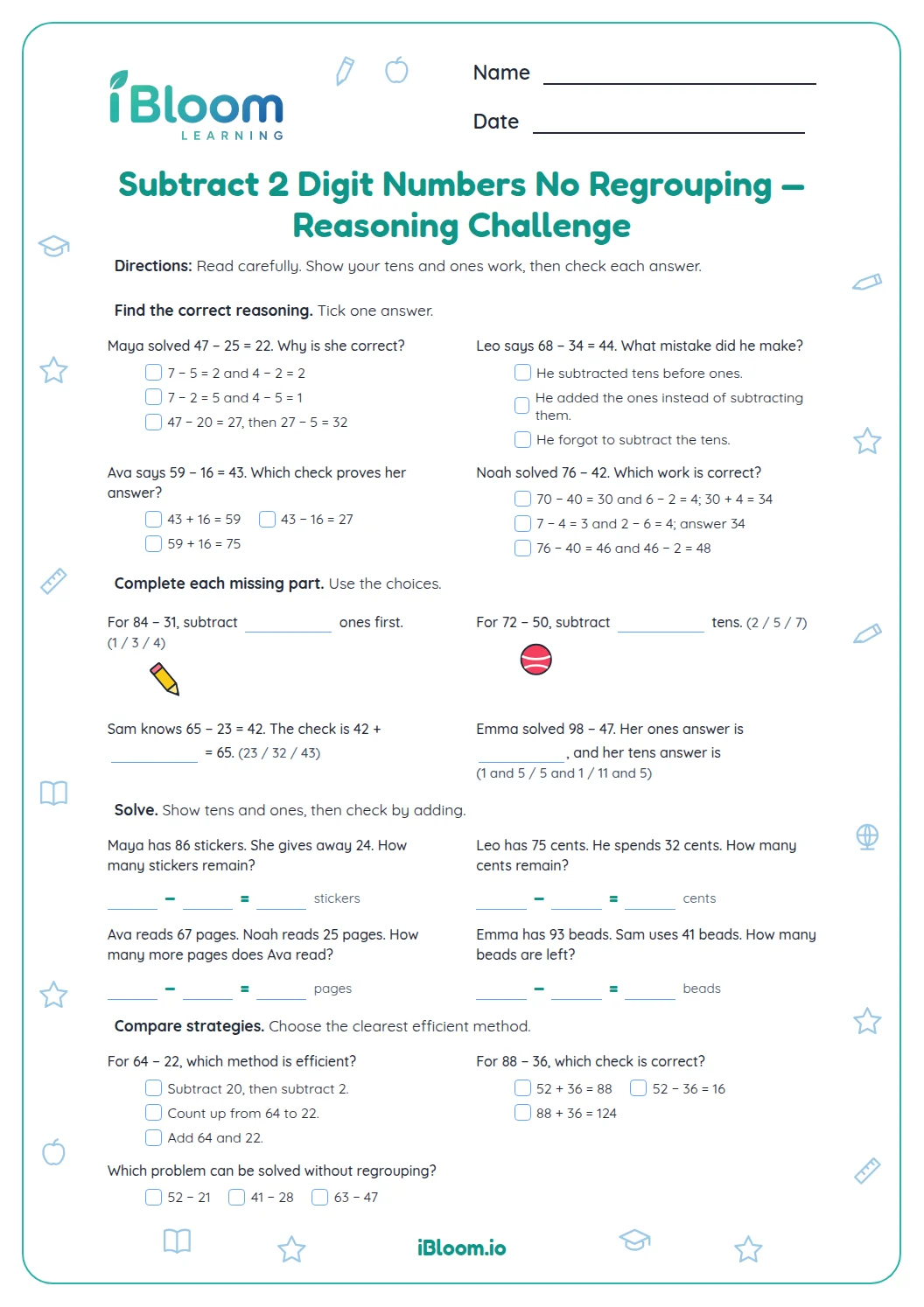
This free printable Grade 1 worksheet gives children 14 short stories to solve with two-digit subtraction without regrouping. Each story provides a starting amount and a part taken away, used, or left as the difference. The numbers let children subtract the ones and tens directly. A separate answer key lists the answers.
How do you spot a take-away story?
Look for the amount at the start and the amount removed. In the first problem, Sam starts with 48 stickers and gives away 23. Subtract 23 from 48 to find what remains.
- 148 − 23 = ___
- 2Ones: 8 − 3 = 5
- 3Tens: 4 tens − 2 tens = 2 tens
- 4Answer: 25 stickers
How do you find the difference in a story?
Identify the total and the part you know, then subtract to find the other part. In question 11, Ava has 58 pages to read and has read 26. The unread pages are 58 − 26 = 32.
How can you check the answer?
Use addition to check a subtraction answer. For question 1, 48 − 23 = 25; adding 25 + 23 returns to 48. Include the story unit in the answer so the result is clear.
How to use this worksheet
- 1Read the whole story once.
- 2Name the starting amount and what changes.
- 3Choose subtraction for what remains; add when finding a whole made of two parts.
- 4Write a number sentence.
- 5Subtract ones, then tens, without regrouping.
- 6Add the parts back to check and include the unit.
Common mistakes and quick fixes
The mistake
Subtracting the larger digit from the smaller in a place.
The fix
Use the story’s order: starting amount minus amount removed.
The mistake
Subtracting the numbers in the order they are mentioned, even when finding a total.
The fix
In question 11, pages read and pages left combine, so add.
The mistake
Leaving off the answer label.
The fix
Repeat the story’s unit in the answer, such as 25 stickers.
What to practice next
Make more practice
Further reading
Questions parents and teachers ask
What is 48 − 23?
48 − 23 = 25. Subtract the ones, 8 − 3 = 5, and then the tens, 4 tens − 2 tens = 2 tens. Question 1 uses this calculation in a sticker story, and the answer is 25 stickers. Add 25 + 23 to check.
What does “without regrouping” mean?
The ones digit in the number being subtracted is no greater than the ones digit in the starting number. That lets a child subtract ones and tens in their own columns. Each problem on this worksheet follows that pattern.
How do I know which number to subtract?
Look for the amount at the start and the amount removed, used, or already counted. Subtract the known part from the total to find what remains or the missing part. In question 11, subtract 26 read pages from 58 total pages.
Why include a unit in the answer?
The unit tells what the answer counts. For question 1, 25 is the number, and 25 stickers connects it to the story. The key lists answers in context where a unit helps make the result clear. A unit such as books or pages makes each result easier to interpret.
Can addition check a subtraction answer?
Yes. Add the amount taken away to the amount left. For 48 − 23 = 25, check 25 + 23 = 48. If the sum does not return to the starting amount, review the subtraction. This check works for any story on these two-digit pages.
Is an answer key included?
Yes. A separate answer key gives the answers for all 14 stories. Children can first write each subtraction sentence and solve it, then compare their results and units with the key. It also lets an adult check the error-correction problem at the end.