




About this worksheet
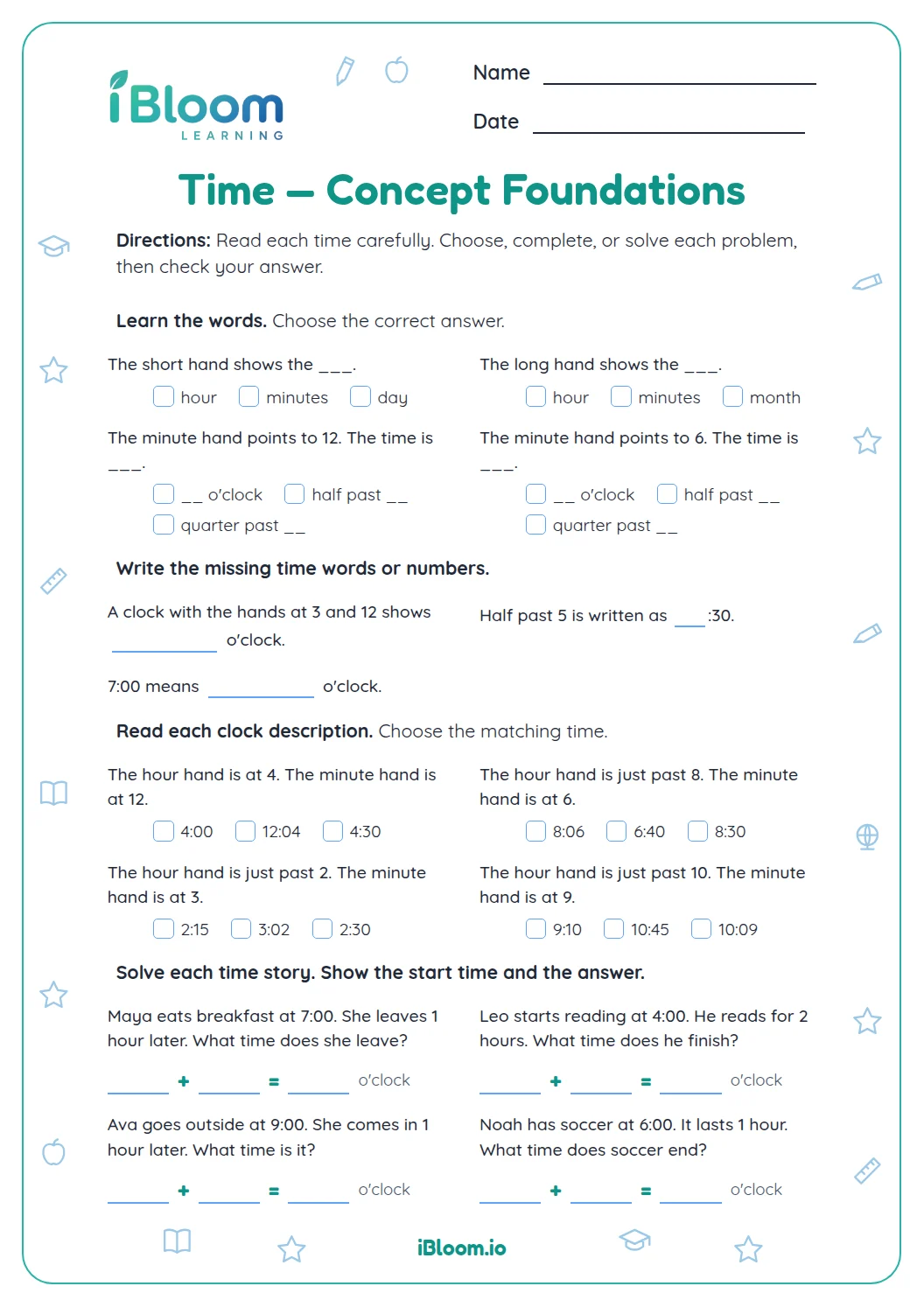
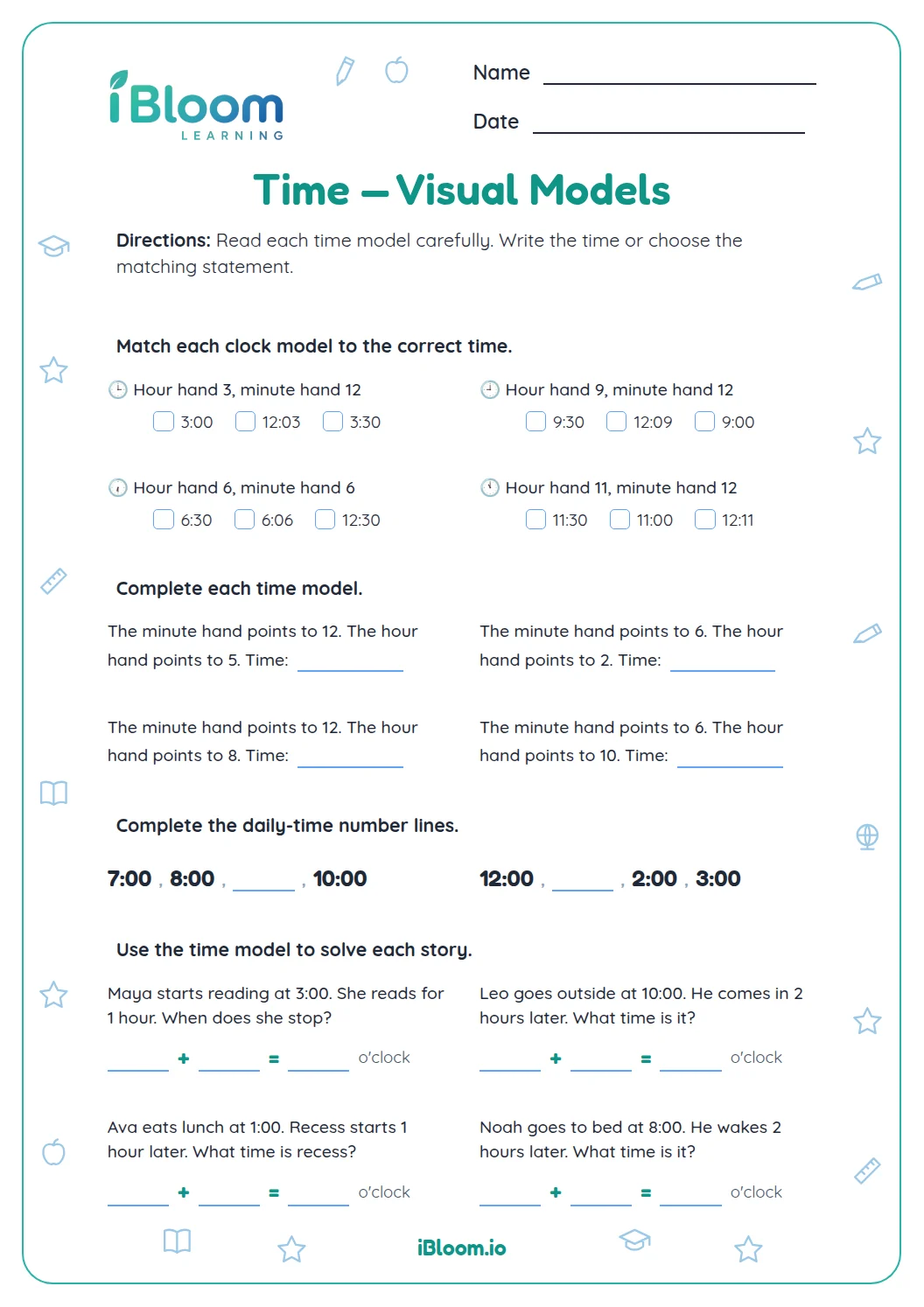
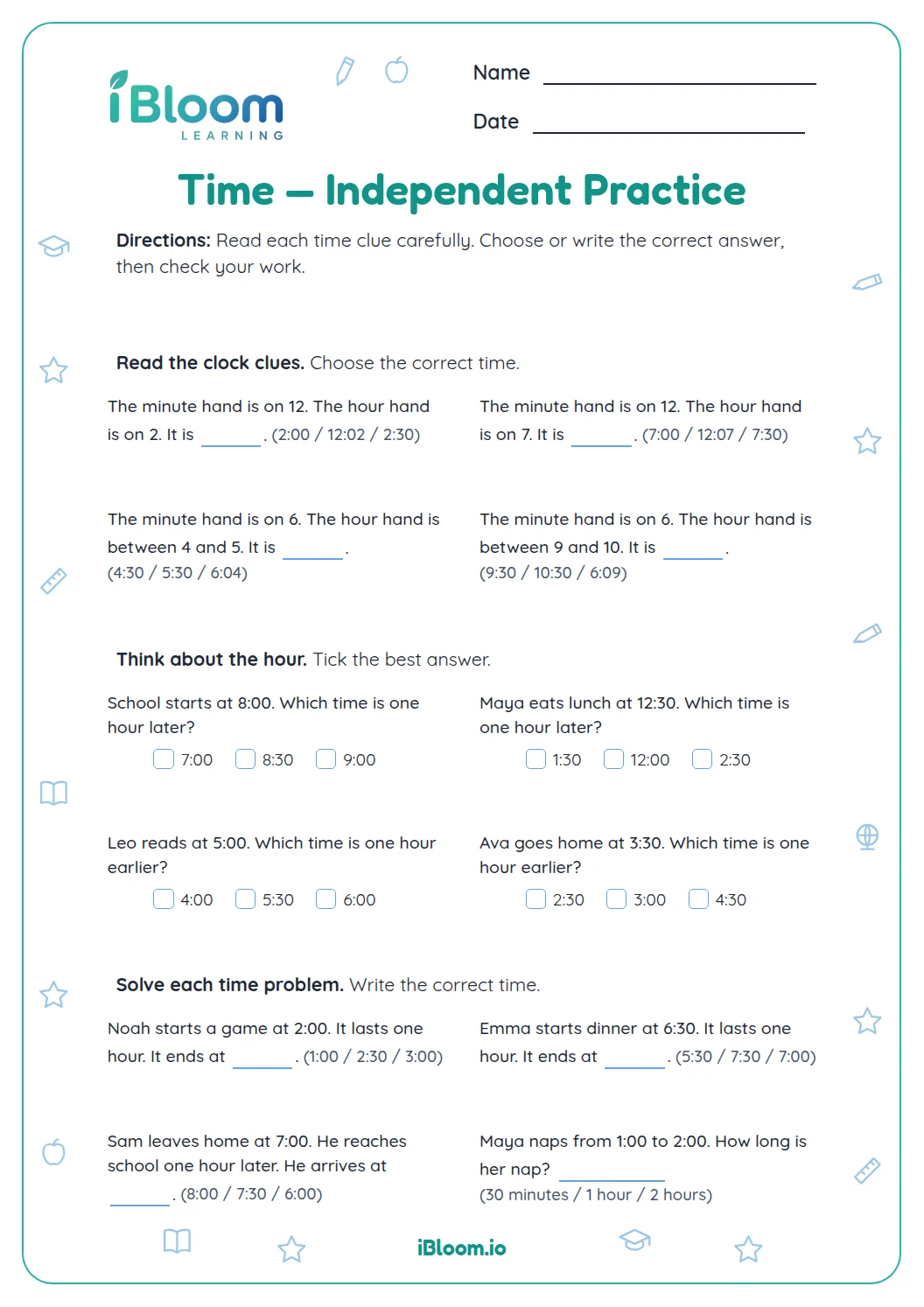
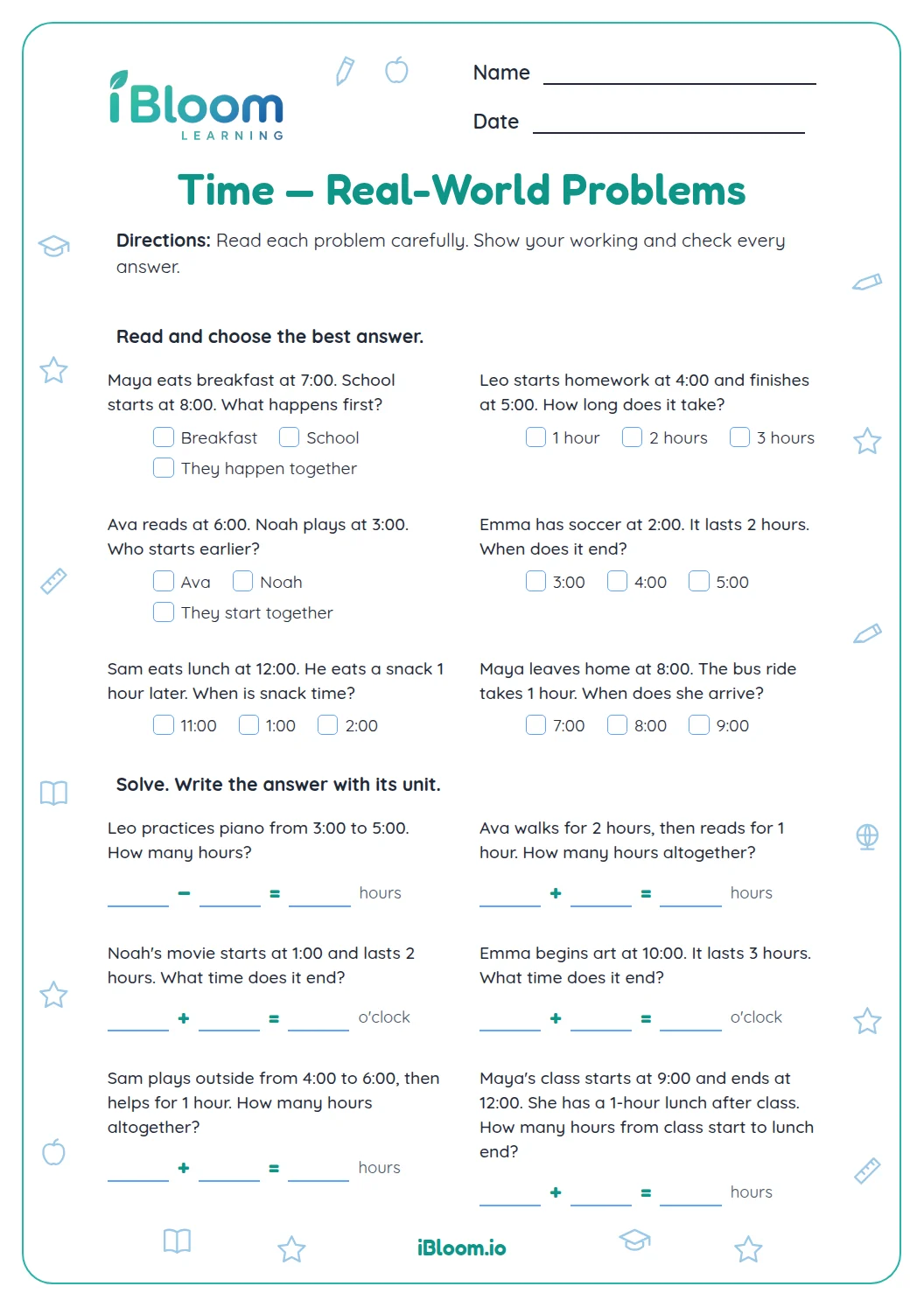
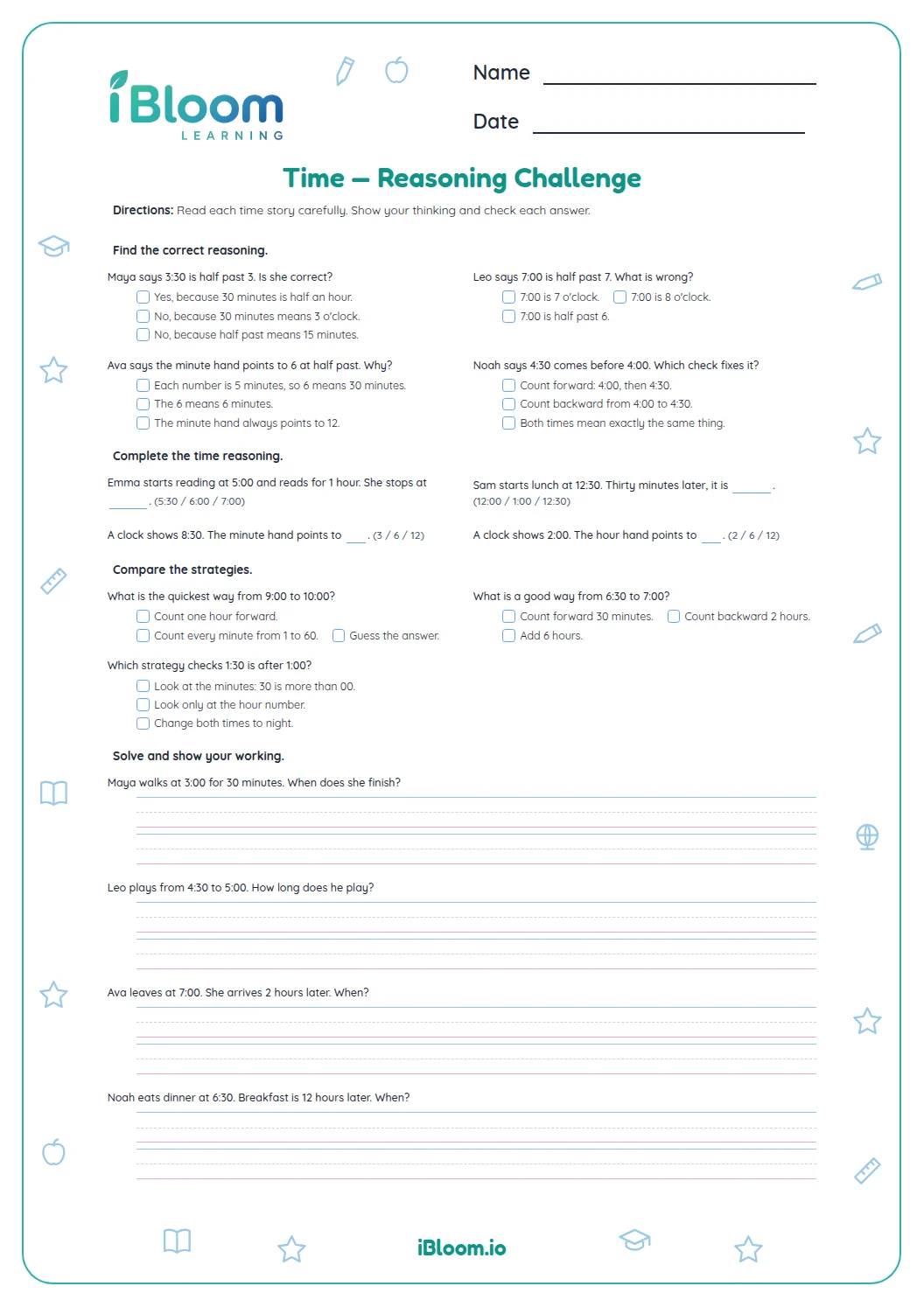
This free printable worksheet gives Grade 1 children guided practice with time stories. Part A shows two clocks, one on the hour and one at half past, and asks what time each says. Part B has four fill-in stories about when something starts or ends, or how many hours it lasts, such as a nap that ends at 3:00 after 2 hours. Part C has two harder stories with room to show thinking, like piano practice that starts at 2:30 and lasts 1 hour. It practices Common Core 1.MD.B.3, telling time in hours and half-hours, and 1.OA.A.1, solving word problems within 20. A separate answer key is included.
Aligned to 1.MD.B.3 and 1.OA.A.1
How do first graders solve time word problems?
Time stories at this age use whole hours and half hours. A child reads the start time, decides how many hours pass, and moves the hour number forward. The minutes do not change when whole hours are added, so 2:30 plus 1 hour is 3:30, not 3:00.
It helps to count on a real or drawn clock: put a finger on the start hour and hop around, one hop for each hour. When the story gives the end time instead, hop backward: Mia’s 2-hour nap ends at 3:00, so hop back from 3 to 2 to 1: it began at 1:00.
- 1Ben starts piano at 2:30. It lasts 1 hour.
- 2Start: 2:30
- 3Add 1 hour: 2 + 1 = 3
- 4The minutes stay at :30
- 5End: 3:30
- 6Answer: 3:30
Why start with reading clocks?
Every story needs a starting time, so Part A gives children two clocks to read first: 3:00 and 5:30. Half-hour clocks are the tricky one, because the hour hand sits halfway between two numbers. Remind children that the short hand points to the hour it has just passed.
The wrong choices in each question are the usual slips: the next or last hour, or the right hour with the wrong minutes.
What is on this worksheet?
Eight questions in three parts on two pages, from reading to solving. The stories are about snack, dinner, reading, a nap, a lesson, breakfast, piano and a movie, things children do every day.
- Part A, Read the clock: 2 clocks, color the matching time
- Part B, Fill in the time: 4 stories with a blank for the start time, the end time or the hours
- Part C, Solve the time stories: 2 stories with space to show thinking
- Answer key on separate pages
How do you find how many hours something lasted?
Start at the beginning time and count hops to the end time. In question 8, the movie starts at 5:00 and ends at 8:00: 6, 7, 8 is three hops, so it lasts 3 hours. Children can also take the smaller number away from the larger (8 − 5 = 3) once they are ready.
Always say the unit in the answer: 3 hours, not just 3. That keeps the length of time separate from a time of day like 3:00.
How to use this worksheet at home or in class
- 1Warm up with a clock face: set it to 3:00 and 3:30 and ask which hand shows the hour.
- 2Read the first clock together and color the time. Ask how your child knows it is not 2:00 or 4:00.
- 3Let your child do the second clock alone, then compare the two hands on both clocks.
- 4In Part B, tap the clock or your fingers to count each hour while reading the story aloud.
- 5In Part C, ask for a quick drawing or hops on a clock, then the answer with its unit.
- 6Check with the answer key and redo any miss on a real clock.
Common mistakes and quick fixes
The mistake
Dropping the half hour, such as writing 3:00 for 2:30 plus 1 hour.
The fix
Say the time in two parts: the hour changes to 3 and the half hour stays. Show 2:30 and 3:30 on a clock to compare.
The mistake
Reading the minute hand number as the hour on a half-hour clock, such as calling 5:30 "6:00" because the long hand points to 6.
The fix
Point to the short hand first. It tells the hour. Then point to the long hand: pointing straight down means half past.
The mistake
Writing the end time when the question asks how long, such as answering 8 for the movie from 5:00 to 8:00.
The fix
Underline the question. "How many hours" needs a count of hops (6, 7, 8 makes 3 hops), not the number the movie ends on.
Common Core alignment
Most US states use the Common Core Mathematics standards or a close state version. This sheet practices the two Grade 1 standards below.
Read and write time to the hour and half hour on a clock.
On this sheet: Part A reads two analog clocks, and every story uses hour and half-hour times written as digital times.
Show the official wordingHide the official wording
Tell and write time in hours and half-hours using analog and digital clocks.
Solve word problems by adding and taking away within 20.
On this sheet: The time stories add hours (7 + 5 = 12), count back to a start time (3 − 2 = 1) and find how many hours passed.
Show the official wordingHide the official wording
Use addition and subtraction within 20 to solve word problems involving situations of adding to, taking from, putting together, taking apart, and comparing, with unknowns in all positions, e.g., by using objects, drawings, and equations with a symbol for the unknown number to represent the problem.
What to practice next
Make more practice
Further reading
Questions parents and teachers ask
What kind of time problems do first graders solve?
First graders work with whole hours and half hours. On this sheet they read clocks at 3:00 and 5:30, find end times such as 6:00 and 3:30, and count how many hours a movie or lesson lasted. All the times are on the hour or the half hour.
Why do the stories add hours but keep the minutes the same?
When a whole number of hours passes, only the hour changes. A lesson that starts at 2:30 and lasts 1 hour ends at 3:30. Keeping :30 the same is the main idea to practice, and it prepares children for adding minutes in later grades.
What are the answers to Part B?
The answers are 6, 1, 2 and 12. Leo reads from 4:00 for 2 hours, so he stops at 6:00. Mia's 2-hour nap ends at 3:00, so it began at 1:00. Emma's lesson from 9:00 to 11:00 lasts 2 hours. Sam's lunch, 5 hours after 7:00, is at 12:00. The key shows all eight answers.
My child can read the clock but gets lost in the story. What helps?
Read the story aloud twice and ask what the child is trying to find: an end time or a number of hours. Then draw a clock or use hops on a real one. Underlining the start time and the number of hours often makes the next step clear.
Why does the sheet include a half-past clock?
Half-hour times are part of Grade 1 time work, and they are where children are most likely to slip. Question 2 shows 5:30, and question 7 adds an hour to 2:30. Pointing to the short hand first, then the long hand, keeps the hour and half hour apart.
Is there an answer key, and how long does the sheet take?
Yes. The answer key is on separate pages and shows all eight answers, with the correct clock choices marked. Most children take about 15 minutes. Allow more time if you stop to count hours on a real clock, which is a good habit for Part C.