



About this worksheet
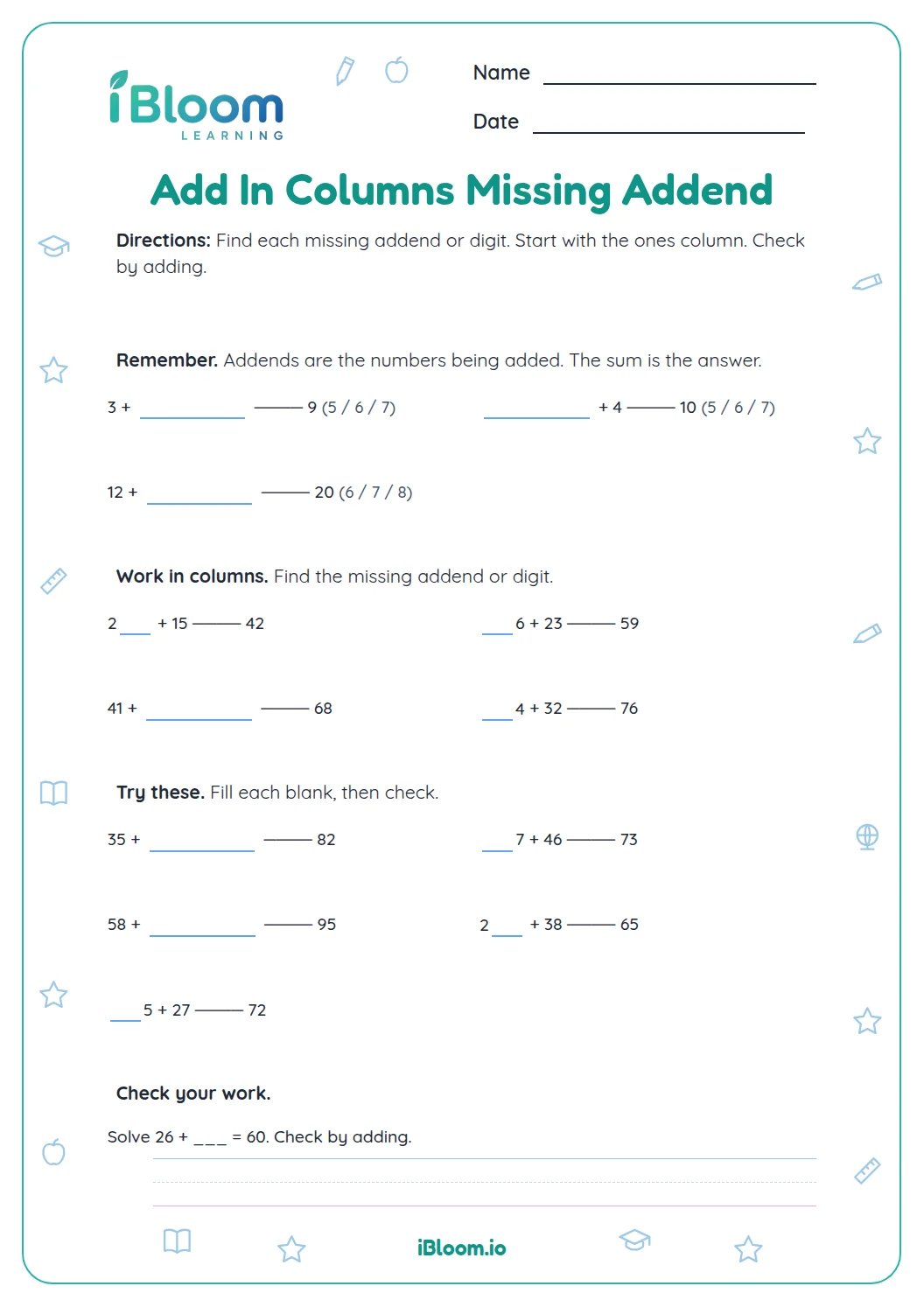
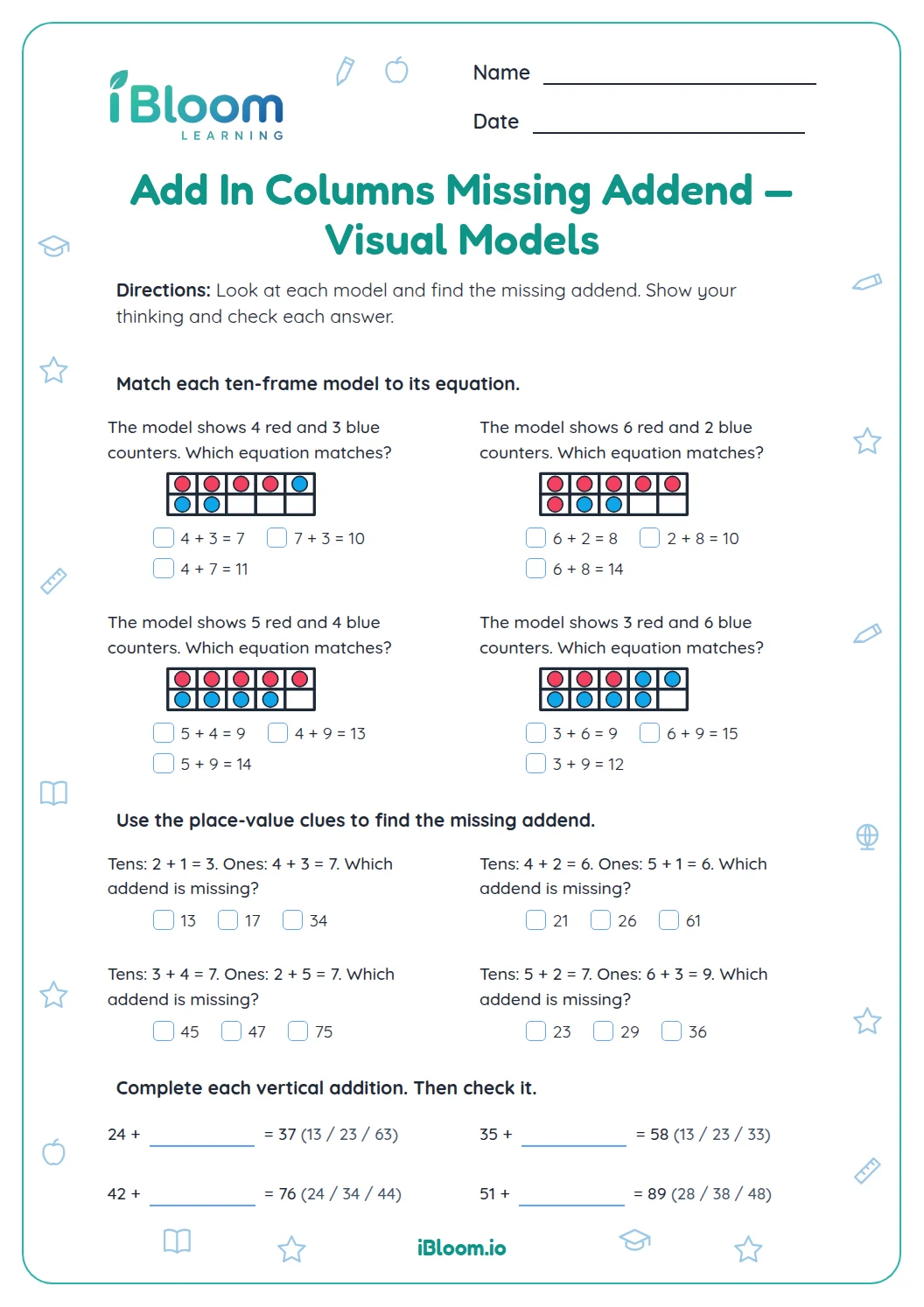
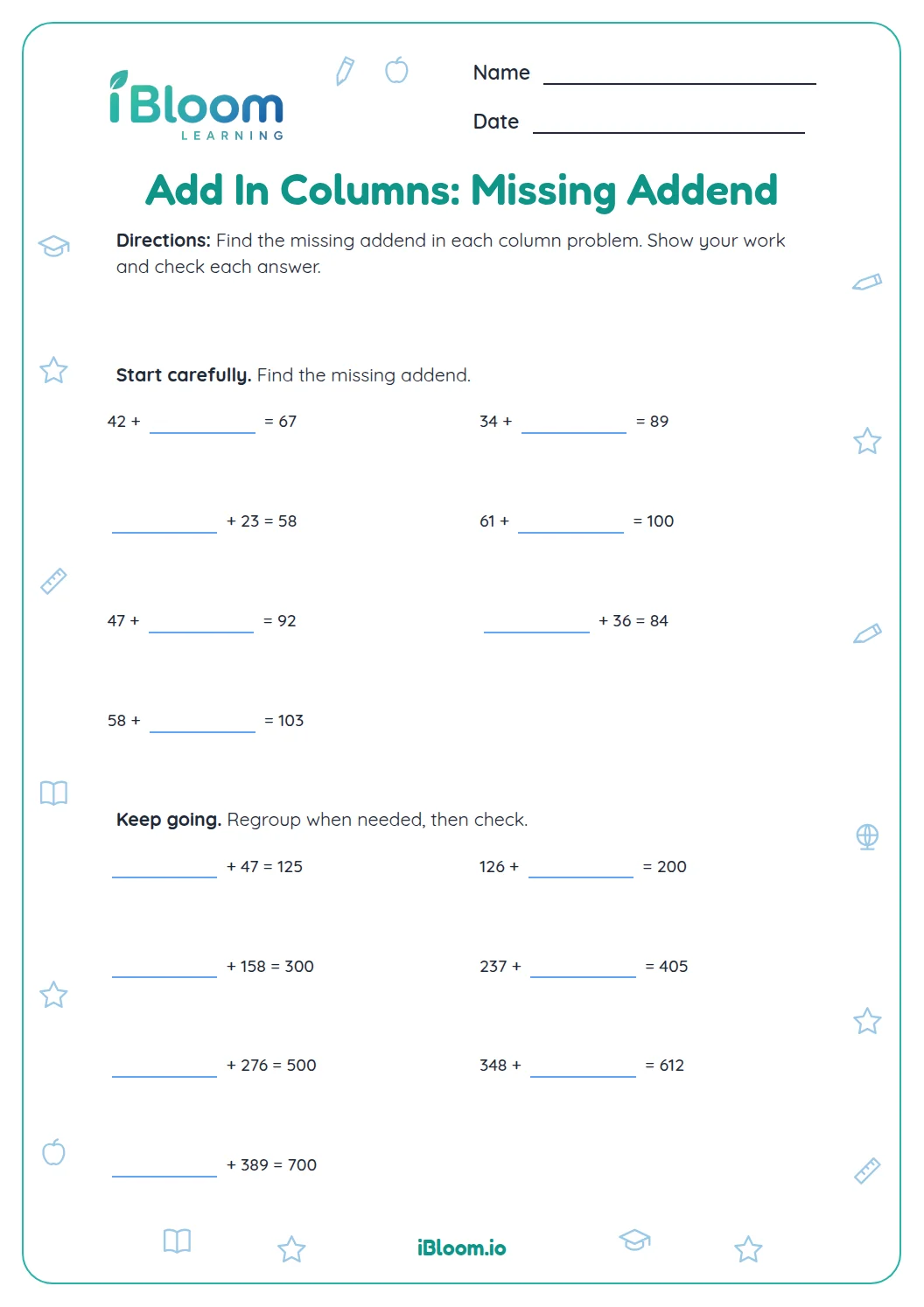
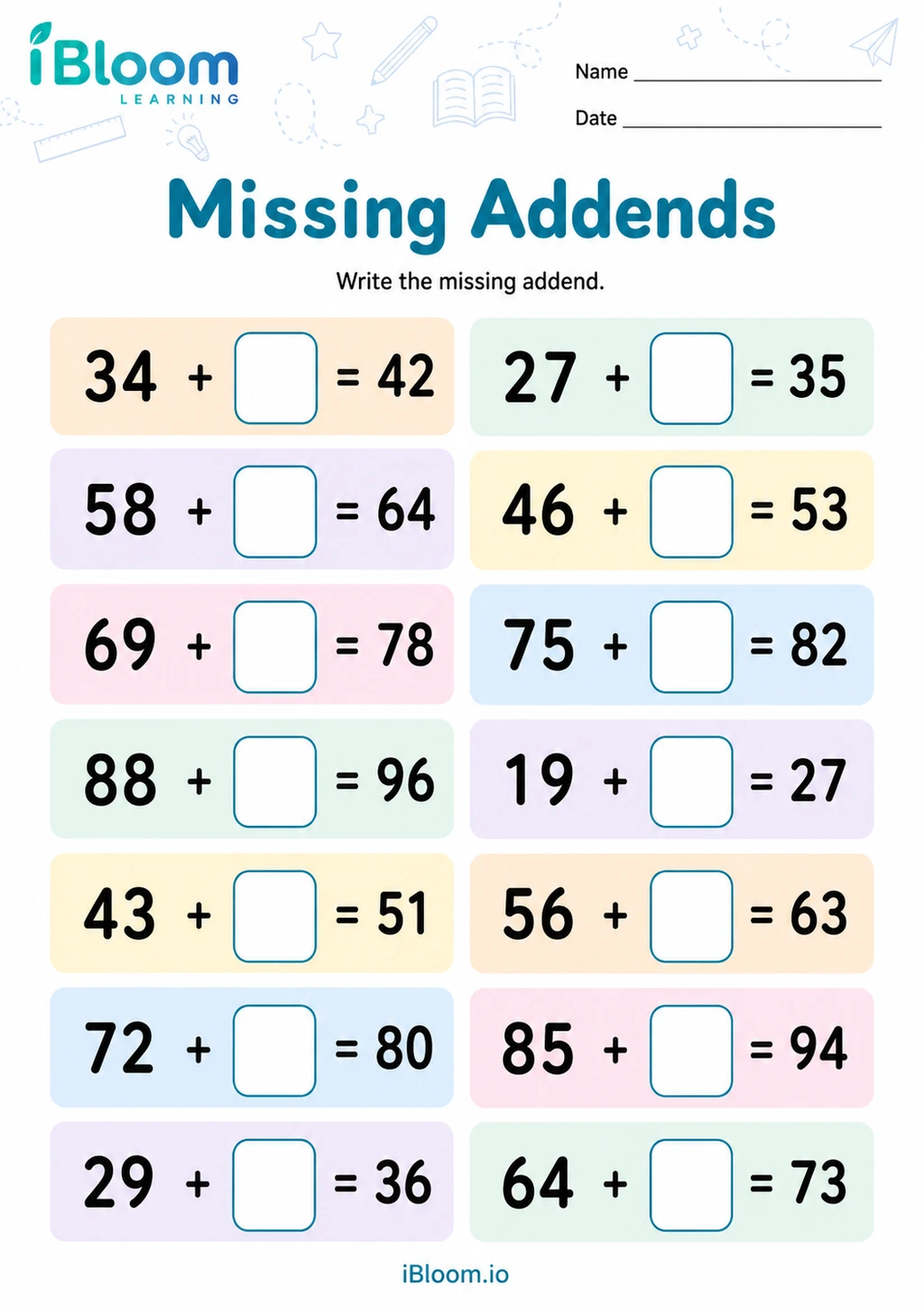
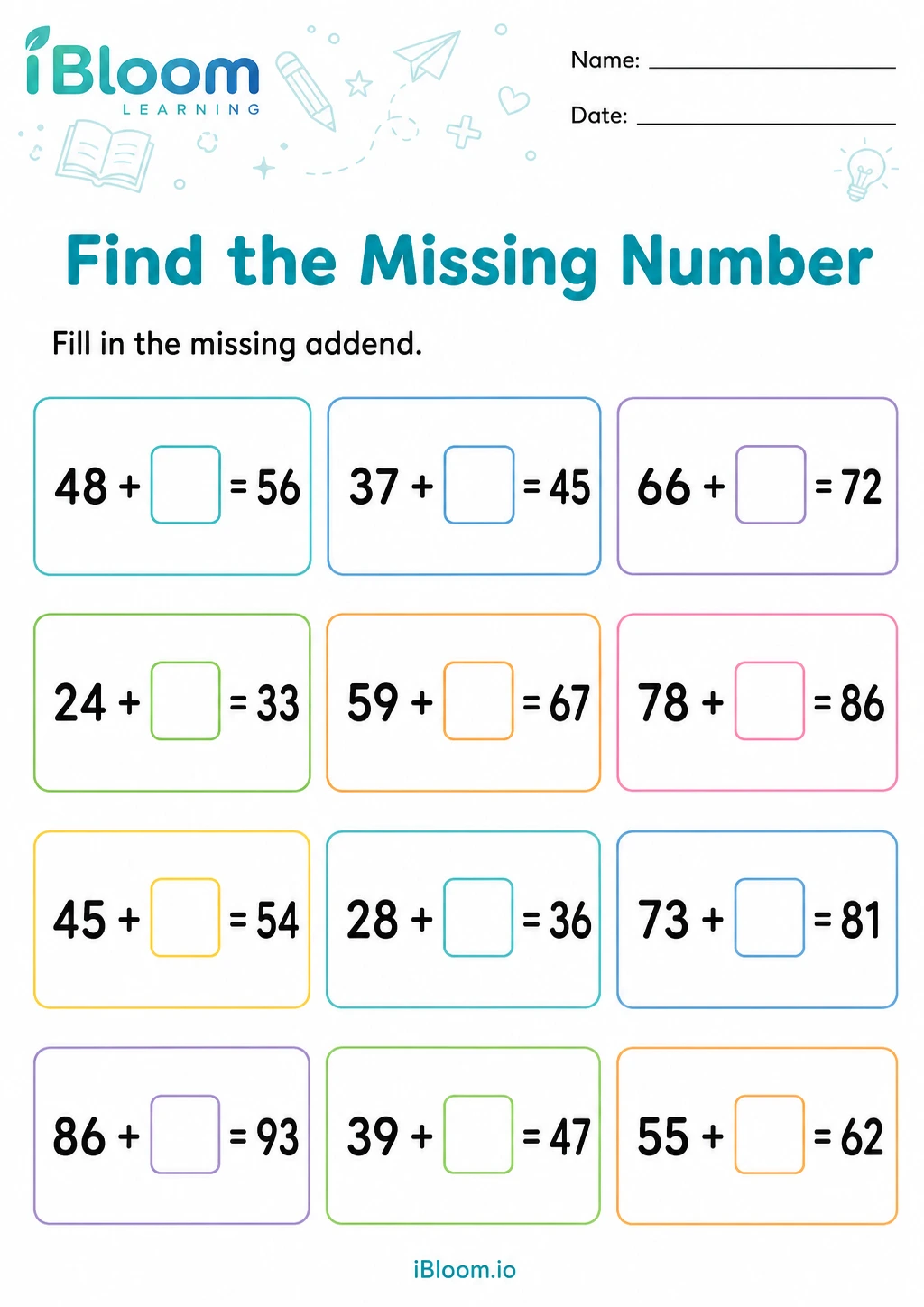
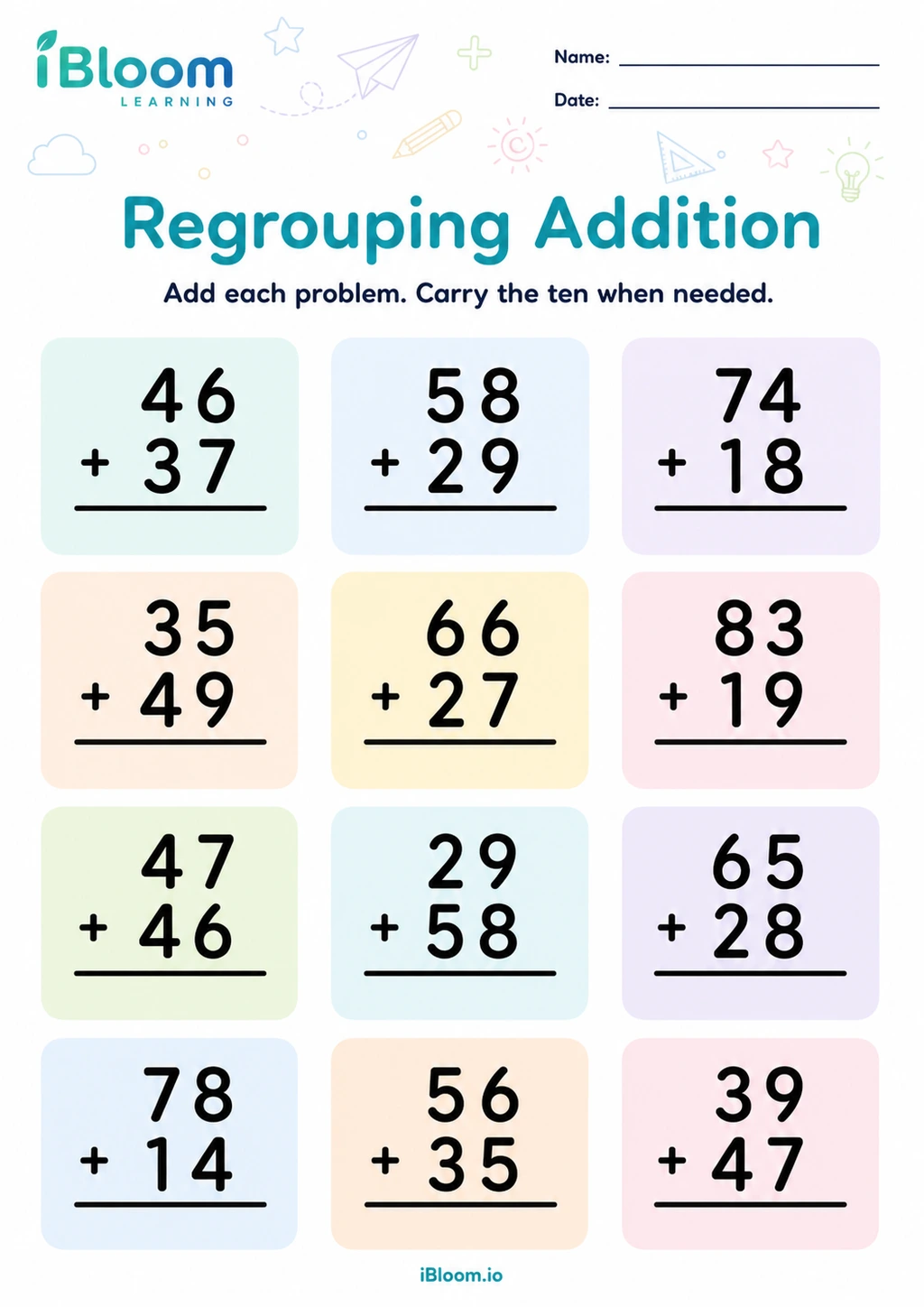
This free Grade 2 math worksheet builds missing-addend reasoning through familiar totals and short real-world situations. Children first complete addition equations, then represent stories with an equation, and finish by adding two-digit numbers. The separate answer key lists each missing value, equation result, and sum. The two-digit calculations stay within 100 and align with CCSS 2.NBT.B.5.
Aligned to 2.NBT.B.5
How can addition reveal a missing part?
An addition equation names two parts and their total. If one part is missing, think about what must join the known part to reach the total. For 24 + ___ = 31, the difference from 24 to 31 is 7, so 24 + 7 = 31.
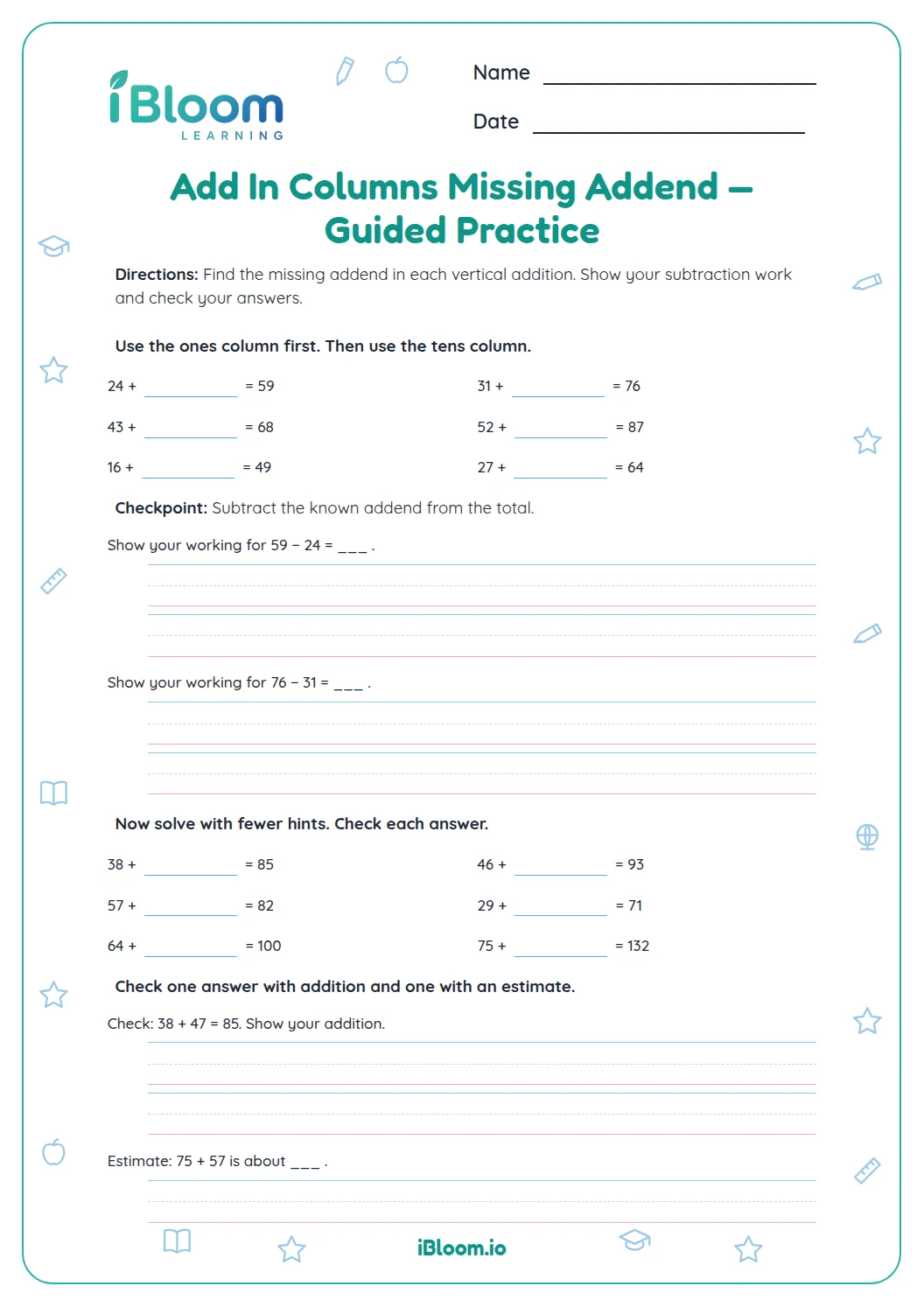
Students can solve by counting on, using place value, or subtracting the known addend from the total. Checking with addition ties the strategy back to the equation.
- 124 + ___ = 31
- 2Count on from 24 to 31: 25, 26, 27, 28, 29, 30, 31
- 3Seven counts, so the missing addend is 7.
- 4Check: 24 + 7 = 31
How should a child turn a story into an equation?
Find the whole amount and the known part. Decide which part is missing, then write an addition equation before calculating so the numbers keep their roles clear. Each story question has room to show an equation and work.
What is a good way to check a column sum?
Line up the ones and tens in the work area. Add the ones, regroup a ten when needed, then add the tens and any regrouped ten. Compare the result with the equation to check it.
How to use this worksheet
- 1Read the equation or story twice.
- 2Mark the total and the part you already know.
- 3Write the missing-addend equation for a story.
- 4Add the ones and regroup a ten when needed.
- 5Add the tens and record the answer.
- 6Check by adding both parts or rereading the question.
Common mistakes and quick fixes
The mistake
Adding the known part to the total.
The fix
Use the total as the answer only after checking the equation.
The mistake
Leaving out a regrouped ten.
The fix
Keep the new ten above the tens column and include it in the next sum.
The mistake
Giving a story answer without its unit.
The fix
Write beads, cans, books, or stickers when the question names them.
Common Core alignment
Add within 100 using place-value strategies.
On this sheet: The column sums and missing addends use two-digit addition within 100.
Show the official wordingHide the official wording
Fluently add and subtract within 100 using strategies based on place value, properties of operations, and/or the relationship between addition and subtraction.
What to practice next
Make more practice
Further reading
Questions parents and teachers ask
What is a missing addend?
A missing addend is an unknown part in an addition equation. In 24 + ___ = 31, the total is 31 and one part is 24. The missing part is 7 because 24 + 7 equals 31; add both parts to check.
How many problems are on this worksheet?
There are 14 problems in three parts: five missing-addend equations, five real-world story problems, and four two-digit addition sums. The answer key gives each missing value, story result, and sum on its separate pages for easy checking with a partner or adult.
Should children subtract to find the missing addend?
They may use subtraction as a strategy, or count on from the known addend to the total. Either approach works when the answer is checked in the original addition equation. For example, count from 37 up to 81 to find the missing 44.
What does “show your work” mean for a story problem?
Write an addition equation that matches the known part and total, then solve it in the work area. Include the unit named in the question, such as cans or books, so the final answer clearly responds to the story. The key includes units for each result.
When is regrouping needed in the final part?
Regroup when the ones add to ten or more. For example, 36 + 28 makes 14 ones, so write 4 ones and add the new ten to the tens column. The key gives the final sum for each item so children can check.