
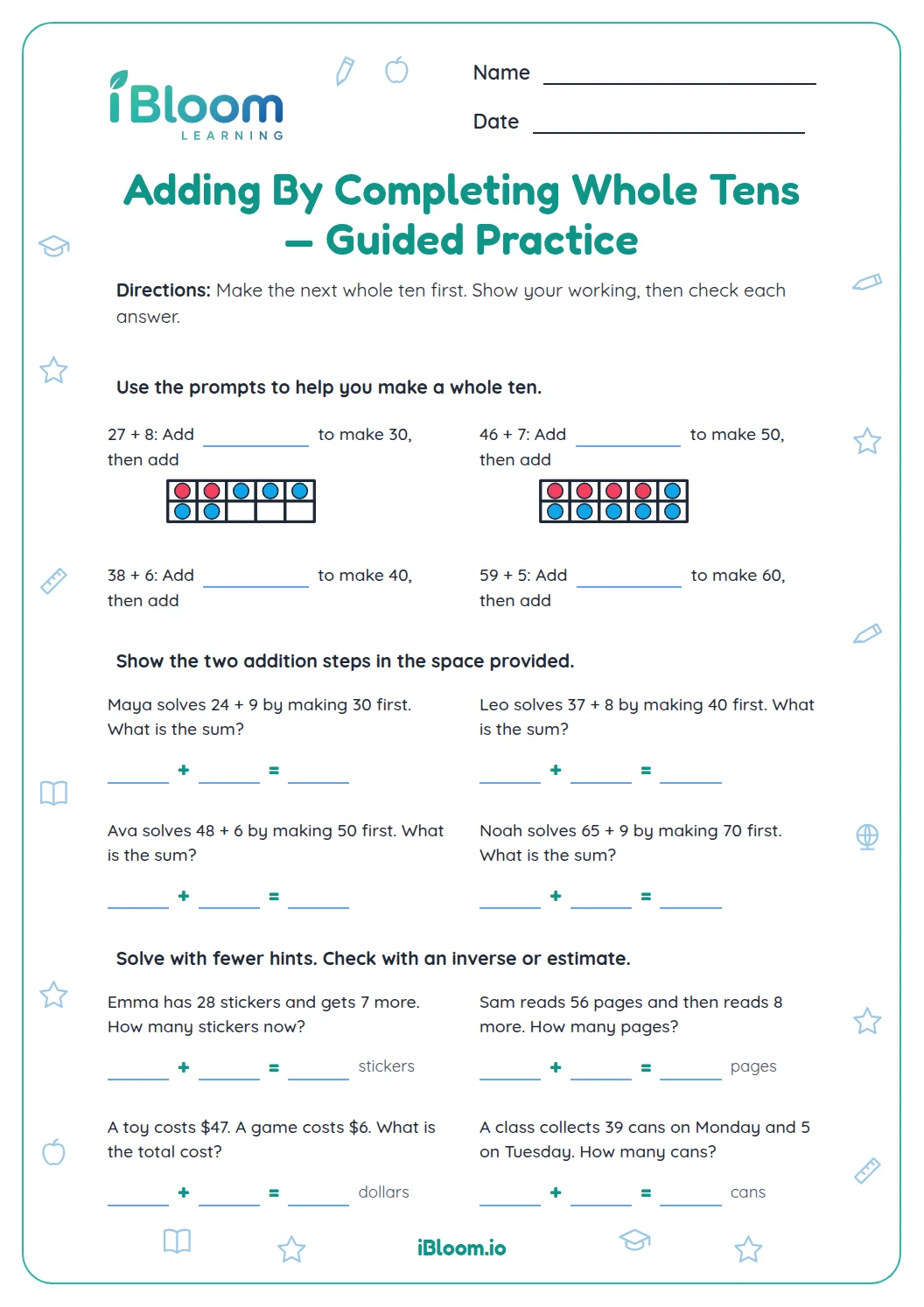
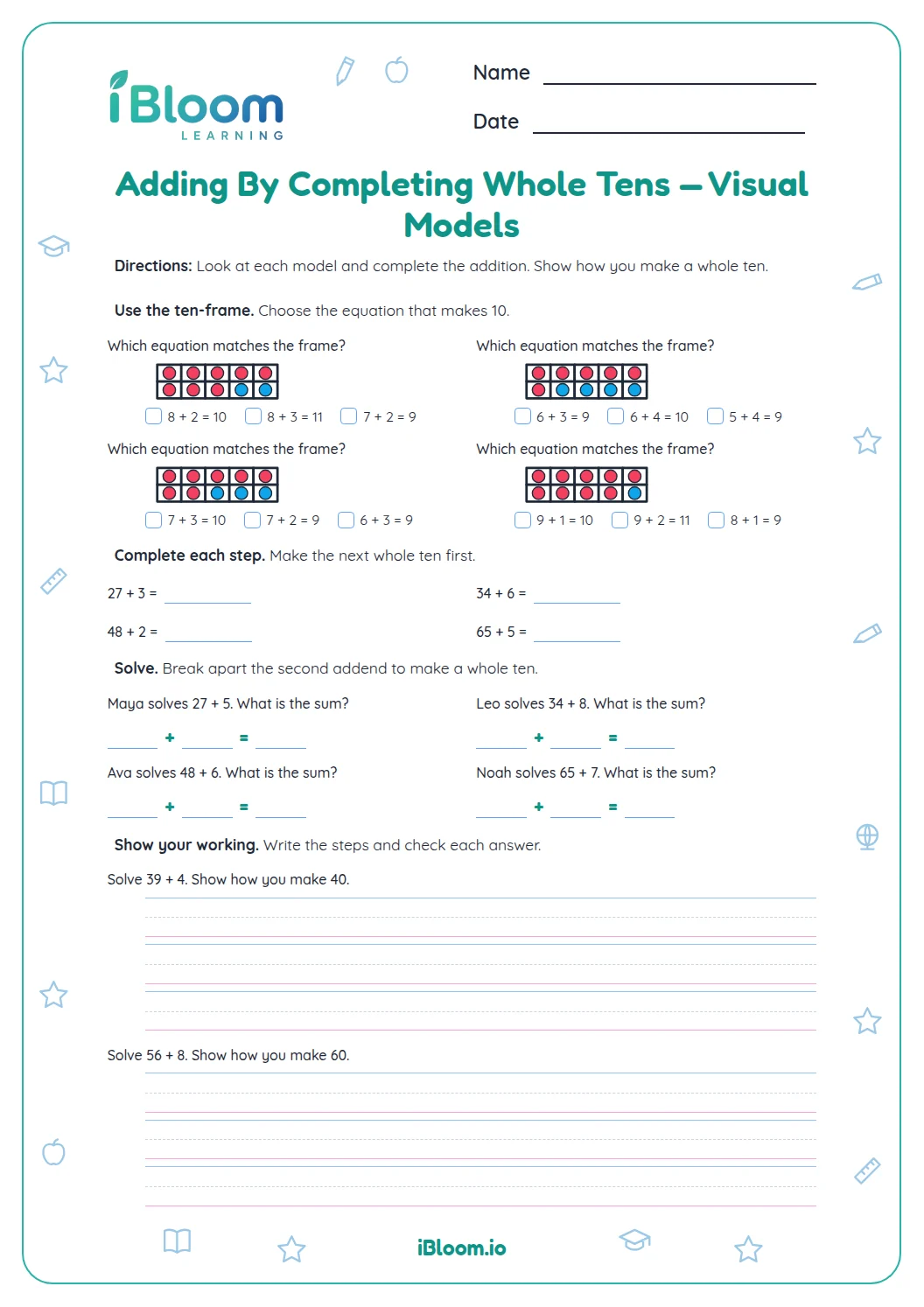
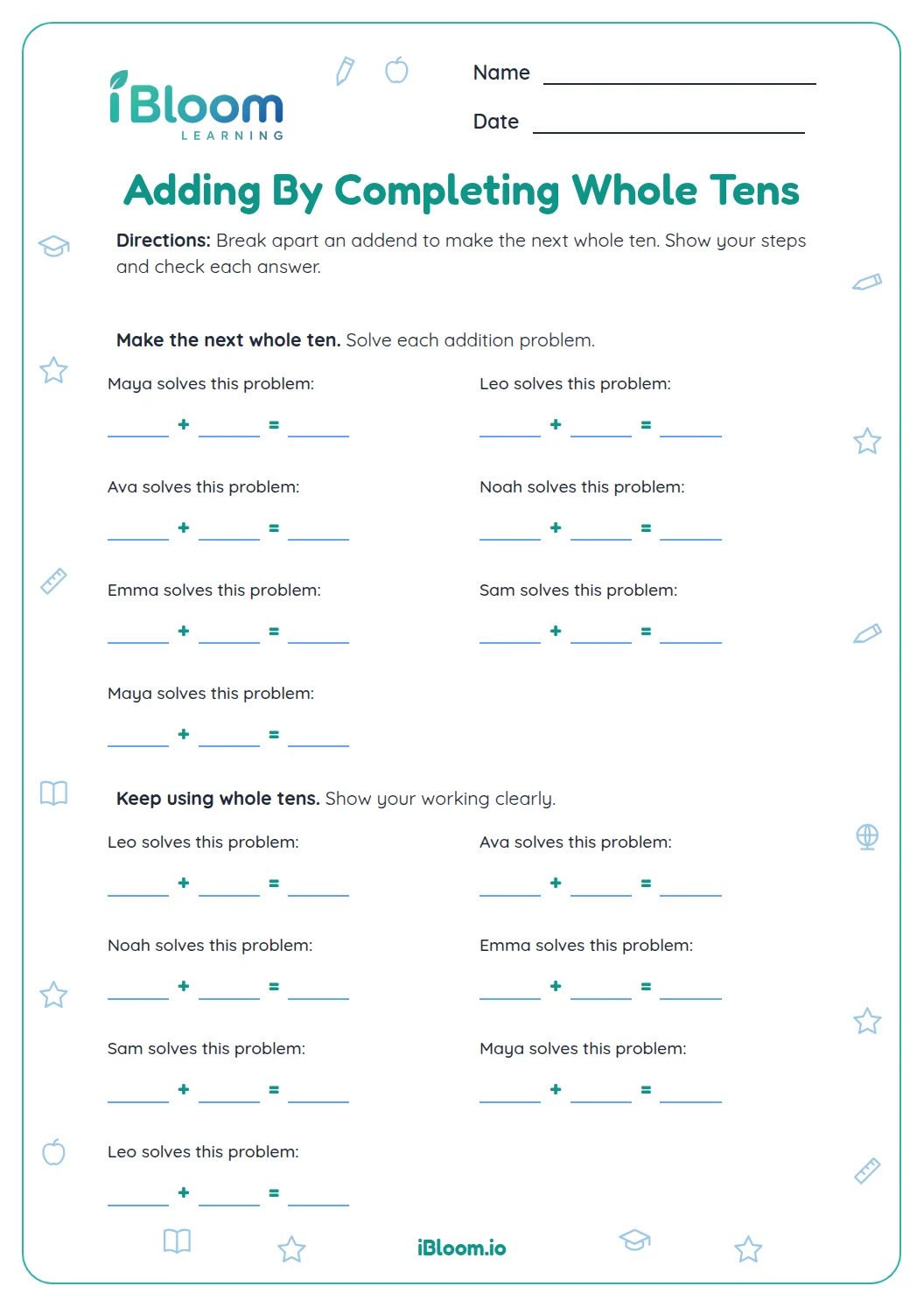

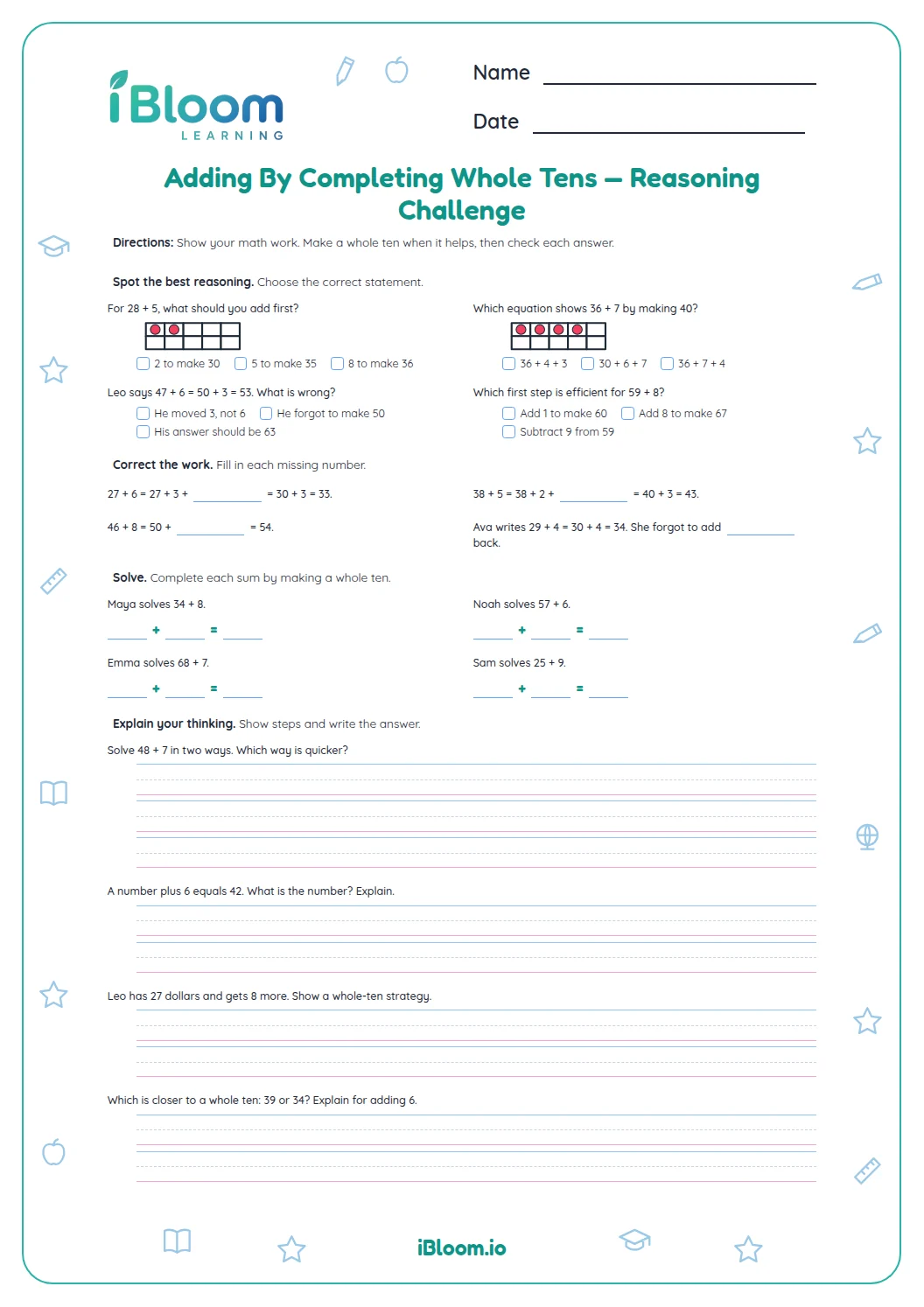



About this worksheet
This printable Grade 2 addition worksheet teaches students to complete a whole ten before adding the rest. Across 16 questions, children find the amount needed to reach a ten, split an addend, finish a sum after the ten, and use the strategy in story problems. The separate answer key supports checking each step. This practice connects to CCSS 2.NBT.B.5, using place-value and operation strategies to add within 100.
Aligned to 2.NBT.B.5
How do you find the amount needed for the next ten?
Part A asks how much a number needs to reach a whole ten. Find the next multiple of ten, then count on from the starting number.
- 124 + ___ = 30
- 2Count on from 24 to 30: 25, 26, 27, 28, 29, 30. The missing amount is 6.
How can you split an addend to make a ten?
Part B shows the second addend split into the amount needed to reach a ten and the amount left over. For 27 + 6, use 3 to reach 30, then add the remaining 3: 30 + 3 = 33.
What do you add after reaching the ten?
Part C gives the next ten and asks for the leftover amount. In 38 + 5 = 40 + ___, two of the five make 40, leaving 3. So the completed total is 43.
How does the strategy work in a story problem?
Part D uses small addition stories. Identify the starting number and amount added, reach the next ten when helpful, and then add the remaining amount. Keep the story’s units, such as beads, buttons, books, or points, in mind.
Use the make-a-ten steps
- 1Read the two addends and name the next whole ten.
- 2Find how much the first number needs to reach that ten.
- 3Split the second addend into the amount used and the amount left.
- 4Add the leftover part to the whole ten.
- 5For a story, check that the answer fits what is being counted.
- 6Use the key to check after completing a part.
Make-a-ten mistakes to check
The mistake
Adding the full second addend after reaching the next ten.
The fix
Subtract the amount used to reach the ten; add only what remains.
The mistake
Choosing the wrong next ten, such as using 50 after 46.
The fix
Name the next multiple of ten: after 46 comes 50.
The mistake
Stopping at the whole ten and forgetting the leftover amount.
The fix
Finish by adding the unused part of the second addend.
Common Core alignment
Students use a place-value strategy to add within 100.
Use place-value strategies to add, including making a ten before adding on.
On this sheet: Students split an addend to make the next ten, then add the amount left.
Show the official wordingHide the official wording
Fluently add and subtract within 100 using strategies based on place value, properties of operations, and/or the relationship between addition and subtraction.
What to practice next
Make more practice
Further reading
Questions parents and teachers ask
What does it mean to complete the next ten?
It means adding enough to reach the next multiple of ten before finishing the problem. For 38 + 5, use 2 from the 5 to reach 40, then add the 3 left over. The total is 43. This worksheet asks students to practice each part of that strategy.
How many questions are on the worksheet?
There are 16 questions in four parts. Students find missing amounts to reach tens, split addends, finish sums from the next ten, and solve short story problems. The answer key is separate and lists one answer for every item. Students can check them in order.
Why split an addend?
Splitting an addend makes a friendly ten that is easier to add to. In 27 + 6, the 6 can be split into 3 and 3. Add 3 to 27 to make 30, then add the remaining 3 to get 33.
What grade is this worksheet for?
It is written for Grade 2 and focuses on addition within 100 by making a ten first. The strategy connects to CCSS 2.NBT.B.5, which includes using place-value and operation strategies to add. The page progresses from number sentences to short stories.
How can I help if my child adds too much?
Ask how much was used to reach the whole ten, then ask how much of the second addend remains. In 38 + 5, reaching 40 uses 2, so 3 remains. Add that leftover amount once, rather than adding all 5 again.