





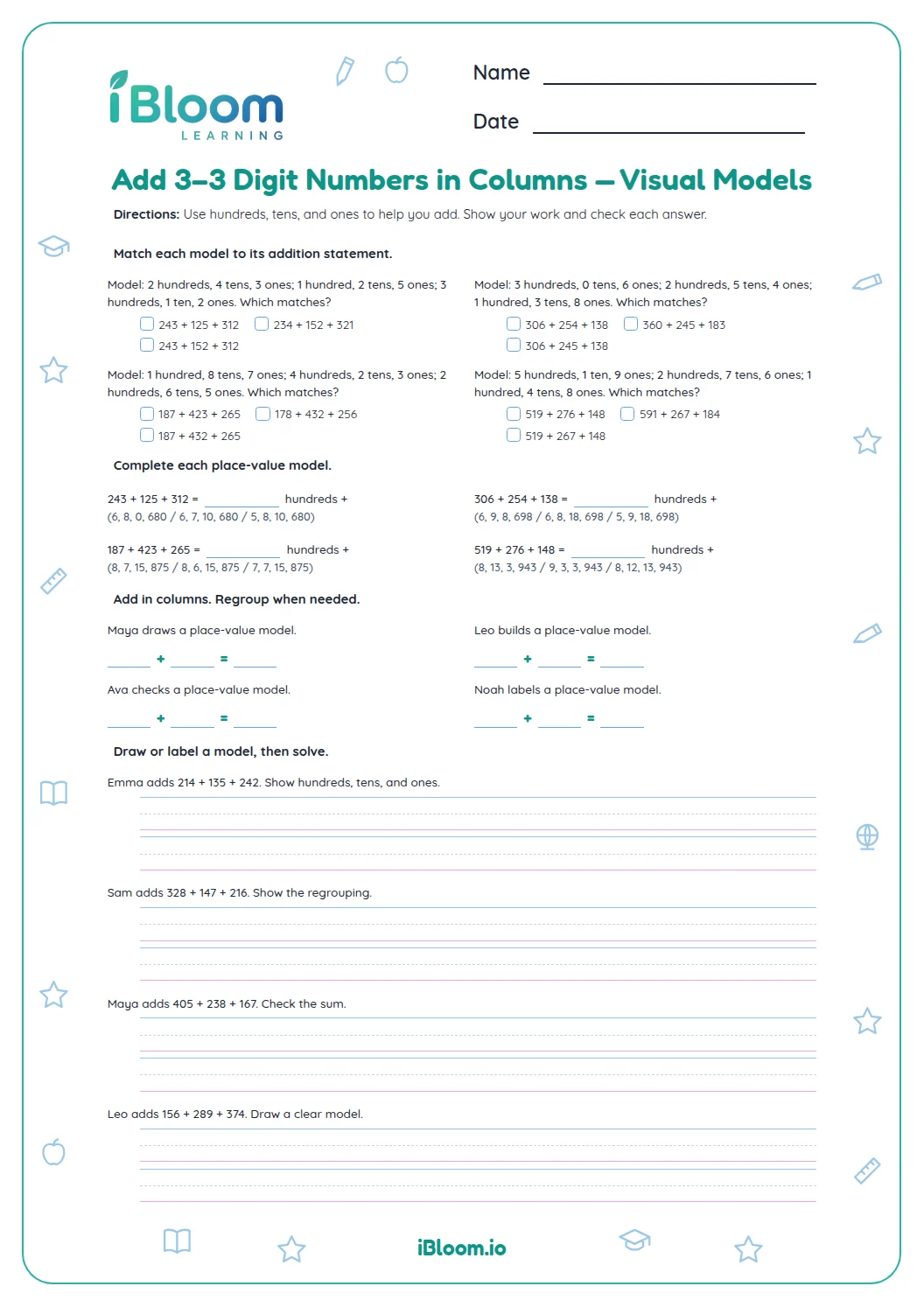
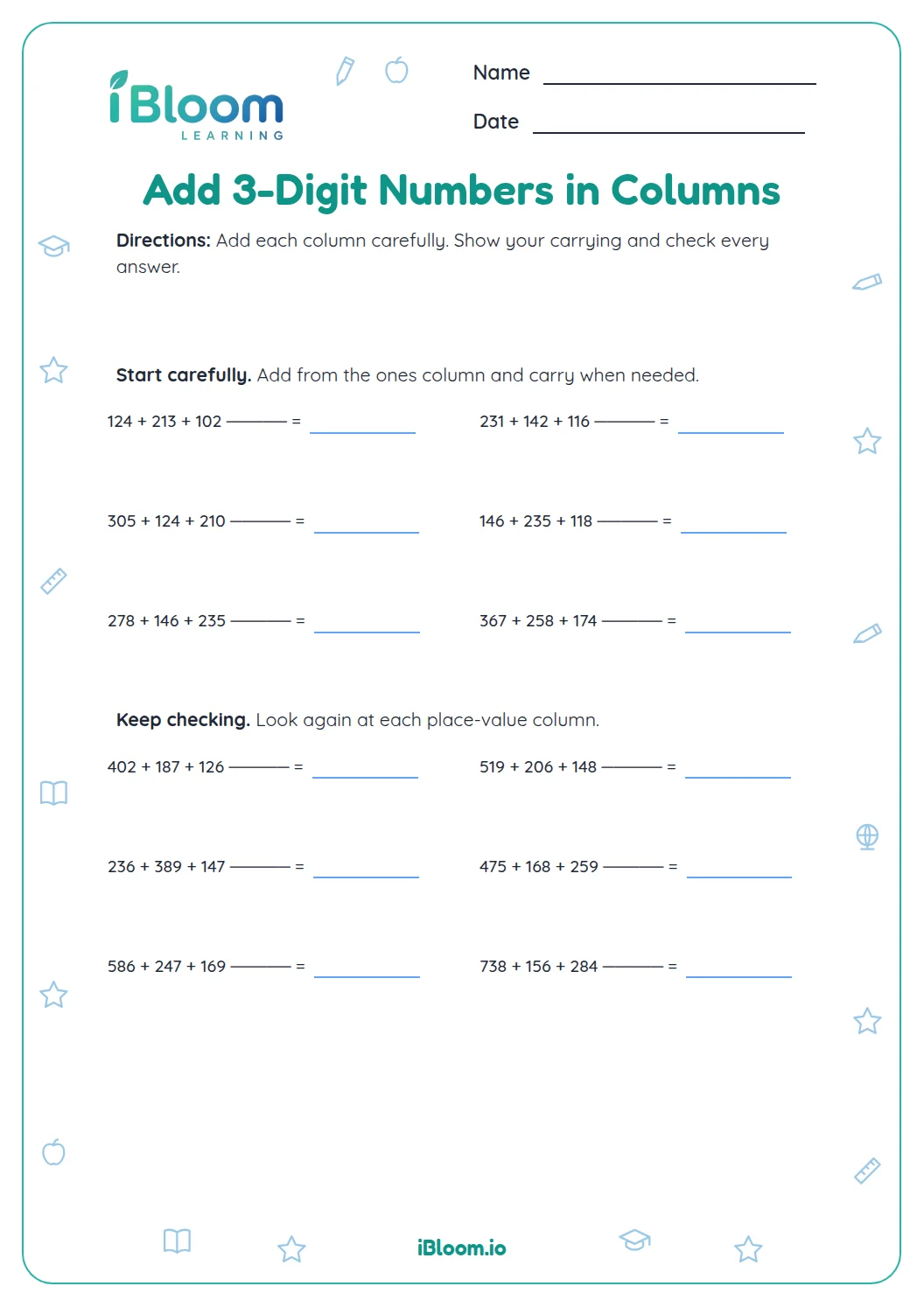
About this worksheet
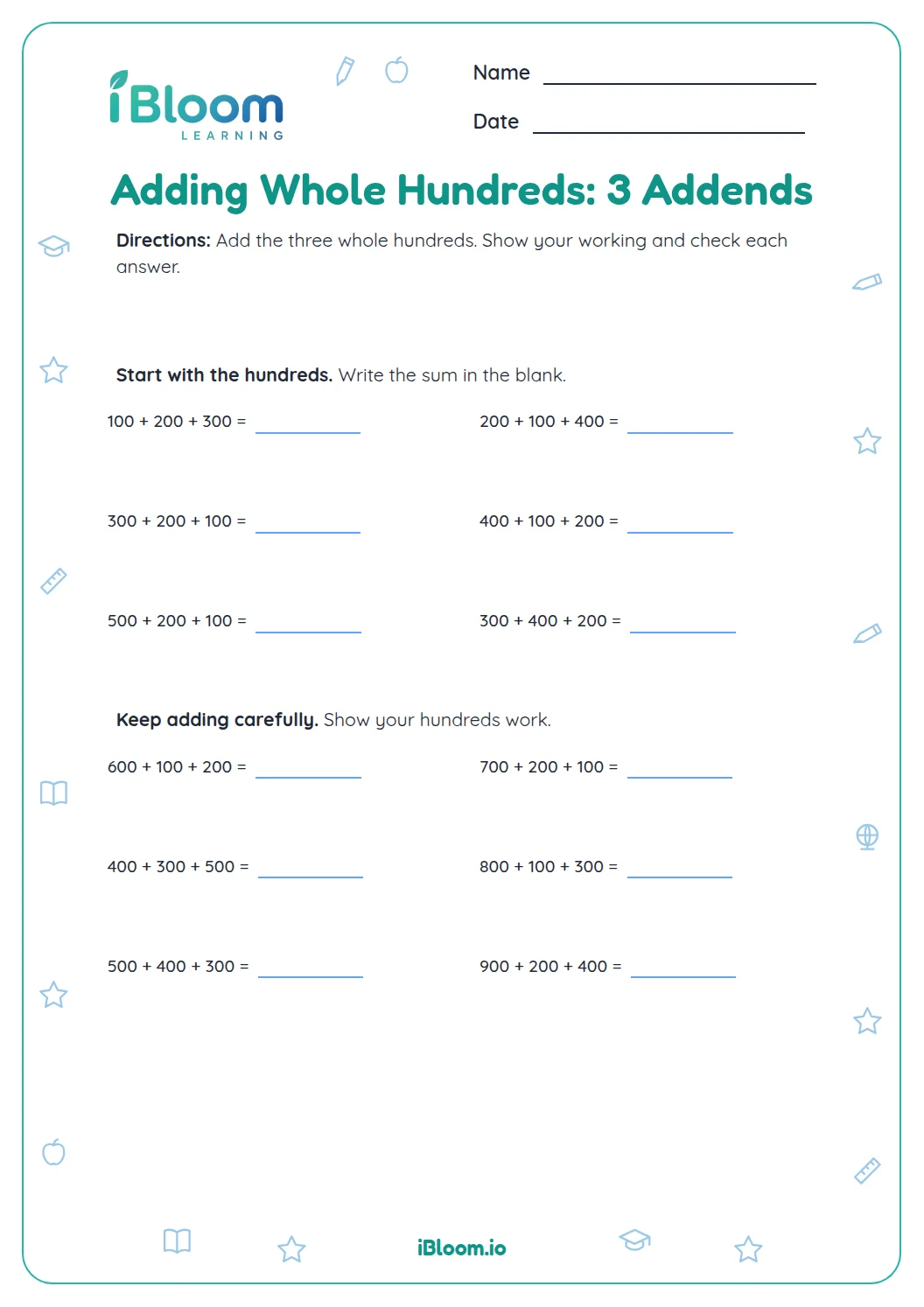
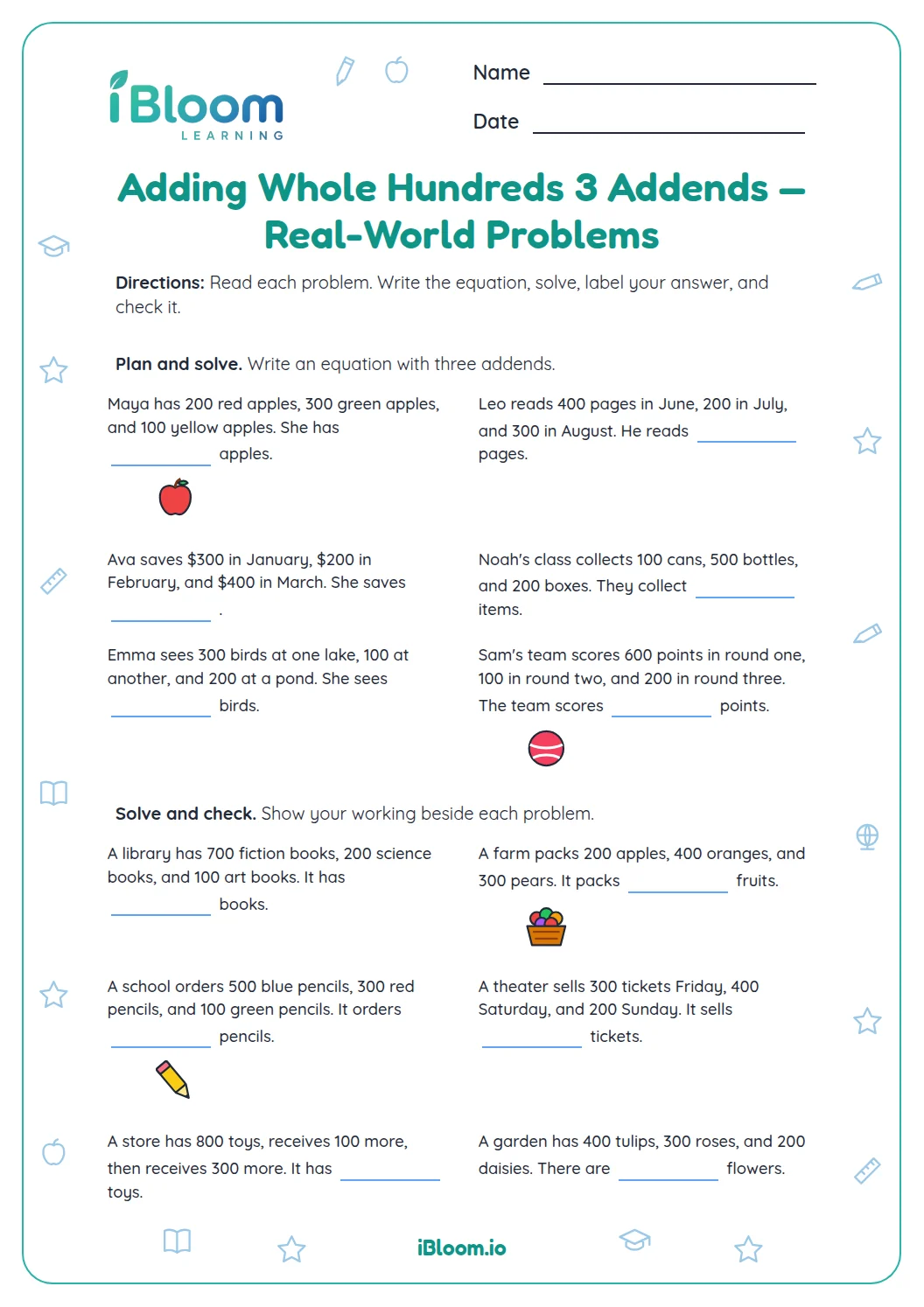
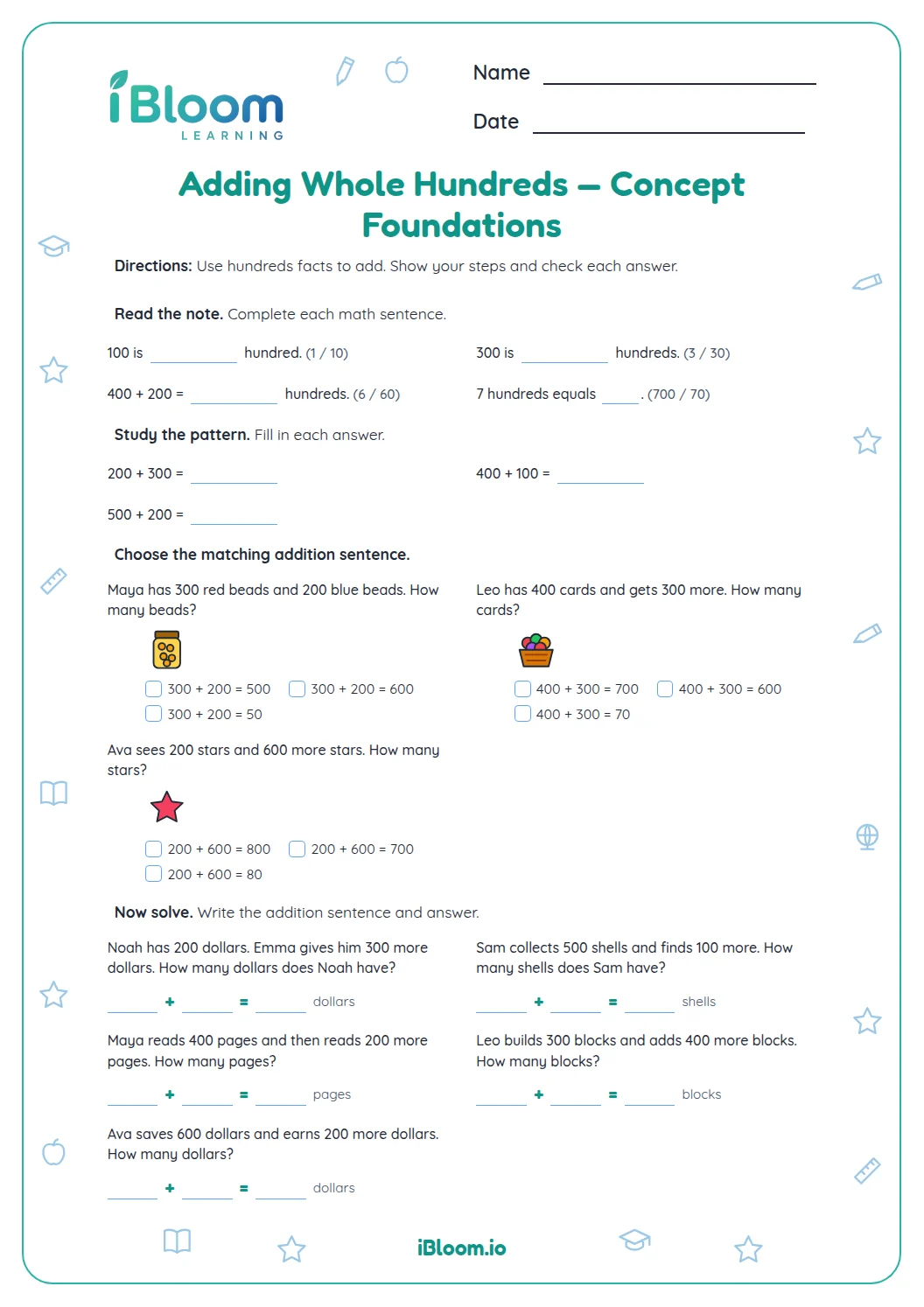
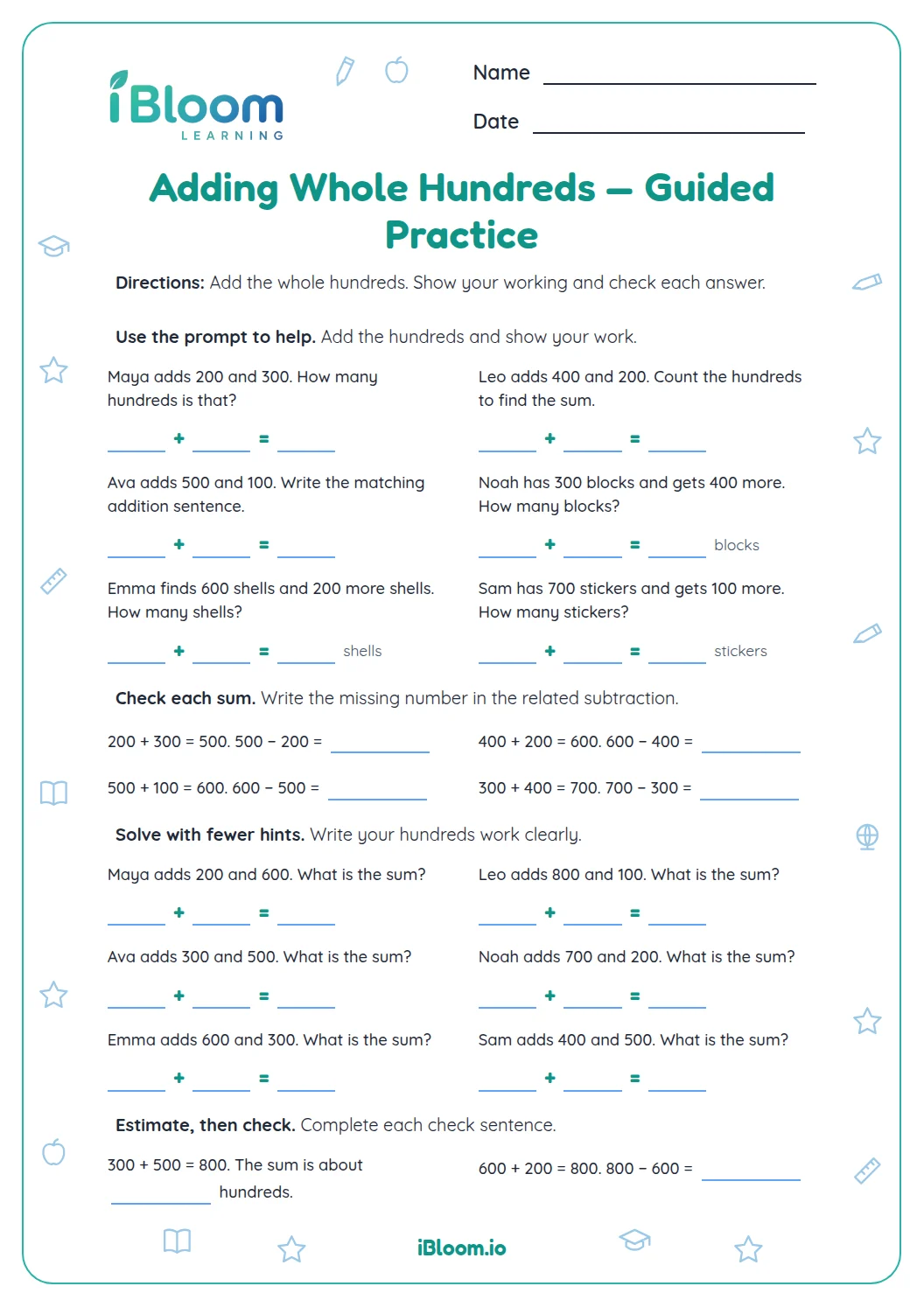
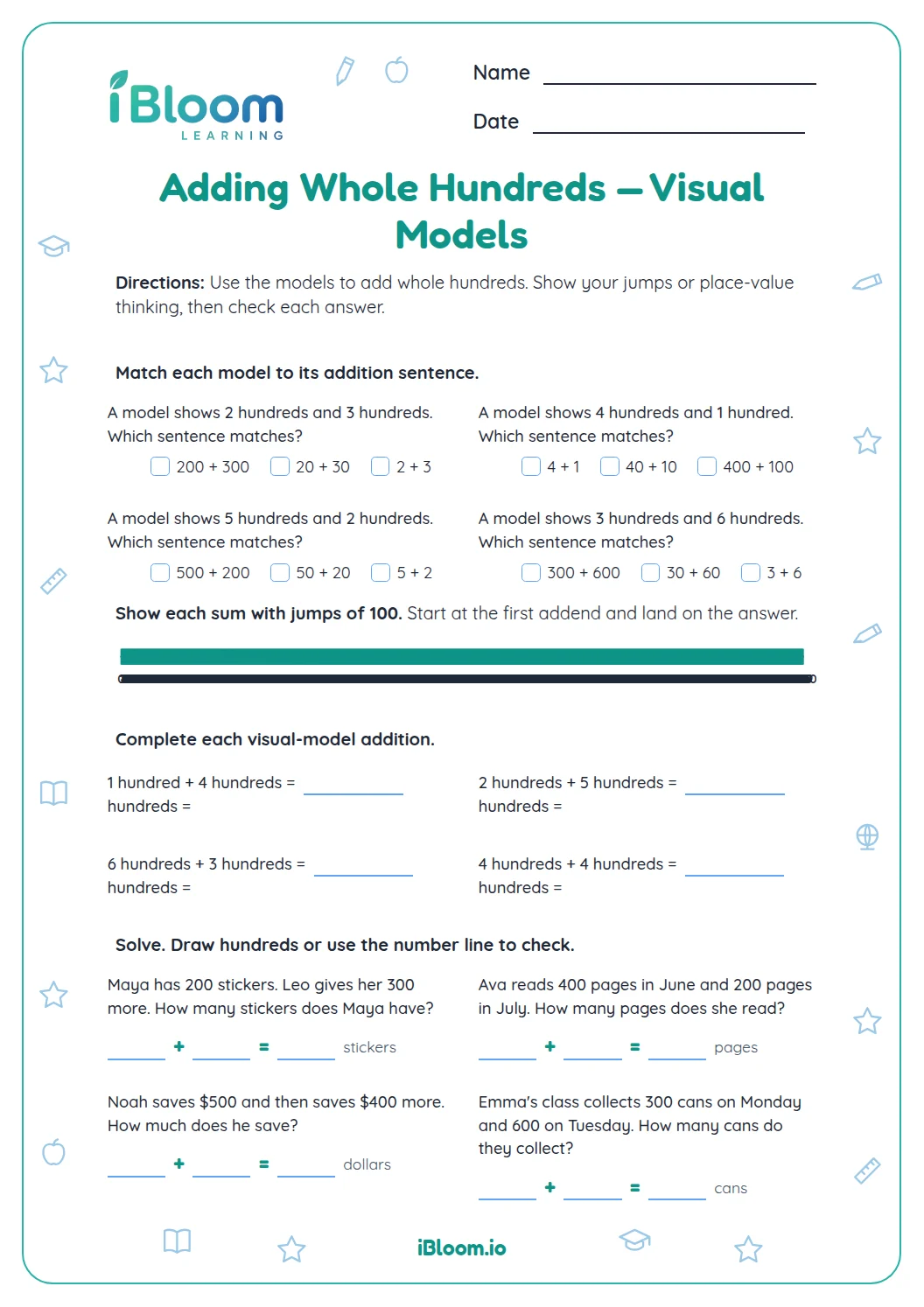
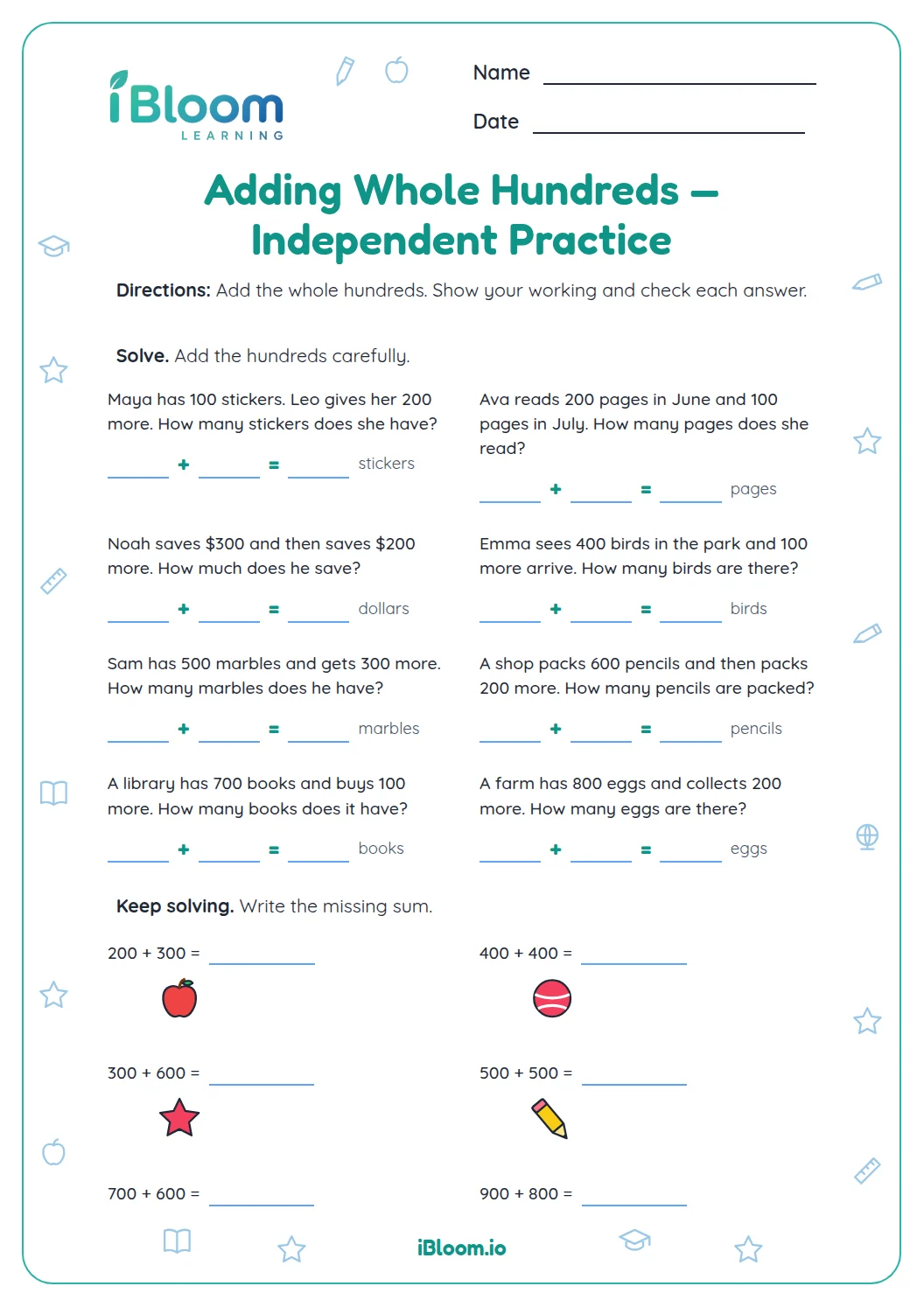
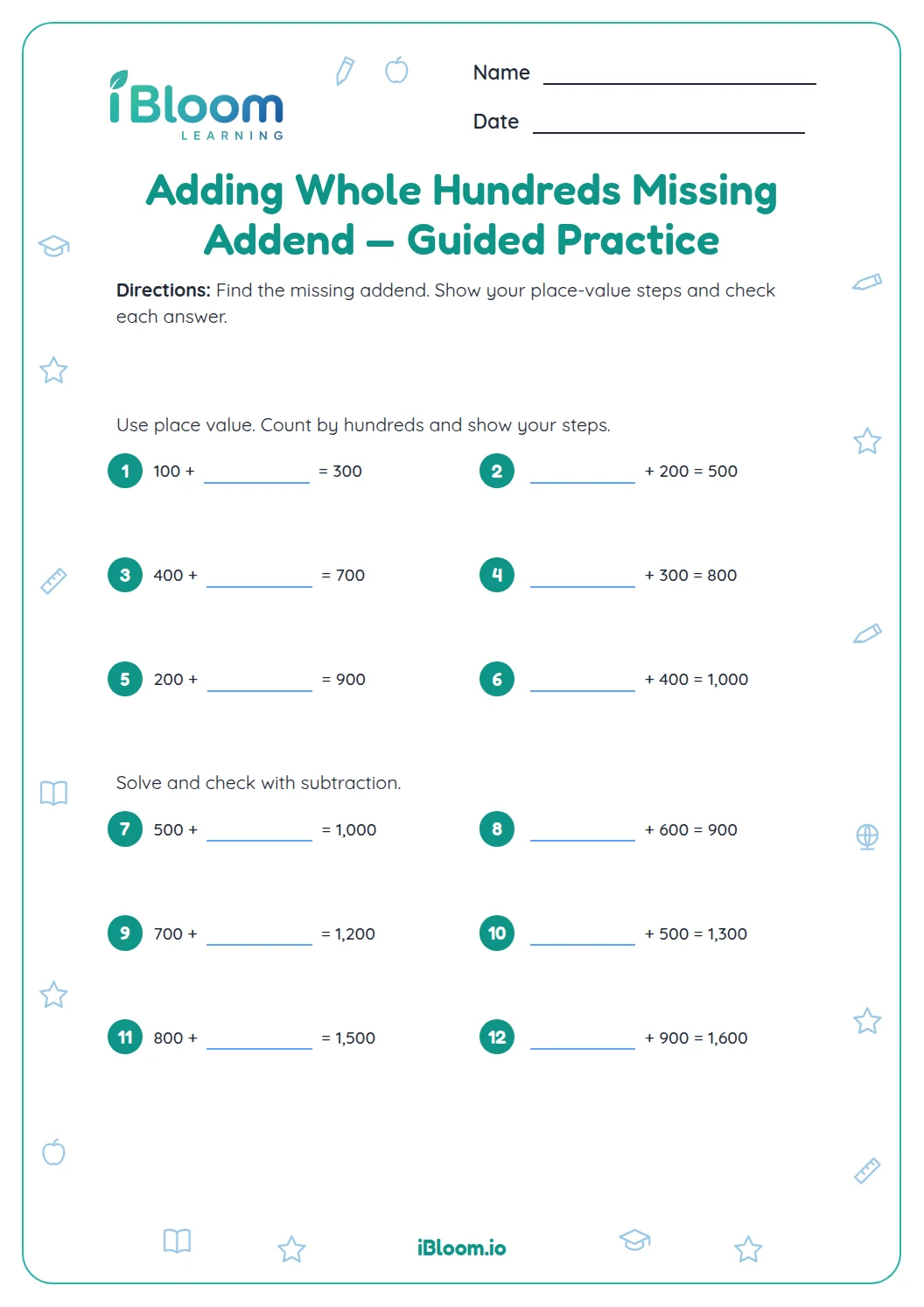
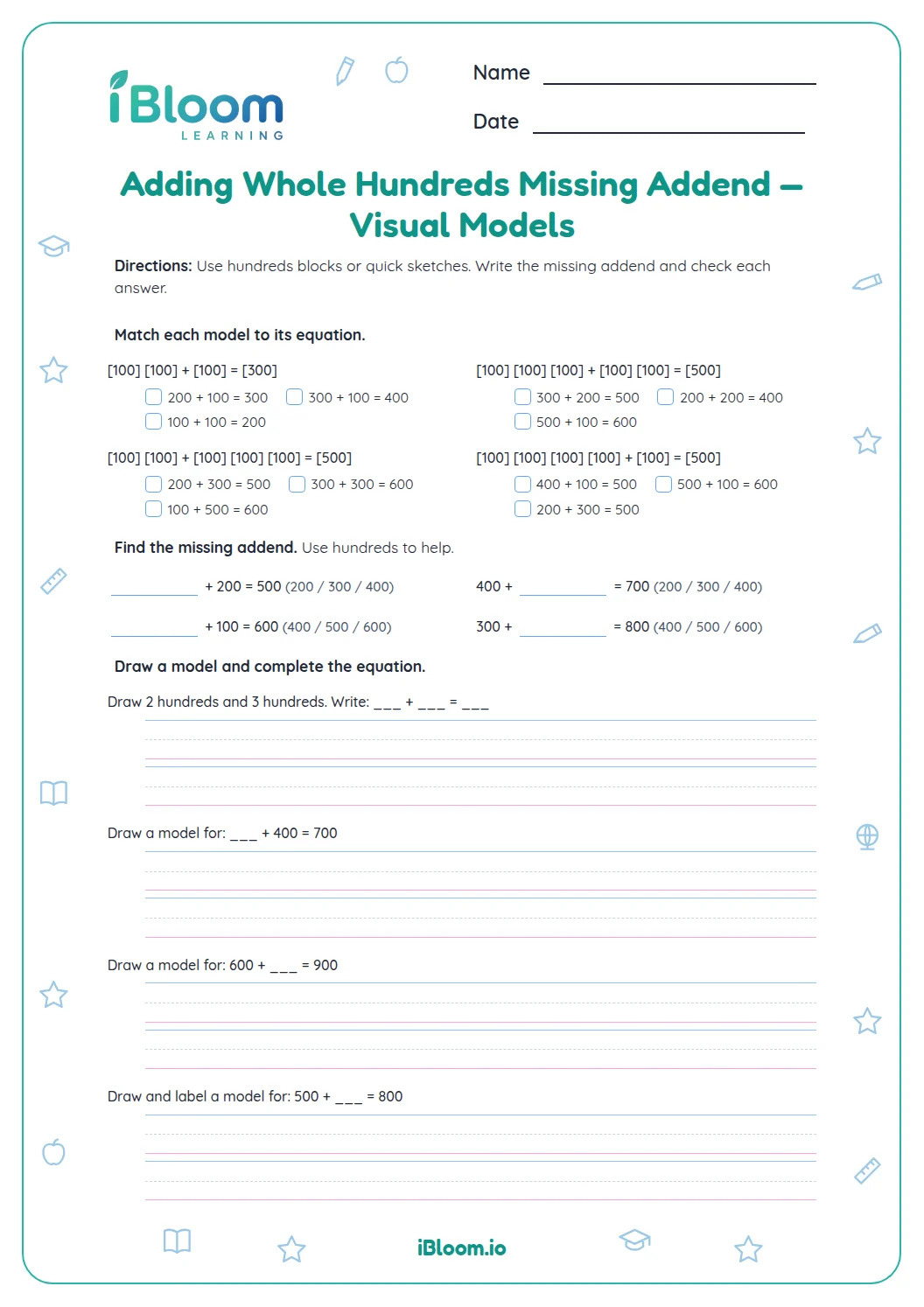
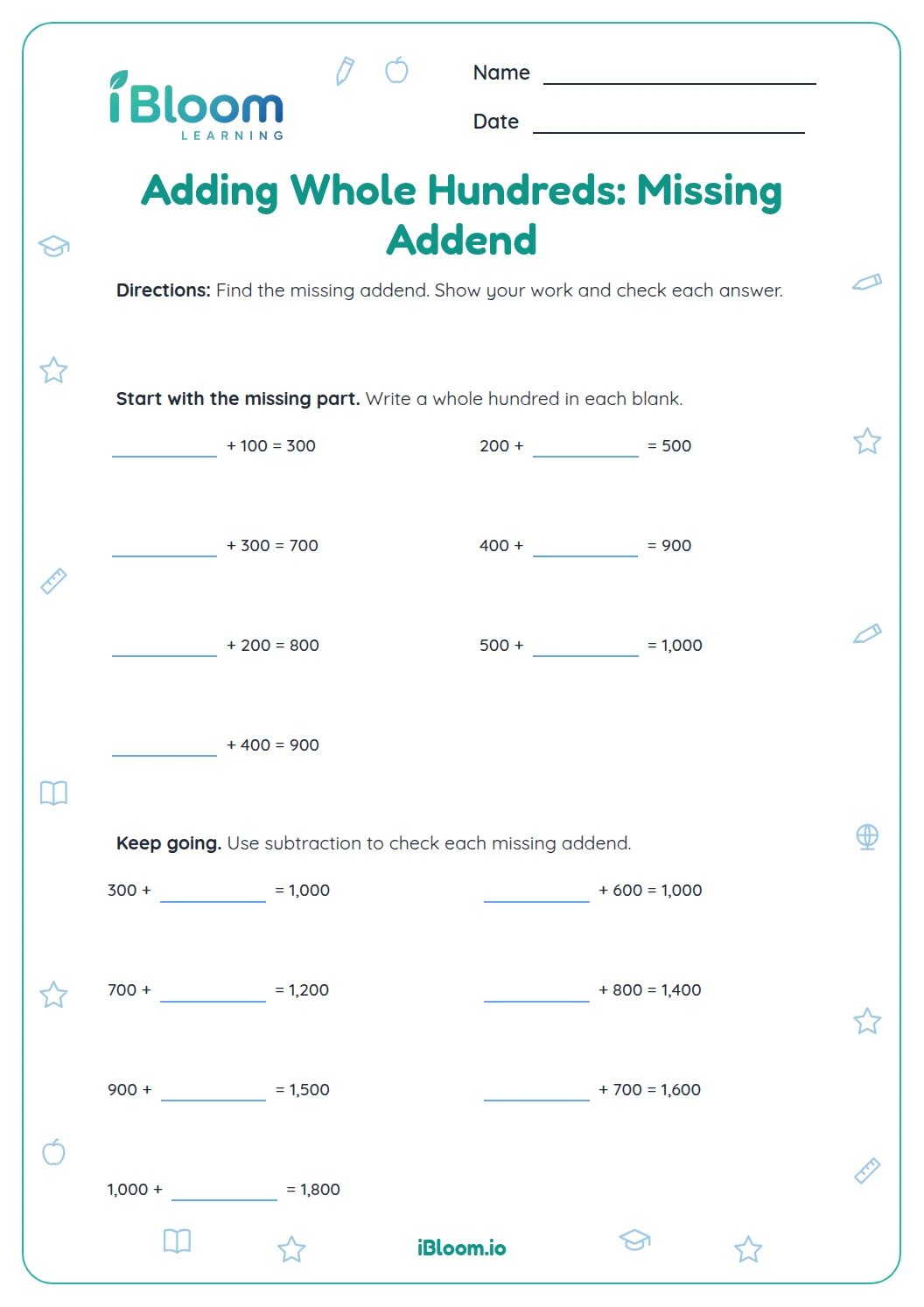
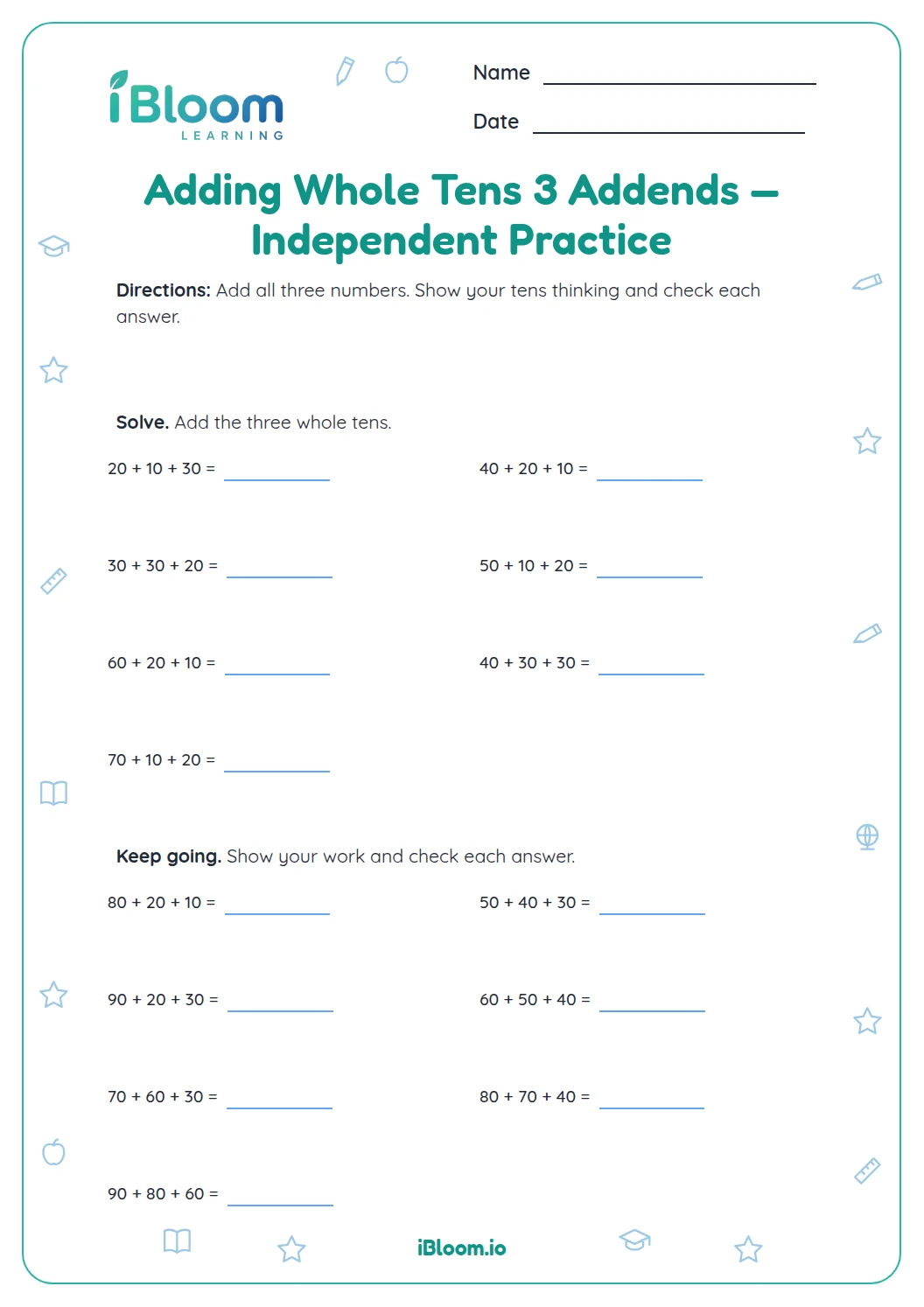
This free Grade 2 addition worksheet focuses on sums with three whole-hundred addends. Students first combine hundreds in equations, then solve a missing-addend item and short contexts. Every sum stays within 1,000, and a separate answer key is included.
Aligned to 2.NBT.B.7
How do you add three whole hundreds?
Add the hundreds digits, then attach two zeros to the sum. In q1, 2 hundreds + 3 hundreds + 1 hundred = 6 hundreds, so 200 + 300 + 100 = 600.
- 1200 + 300 + 100
- 22 hundreds + 3 hundreds + 1 hundred
- 36 hundreds = 600
How can you check a three-addend sum?
Group two addends first, or add all three hundreds digits. For q9, 400 + 400 + 100 is 4 + 4 + 1 = 9 hundreds, or 900.
How does the same idea work in a story?
Look for three amounts that are being combined. Keep the unit in your answer, such as points or tiles, and check that the total makes sense.
How to solve each addition question
- 1Read the three addends and note that each is a whole hundred.
- 2Add the hundreds digits.
- 3Write the total number of hundreds with two zeros.
- 4For a story, include the unit in the answer.
- 5For a missing addend, subtract the known hundreds from the total.
Addition slips to watch for
The mistake
Adding only two of the three addends.
The fix
Point to each addend as you combine it, then count three amounts.
The mistake
Writing 9 instead of 900 for 9 hundreds.
The fix
Say “9 hundreds” and write 900.
The mistake
Forgetting which amount is missing.
The fix
Add the known addends first, then find how many hundreds are needed to reach the total.
Common Core alignment
Add three-digit numbers by combining hundreds and relating the strategy to an equation.
On this sheet: All addends are whole hundreds, so students combine hundreds and record the written sum.
Show the official wordingHide the official wording
Add and subtract within 1000, using concrete models or drawings and strategies based on place value, properties of operations, and/or the relationship between addition and subtraction; relate the strategy to a written method. Understand that in adding or subtracting three-digit numbers, one adds or subtracts hundreds and hundreds, tens and tens, ones and ones; and sometimes it is necessary to compose or decompose tens or hundreds.
What to practice next
Make more practice
Further reading
Questions parents and teachers ask
What are whole-hundred addends?
They are numbers such as 100, 300, or 700, with zero tens and ones. This worksheet combines three such amounts and writes the sum as a number of hundreds. Students can add the hundreds digits first. Invite the student to reread the example and explain how its clue supports the answer.
How many questions are on this worksheet?
There are 15 questions in three parts. The first two parts give addition equations, and the last part applies the same skill in contexts and a missing-addend clue. The separate key shows each answer. Invite the student to reread the example and explain how its clue supports the answer.
Are all the sums within 1,000?
Yes. The sums in the practice set are 600, 800, 900, or 1,000. Students can check a total by adding the hundreds digits before writing the two zeros. The word problems use the same strategy. Invite the student to reread the example and explain how its clue supports the answer.
Is an answer key included?
Yes. A separate answer key lists the total for each equation and story, plus the missing hundreds addend and the sum that equals 1,000. Keep it nearby for a quick check after each part. Invite the student to reread the example and explain how its clue supports the answer.
What if the addends are hard to track?
Have your child say each amount as a number of hundreds, such as 2 hundreds + 3 hundreds + 1 hundred. Add those small digits, then write the result in hundreds. This keeps the place value visible. Invite the student to reread the example and explain how its clue supports the answer.