





About this worksheet
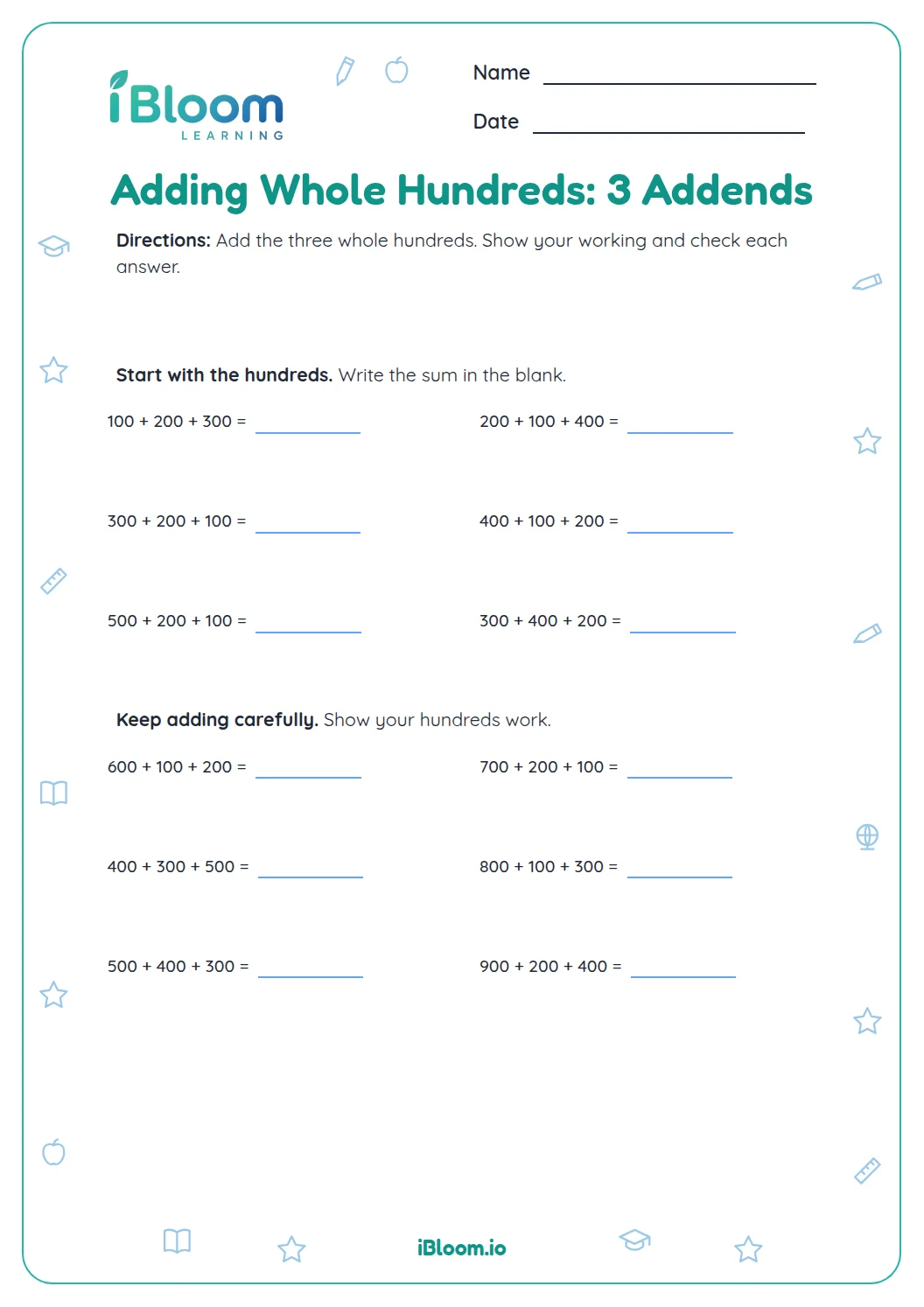
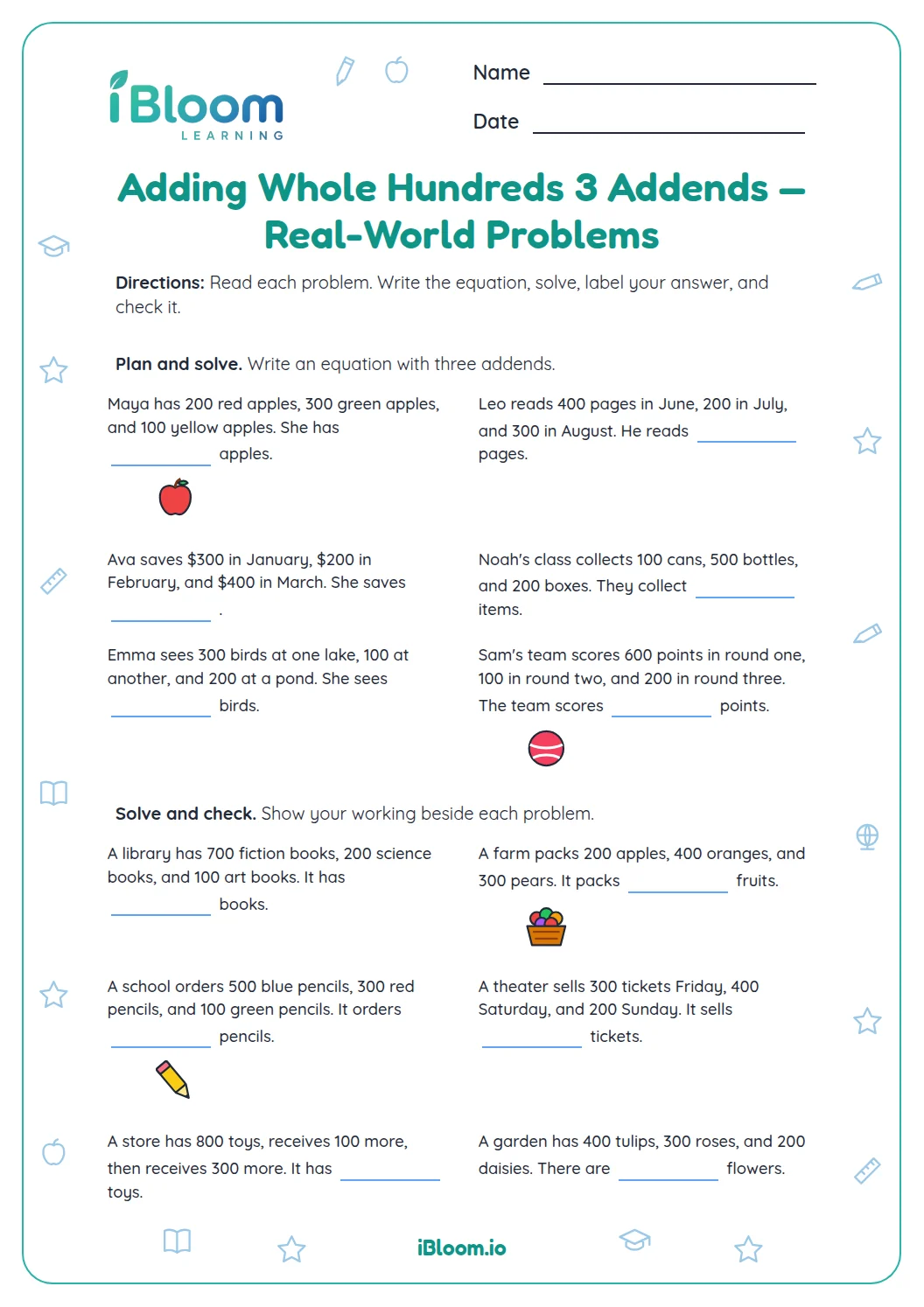
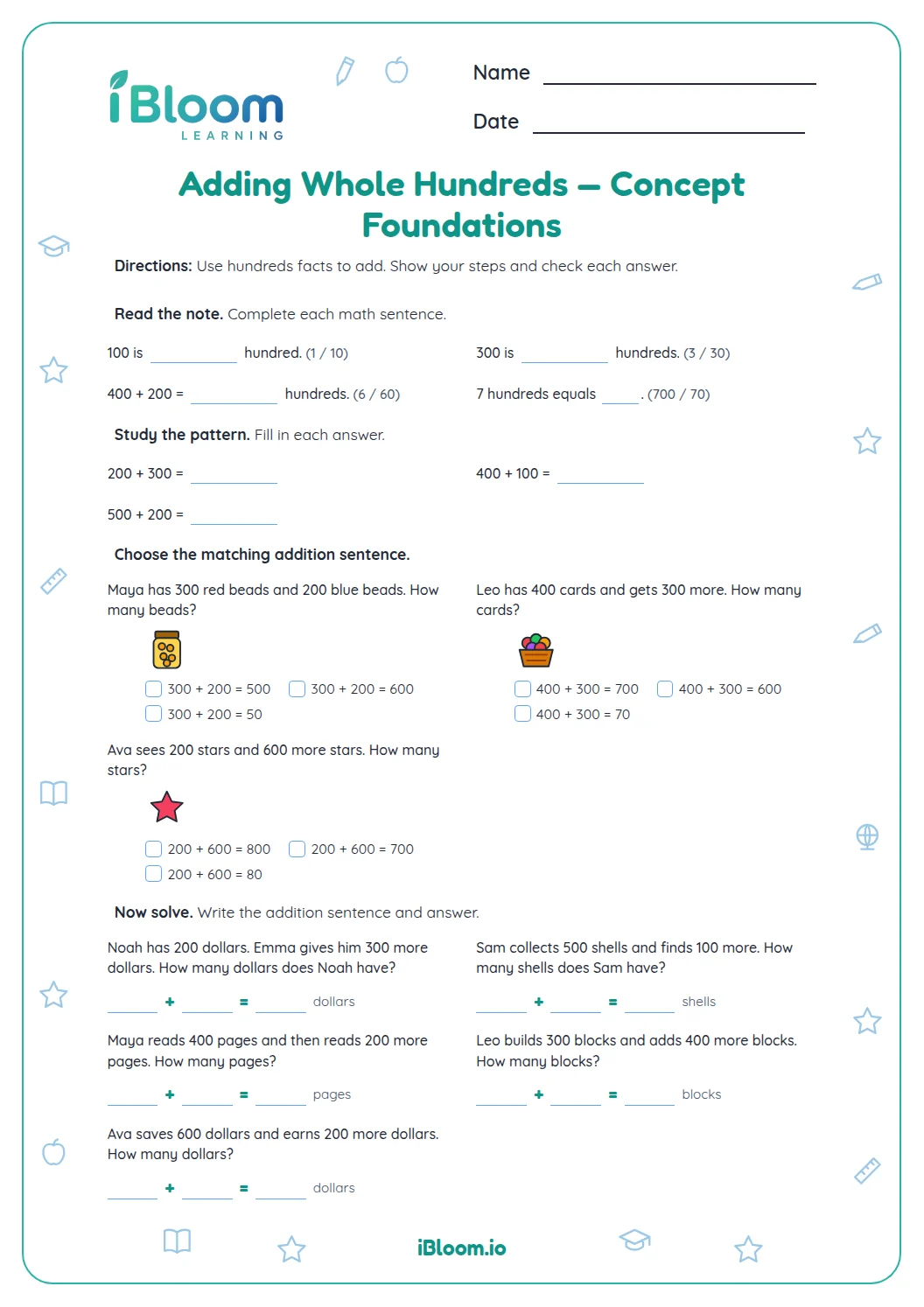
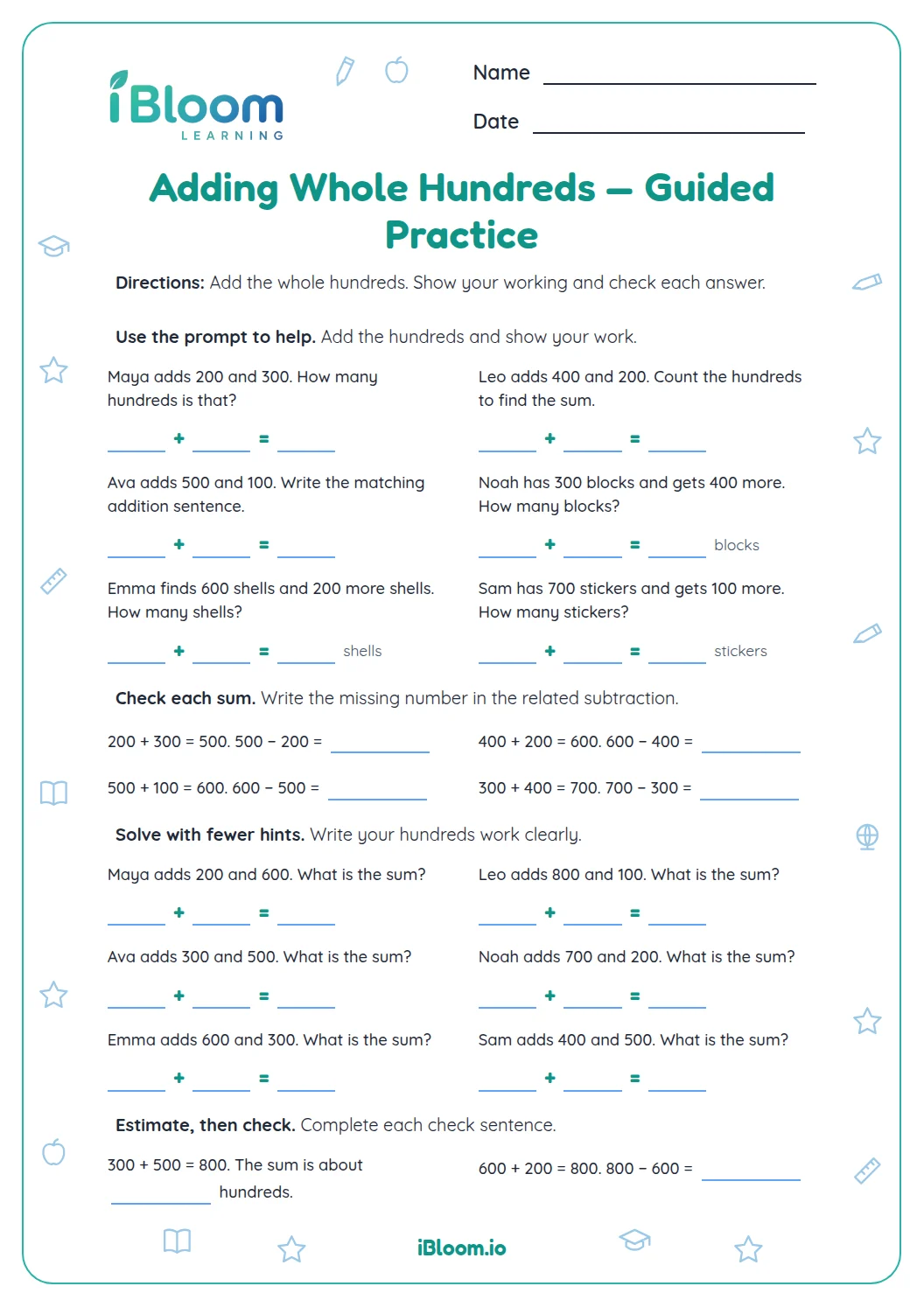
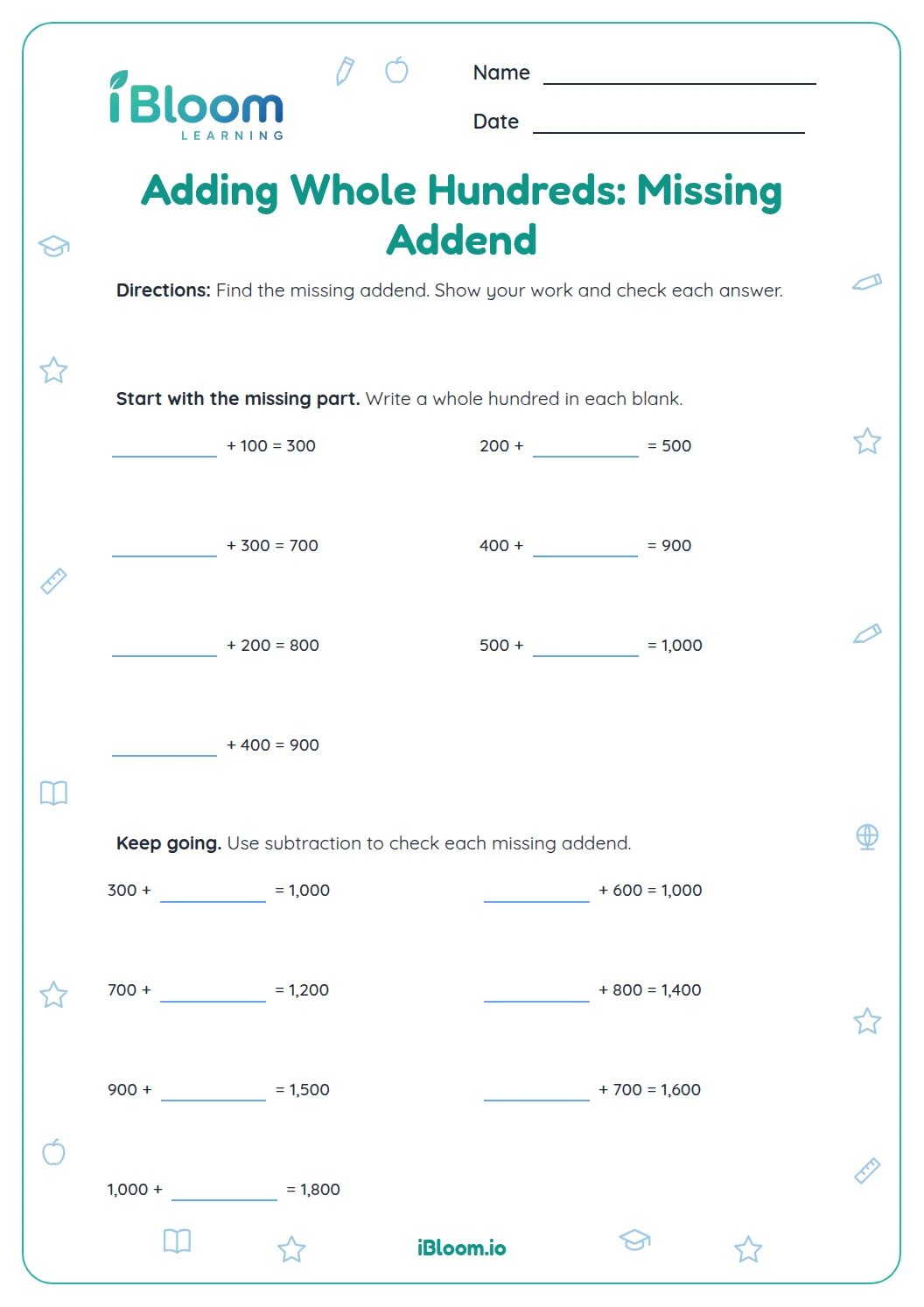
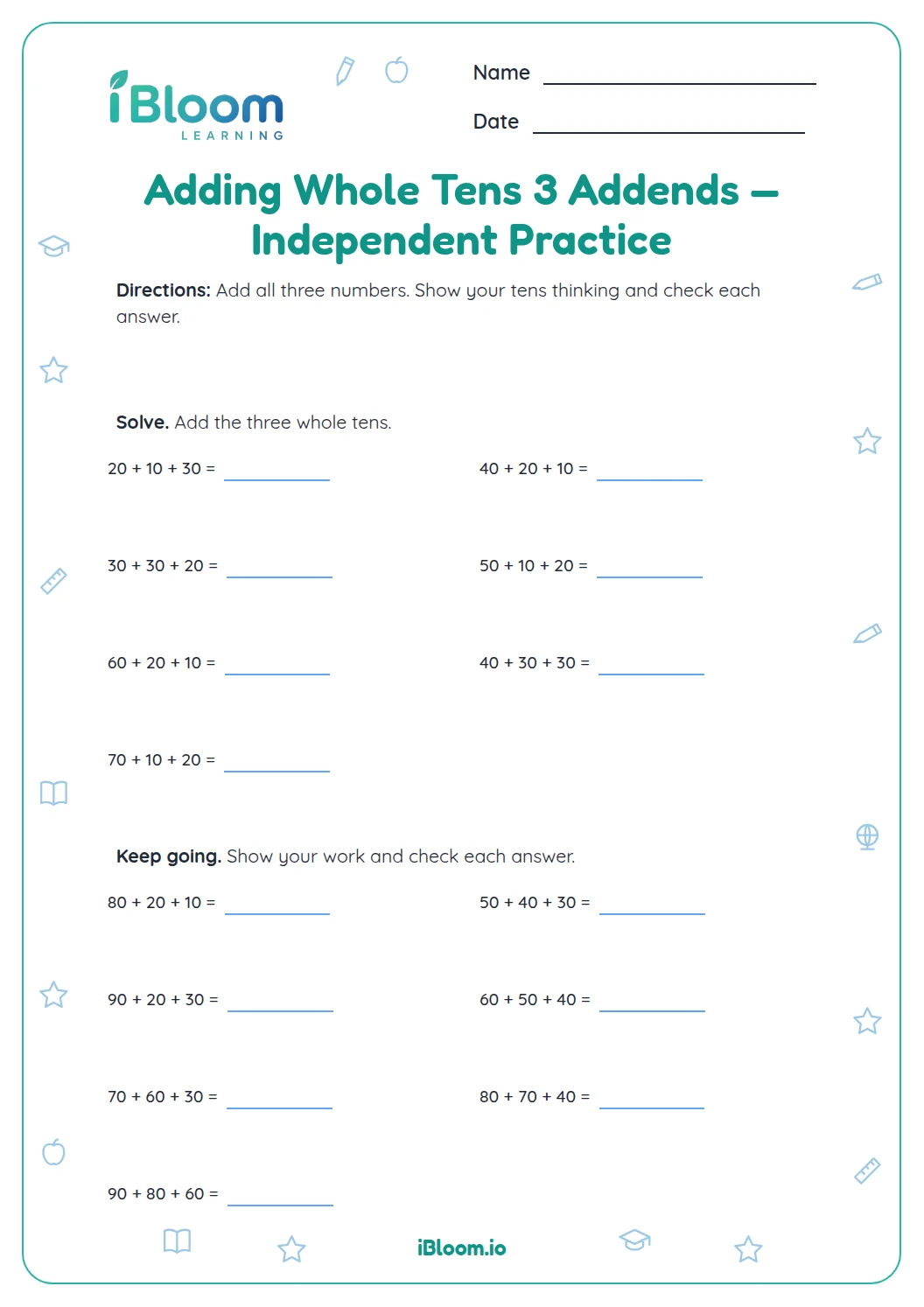
This Grade 2 printable practices adding three whole hundreds, such as 200 + 300 + 400. Children look for groups that make 1,000, complete missing-addend equations, compare strategies, and solve short stories. The 15 questions move from direct sums to reasoning, with room to write equations and explain a strategy. It practices CCSS 2.NBT.B.7, adding within 1,000 using place-value strategies and models. A separate answer key is included.
Aligned to 2.NBT.B.7
How do you add three whole hundreds?
Add the hundreds or group two addends first. For 200 + 300 + 500, the 200 and 300 make 500; then 500 + 500 makes 1,000. The addends can be grouped in a different order without changing the sum.
How can a missing addend help you reason?
Think of the total as a target. If 300 + ___ + 200 = 900, the known addends make 500, so the missing amount is 400.
- 1400 + 200 + 300
- 2Group 400 + 200 = 600
- 3600 + 300 = 900
- 4Answer: 900
What practice is included?
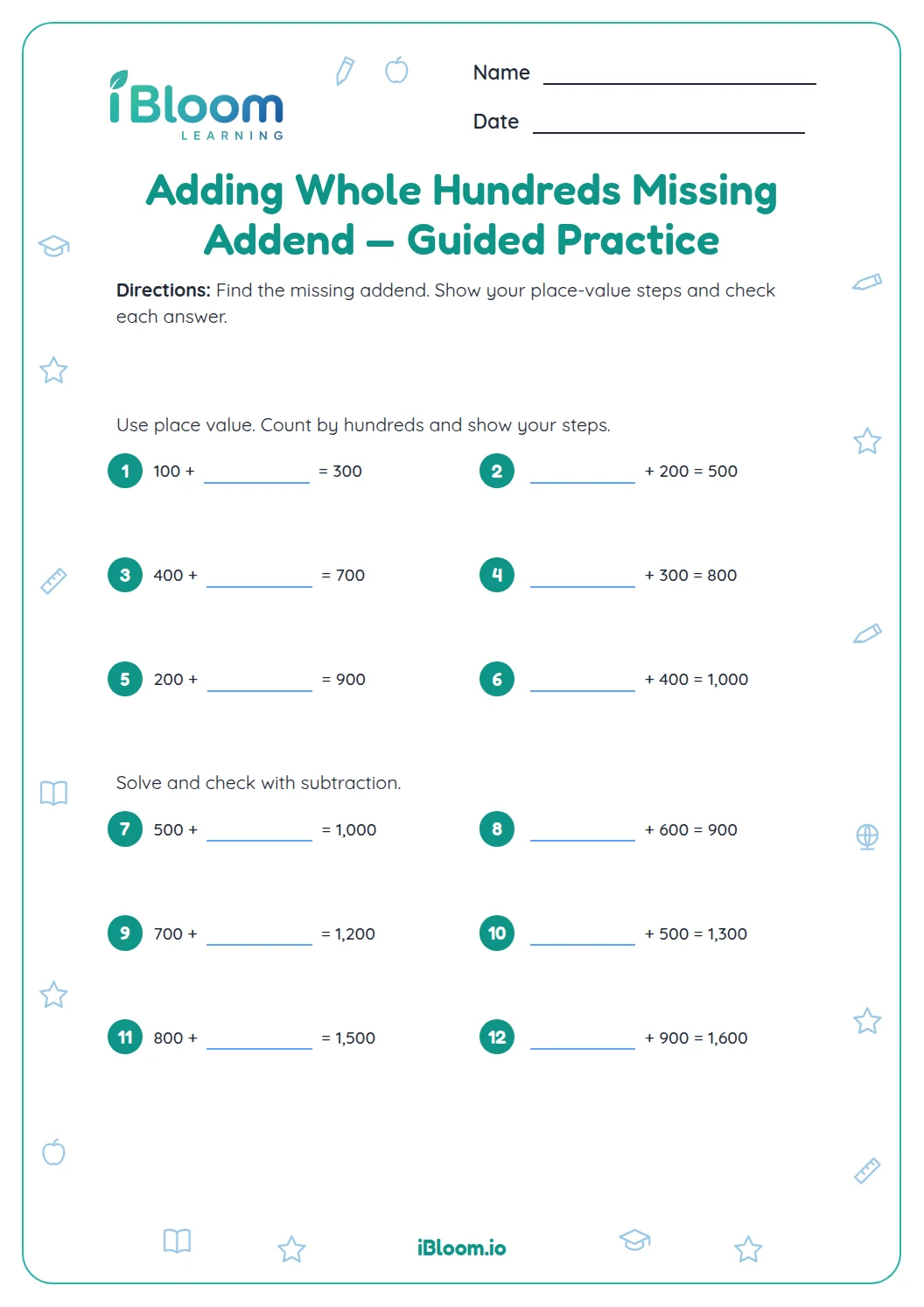
Part A asks for sums and friendly groupings. Part B uses missing addends, comparisons, and short stories about collections counted in hundreds. Each story gives enough information for one total.
How to use this worksheet
- 1Read all three addends before choosing a pair to add first.
- 2Look for two hundreds that make 500 or 1,000 with the remaining addend.
- 3For a missing addend, subtract the known hundreds from the total.
- 4Write the equation for each story before finding its sum.
- 5Use the answer key to check both the total and your grouping.
Common mistakes and quick fixes
The mistake
Adding only two of the three hundreds.
The fix
Point to each addend and make sure all three are included.
The mistake
Treating 300 + 400 as 700 instead of 7 hundreds.
The fix
Say the hundreds aloud: 3 hundreds plus 4 hundreds is 7 hundreds.
The mistake
Filling a missing addend with the total.
The fix
First add the known addends, then find how many more hundreds reach the total.
Common Core alignment
This sheet gives children direct practice with the stated grade-level skill.
Add hundreds within 1,000 by using place value and strategies.
On this sheet: Children add three whole hundreds and use place-value grouping to explain sums.
Show the official wordingHide the official wording
Add and subtract within 1000, using concrete models or drawings and strategies based on place value, properties of operations, and/or the relationship between addition and subtraction; relate the strategy to a written method.
What to practice next
Make more practice
Further reading
Questions parents and teachers ask
What numbers are used on this sheet?
Every addend is a whole hundred, such as 200, 500, or 800, and each total stays within 1,000. The questions include three-addend sums, unknown addends, and short collection stories. The answer key gives a way to group the hundreds as well as the final sum.
How can I help my child choose which numbers to add first?
Ask your child to look for pairs that make a friendly amount, such as 200 and 300 making 500. Then add the remaining hundred. The order can change because the same three amounts are still being combined. Reread each prompt and check the answer key when the work is complete.
Does the worksheet include missing addends?
Yes. Several questions give a total and two addends, then ask for the third amount. Add the known amounts first and compare that partial sum with the total to find what is missing. Reread each prompt and check the answer key when the work is complete.
What is the answer to the worked example?
For 400 + 200 + 300, combine 400 and 200 to get 600, then add 300. The total is 900. The worksheet uses this kind of grouping to make three addends easier to handle. Reread each prompt and check the answer key when the work is complete.
Can this be used as independent practice?
Yes, once a child is comfortable adding hundreds. The first set begins with direct sums, then later questions ask for a missing amount or a short explanation. An adult can read the story questions aloud if that helps. Reread each prompt and check the answer key when the work is complete.