



About this worksheet
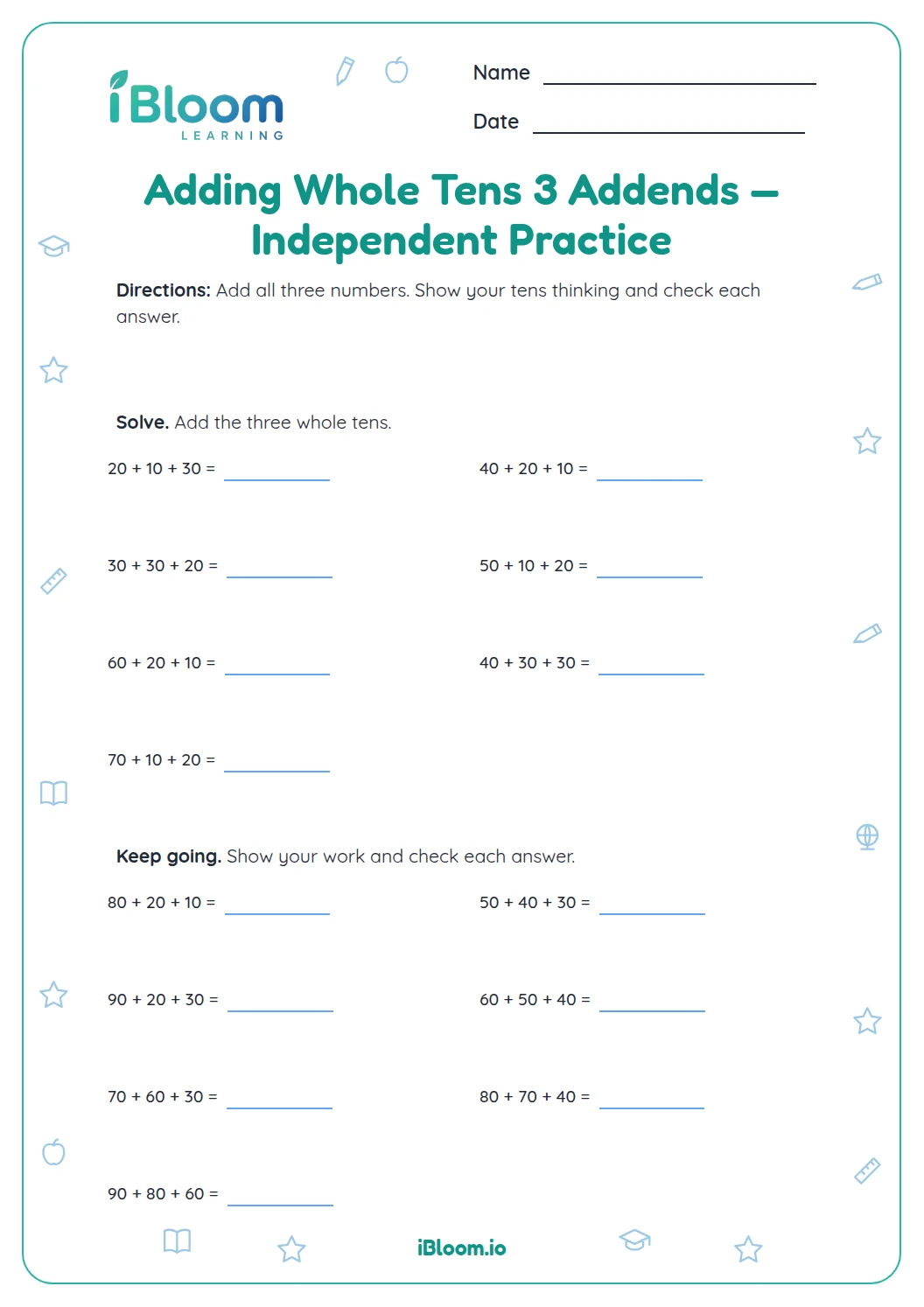
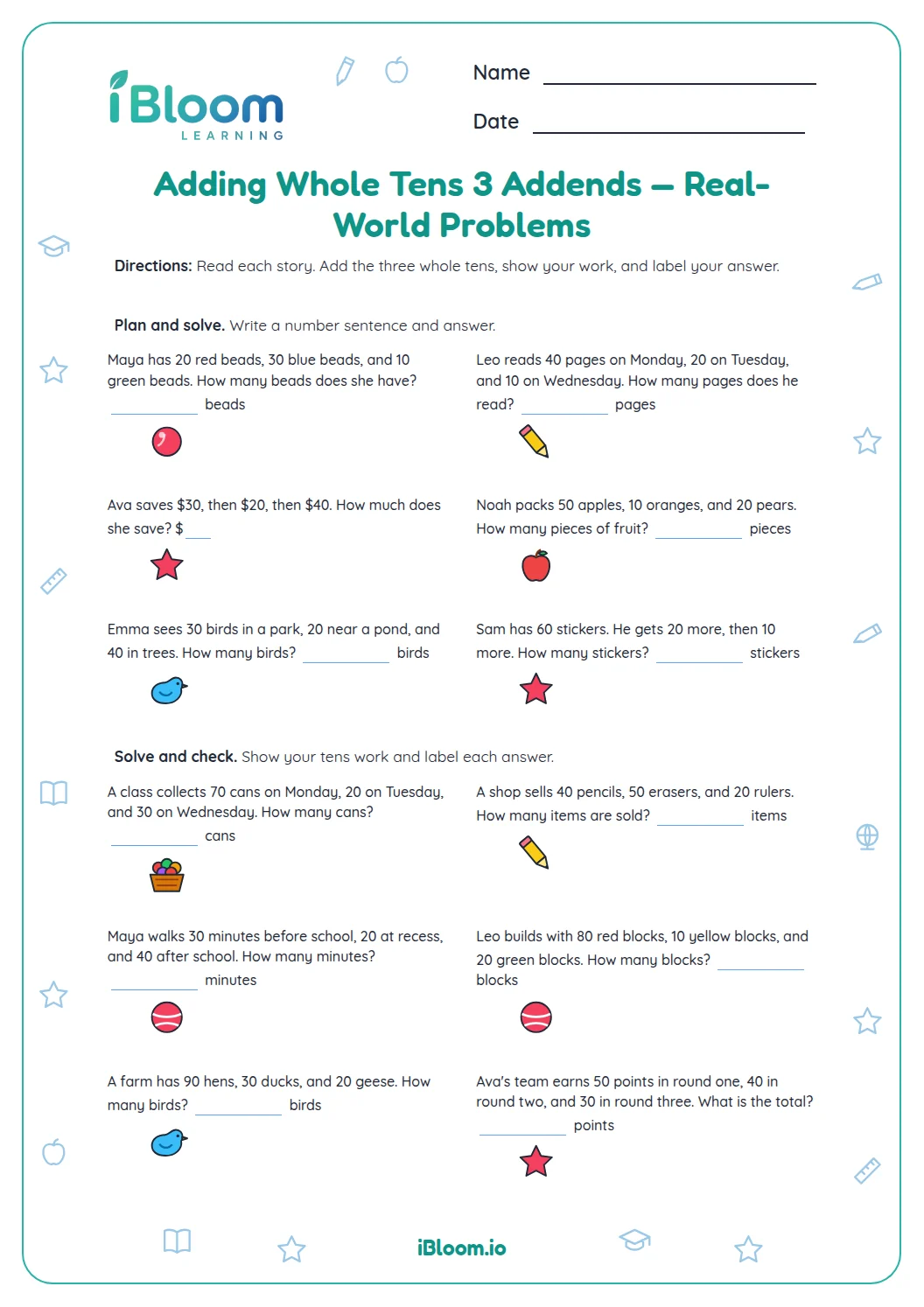
This Grade 2 printable builds fluency adding three whole tens. Learners start with six tens tables, then solve eight number sentences. The separate answer key lists all 14 totals.
Aligned to 2.NBT.B.6
How do you add three groups of tens?
For 20 + 30 + 10, the tens table records 2 tens, 3 tens, and 1 ten. Add 2 + 3 + 1 = 6 tens, or 60. Each question includes a table to organize the three addends.
How does the practice build?
The first six problems use tens tables. The remaining eight practice the same addition with number sentences. All 14 totals are listed in the key.
Steps for adding whole tens
- 1Read each addend and identify its number of tens.
- 2Record the three groups in the tens table.
- 3Add the tens and write the total in tens and ones.
- 4Check that all three addends are included.
Whole-tens checks
The mistake
Adding the tens digits but forgetting their place value.
The fix
A tens-digit sum of 6 means 60, not 6.
The mistake
Dropping one of the three addends.
The fix
Point to and include all three numbers before totaling.
The mistake
Writing a zero in the tens place.
The fix
Keep the tens sum in the tens place and put zero in ones.
Common Core alignment
Add up to four two-digit numbers by using place value and properties.
On this sheet: Children add three multiples of ten using place-value strategies.
Show the official wordingHide the official wording
Add up to four two-digit numbers using strategies based on place value and properties of operations.
What to practice next
Make more practice
Further reading
Questions parents and teachers ask
How should a child use this worksheet?
Start with one item at a time. Read the direction, then look for the exact clue the question asks about. For a choice, compare every option before deciding. For a written response, use a complete thought and return to the story, model, or sentence to check it.
What is included with the printable?
The answer key is a separate checking tool. Let the learner finish a section before looking at it, then compare one response at a time. If an answer differs, reread the prompt and point to the evidence or calculation that supports a correction.
Can the practice be split into shorter sessions?
A short practice session can be split across the worksheet pages. Pause between parts to talk through one example, especially when moving from recognition to an explanation or a written answer. Resume with the next unanswered question, and return to missed items after a brief break.
What materials are helpful?
These questions focus on the named skill using varied item formats. Keep scratch paper nearby for computations or notes, and encourage the learner to explain how a clue, model, or sentence supports a response. Talking through one answer can help reveal which step needs another look.