Free printable practice
Area Practice Activities
Printable Grade 2 area worksheets that help children cover shapes, count square units, compare spaces, and build early geometry understanding.
Free printable worksheet PDFs
Preview every available page, then download the free worksheet PDF for home, homeschool, tutoring, or classroom practice.
Preview the exact activity before downloading it.
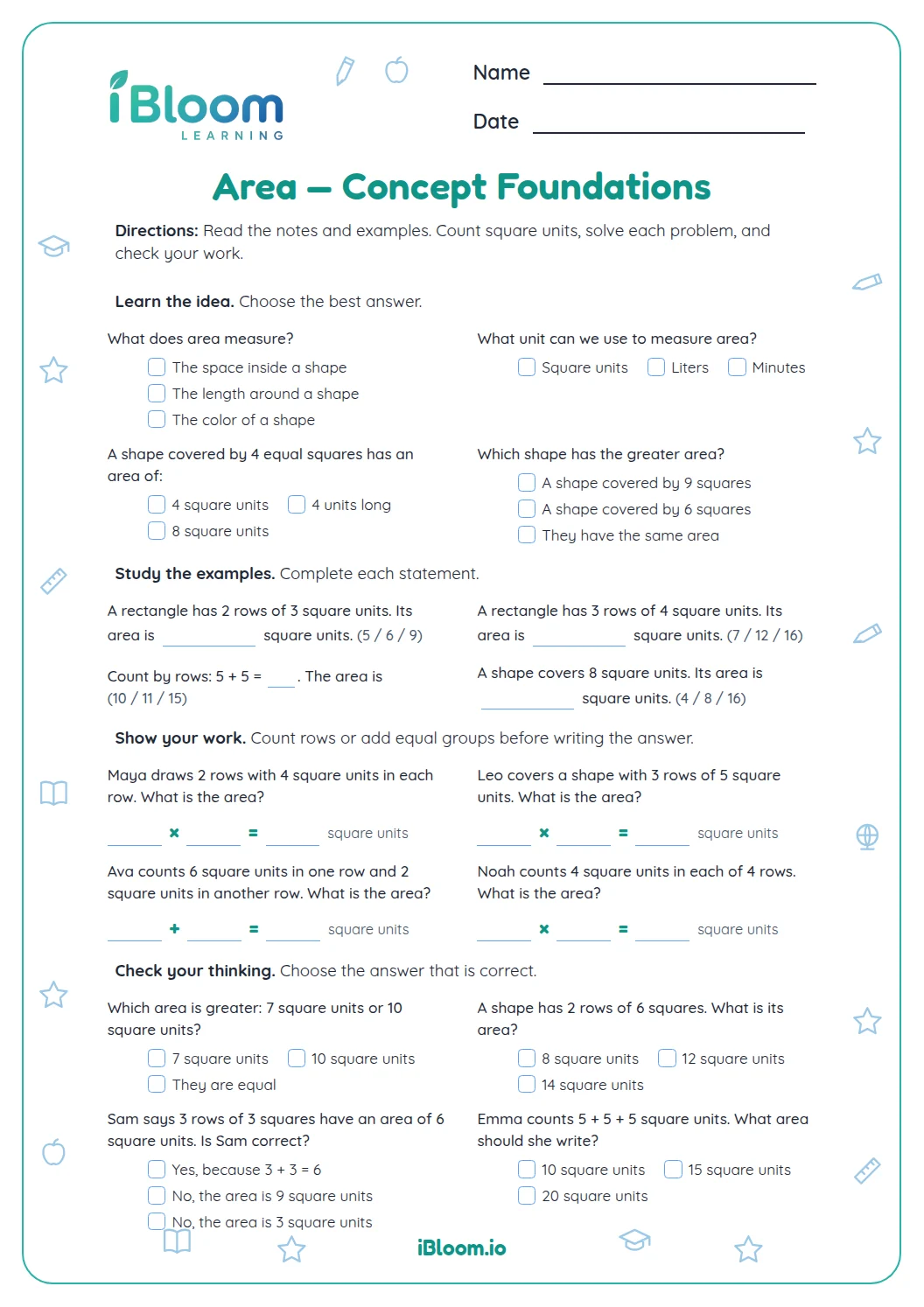 Area — Concept FoundationsPrintable Grade 2 area worksheets that help children cover shapes, count square units, compare spaces, and build early geometry understanding. This Grade 2 foundations worksheet adds concise teaching notes, worked examples, and supported first attempts.Grade 2Free PDF preview
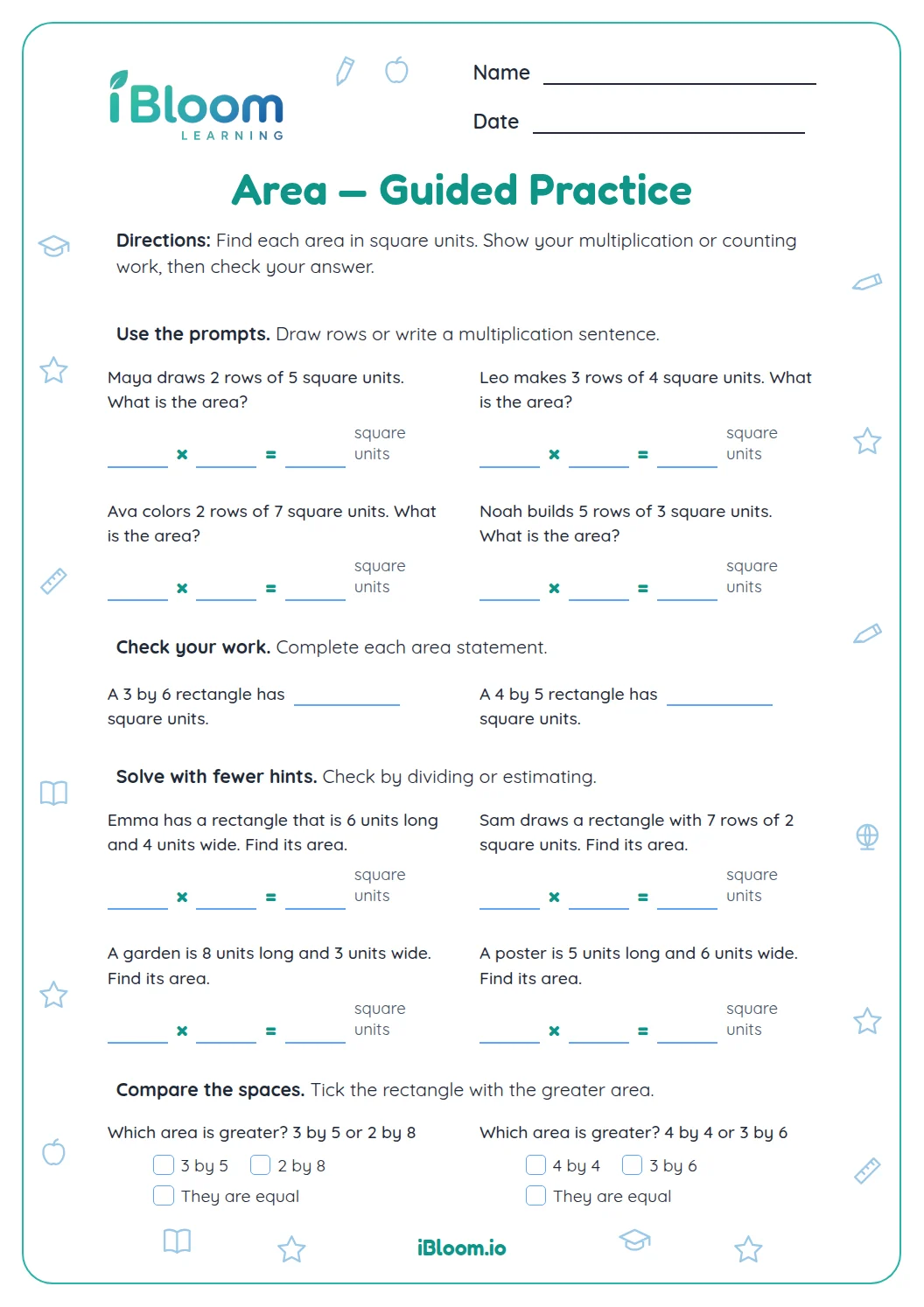 Area — Guided PracticePrintable Grade 2 area worksheets that help children cover shapes, count square units, compare spaces, and build early geometry understanding. This Grade 2 guided-practice worksheet progresses from prompts and checkpoints to independent questions.Grade 2Free PDF preview
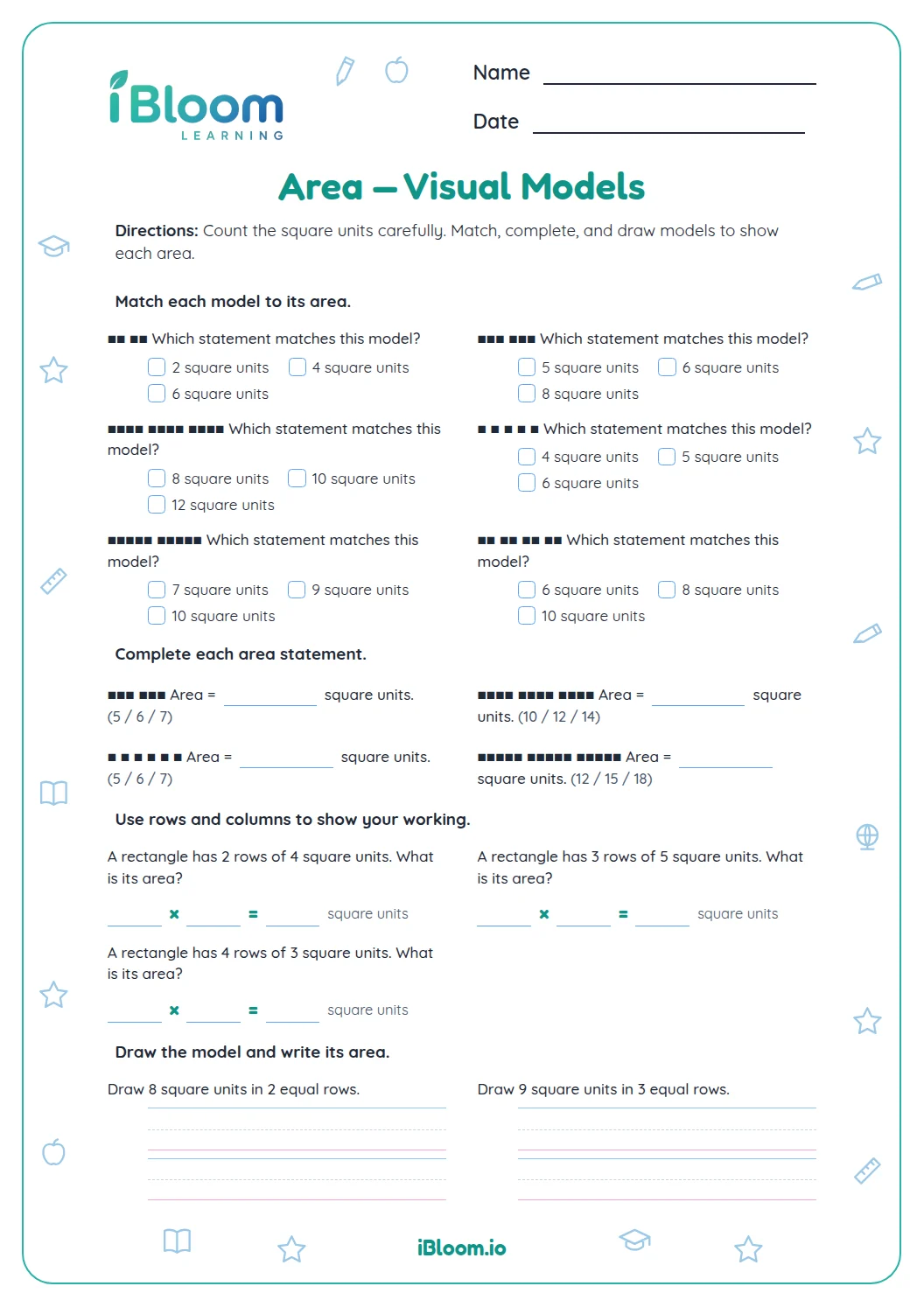 Area — Visual ModelsPrintable Grade 2 area worksheets that help children cover shapes, count square units, compare spaces, and build early geometry understanding. This Grade 2 visual-model worksheet connects suitable diagrams, tables, number lines, or place-value models to mathematical notation.Grade 2Free PDF preview
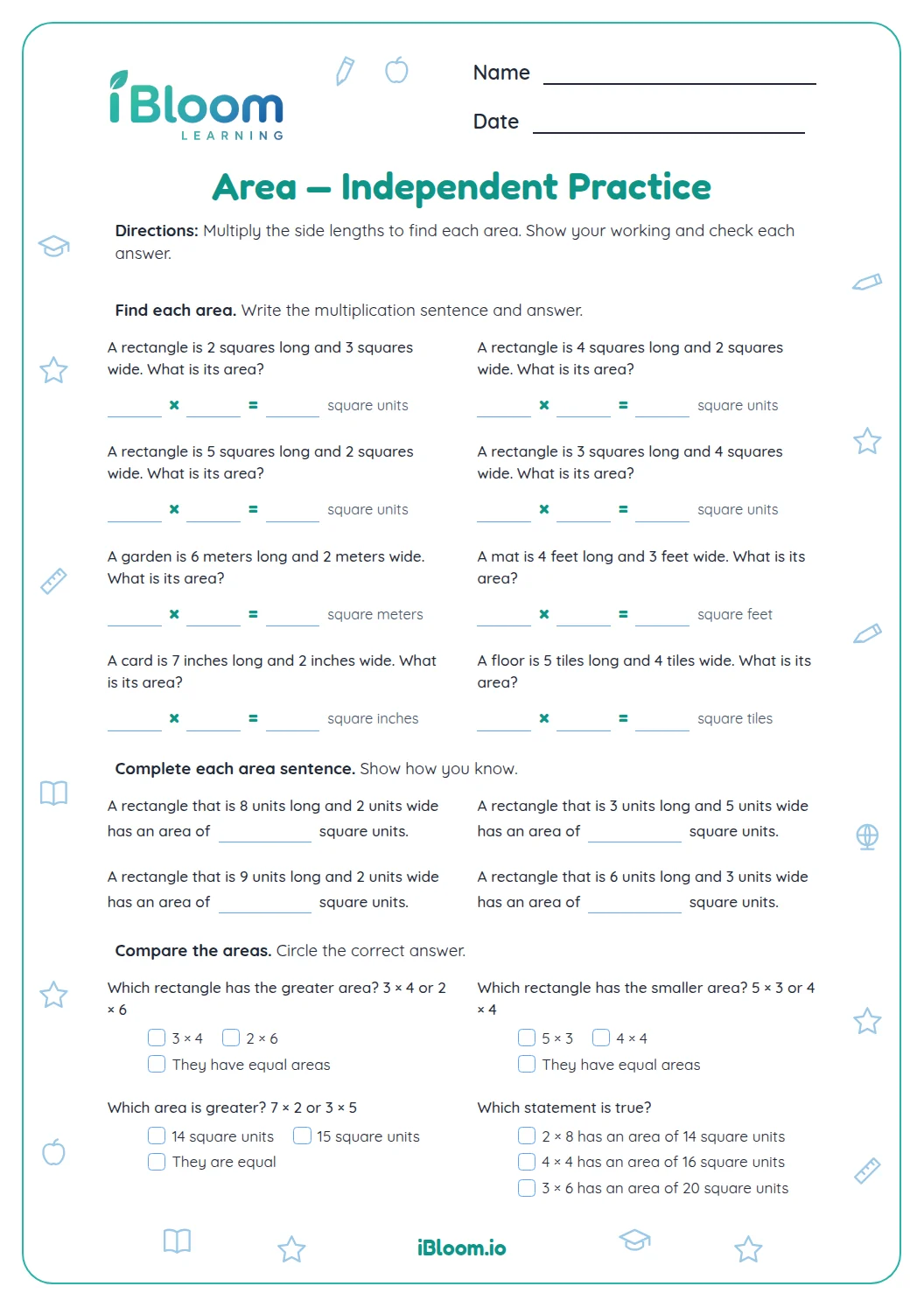 Area — Independent PracticePrintable Grade 2 area worksheets that help children cover shapes, count square units, compare spaces, and build early geometry understanding. This Grade 2 independent-practice worksheet provides a balanced sequence of accurate, grade-level exercises.Grade 2Free PDF preview
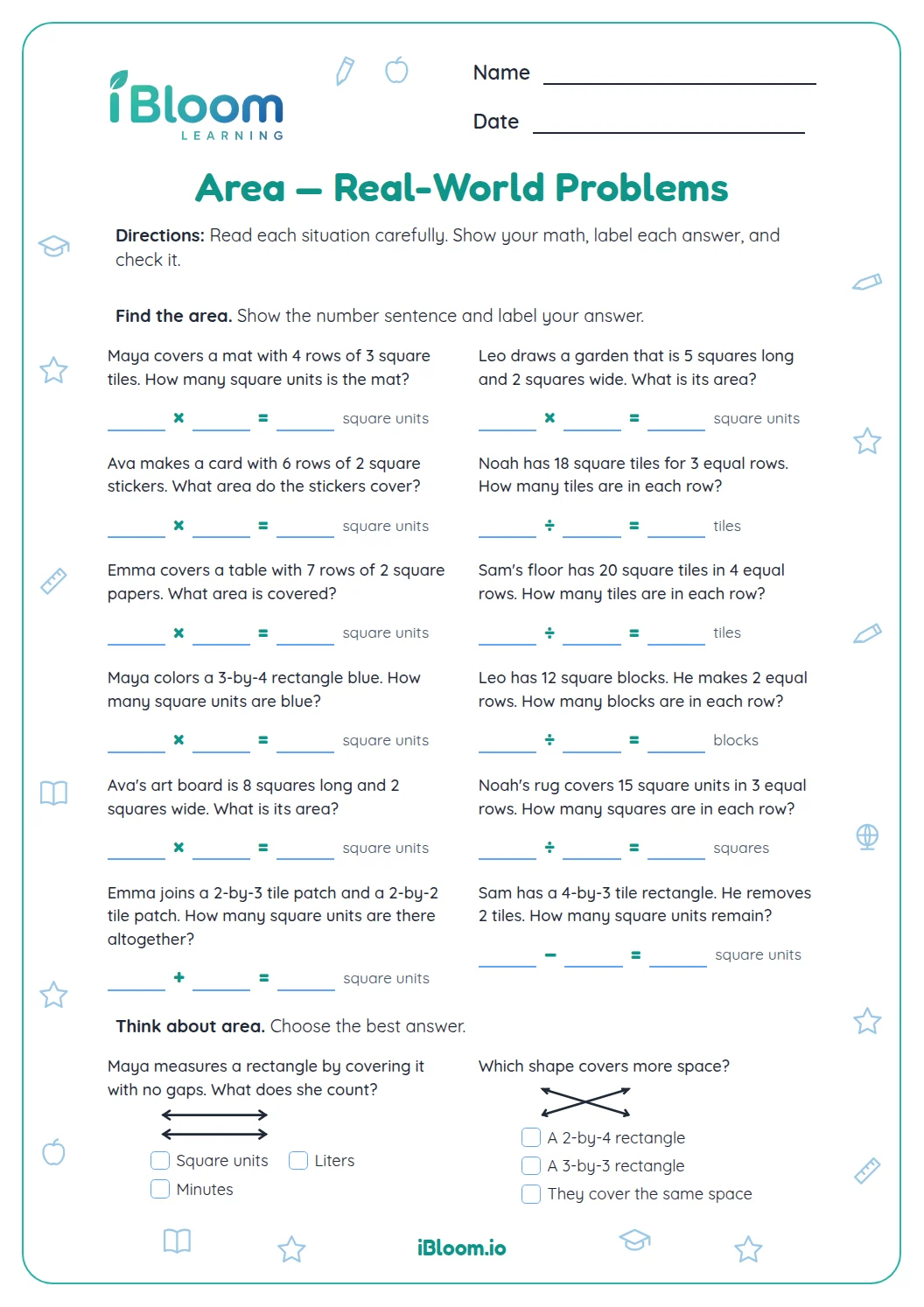 Area — Real-World ProblemsPrintable Grade 2 area worksheets that help children cover shapes, count square units, compare spaces, and build early geometry understanding. This Grade 2 application worksheet uses realistic one-step and multi-step situations with room to model and solve.Grade 2Free PDF preview4 pages
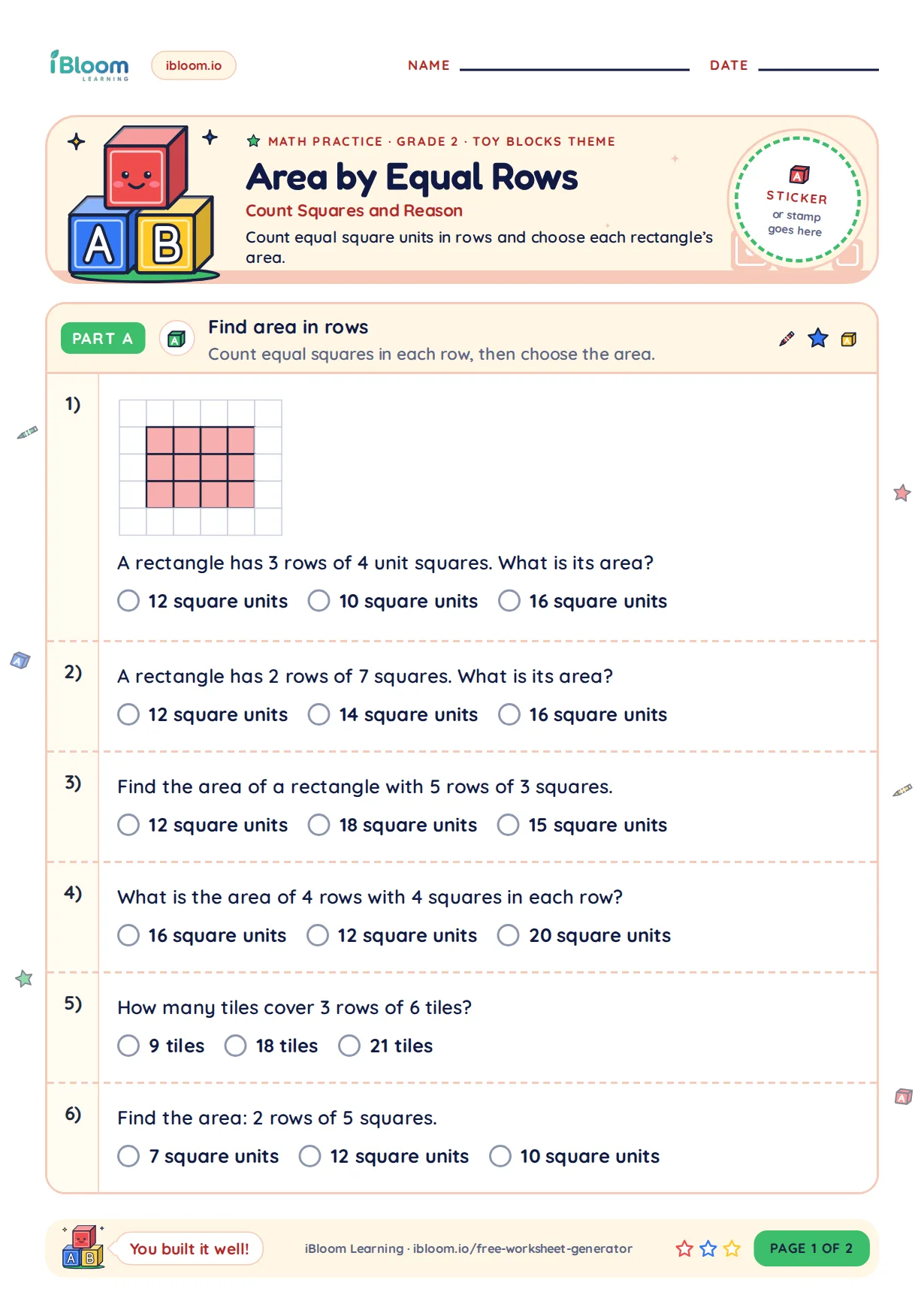 Area — Reasoning ChallengePrintable Grade 2 area worksheets that help children cover shapes, count square units, compare spaces, and build early geometry understanding. This Grade 2 reasoning worksheet combines error analysis, strategy comparison, missing information, and a gentle extension.Grade 2Free PDF preview
Practice that builds confidence
What children learn about area
These Grade 2 area practice activities help children understand area as the amount of flat space a shape covers. Students practise covering rectangles and simple shapes with equal-sized squares, counting square units, and comparing which shape has more or less area.
The printable worksheets include visual models, tiled shapes, grid-based tasks, and simple reasoning questions. Children move from seeing area as “covering” to using organized counting, rows, and columns to find the total space inside a shape.
Area can feel abstract until children see it as a covering problem: How many same-size squares fill the inside of this shape with no gaps or overlaps? These worksheets keep the focus on concrete visual models, so Grade 2 learners connect the word area with unit squares, grids, rows, columns, and the inside of a shape.
How the practice progresses
Early activities invite children to count every square in a tiled shape. Later pages encourage more efficient strategies, such as counting by rows, using repeated addition, or noticing equal groups in a rectangle. Some tasks ask students to compare two shapes and explain which covers more space. The goal is not memorizing a formula; it is building the idea that area is measured in equal square units.
A simple parent routine
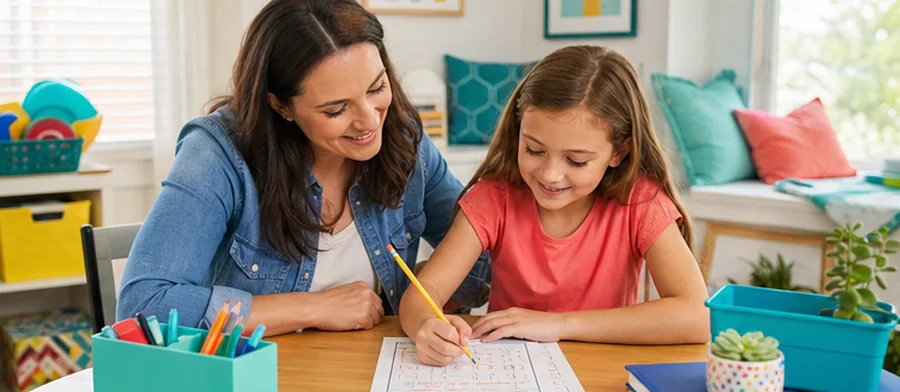
At home, start with real objects: a book cover, a sticky note, or a rectangular table mat. Ask your child to imagine covering it with small square tiles. Then complete one worksheet section together. Have your child point to each unit square, say the count aloud, and circle the final answer. For a challenge, ask, “Can you count it a faster way?” This turns counting into reasoning without rushing the concept.
Classroom uses for teachers
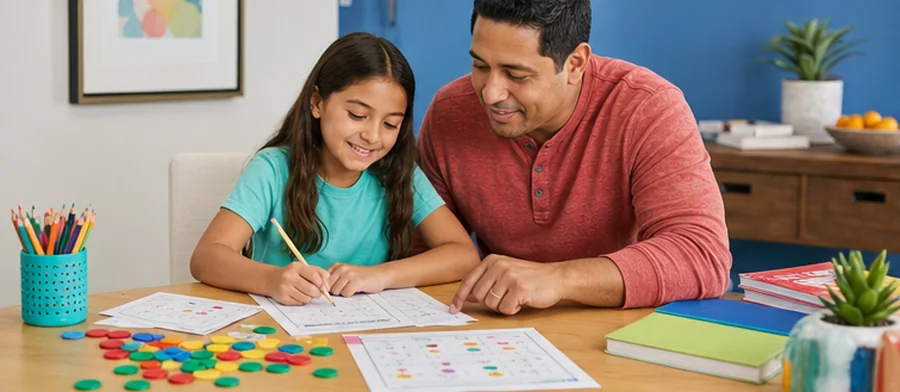
Teachers can use these printables during geometry lessons, math centers, small-group reteaching, or quick checks after hands-on tile work. The grid-based pages are useful for students who need visual structure, while comparison questions support math talk: “How do you know this shape has a greater area?” Students can also color rows in different colors to show grouping strategies.
Common errors to watch for
Some children count boundary lines instead of the squares inside the shape. Others skip hidden or partial-looking spaces on a grid, double-count squares, or compare area by height only. Remind students that each square unit must be the same size and that area measures the inside space, not the distance around the edge.
Free printable PDF download
Use this grade 2 area worksheet page to preview the activity, print it, or download it as a PDF for quick practice. It works well for homework, homeschool lessons, tutoring, morning work, revision, and classroom centers.
Answers and answer key support
After the child completes the worksheet independently, parents and teachers can use the answer support or answer key information to check the work, review mistakes, and choose the next practice step.
Why iBloom worksheets help
The activities are designed to make area visible before it becomes procedural. Children see clear shapes, countable unit squares, and varied layouts that encourage flexible thinking. A child-friendly strategy is: cover, count, check. First look for equal squares covering the shape, then count carefully, then check by grouping rows or columns.
Helpful answers
Frequently asked questions
What does area mean for a Grade 2 student?
At this level, area means the amount of flat space inside a shape. Children usually explore it by covering shapes with equal-size squares and counting the square units.
Do these worksheets teach the area formula?
No. These activities focus on understanding area visually through unit squares, grids, rows, and columns. This prepares children for formulas later without making the lesson too abstract.
How can I help my child stop counting the lines instead of the squares?
Ask your child to lightly color or touch each square space inside the shape as they count. Remind them that area counts the spaces that cover the shape, not the grid lines around them.
Can these area worksheets be used after hands-on tile activities?
Yes. They work well after children have used square tiles, paper squares, or grid paper because the worksheets transfer that hands-on covering idea to printed models.
What strategy should children use when a shape has many squares?
Encourage them to count by rows or columns instead of one square at a time. They can mark each row, use skip counting when rows are equal, and then check the total.
Is this grade 2 area worksheet free?
Yes. You can preview it for free and use the printable worksheet for home or classroom practice.
Can I download this grade 2 area worksheet as a PDF?
Yes. Use the worksheet download option to save a printable PDF, or print the worksheet directly from the page.
Does this grade 2 area worksheet include answers or an answer key?
When the activity has fixed answers, iBloom includes answer support so parents and teachers can check the completed worksheet.