Free printable practice
Geometry Practice Activities
Grade 2 geometry worksheets for identifying 2D and 3D shapes, symmetry, area, perimeter, congruence, and composing rectangles.
Explore Geometry
Free printable worksheet PDFs
Preview every available page, then download the free worksheet PDF for home, homeschool, tutoring, or classroom practice.
Preview the exact activity before downloading it.
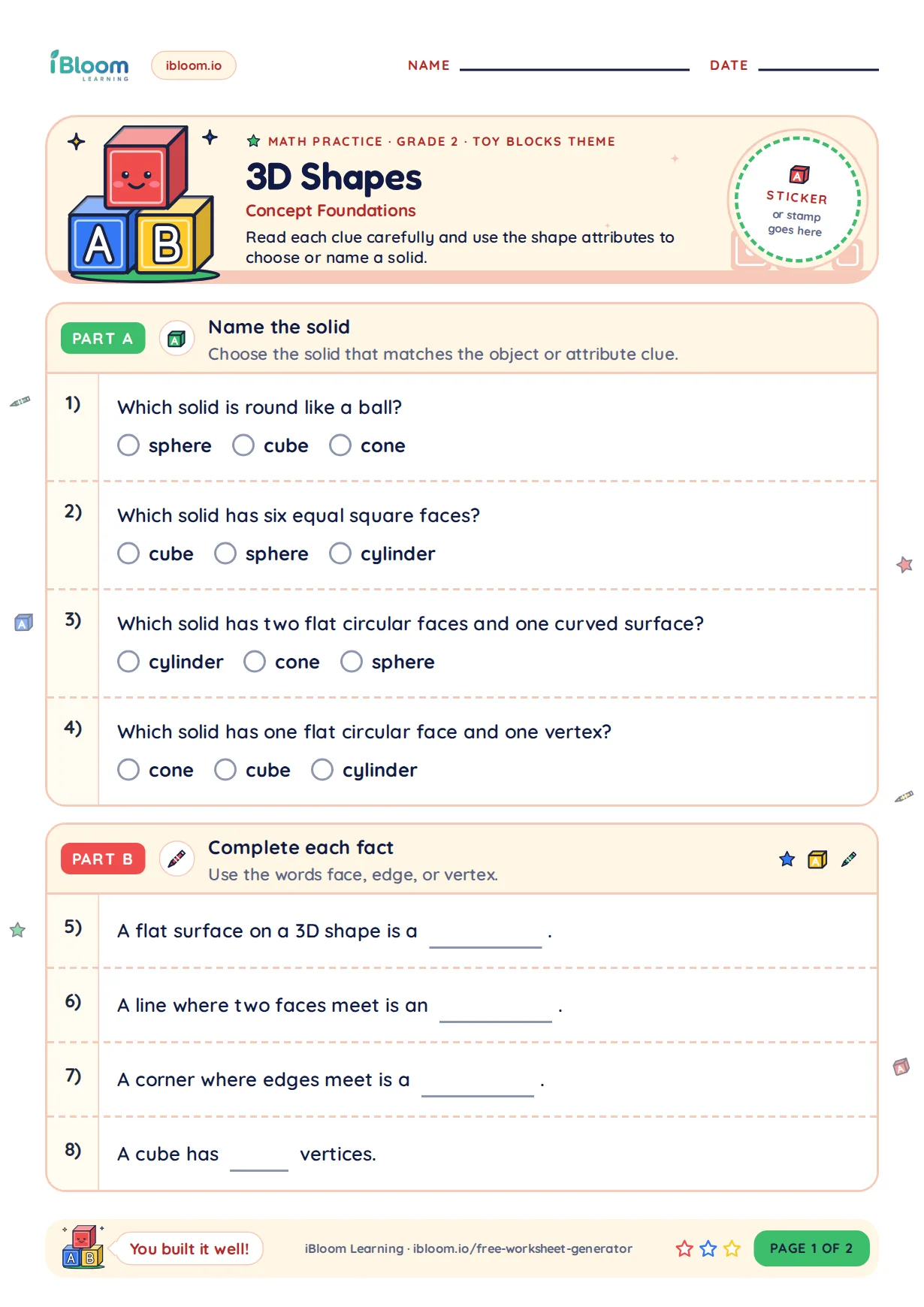 3D Shapes — Concept FoundationsPrintable Grade 2 geometry worksheets for naming, comparing, sorting, and describing 3D shapes using faces, edges, vertices, and real-world examples. This Grade 2 foundations worksheet adds concise teaching notes, worked examples, and supported first attempts.Grade 2Free PDF preview
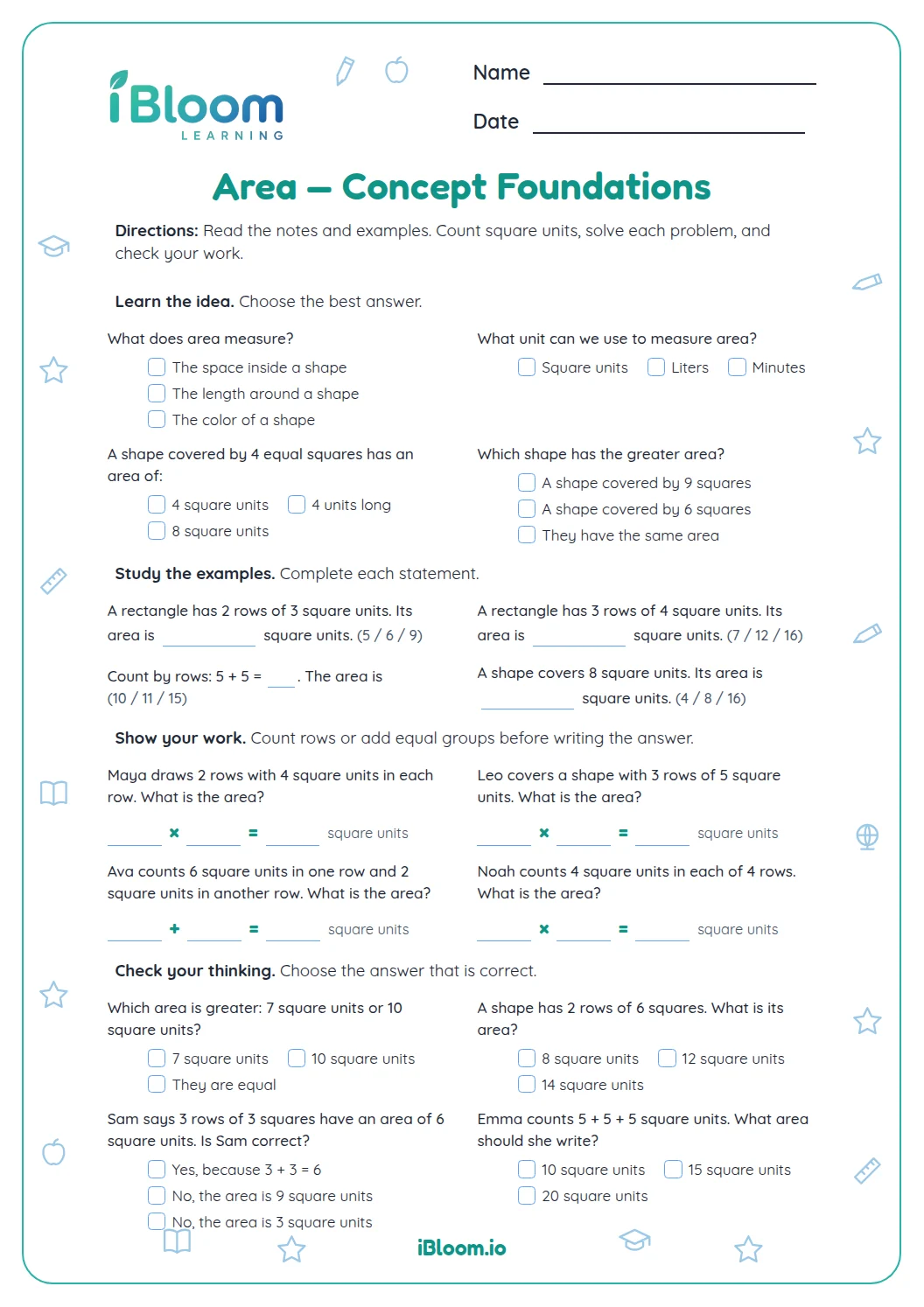 Area — Concept FoundationsPrintable Grade 2 area worksheets that help children cover shapes, count square units, compare spaces, and build early geometry understanding. This Grade 2 foundations worksheet adds concise teaching notes, worked examples, and supported first attempts.Grade 2Free PDF preview
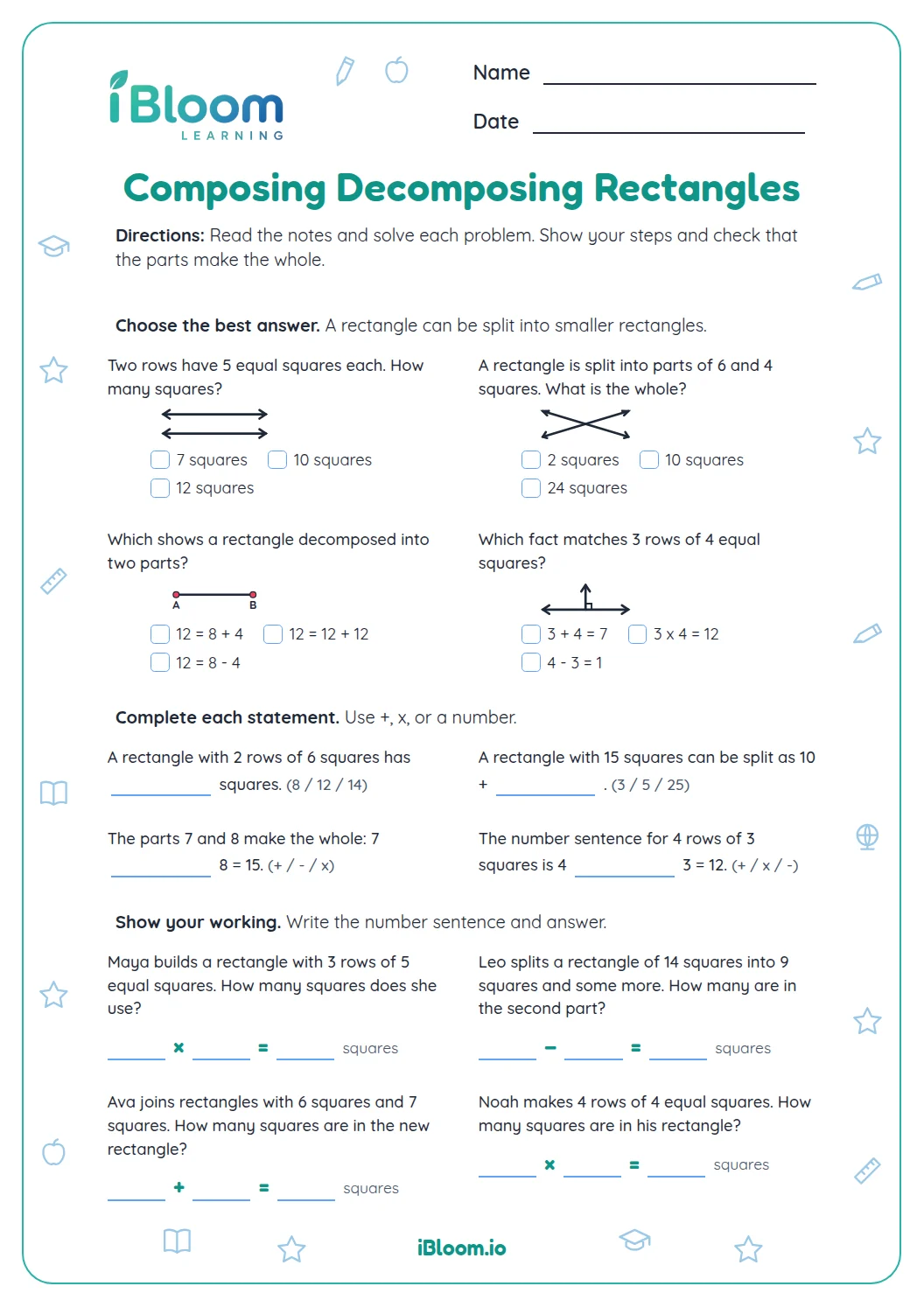 Composing Decomposing Rectangles — Concept FoundationsGrade 2 geometry worksheets that help children build, split, and describe rectangles made from smaller rectangles and equal-size squares. This Grade 2 foundations worksheet adds concise teaching notes, worked examples, and supported first attempts.Grade 2Free PDF preview
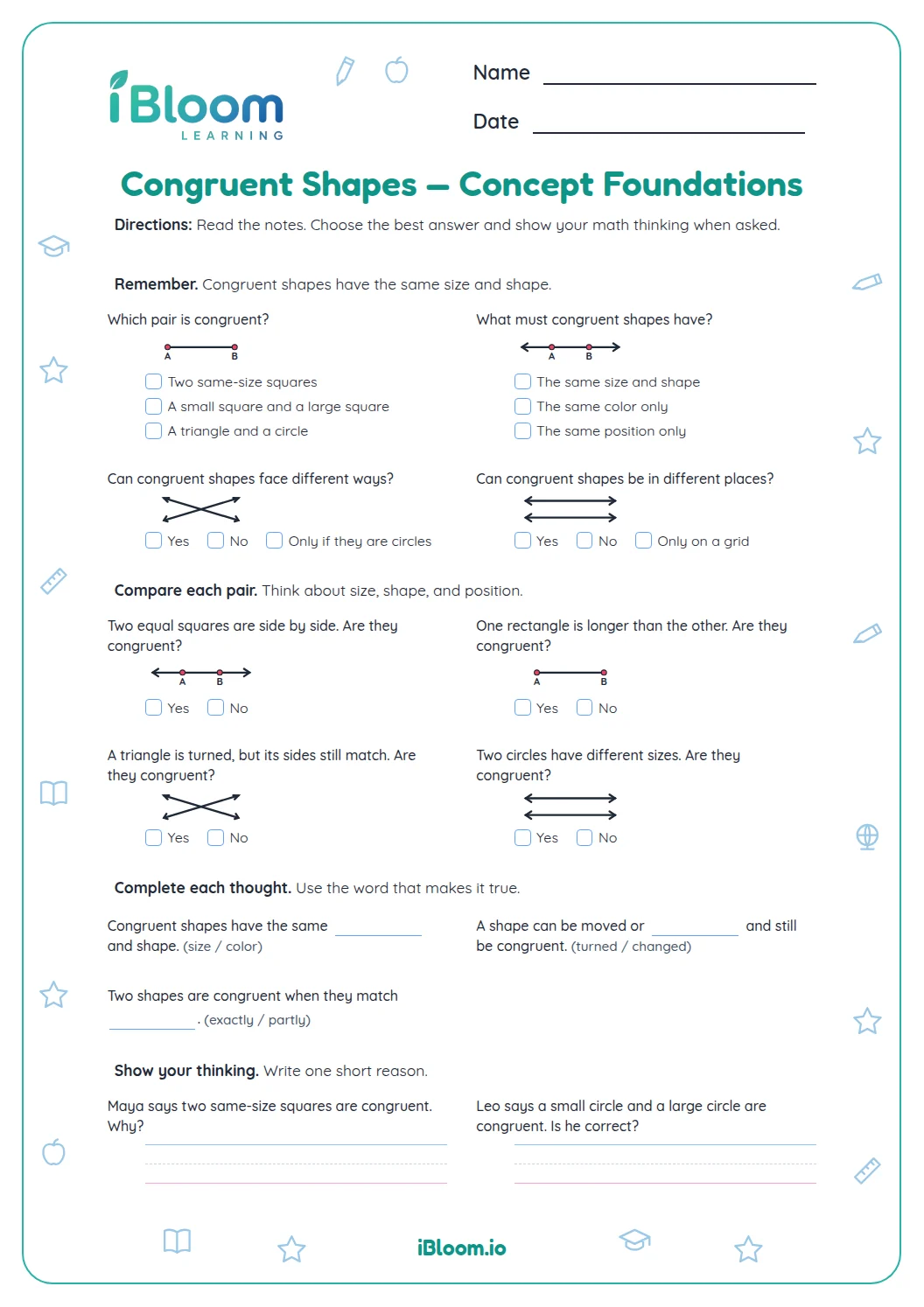 Congruent Shapes — Concept FoundationsGrade 2 geometry worksheets that help children identify congruent shapes by comparing size, shape, orientation, and position. This Grade 2 foundations worksheet adds concise teaching notes, worked examples, and supported first attempts.Grade 2Free PDF preview
 Edges Vertices — Concept FoundationsGrade 2 geometry worksheets for counting and identifying edges and vertices on familiar 2D and 3D shapes. This Grade 2 foundations worksheet adds concise teaching notes, worked examples, and supported first attempts.Grade 2Free PDF preview
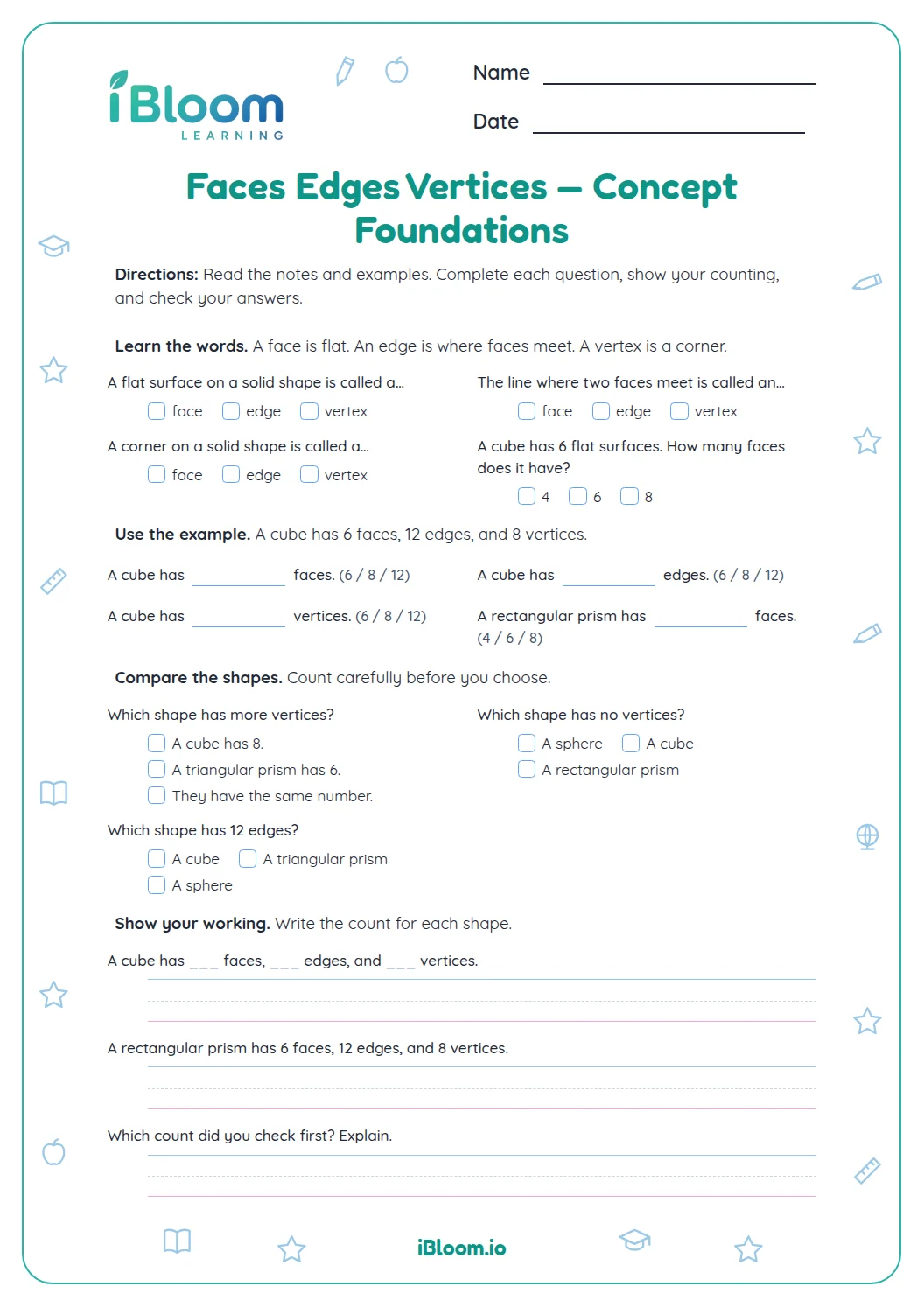 Faces Edges Vertices — Concept FoundationsGrade 2 geometry worksheets for identifying, counting, and comparing faces, edges, and vertices on common 3D shapes. This Grade 2 foundations worksheet adds concise teaching notes, worked examples, and supported first attempts.Grade 2Free PDF preview
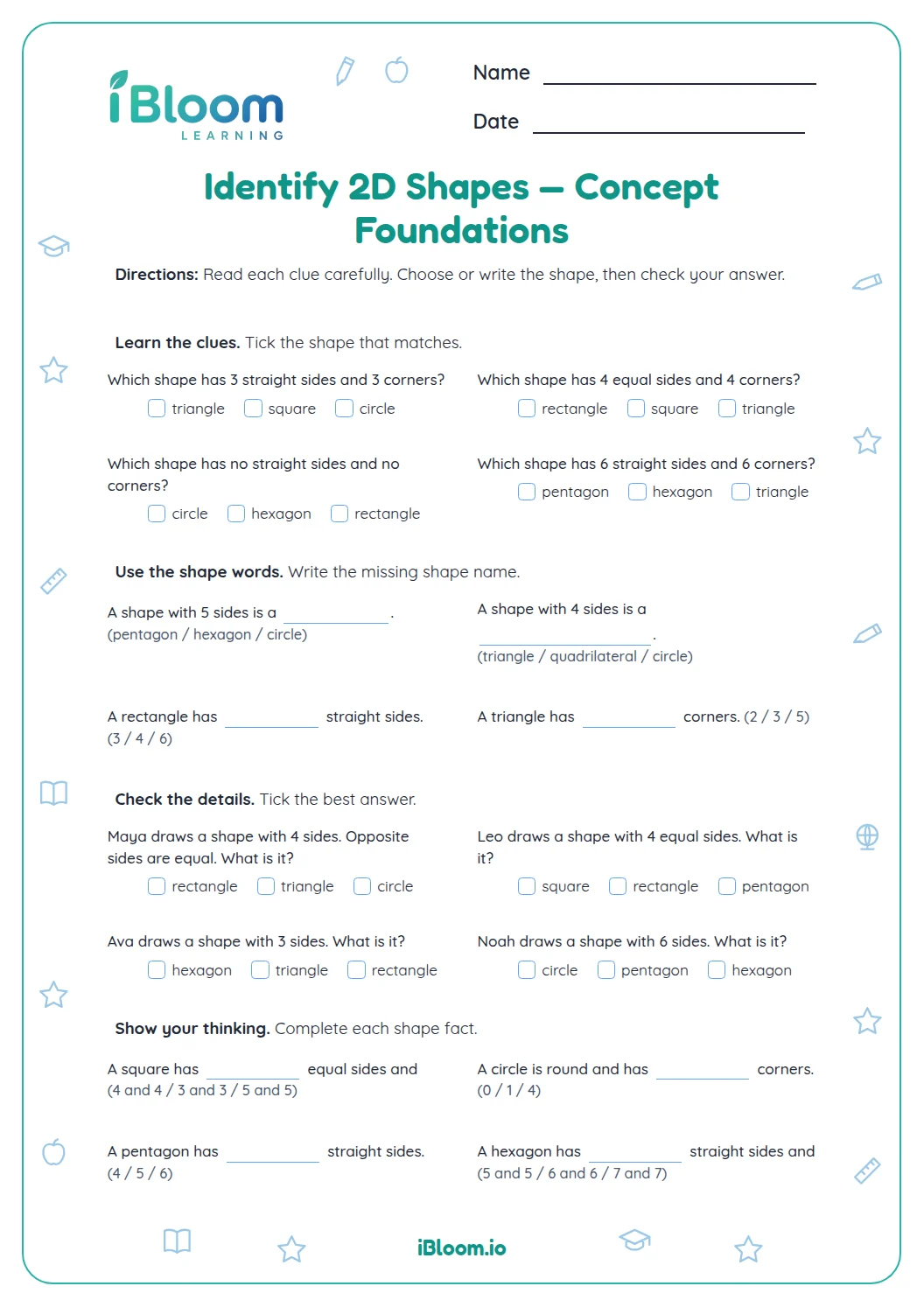 Identify 2D Shapes — Concept FoundationsExplore identify 2d shapes practice activities within Geometry Practice Activities, organised so children, families, and elementary teachers can move from broad learning areas to focused printable practice. This Grade 2 foundations worksheet adds concise teaching notes, worked examples, and supported first attempts.Grade 2Free PDF preview6 pages
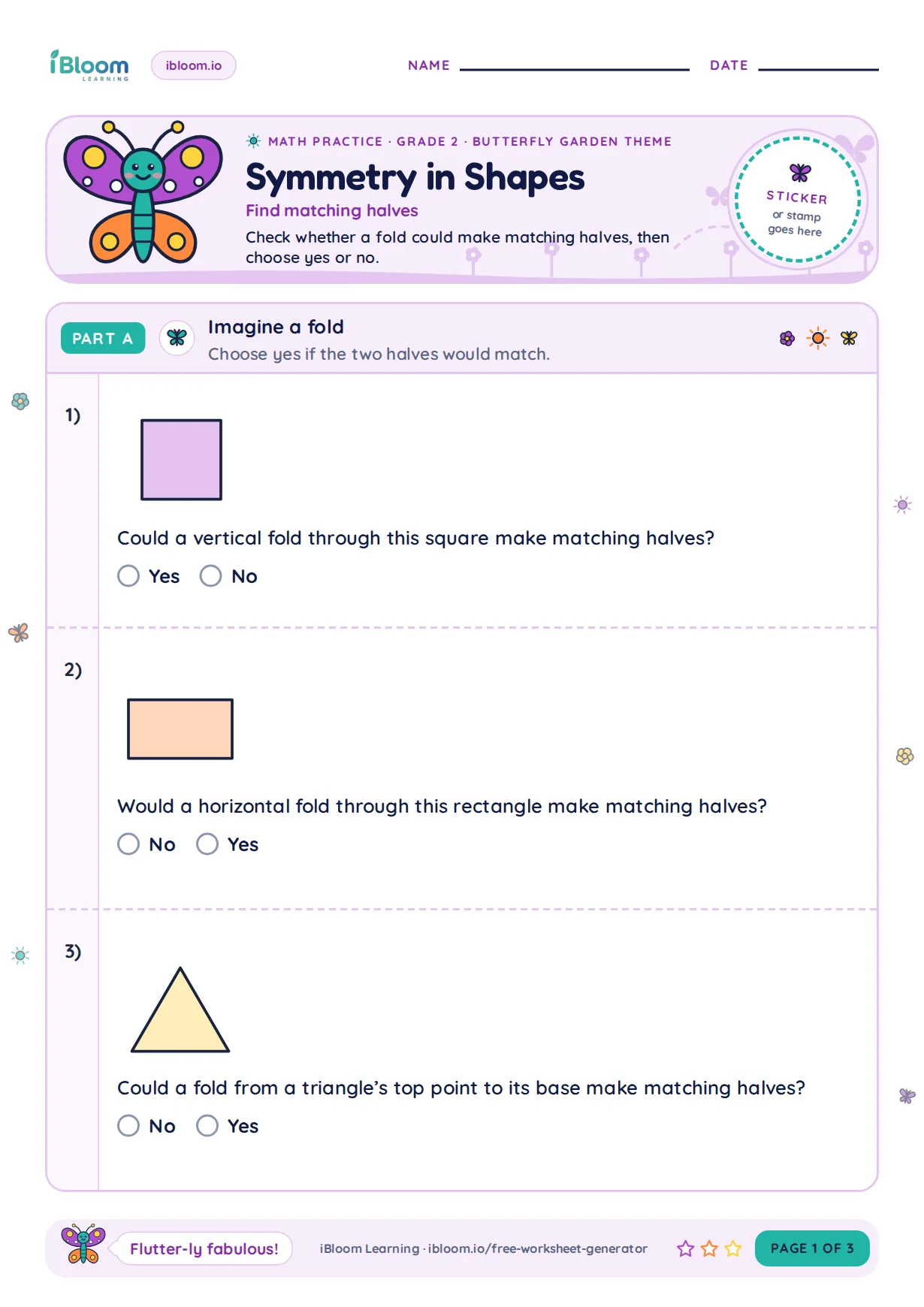 Line Of Symmetry — Concept FoundationsPrintable Grade 2 geometry worksheets for identifying, drawing, and checking lines of symmetry in shapes and simple pictures. This Grade 2 foundations worksheet adds concise teaching notes, worked examples, and supported first attempts.Grade 2Free PDF preview
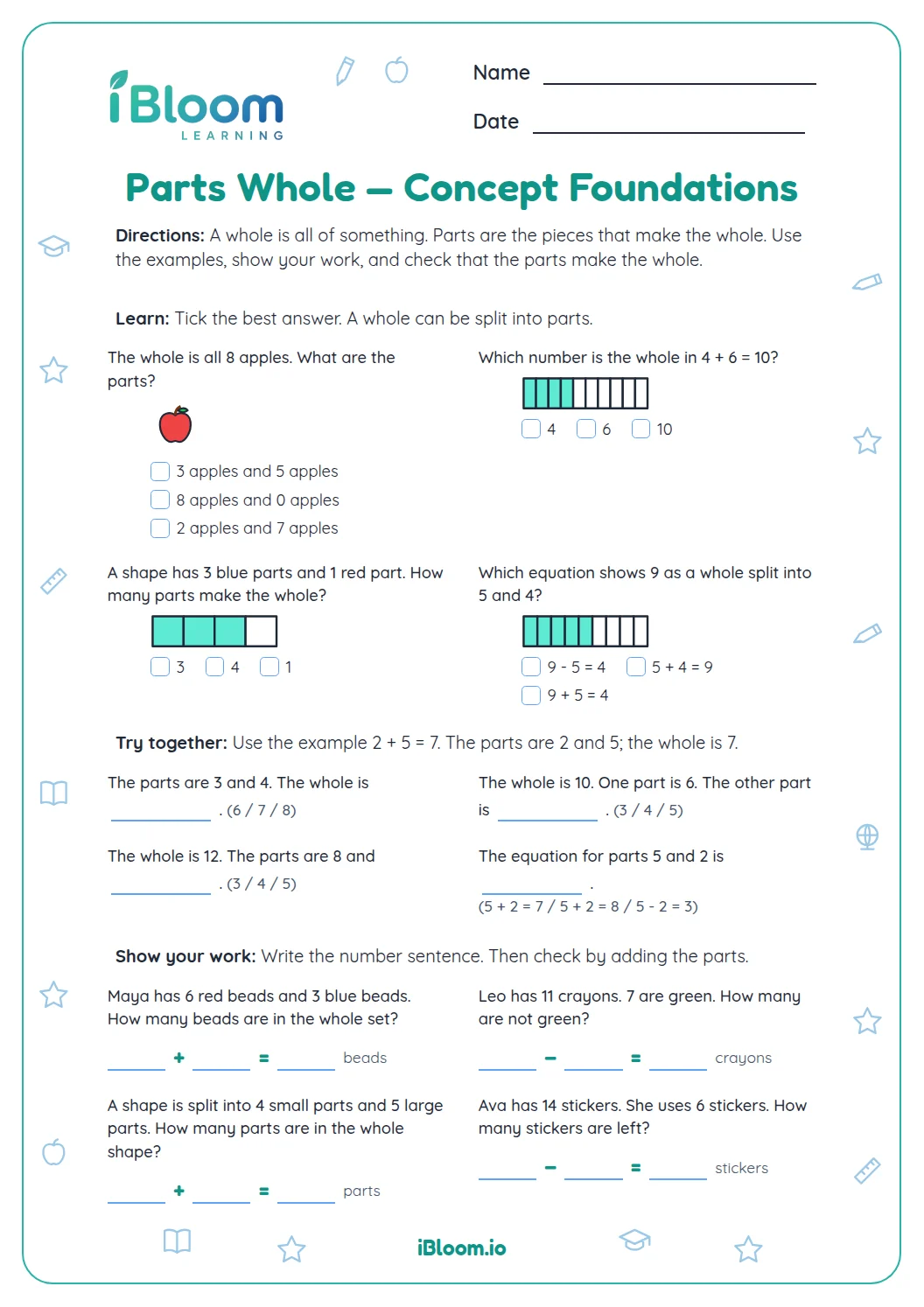 Parts Whole — Concept FoundationsGrade 2 children build part-whole thinking by splitting shapes and sets into meaningful parts and explaining how the parts make one whole. This Grade 2 foundations worksheet adds concise teaching notes, worked examples, and supported first attempts.Grade 2Free PDF preview4 pages
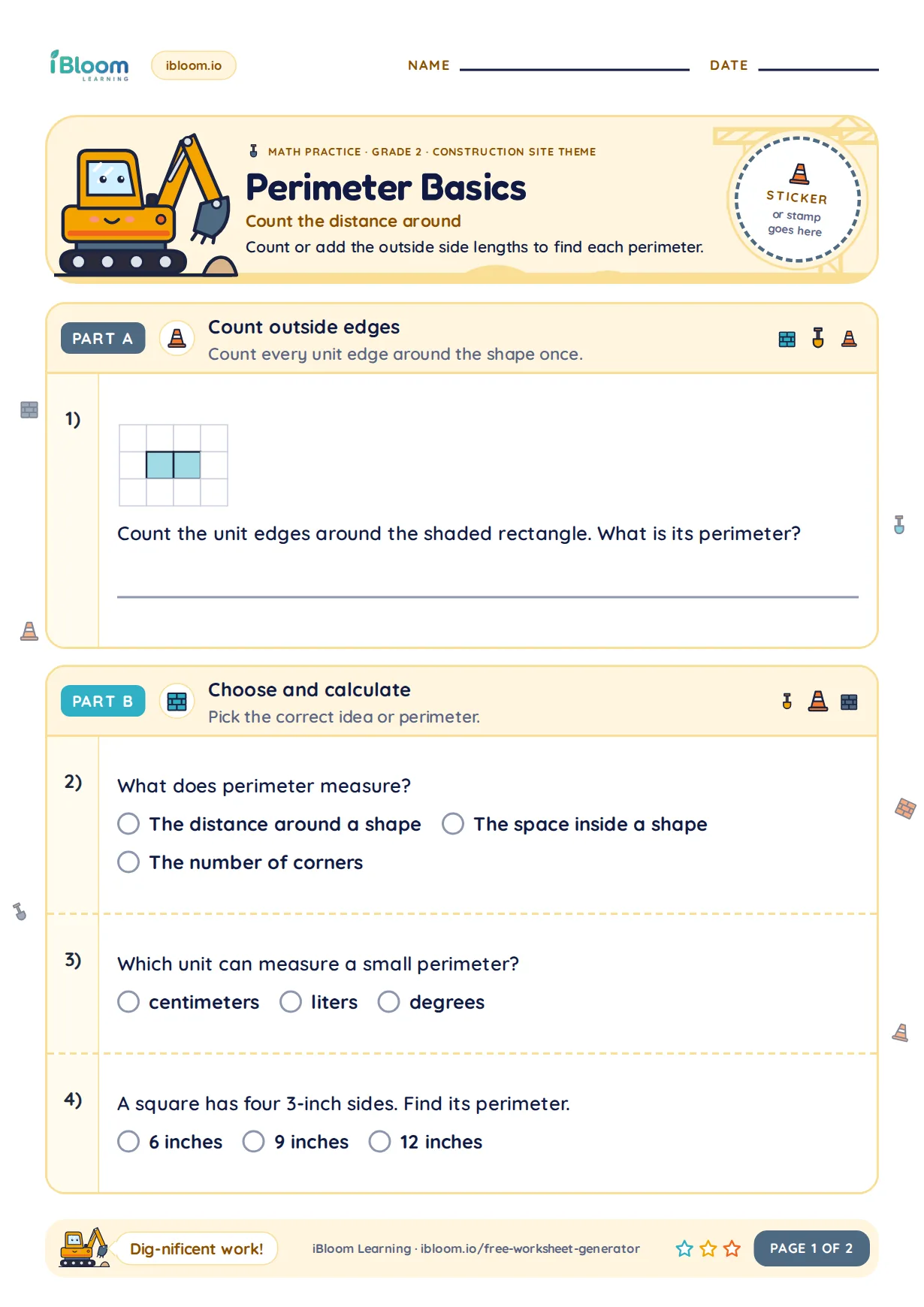 Perimeter — Concept FoundationsExplore perimeter practice activities within Geometry Practice Activities, organised so children, families, and elementary teachers can move from broad learning areas to focused printable practice. This Grade 2 foundations worksheet adds concise teaching notes, worked examples, and supported first attempts.Grade 2Free PDF preview
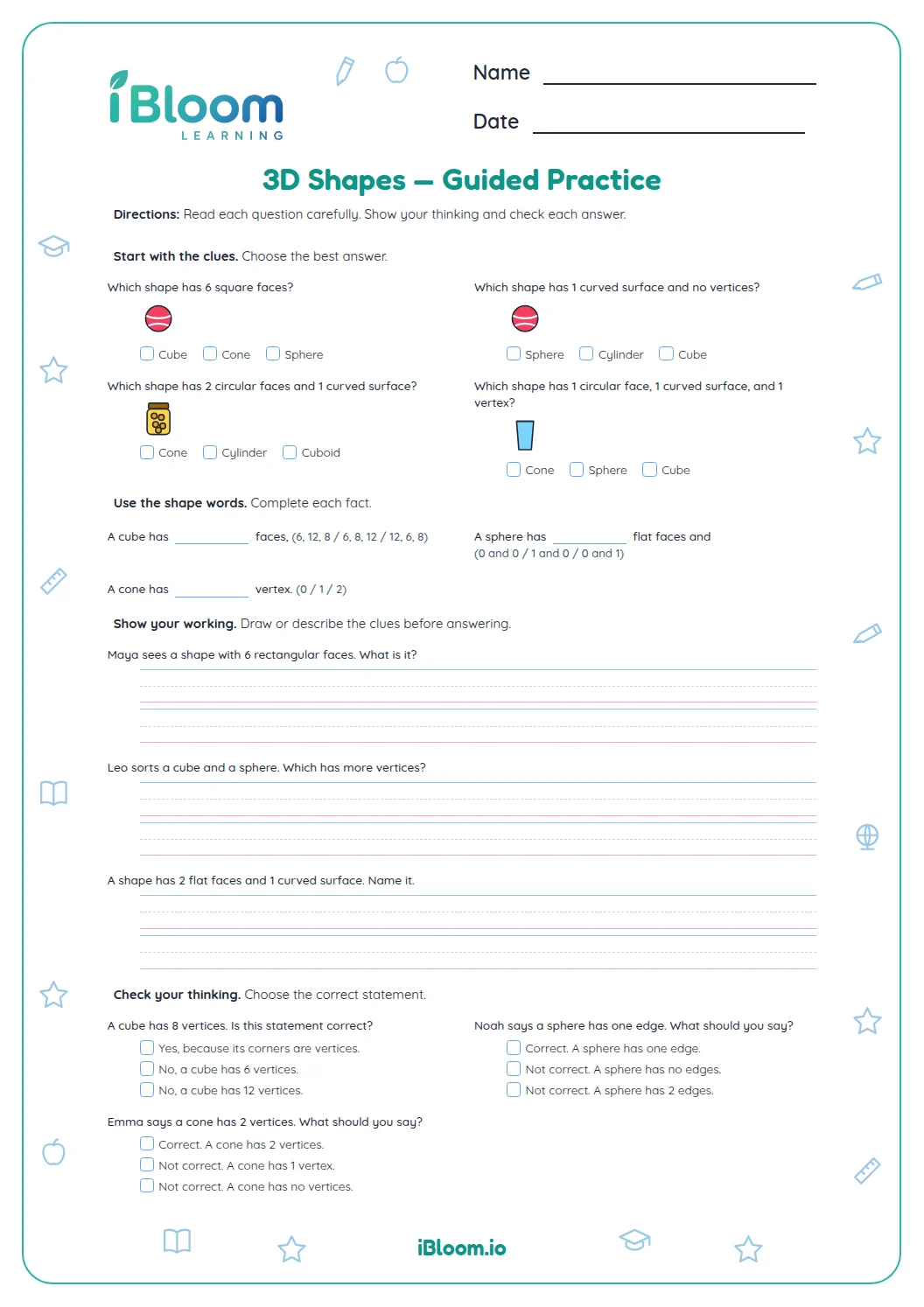 3D Shapes — Guided PracticePrintable Grade 2 geometry worksheets for naming, comparing, sorting, and describing 3D shapes using faces, edges, vertices, and real-world examples. This Grade 2 guided-practice worksheet progresses from prompts and checkpoints to independent questions.Grade 2Free PDF preview
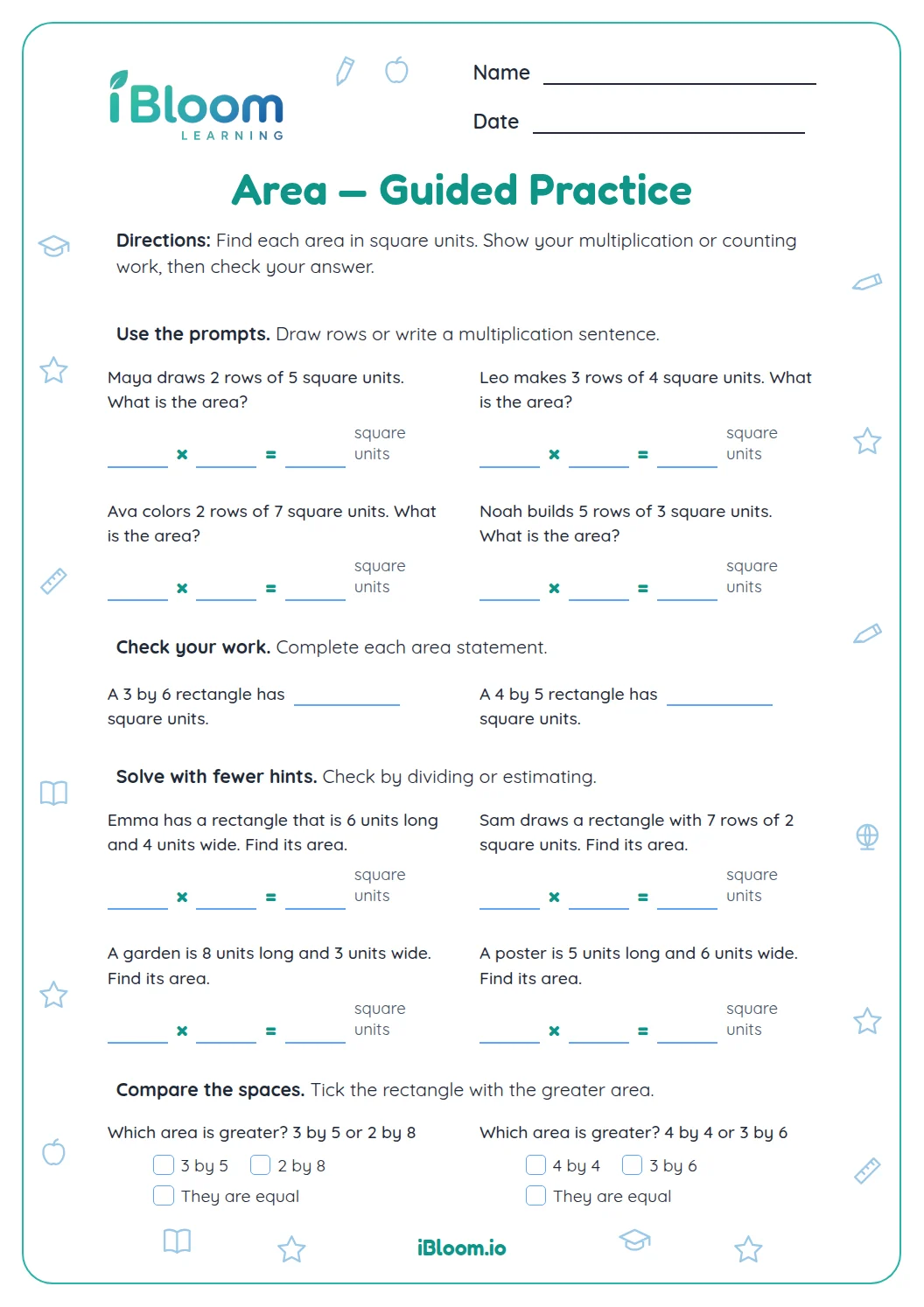 Area — Guided PracticePrintable Grade 2 area worksheets that help children cover shapes, count square units, compare spaces, and build early geometry understanding. This Grade 2 guided-practice worksheet progresses from prompts and checkpoints to independent questions.Grade 2Free PDF preview8 pages
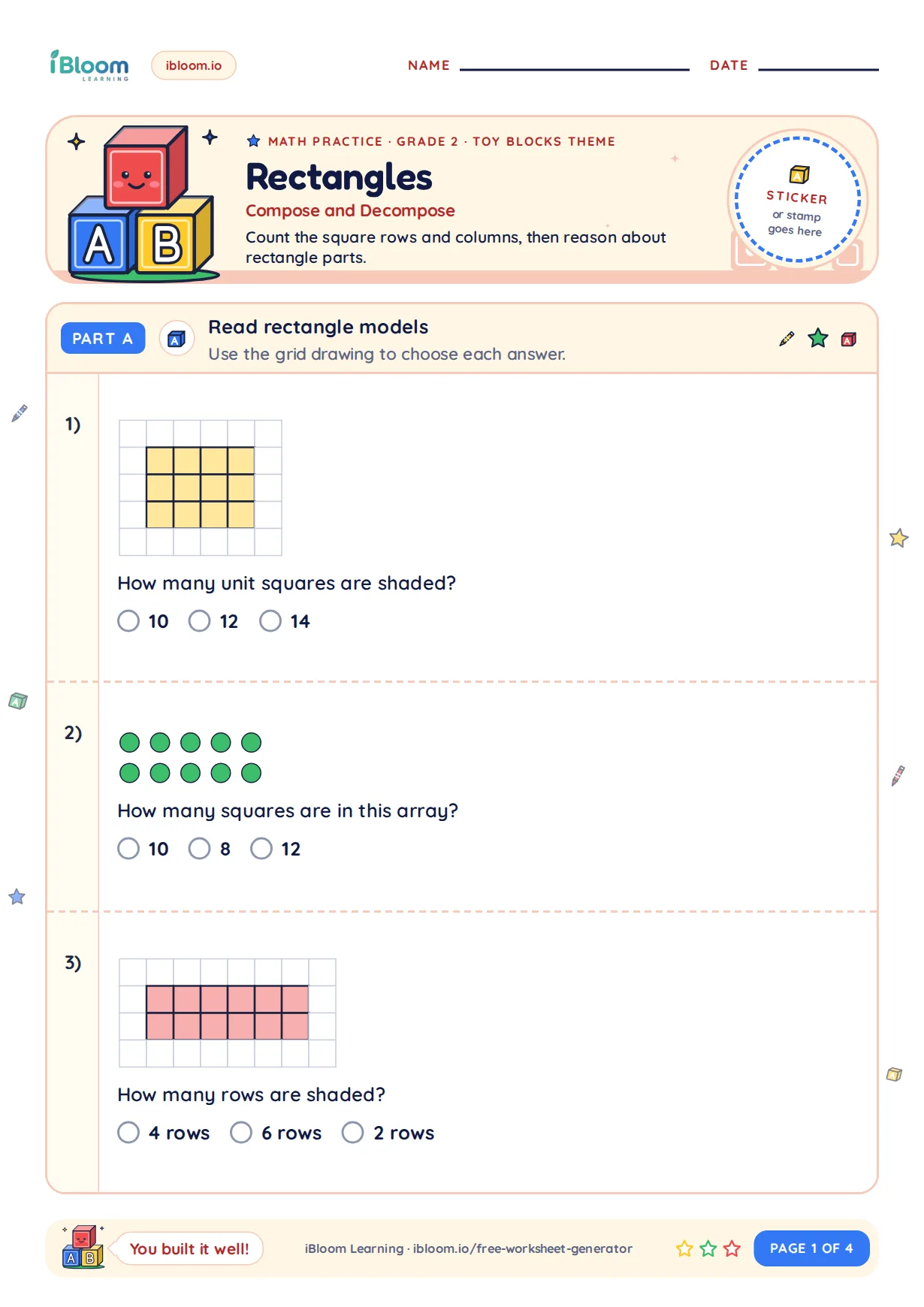 Composing Decomposing Rectangles — Guided PracticeGrade 2 geometry worksheets that help children build, split, and describe rectangles made from smaller rectangles and equal-size squares. This Grade 2 guided-practice worksheet progresses from prompts and checkpoints to independent questions.Grade 2Free PDF preview
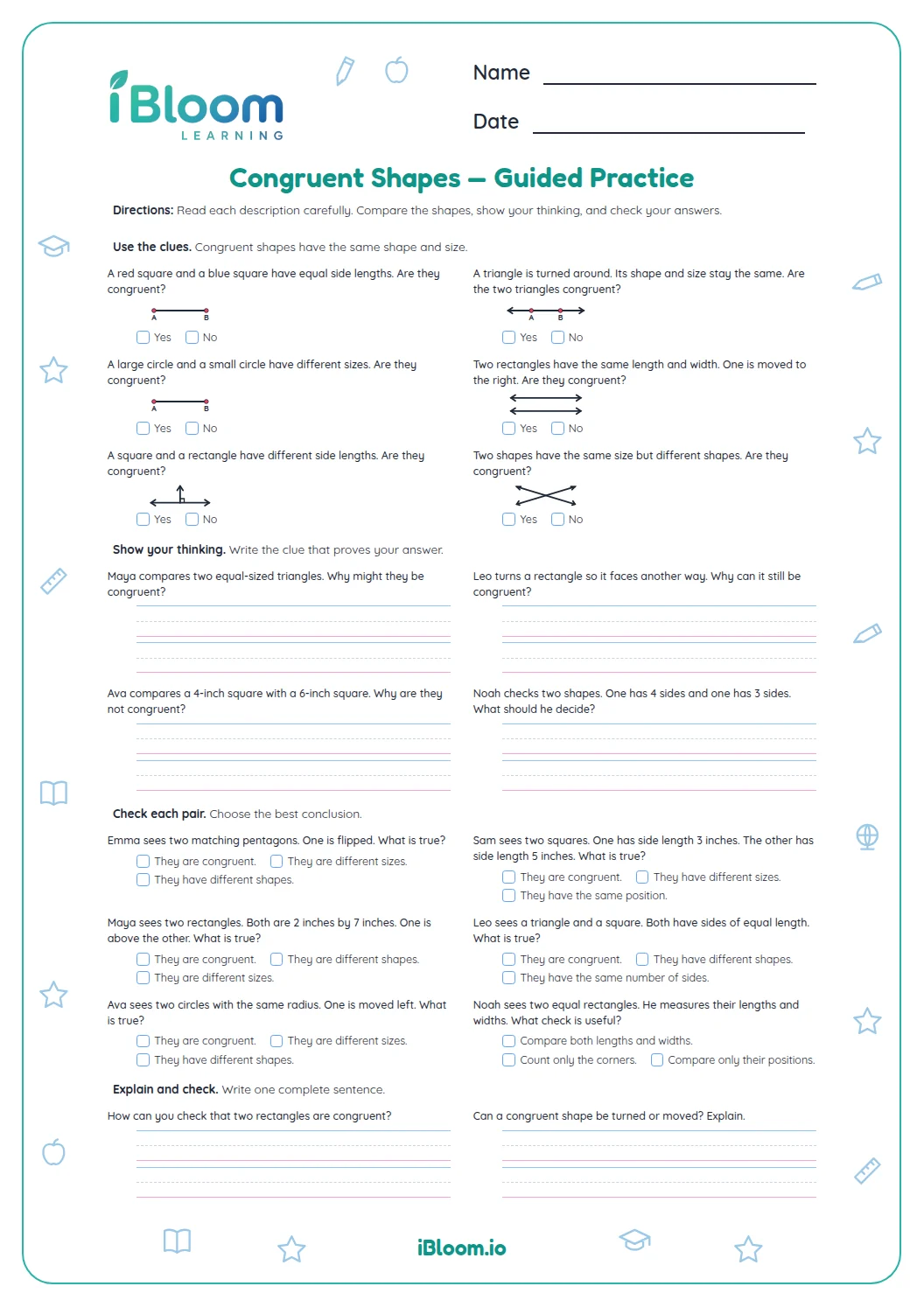 Congruent Shapes — Guided PracticeGrade 2 geometry worksheets that help children identify congruent shapes by comparing size, shape, orientation, and position. This Grade 2 guided-practice worksheet progresses from prompts and checkpoints to independent questions.Grade 2Free PDF preview4 pages
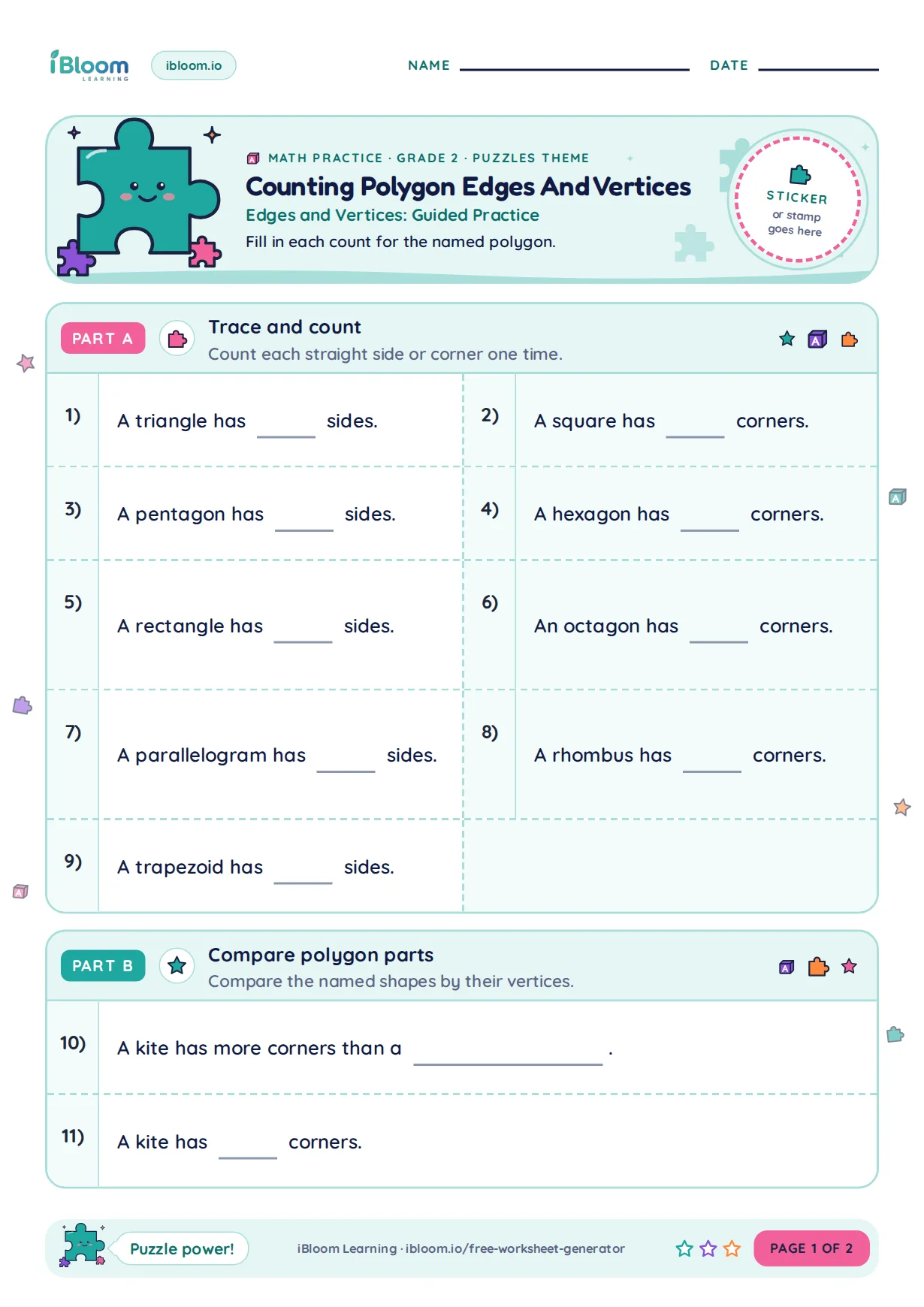 Edges Vertices — Guided PracticeGrade 2 geometry worksheets for counting and identifying edges and vertices on familiar 2D and 3D shapes. This Grade 2 guided-practice worksheet progresses from prompts and checkpoints to independent questions.Grade 2Free PDF preview
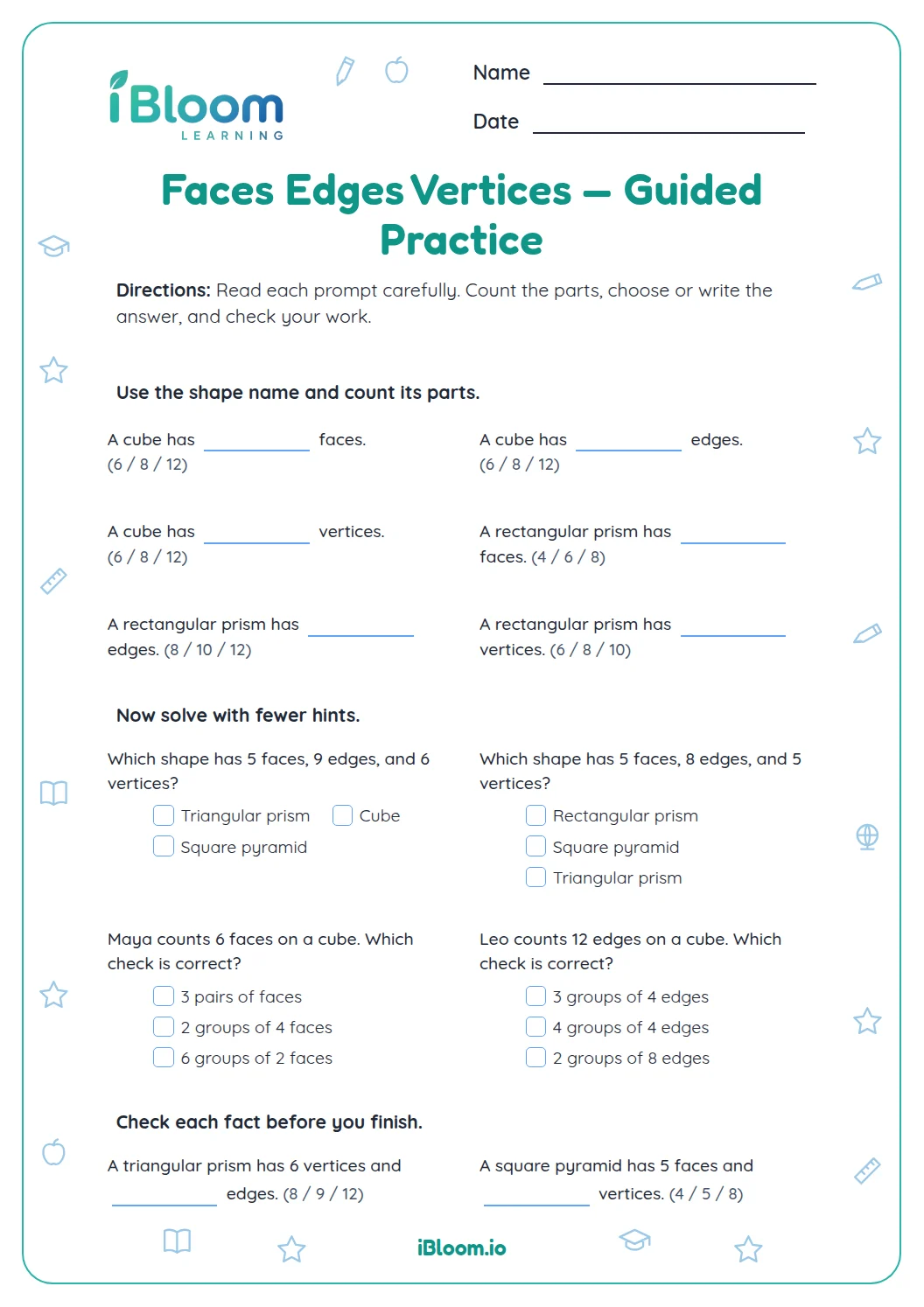 Faces Edges Vertices — Guided PracticeGrade 2 geometry worksheets for identifying, counting, and comparing faces, edges, and vertices on common 3D shapes. This Grade 2 guided-practice worksheet progresses from prompts and checkpoints to independent questions.Grade 2Free PDF preview
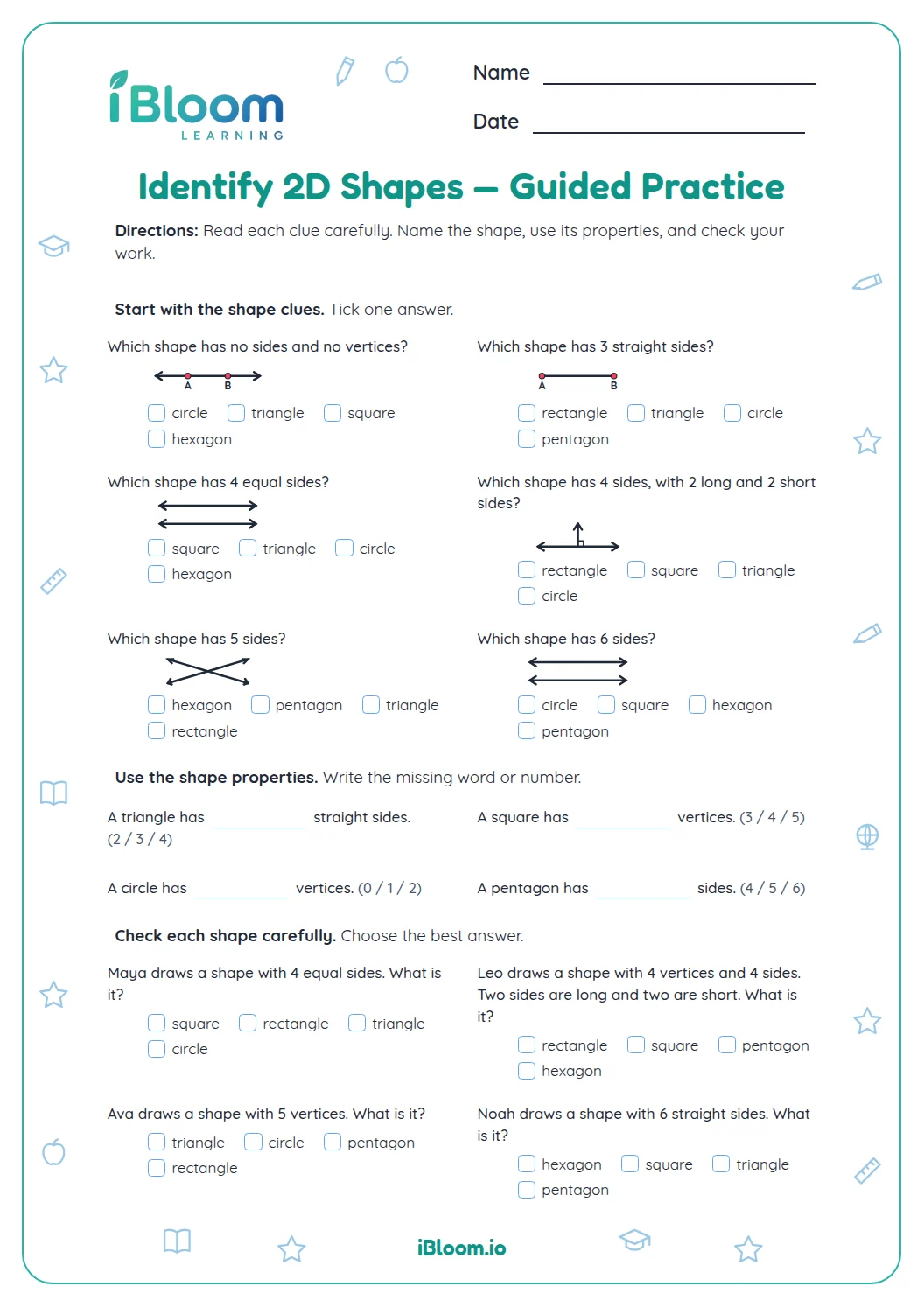 Identify 2D Shapes — Guided PracticeExplore identify 2d shapes practice activities within Geometry Practice Activities, organised so children, families, and elementary teachers can move from broad learning areas to focused printable practice. This Grade 2 guided-practice worksheet progresses from prompts and checkpoints to independent questions.Grade 2Free PDF preview
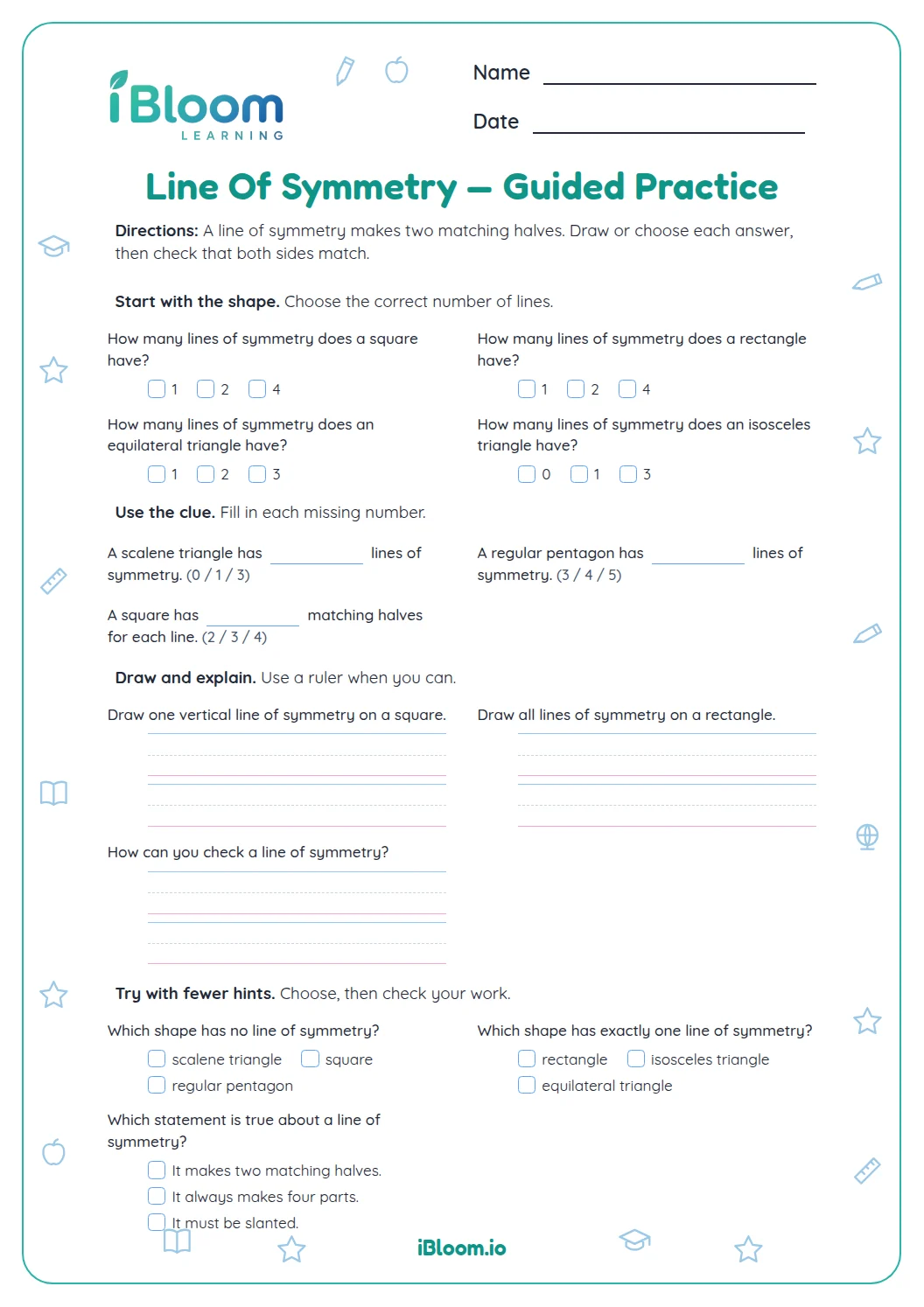 Line Of Symmetry — Guided PracticePrintable Grade 2 geometry worksheets for identifying, drawing, and checking lines of symmetry in shapes and simple pictures. This Grade 2 guided-practice worksheet progresses from prompts and checkpoints to independent questions.Grade 2Free PDF preview
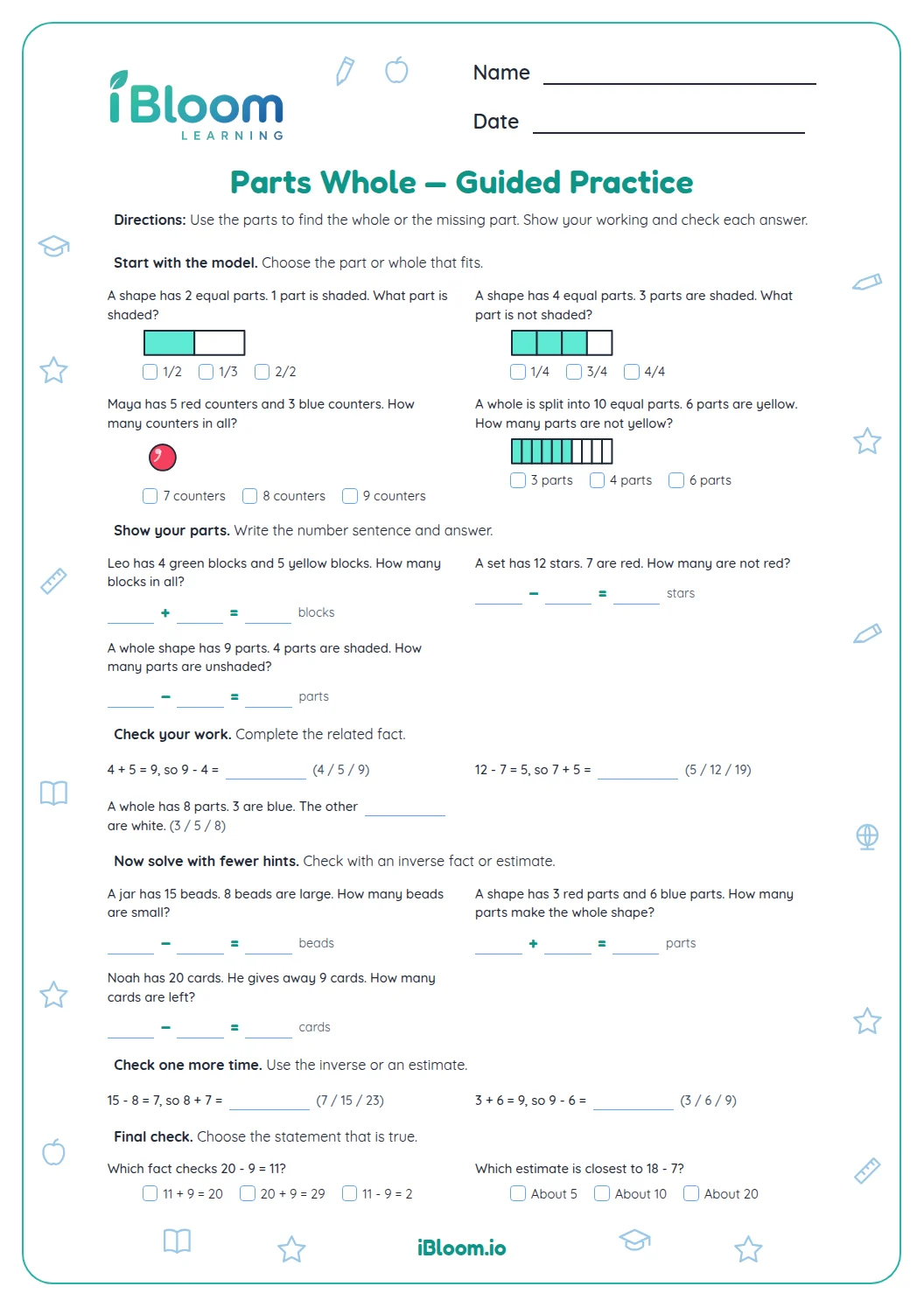 Parts Whole — Guided PracticeGrade 2 children build part-whole thinking by splitting shapes and sets into meaningful parts and explaining how the parts make one whole. This Grade 2 guided-practice worksheet progresses from prompts and checkpoints to independent questions.Grade 2Free PDF preview
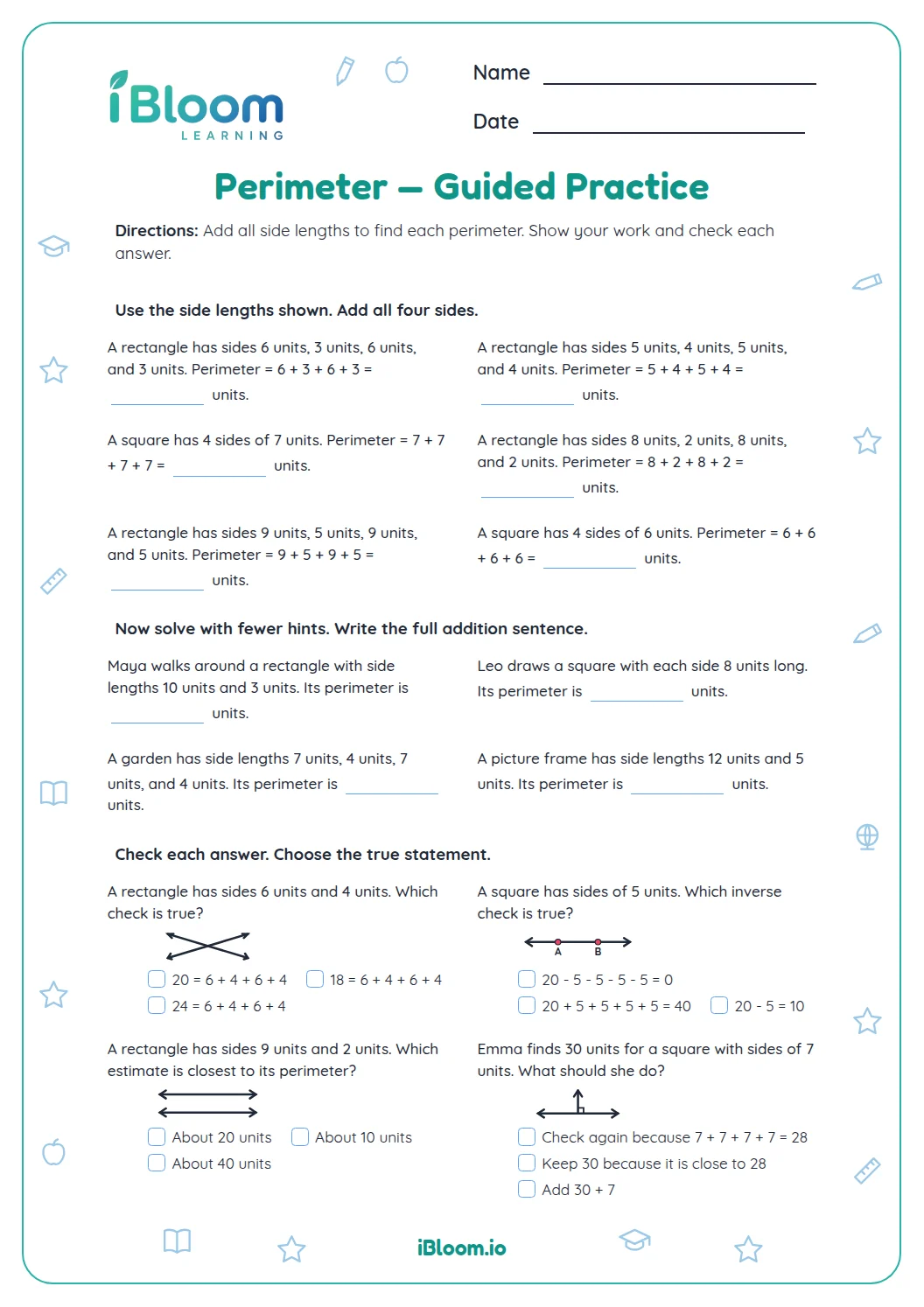 Perimeter — Guided PracticeExplore perimeter practice activities within Geometry Practice Activities, organised so children, families, and elementary teachers can move from broad learning areas to focused printable practice. This Grade 2 guided-practice worksheet progresses from prompts and checkpoints to independent questions.Grade 2Free PDF preview
Practice that builds confidence
What Grade 2 geometry practice covers
These Grade 2 math geometry worksheets help children move from simply naming shapes to describing, building, comparing, and measuring them. Students practise identifying 2D shapes, recognizing 3D shapes, naming faces, edges, and vertices, and noticing how parts can make a whole shape.
The printable activities include shape sorting, drawing, matching, counting, and grid-based tasks. Children work with congruent shapes, lines of symmetry, composing and decomposing rectangles, early area ideas, and perimeter in a clear progression.
In the Math > Grade 2 > Geometry collection, children strengthen the language and reasoning needed to describe shapes precisely. They identify 2D shapes such as triangles, rectangles, squares, and other polygons, then connect those flat shapes to 3D shapes by studying faces, edges, and vertices. Worksheets may ask students to count corners, trace sides, compare shapes, or decide which shapes share the same attributes.
From shape names to shape relationships
The practice moves beyond naming. Students explore part-whole thinking by seeing how smaller shapes can fit together to make a larger one. Composing and decomposing rectangles supports early area understanding because children see rows, columns, and equal-size squares as parts of a whole. Congruent shapes are introduced through matching and comparison, helping children notice when shapes are the same size and same shape even if they are turned.
Measurement ideas: area, perimeter, and symmetry
Area and perimeter are introduced visually. Children may count square units to find area or count the distance around a rectangle to understand perimeter. Line of symmetry tasks ask students to fold, draw, or complete shapes so both sides match. These activities build spatial reasoning and give children useful vocabulary: side, corner, face, edge, vertex, equal parts, whole, congruent, area, perimeter, and symmetry.
A simple parent routine
At home, choose one worksheet and one real object. Ask, “What shape do you see? How do you know?” Count sides or vertices together, then compare it with another object such as a box, book, tile, or window. For rectangle work, let your child cover a small drawn rectangle with equal squares, then count around the outside for perimeter. End with one sentence: “I know this is a ___ because ___.”
Classroom uses for teachers
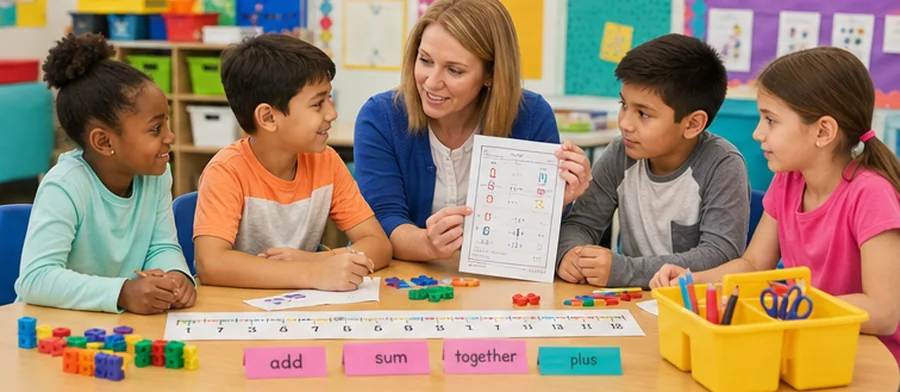
Teachers can use these printables in geometry centers, small-group reteaching, morning review, or as follow-up after hands-on work with pattern blocks, geoboards, cubes, and classroom solids. They also work well for quick checks: one page can show whether a student is confusing edges with vertices, counting area squares carefully, or recognizing a line of symmetry.
Free printable PDF download
Use this grade 2 geometry worksheet page to preview the activity, print it, or download it as a PDF for quick practice. It works well for homework, homeschool lessons, tutoring, morning work, revision, and classroom centers.
Answers and answer key support
After the child completes the worksheet independently, parents and teachers can use the answer support or answer key information to check the work, review mistakes, and choose the next practice step.
Why iBloom worksheets help
iBloom worksheets are designed to make abstract geometry visible. The pages vary the representation—pictures, grids, outlines, and shape combinations—so children do not rely on memorizing one familiar image. Watch for common errors such as calling every four-sided shape a square, counting faces as edges on 3D shapes, mixing up area and perimeter, or thinking a turned shape is no longer congruent. A child-friendly strategy is: “Name it, count it, check it.” Name the shape, count the important parts, then check whether the description still fits if the shape is moved or turned.
Helpful answers
Frequently asked questions
What geometry skills are included in these Grade 2 worksheets?
They cover identifying 2D shapes, exploring 3D shapes, counting faces, edges, and vertices, recognizing congruent shapes, composing and decomposing rectangles, finding area and perimeter, and working with lines of symmetry.
How can I help my child understand faces, edges, and vertices?
Use a box or cube. A face is a flat surface, an edge is where two faces meet, and a vertex is a corner. Have your child touch each part while counting it before moving to the worksheet.
What is the difference between area and perimeter for Grade 2 students?
Area is the space covered inside a shape, often counted with square units. Perimeter is the distance around the outside of a shape, often found by counting or adding side lengths.
Why do the worksheets include composing and decomposing rectangles?
Building and breaking apart rectangles helps children see how equal parts make a whole. It also prepares them for area because they begin to notice rows, columns, and repeated square units.
How should teachers use these geometry printables in class?
They can be used after hands-on shape exploration, in math centers, for small-group review, or as quick checks to see whether students understand shape attributes, symmetry, area, and perimeter.
Is this grade 2 geometry worksheet free?
Yes. You can preview it for free and use the printable worksheet for home or classroom practice.
Can I download this grade 2 geometry worksheet as a PDF?
Yes. Use the worksheet download option to save a printable PDF, or print the worksheet directly from the page.
Does this grade 2 geometry worksheet include answers or an answer key?
When the activity has fixed answers, iBloom includes answer support so parents and teachers can check the completed worksheet.