
About this worksheet
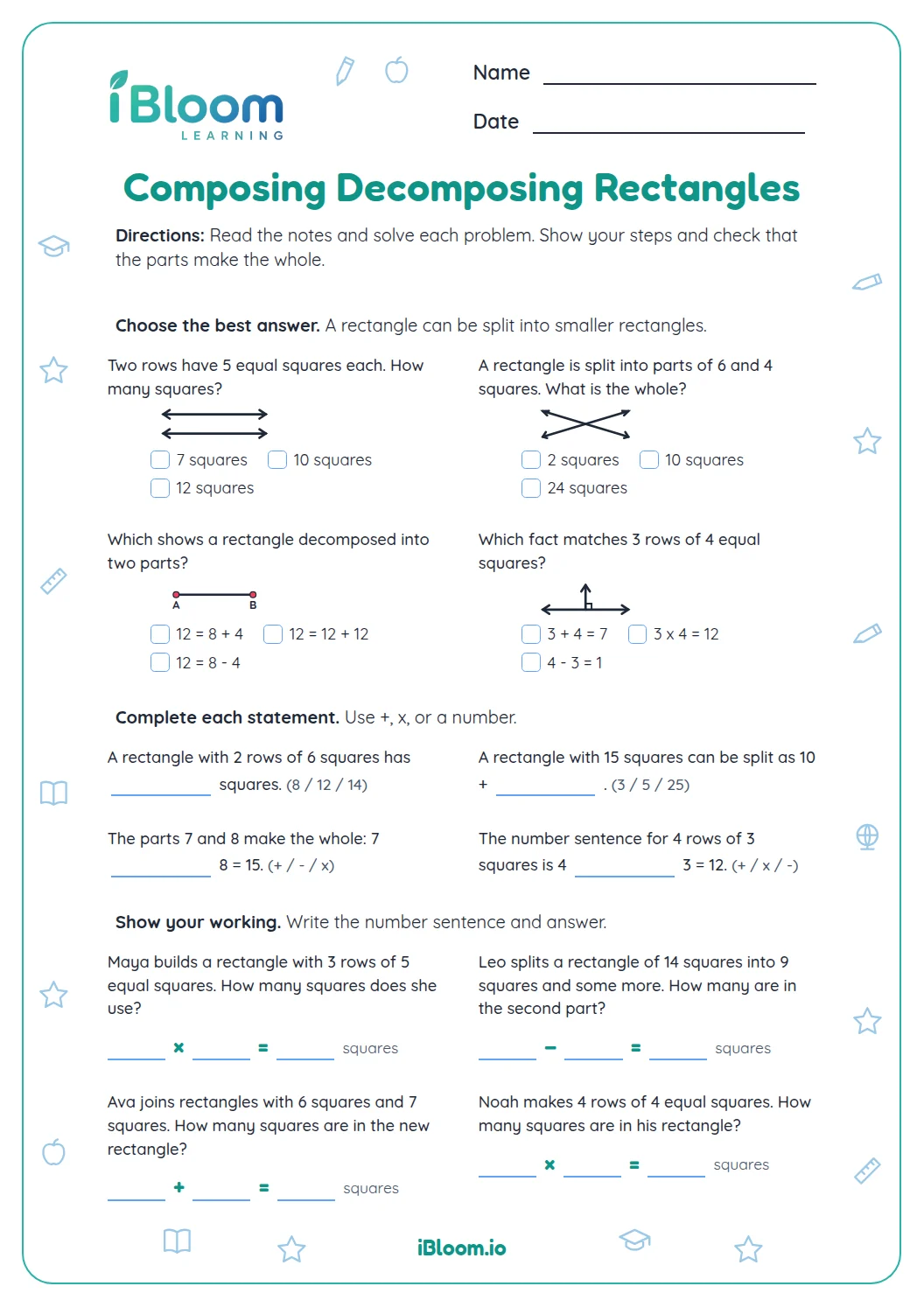
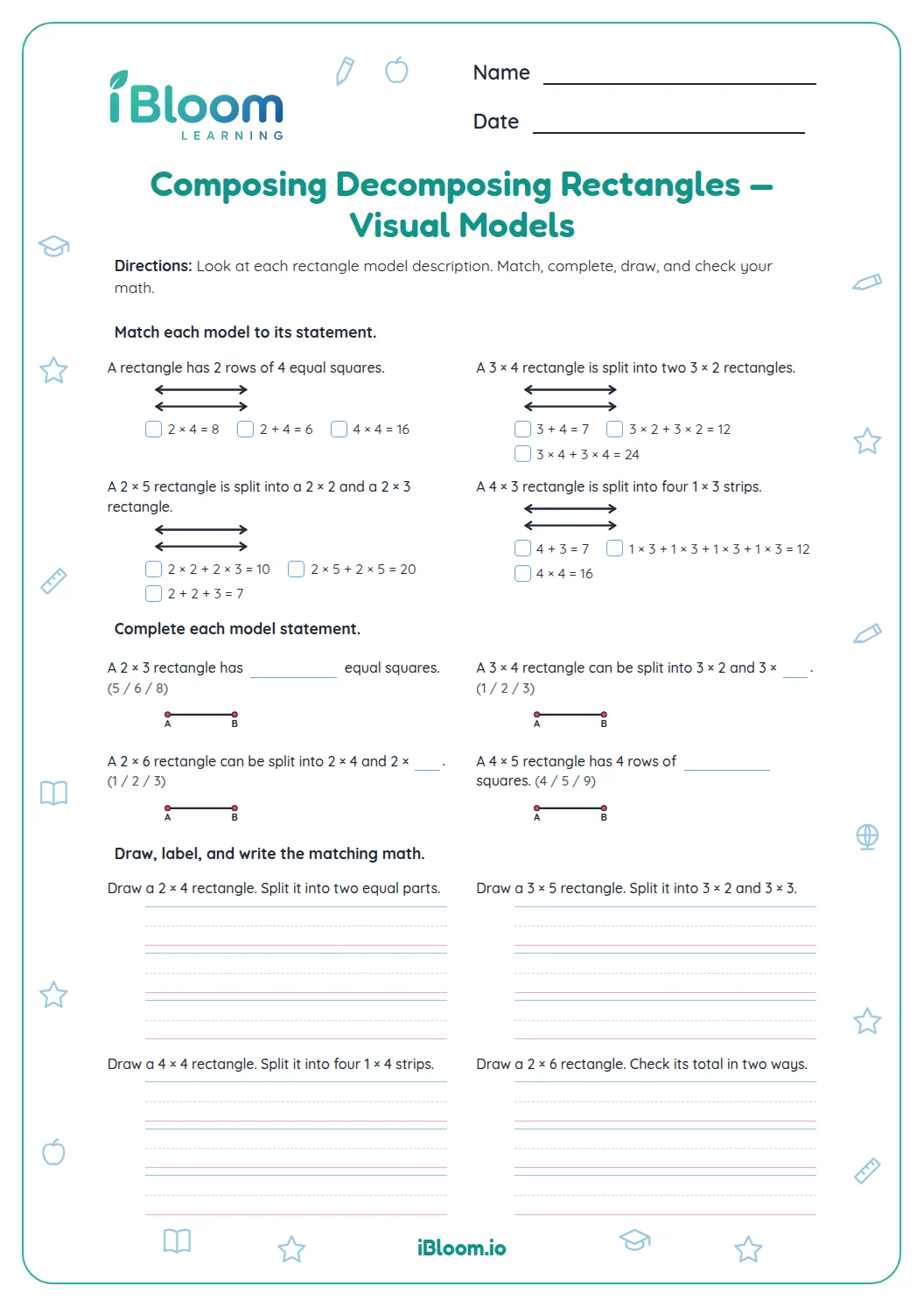
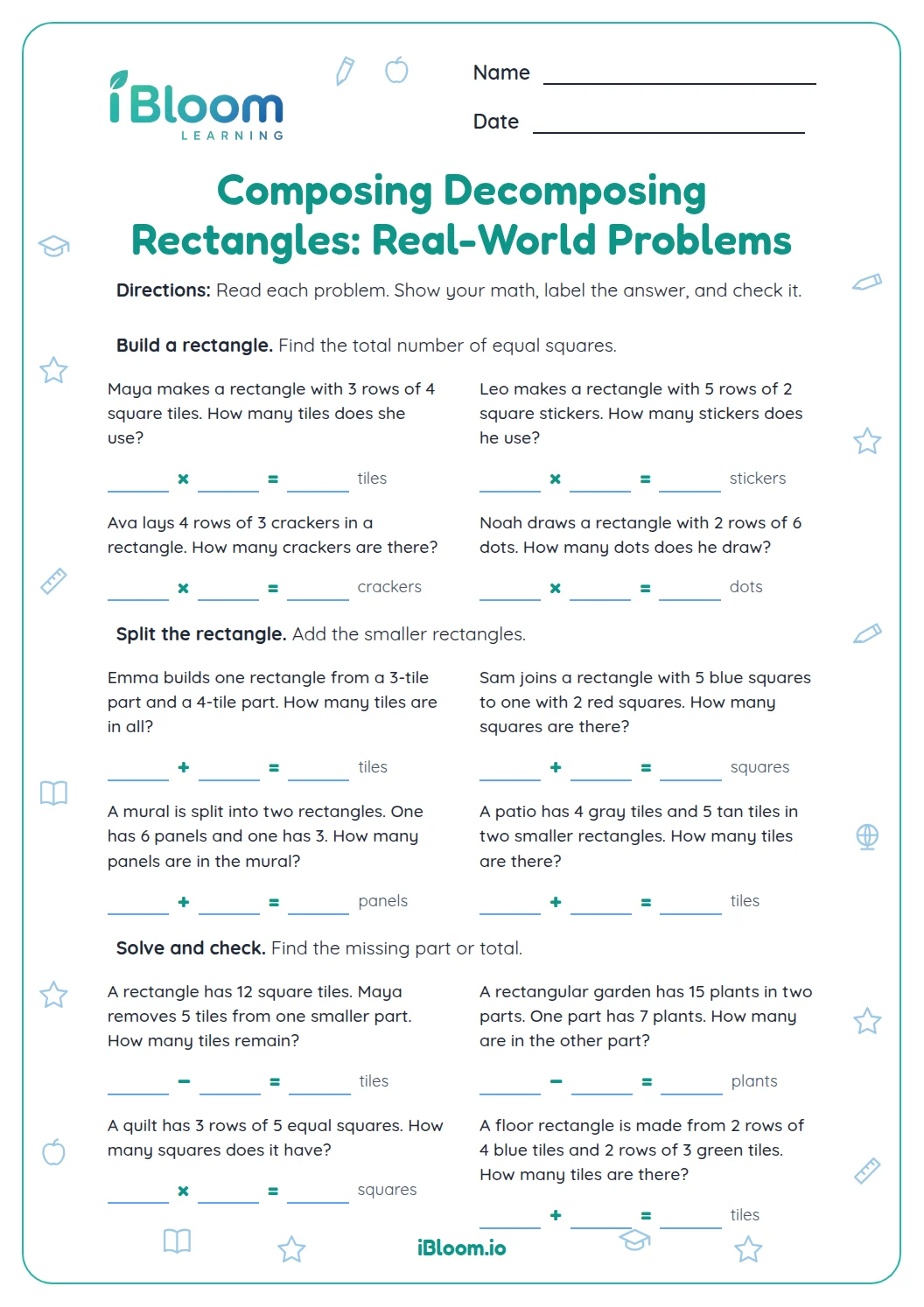
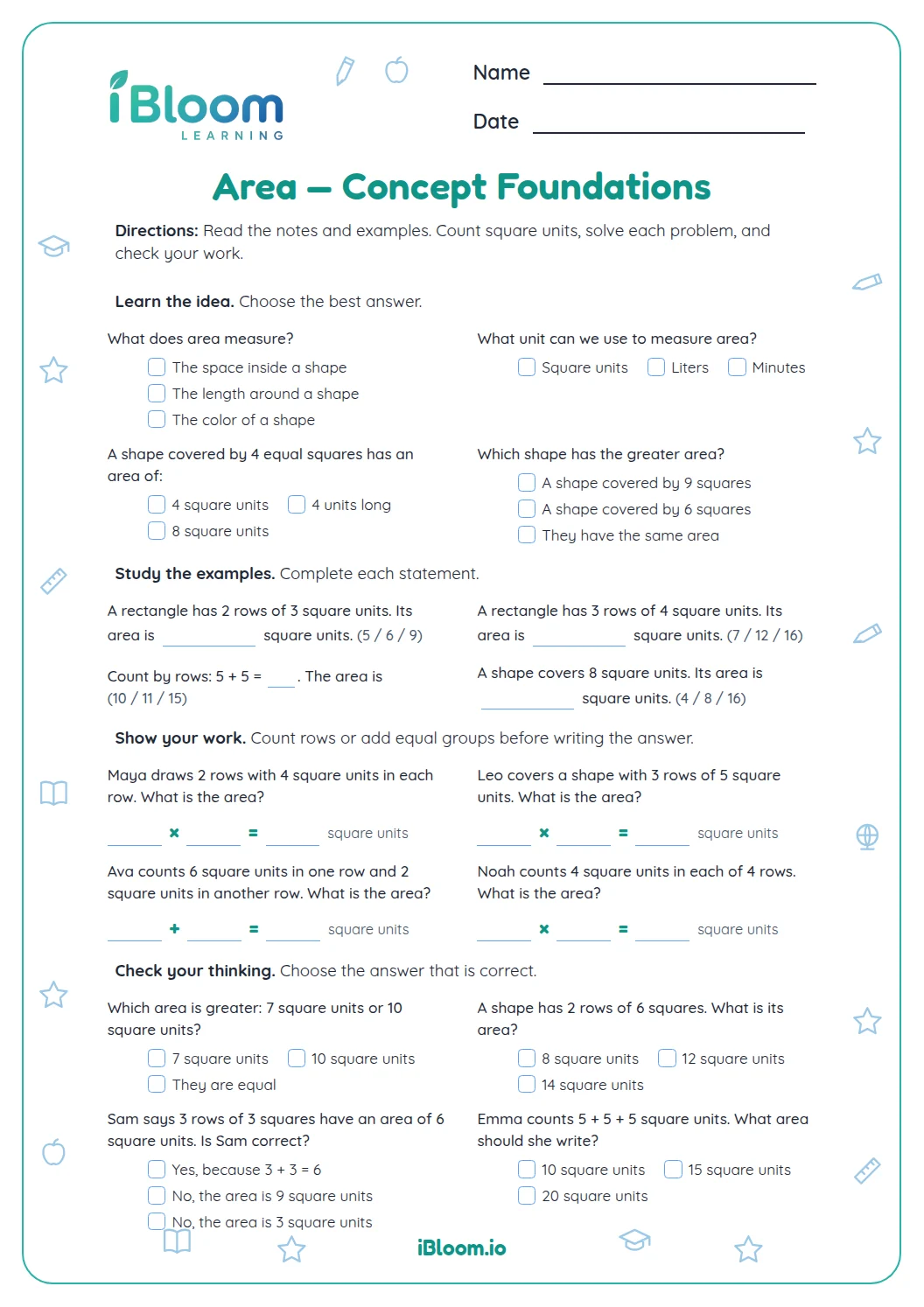
This free printable gives Grade 2 students 16 multiple-choice questions about composing and decomposing rectangles. Four early questions use unit-square grids; later items ask students to join rectangles along a stated side, find equal pieces, and choose the correct dimensions for a split. The work practices CCSS 2.G.A.2 by partitioning rectangles into rows and columns of same-size squares and counting them. A separate key marks each correct choice.
Aligned to 2.G.A.2
How do rows and columns help you count a rectangle?
A rectangle grid is a set of same-size unit squares arranged in rows and columns. Count the squares in each row, then combine the equal groups. The drawing in question 1 has 3 rows of 4 squares, so there are 12 unit squares altogether.
Keeping the row count and column count separate also helps when a rectangle is split. A cut between columns changes the number of columns in each piece; a cut between rows changes the number of rows.
- 1Question 1 shows 3 rows with 4 squares in each row.
- 2Count 4 + 4 + 4.
- 3There are 12 unit squares.
How can you tell what rectangle two pieces will make?
Look for the side the pieces share. In question 7, each 2-by-3 rectangle shares a 2-unit side, so the 3-column widths join: the new rectangle is 2 rows by 6 columns. If the 3-unit side is shared instead, the row counts join.
For a split, reverse the reasoning. Divide only the dimension crossed by the cut; the other dimension stays the same.
What will students practice in each part?
Part A has eight questions, including four grids for counting squares or reading rows and columns. Part B has eight join-and-split situations with the shared side or cut named in each prompt. The multiple-choice format keeps the focus on rectangle dimensions and equal parts.
The rectangle drawings are compact models for counting and partitioning. Students can sketch a cut on scrap paper if they want to see how the pieces fit.
How to work through the rectangle questions
- 1Name the number of rows and columns before counting.
- 2For a grid, count equal squares one row at a time.
- 3When pieces join, find the length of the shared side; the other dimension grows.
- 4When a rectangle is split, keep the uncut dimension and divide the cut dimension.
- 5Check that the areas of all pieces add to the whole rectangle.
Common rectangle mistakes
The mistake
Adding both dimensions when two rectangles join.
The fix
Keep the shared side length and add only the widths or heights that meet.
The mistake
Changing both dimensions after a straight cut.
The fix
A cut through rows divides the row count; a cut through columns divides the column count.
The mistake
Counting grid lines instead of unit squares.
The fix
Count the spaces between lines in each row, then combine the rows.
Common Core alignment
These questions build rectangle partitioning through same-size square rows and columns.
Partition rectangles into equal square rows and columns, then count the squares.
On this sheet: The grid questions count same-size squares and reason about rectangle rows and columns.
Show the official wordingHide the official wording
Partition a rectangle into rows and columns of same-size squares and count to find the total number of them.
What to practice next
Make more practice
Further reading
Questions parents and teachers ask
How many questions are on the rectangle worksheet?
There are 16 multiple-choice questions in two parts. Four early items include grids for counting squares or reading rows and columns, and the later items ask students to join rectangles, split them into equal pieces, or find a missing part. The separate key marks every correct choice.
What is the answer to question 1?
Question 1 shows a shaded rectangle with 3 rows and 4 columns of unit squares. Counting 4 squares in each of the 3 rows gives 12 unit squares. The drawing makes the groups visible, so students can count row by row before working with rectangle dimensions in words.
How do students know which dimensions change when rectangles join?
The prompt names the length of the shared side. Keep that side length as one dimension, then add the lengths that extend away from it. For example, two 2-row by 3-column rectangles sharing a 2-unit side make a 2-row by 6-column rectangle.
Does the worksheet include an answer key?
Yes. The key marks the correct choice for all 16 questions, including the dimensions of each split or joined rectangle. Each item has one best answer because the prompt names the shared side, the cut, or the quantity to find. Students can compare their selection with the grid when one is provided.
What standard does this page practice?
The worksheet practices CCSS 2.G.A.2: partitioning a rectangle into rows and columns of same-size squares and counting the total. The early questions use actual grid drawings, and the later prompts apply the same row-and-column reasoning to rectangles that are joined or split.