

About this worksheet
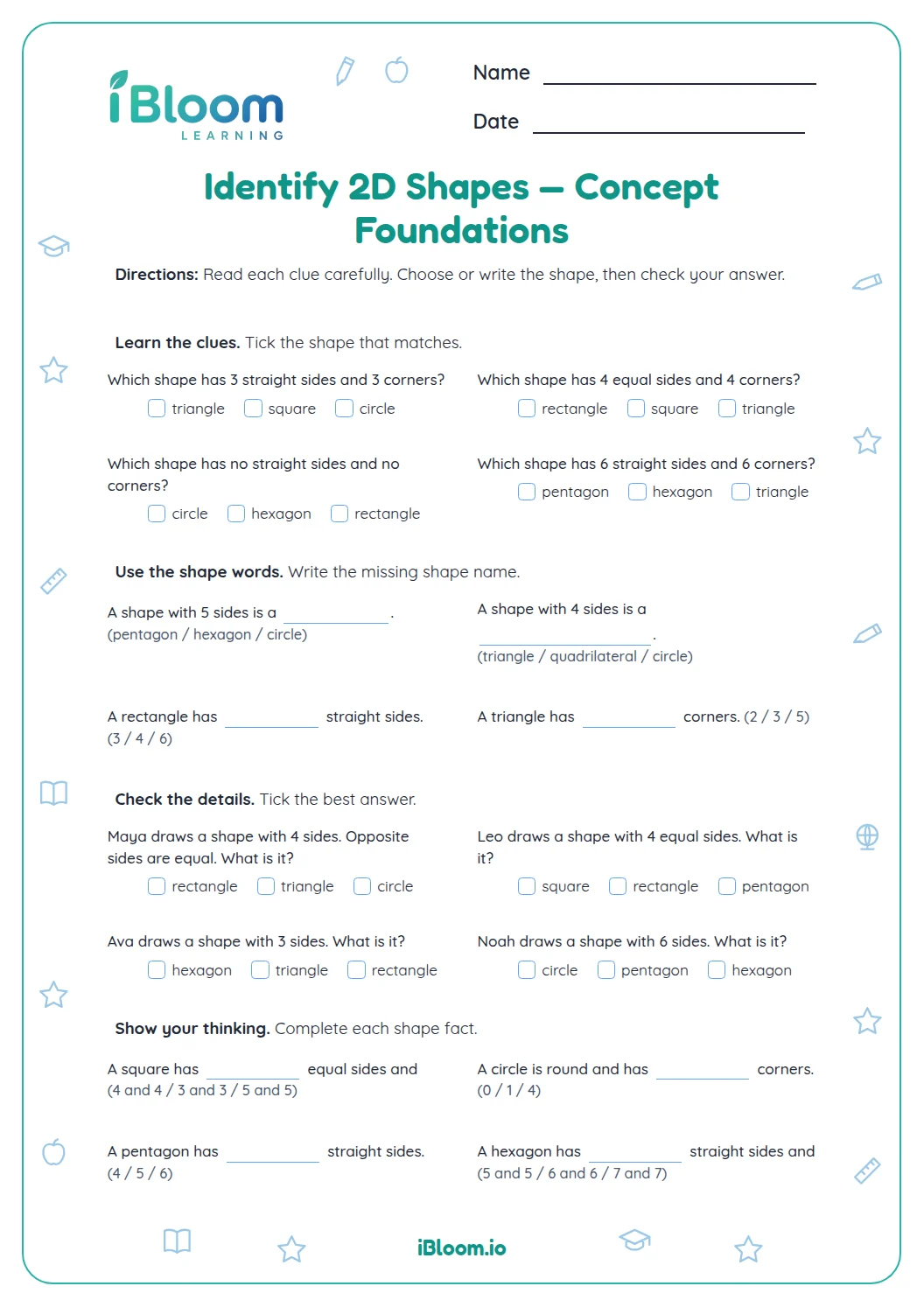
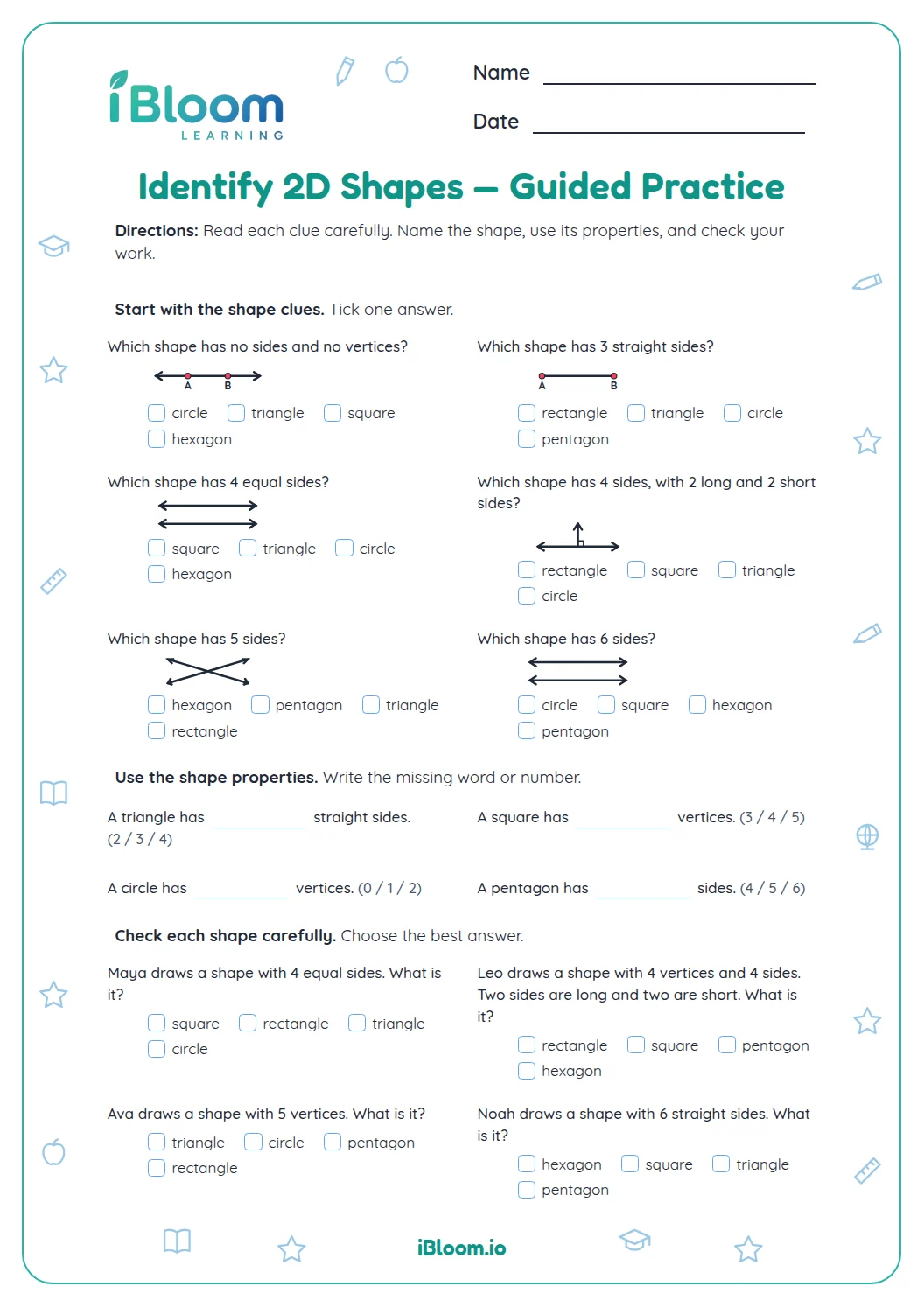
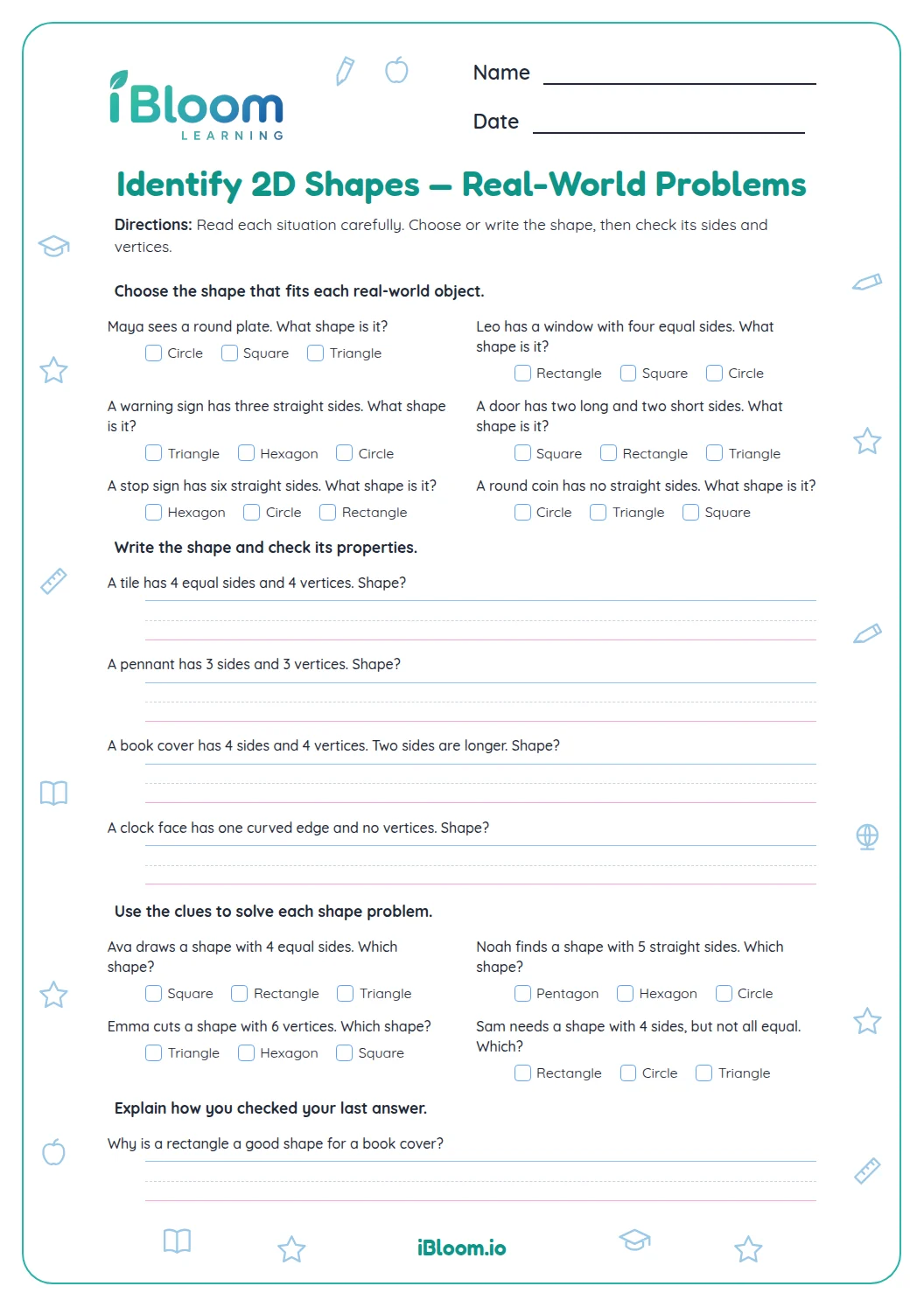
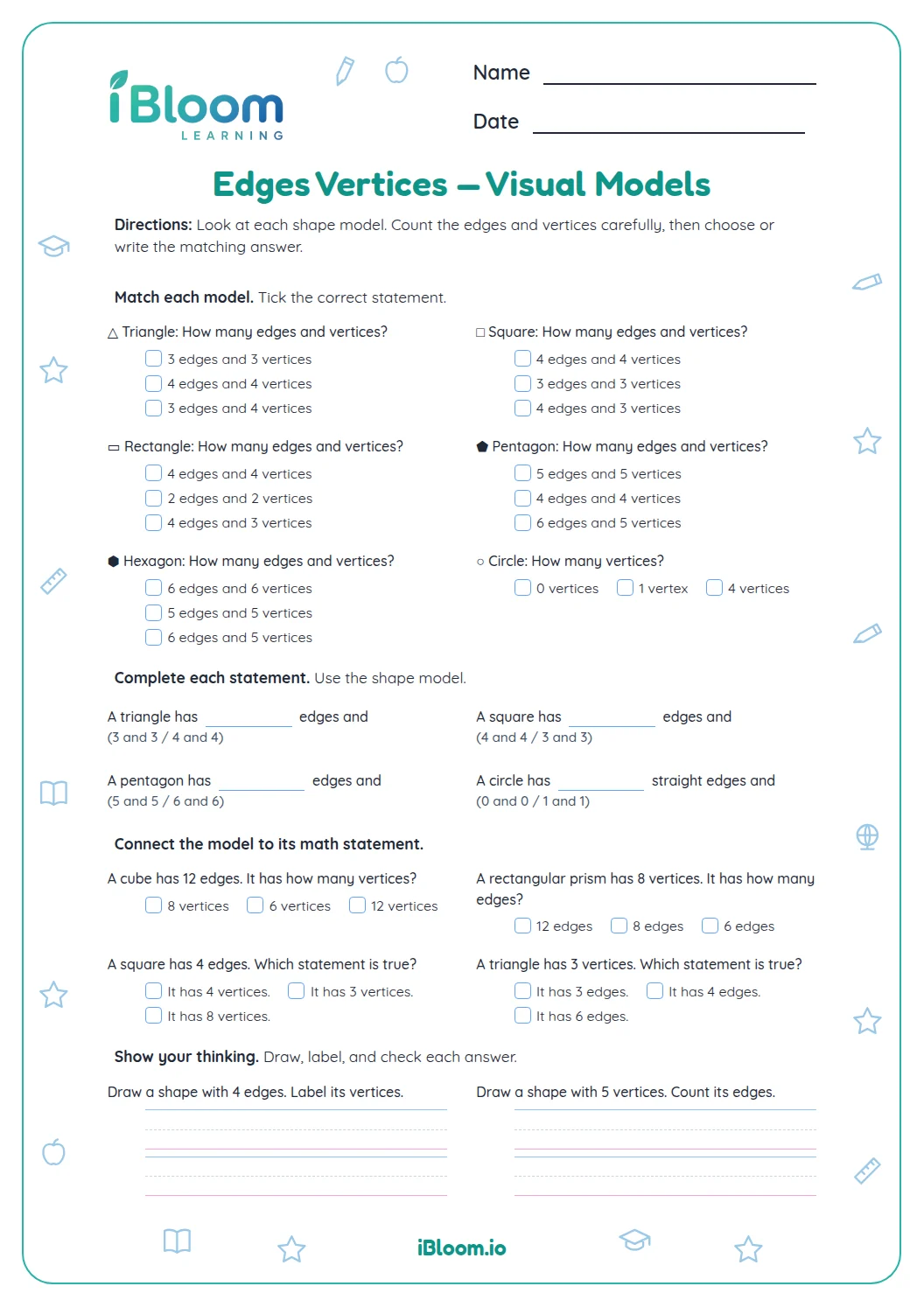
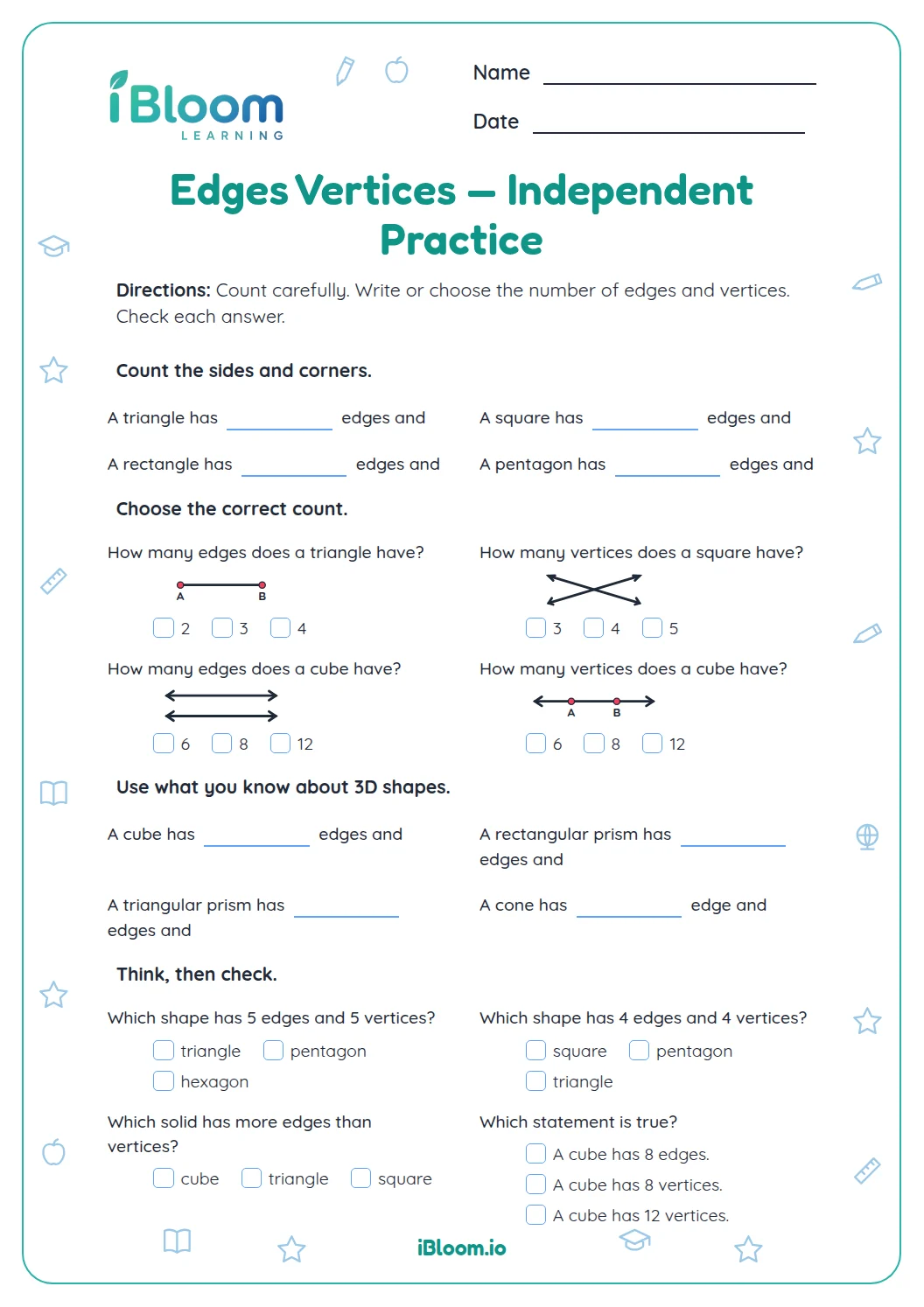
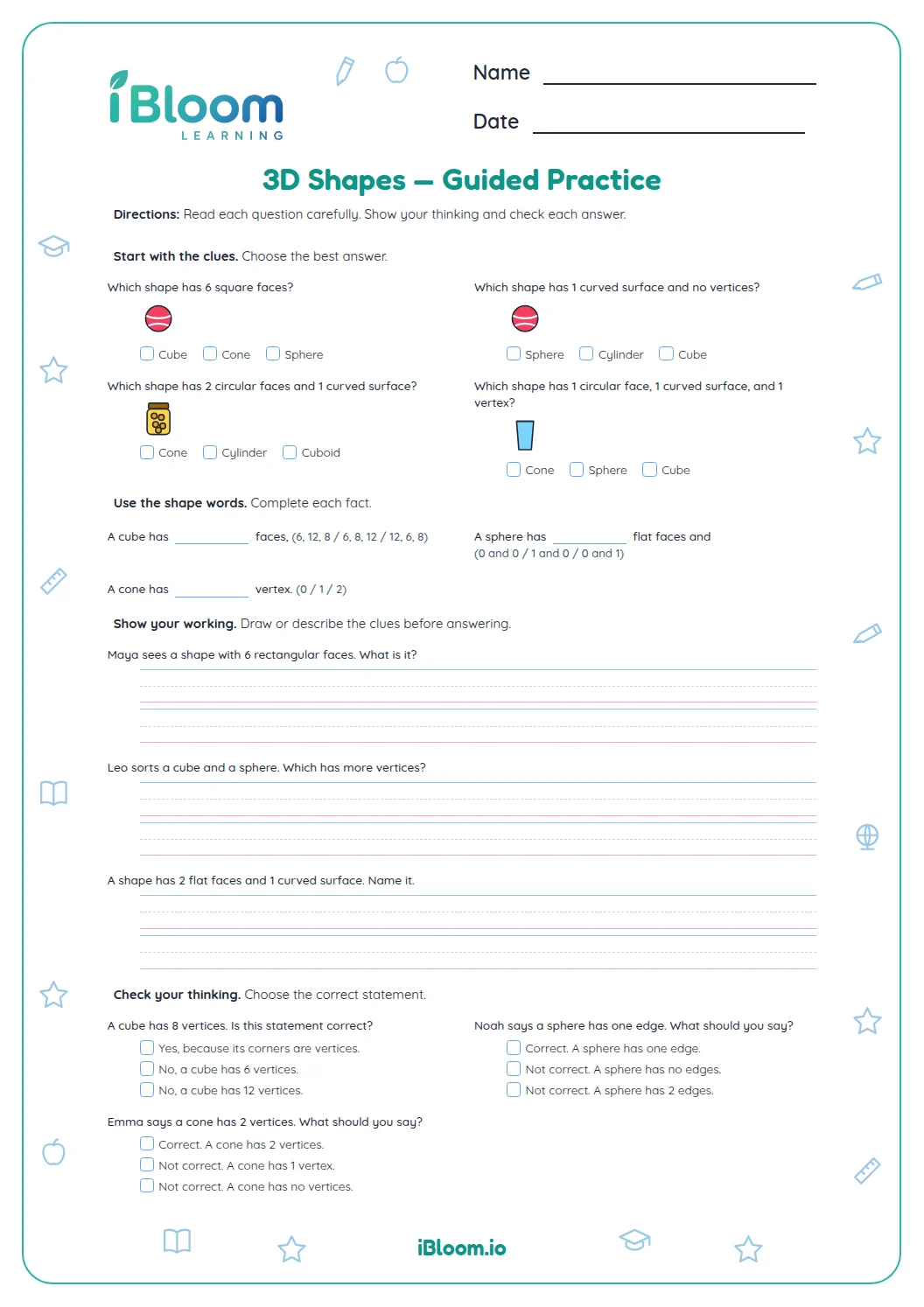
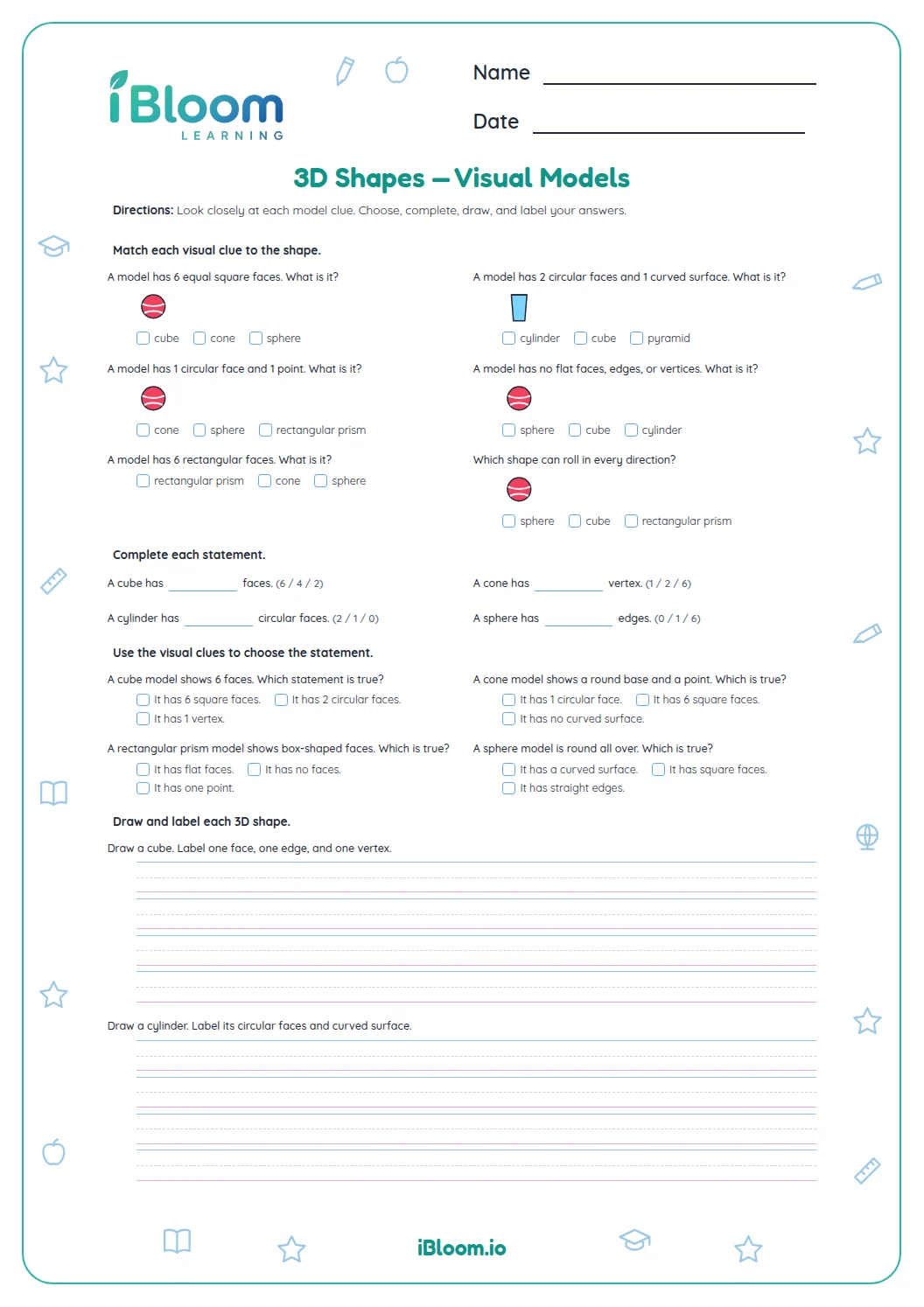
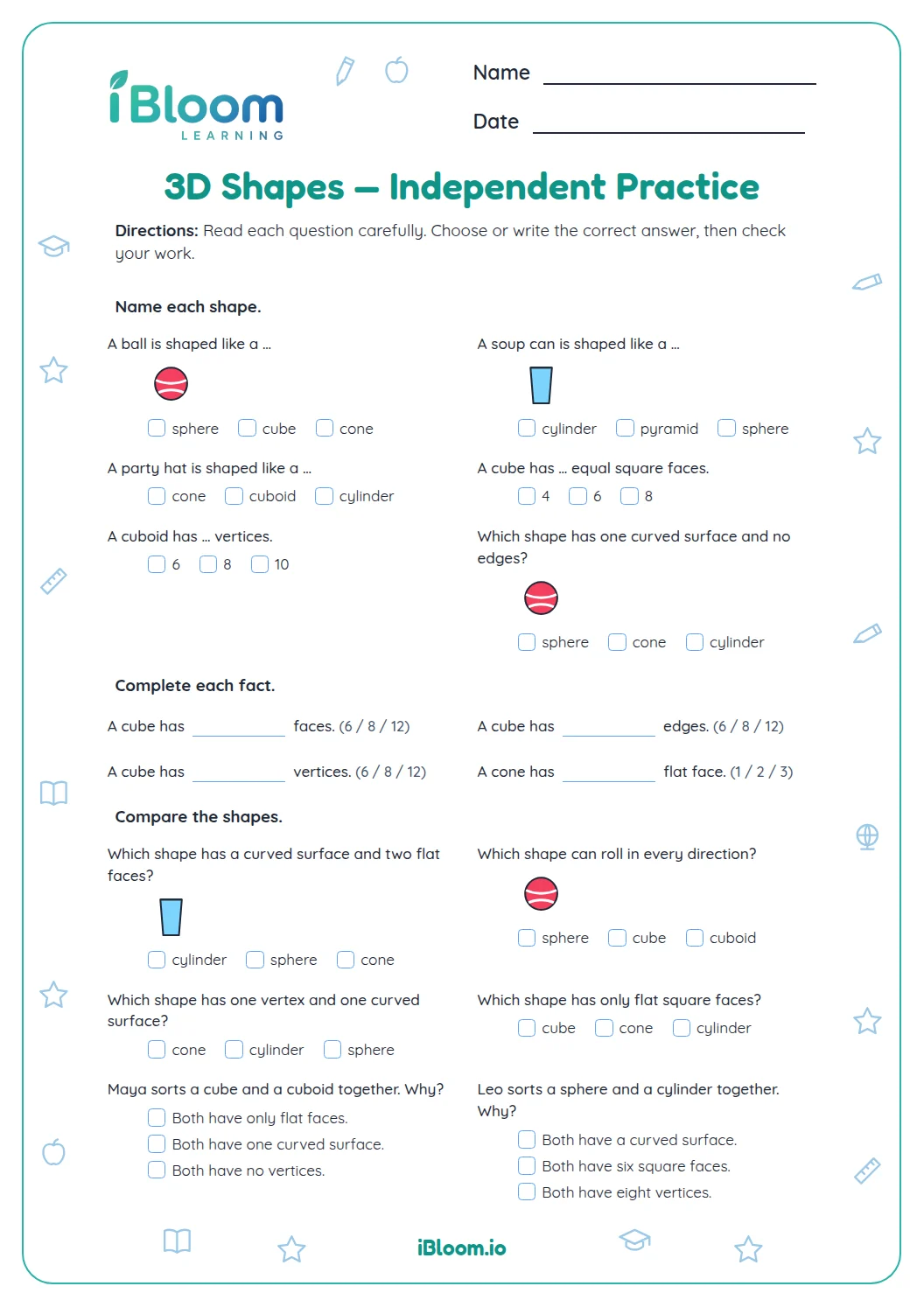
This Grade 2 printable has 14 questions about two-dimensional shape names and attributes. Students read a labeled shape model, recognize polygons and a circle, and use side and corner counts to identify or classify shapes. A separate answer key lists the correct choices.
Aligned to CCSS.Math.Content.2.G.A.1
How do the drawings support shape names?
Part A shows a labeled set of a triangle, square, and circle. Students identify the shape named by its letter. The remaining questions use shape names and attribute clues to review sides, corners, and equal sides.
How can side and corner counts identify a shape?
A hexagon has six straight sides, so question 3 is answered by counting its sides. A circle has no straight sides and no corners, which helps distinguish it from the polygons in the other questions.
Which attributes should students notice?
Count straight sides and corners, and notice equal sides when the question asks about a square. The name quadrilateral describes the group of shapes with four straight sides.
How to use this worksheet
- 1Look at the whole drawing before choosing a shape name.
- 2Count straight sides, then count corners.
- 3Use equal-side clues when the question asks about a square.
- 4Match the shape name to its defining count or property.
- 5Check each response with the answer key after finishing.
Common mistakes and quick fixes
The mistake
Counting a curved edge as a straight side.
The fix
Trace around the shape and count only straight boundary segments.
The mistake
Mixing up a shape’s sides and corners.
The fix
Count each straight segment and each meeting point separately.
The mistake
Calling every four-sided shape a square.
The fix
A quadrilateral has four sides; a square has four equal sides as well.
Curriculum alignment
This practice aligns with the following Common Core standard.
Students identify and compare flat shapes by their sides and corners.
On this sheet: The questions identify triangles, quadrilaterals, pentagons, and hexagons and count their visible attributes.
Show the official wordingHide the official wording
Recognize and draw shapes having specified attributes, such as a given number of angles or a given number of equal faces. Identify triangles, quadrilaterals, pentagons, hexagons, and cubes.
What to practice next
Make more practice
Further reading
Questions parents and teachers ask
What shapes are practiced on this Grade 2 sheet?
Students work with triangles, squares, rectangles, circles, pentagons, hexagons, and quadrilaterals. Drawings and written clues ask them to name shapes or use the number of sides and corners. Invite the student to count the sides aloud and explain which clue identifies the shape.
How can a student tell a square from a rectangle?
Both have four sides and four corners. A square has four equal sides, while a rectangle does not need all four sides to be equal; this worksheet asks students to notice the equal-side clue. Invite the student to count the sides aloud and explain which clue identifies the shape.
What is a quadrilateral?
A quadrilateral is a shape with four straight sides. Squares and rectangles are examples, so the group name is broader than either specific shape name. Invite the student to count the sides aloud and explain which clue identifies the shape.
How many questions are included?
There are 14 questions on two worksheet pages, with a separate two-page answer key. They include a labeled visual model, shape recognition, side and corner counts, and a few property clues. Invite the student to count the sides aloud and explain which clue identifies the shape.
What should students do if two shape names seem possible?
Return to the exact clue and count carefully. A four-sided shape belongs to the quadrilateral group, while a square also has four equal sides; the drawing or wording helps decide how specific the answer should be. Invite the student to count the sides aloud and explain which clue identifies the shape.