

About this worksheet
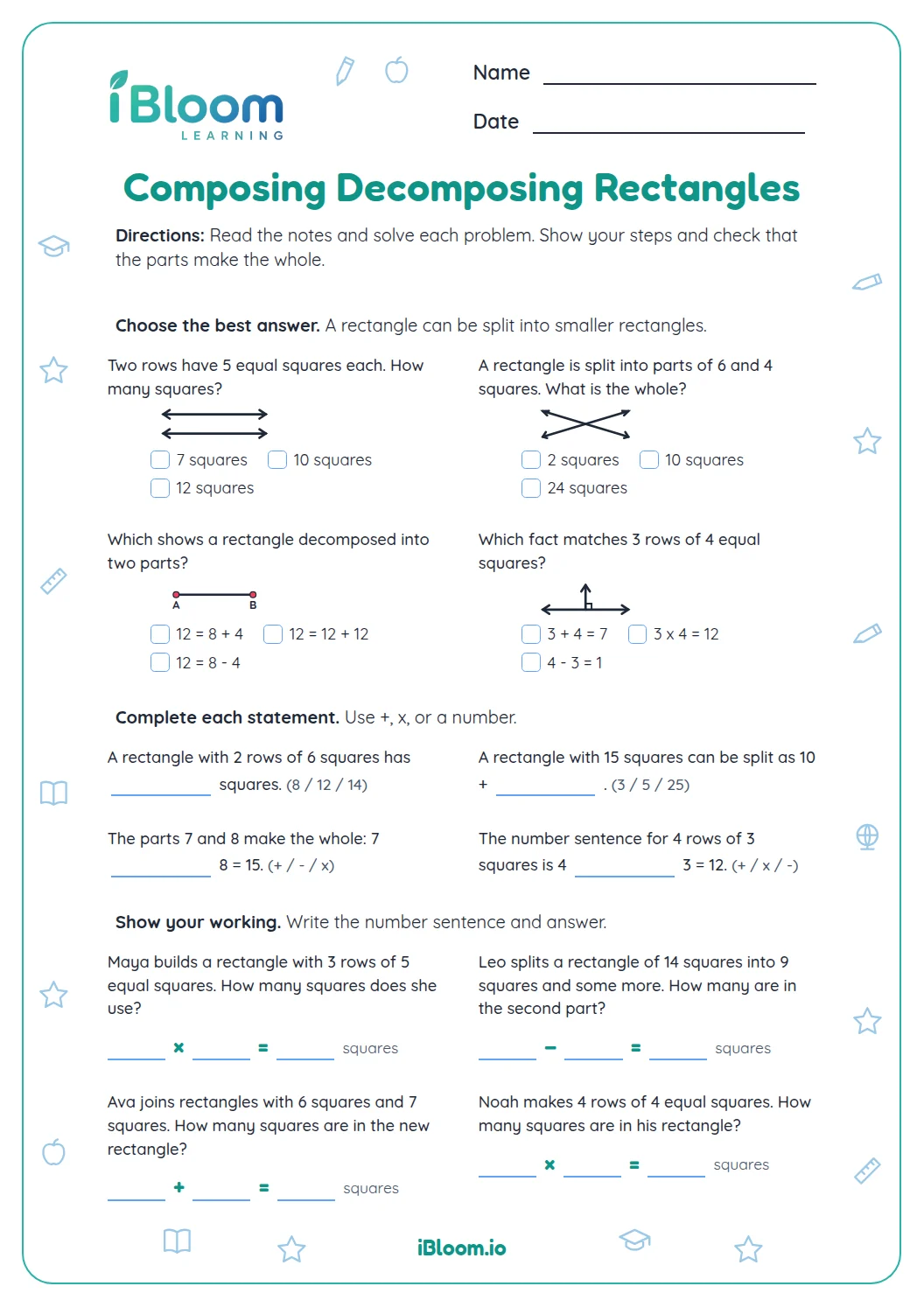
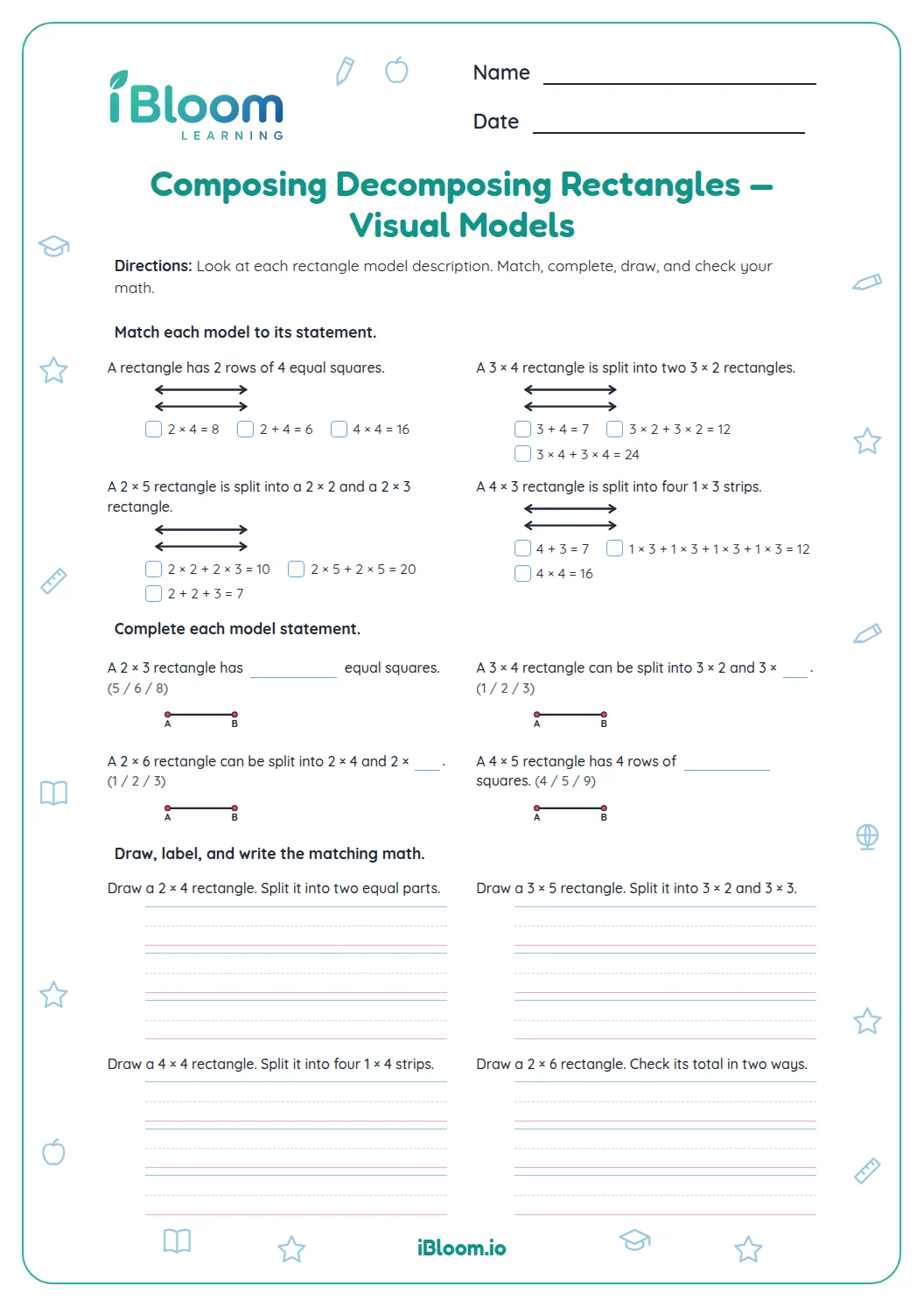
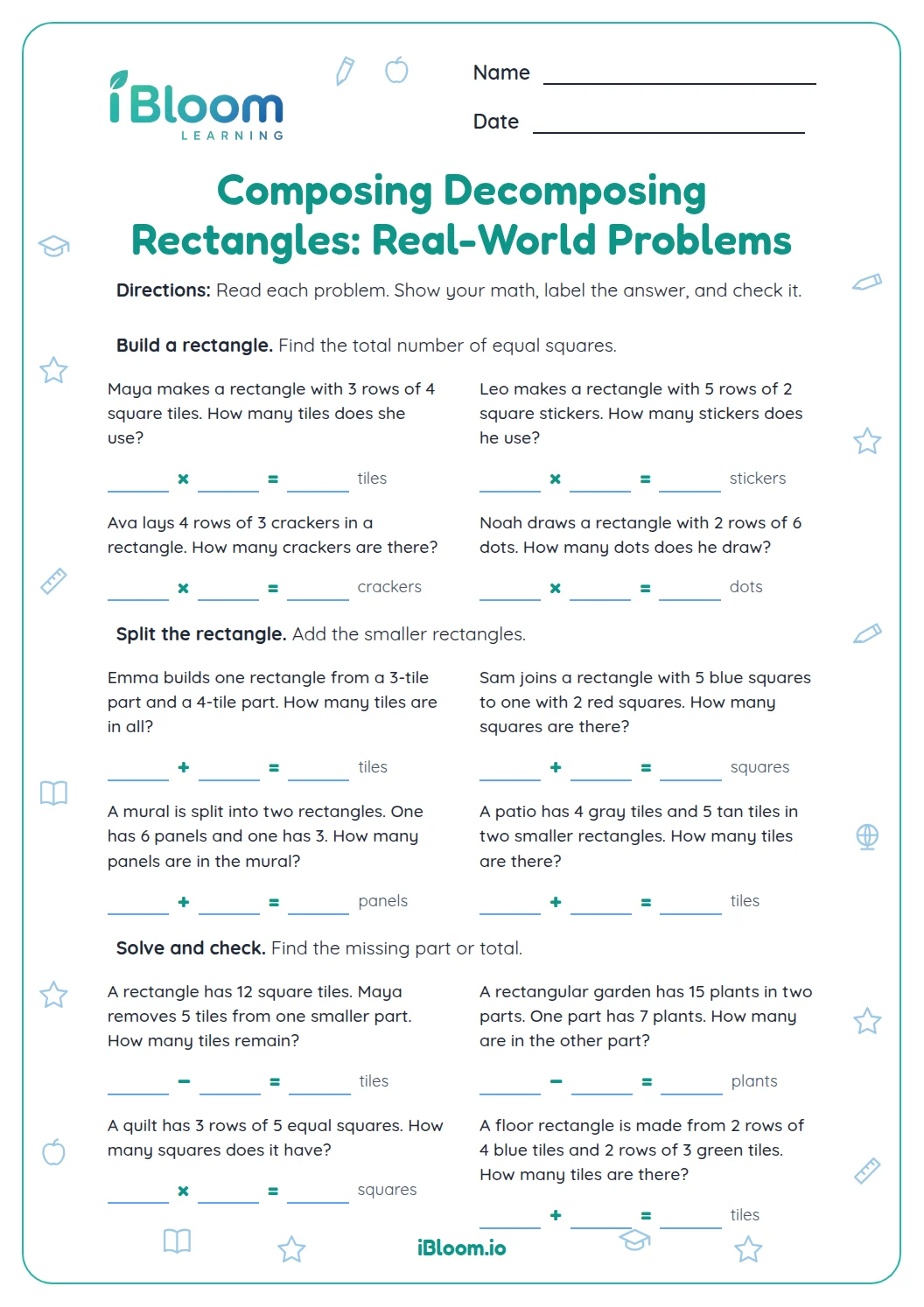
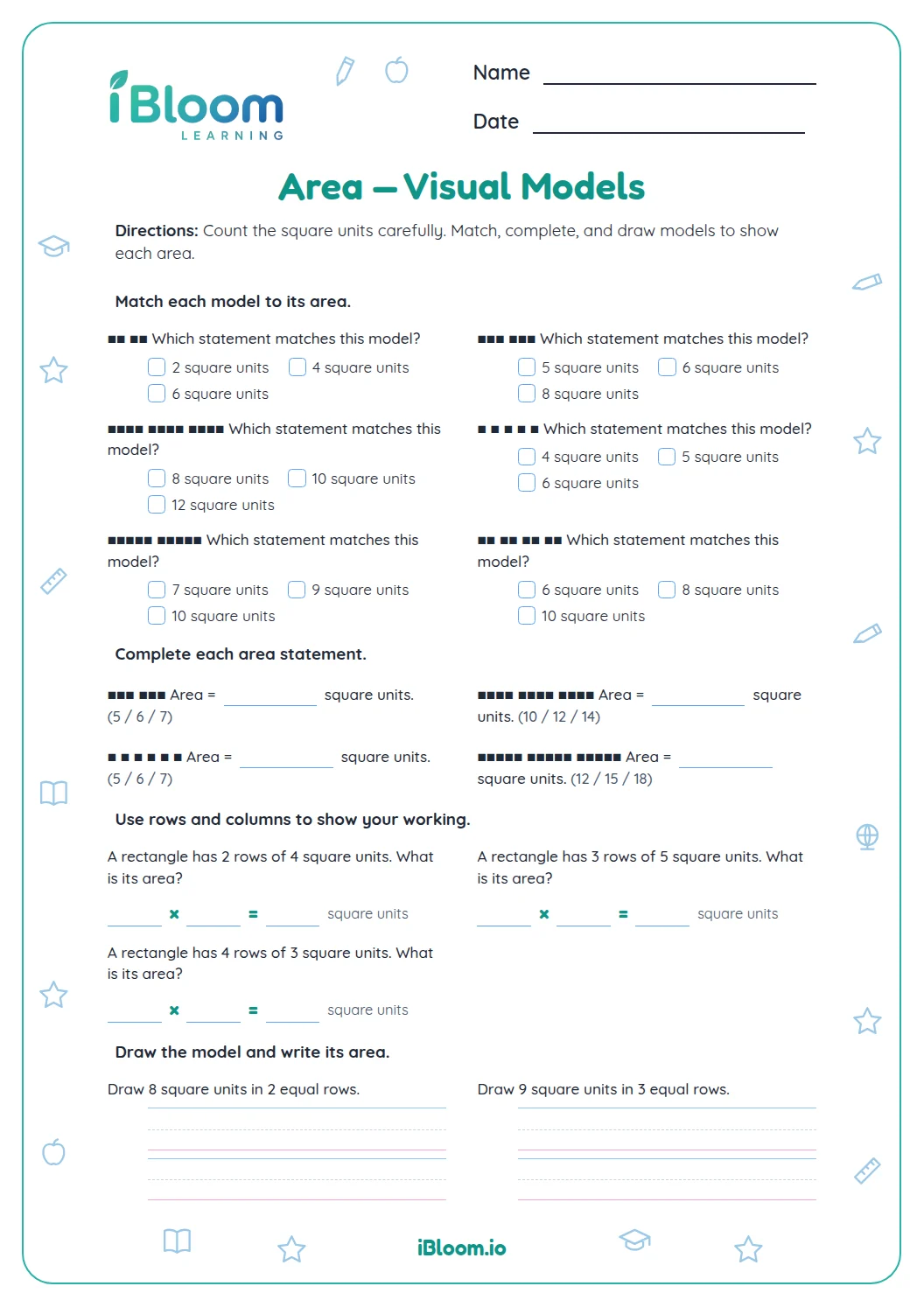
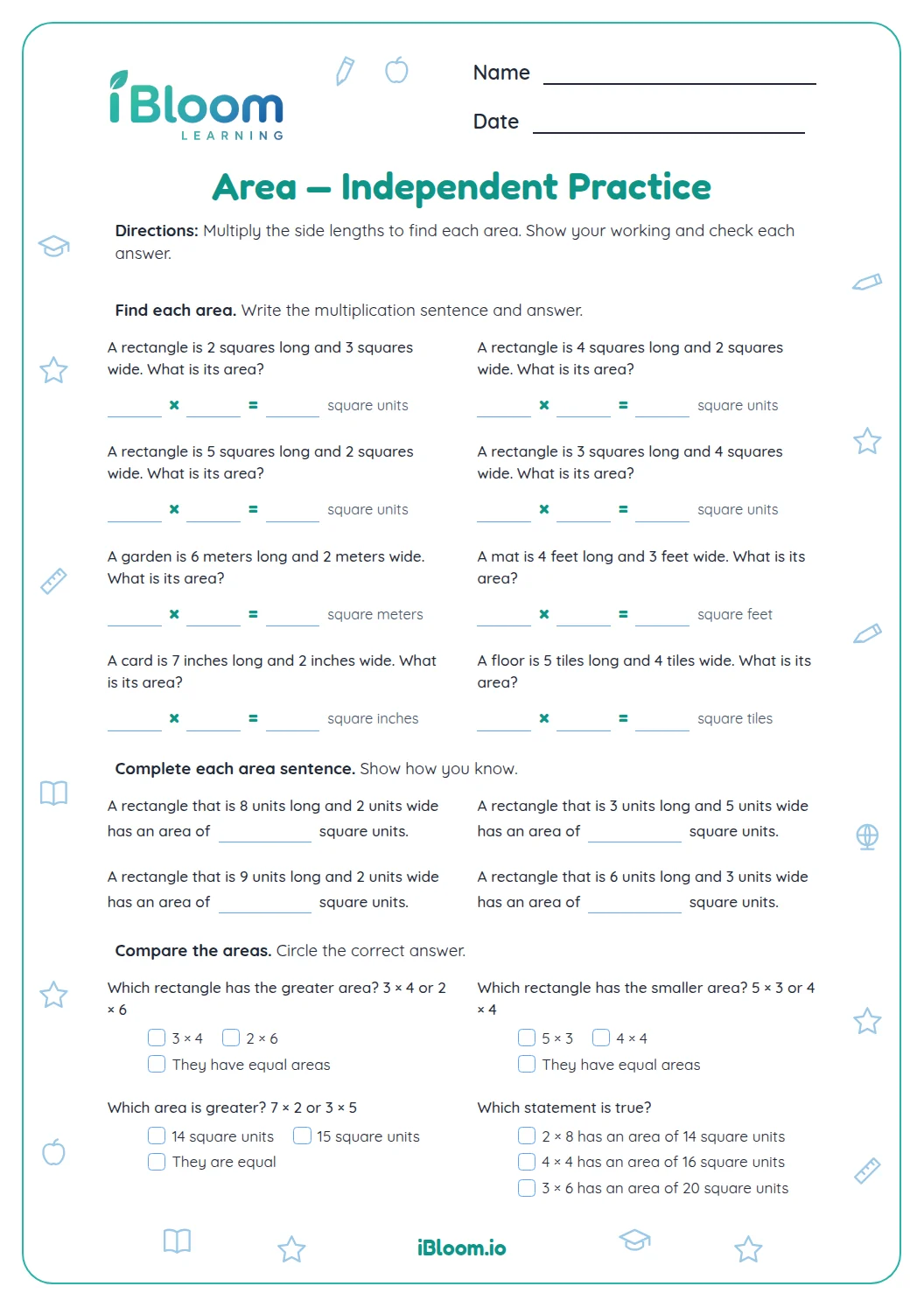
This Grade 2 worksheet builds rectangle composition from unit squares. Students count shaded grids, relate rows to totals, describe rectangle splits with repeated addition, and find a missing part. The page practices CCSS 2.G.A.2, partitioning rectangles into rows and columns of equal squares and counting them. A separate answer key is included.
Aligned to 2.G.A.2
How do rows and columns make a rectangle?
Each small square is one unit square. Counting the rows and the squares in each row gives the total, as in the first two shaded-grid questions.
How can a rectangle be split into smaller rectangles?
A 4 by 6 rectangle has 24 unit squares. Split it into two 4 by 3 rectangles. Each part has 12 squares, and 12 + 12 = 24. The number sentence on the worksheet is completed by adding the repeated row counts.
- 1Each 4 by 3 part has 12 unit squares.
- 2Add the two parts: 12 + 12 = 24.
How can a missing part complete the rectangle?
Keep the total number of rows or columns in view. If eight rows are split into three and another part, the missing part is five rows because 3 + 5 = 8.
How to work through the rectangle models
- 1Count shaded unit squares in each grid.
- 2Use rows and squares per row to check a total.
- 3Find the square count in each smaller rectangle.
- 4Add the parts to check the whole rectangle.
- 5Use addition to find a missing row or square count.
Rectangle counting mistakes to watch for
The mistake
Counting only the rows or only the squares in one row.
The fix
Use both counts: rows × squares in each row.
The mistake
Adding the two side lengths instead of counting every unit square.
The fix
Find the squares in each smaller rectangle, then add those totals.
The mistake
Changing the shared side length in a decomposition.
The fix
Keep that factor the same in both smaller rectangles and split the other side.
Common Core alignment
Use rows and columns to compose and decompose rectangles into unit squares.
On this sheet: Use rows and columns to compose and decompose rectangles into unit squares.
Show the official wordingHide the official wording
Partition a rectangle into rows and columns of same-size squares and count to find the total number of them.
What to practice next
Make more practice
Further reading
Questions parents and teachers ask
What is a unit square?
A unit square is one small square used as a single square unit. In the first two questions, count only the shaded unit squares. The rows and columns help check that no square is skipped or counted twice.
What does it mean to decompose a rectangle?
Decomposing means splitting one rectangle into smaller rectangles. A 4 by 6 rectangle can be split into two 4 by 3 rectangles. Each part has 12 unit squares, so 12 + 12 = 24 squares altogether. This example matches question 7 on the sheet.
Why does a split use repeated addition?
The smaller rectangles have square counts that add to the original total. For question 7, each 4 by 3 part has 12 unit squares, and 12 + 12 = 24. The repeated-addition sentence shows how the rows combine to make the full rectangle.
How many problems are on the printable?
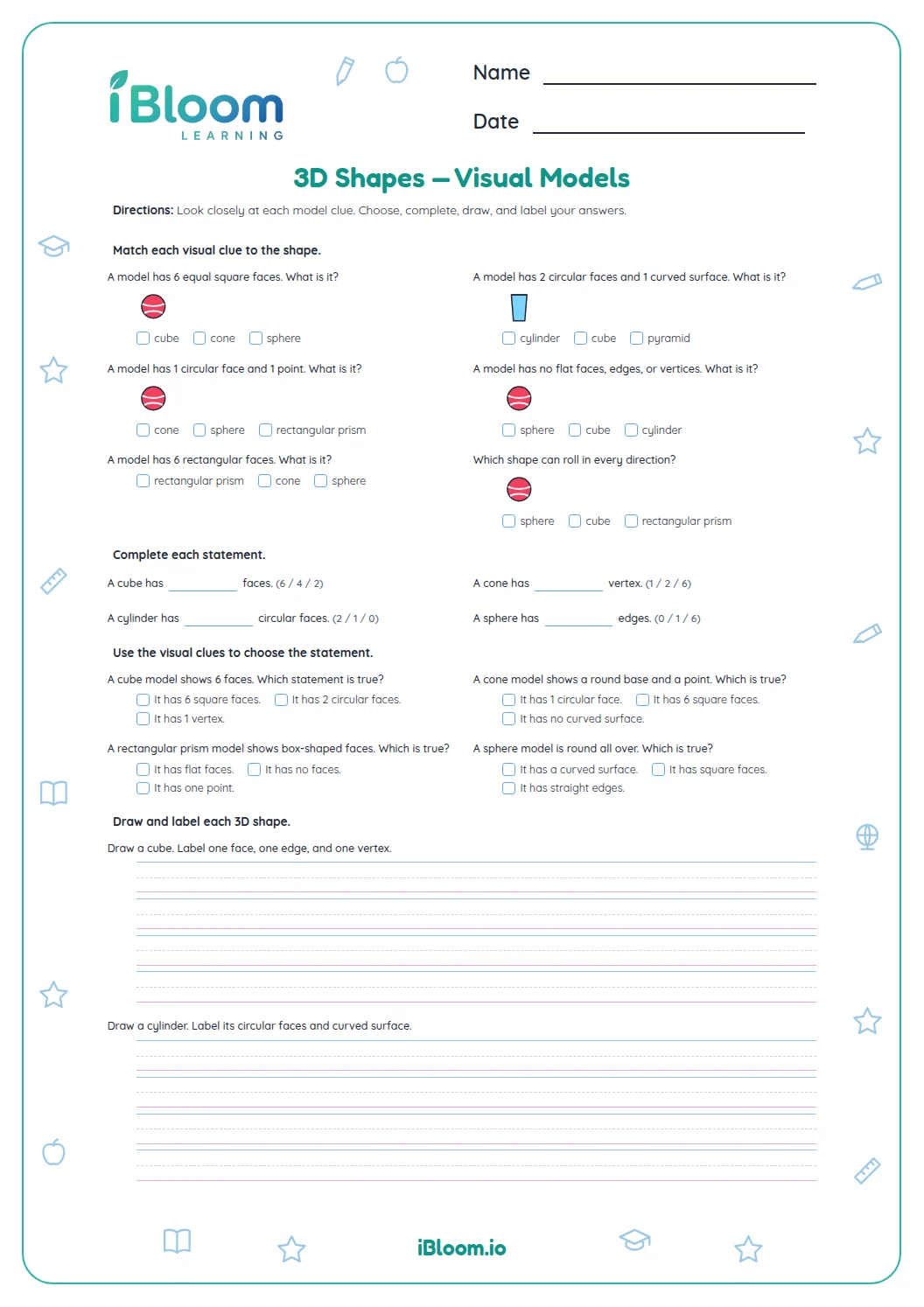
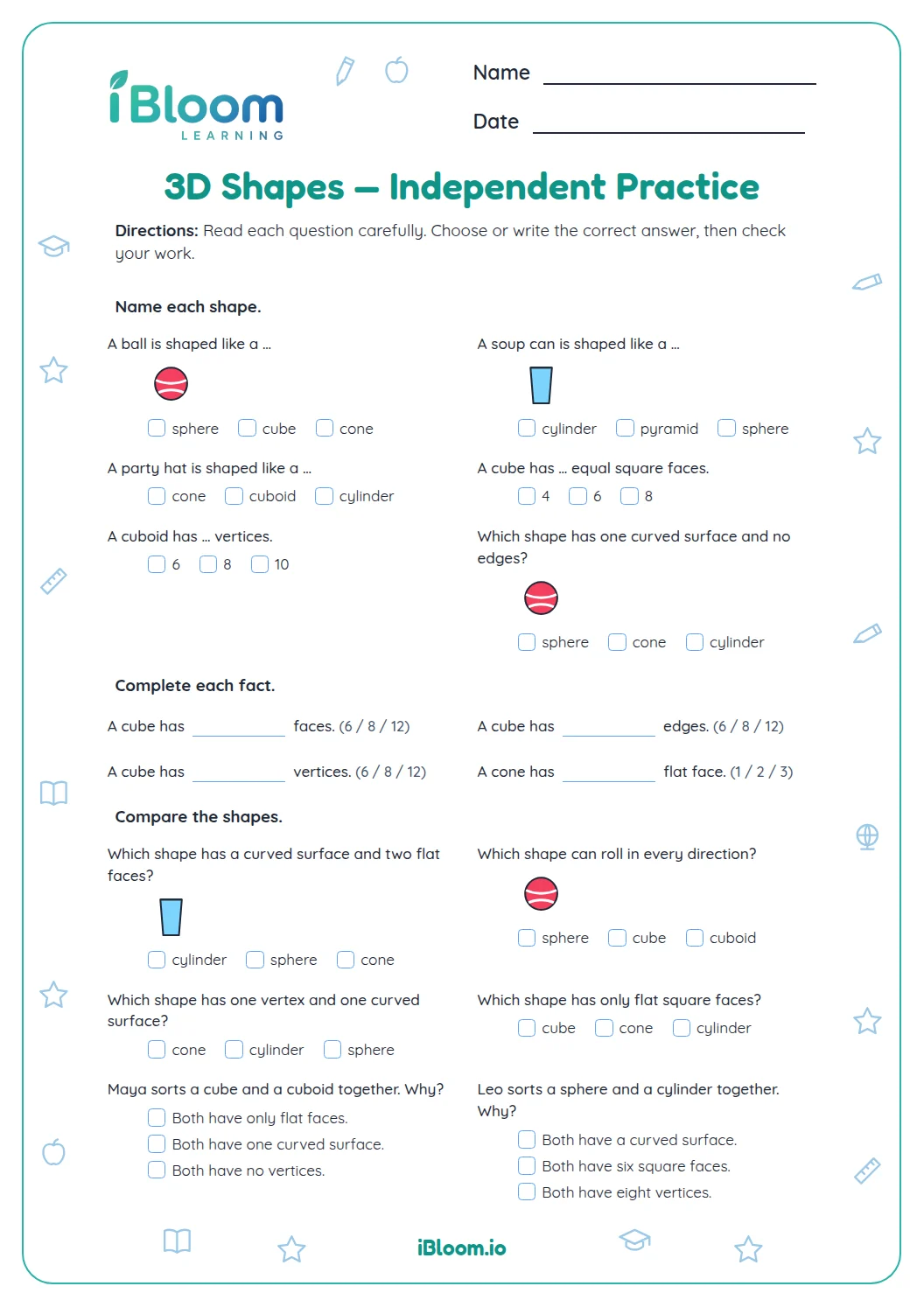
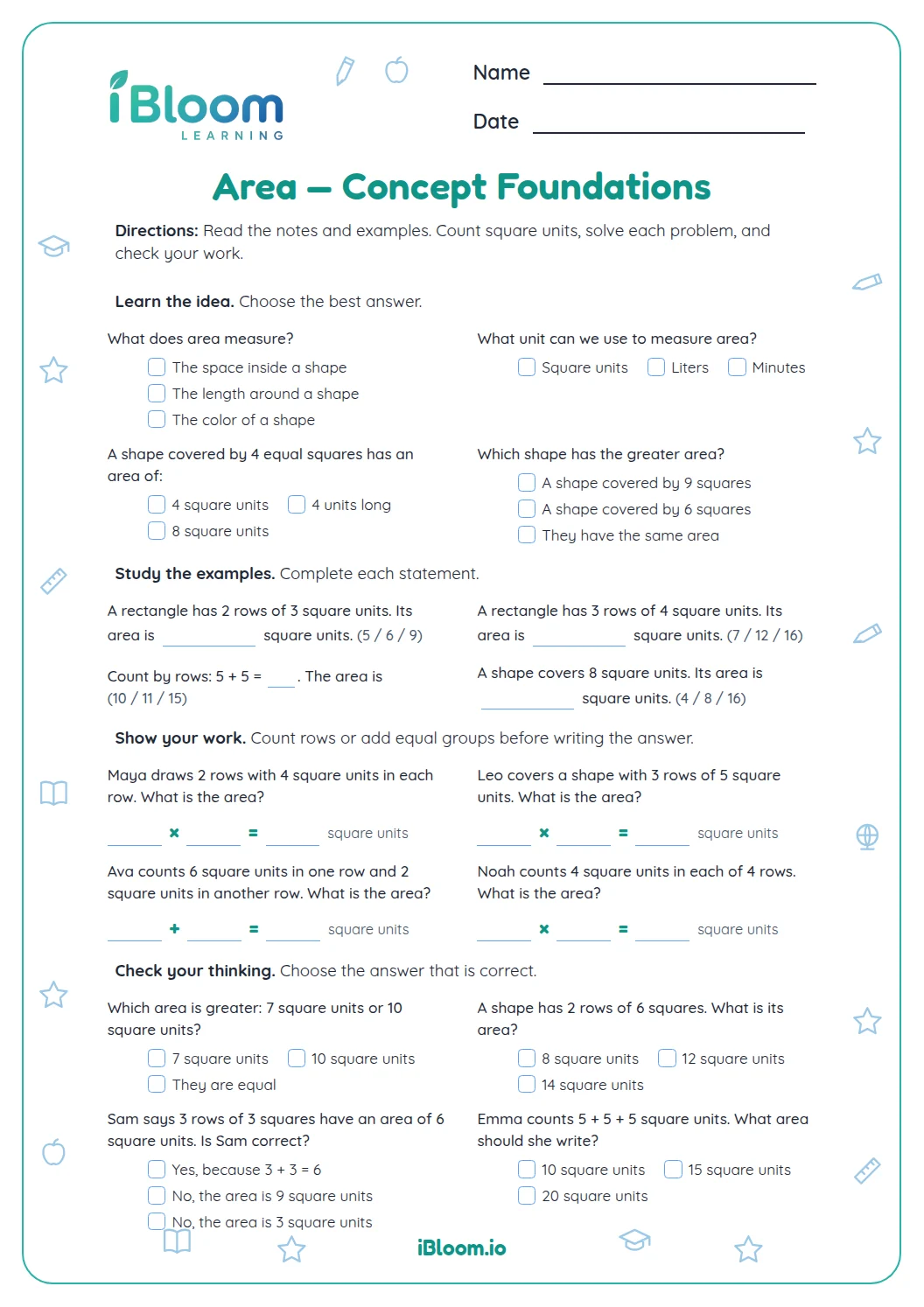
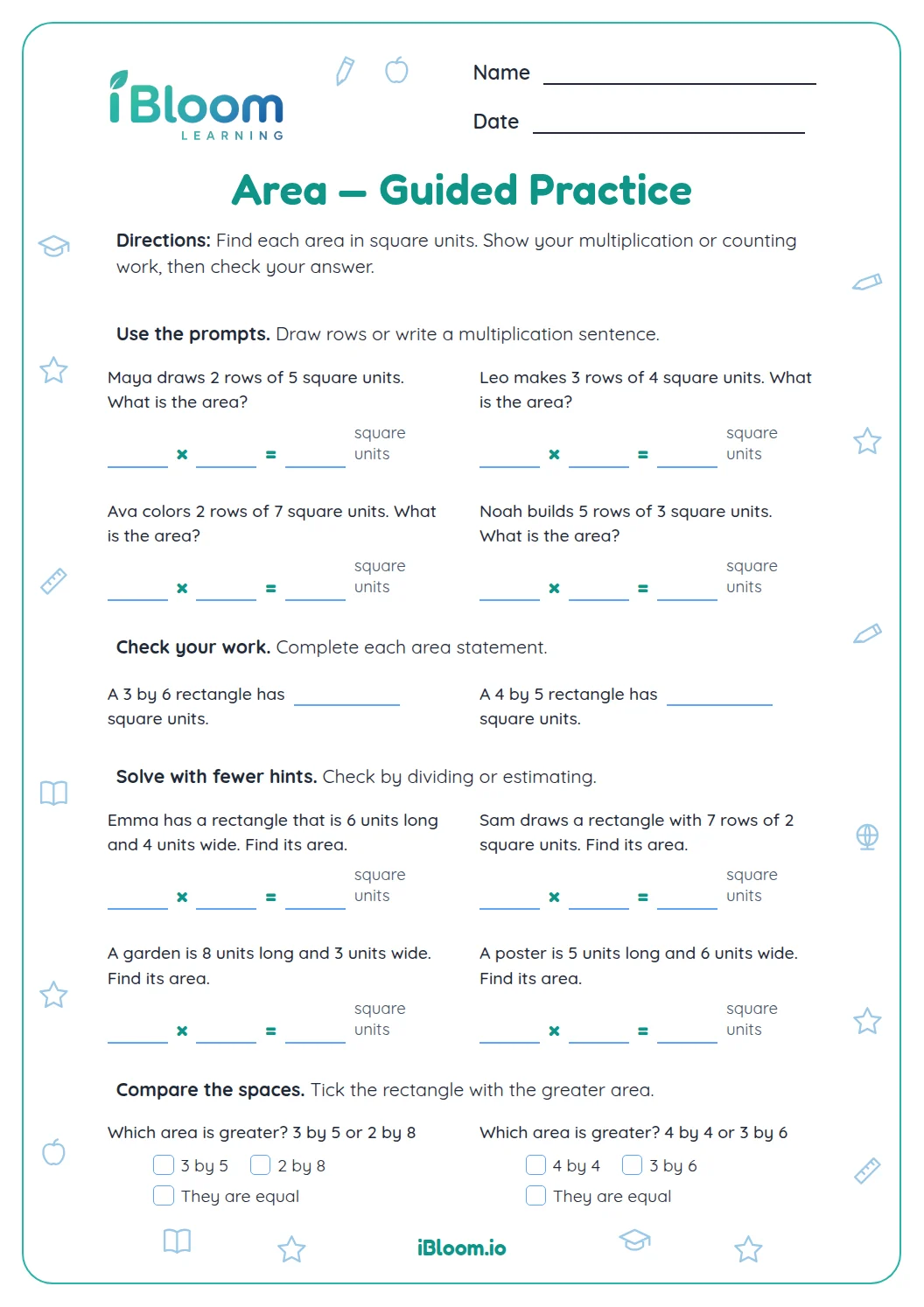
There are 14 numbered problems: two shaded-grid counts, four row counts, four repeated-addition totals, and four missing parts. The worksheet takes two pages, and the answer key takes two pages. The methods move from counting unit squares to splitting totals.
How can a child find a missing part?
Keep the shared number of rows the same and ask how the two parts add to the full count. If eight rows split into three and another part, 3 + 5 = 8, so the missing part is five rows. Check by adding both row groups.